Amalienborg Palace: Inside Copenhagen's Living Royal Residence
Amalienborg is the official home of the Danish royal family and one of Copenhagen's most architecturally coherent ensembles. Four near-identical Rococo palaces frame a grand octagonal square, with the Amalienborg Museum open to visitors inside Christian VIII's Palace. The daily changing of the guard at noon is a punctual, unhurried ceremony worth timing your visit around.
Quick Facts
- Location
- Amalienborg Slotsplads 5, 1257 København K, Indre By, Copenhagen
- Getting There
- Bus lines 26 and 29 stop nearby; closest Metro is Kongens Nytorv (M1/M2), roughly 10 min on foot
- Time Needed
- 1.5 to 2.5 hours including the museum and the noon Guard Change
- Cost
- Museum: 125 DKK adults, free for children under 18; Copenhagen Card holders enter free. The square and Guard Change are free to watch.
- Best for
- History lovers, architecture enthusiasts, families, and first-time visitors to Copenhagen
- Official website
- www.kongehuset.dk/en/palaces-and-the-royal-yacht/amalienborg
What Amalienborg Actually Is
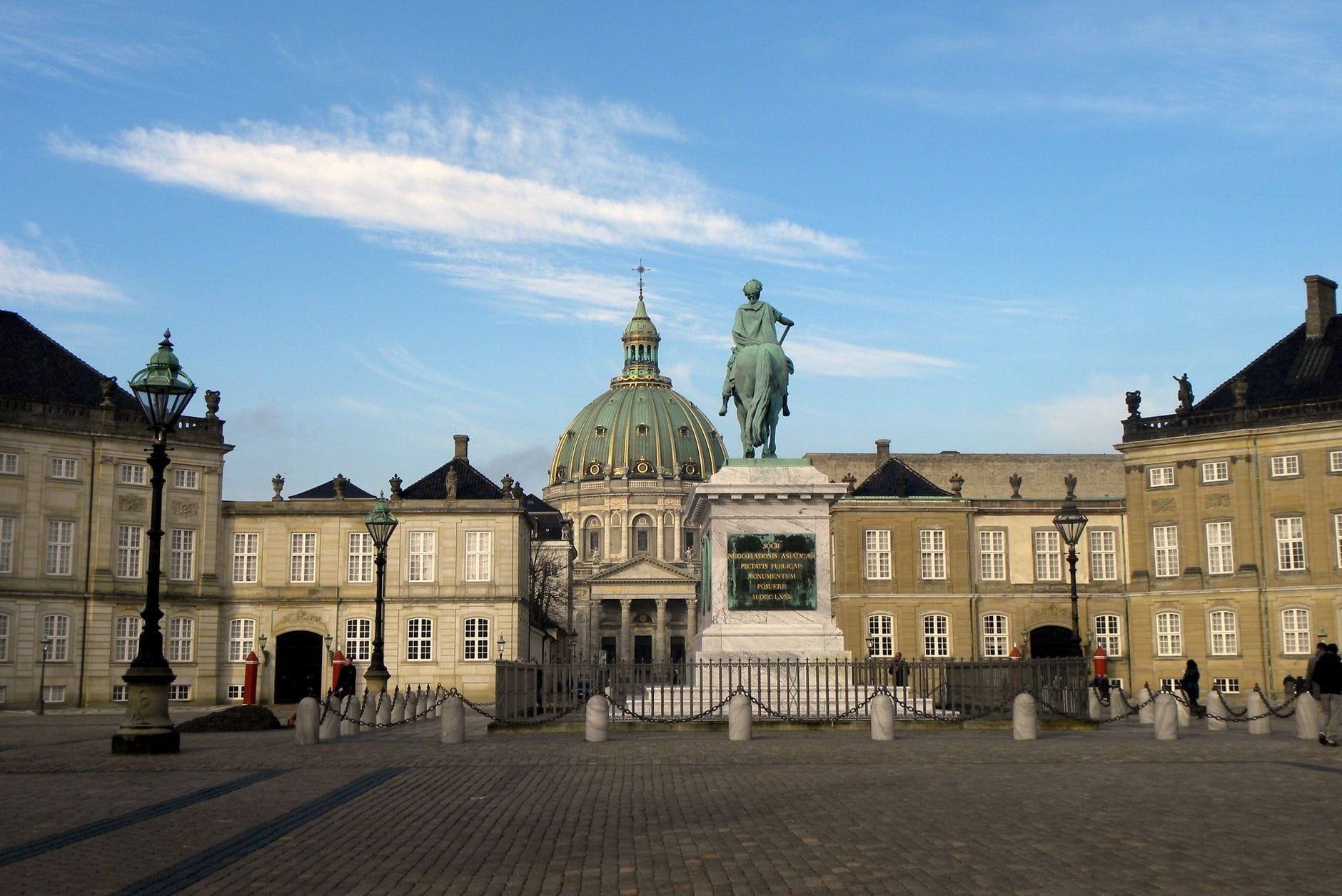
Amalienborg Palace is not a single building. It is a complex of four nearly identical Rococo palaces arranged symmetrically around a large octagonal cobblestone square, with an equestrian statue of King Frederik V at its center. The palaces were built between 1750 and 1760 as aristocratic townhouses, and the royal family moved in after Christiansborg burned down in 1794. They have been the primary royal residence ever since.
The four palaces carry formal names: Christian VII's Palace (Moltke's Palace), Christian VIII's Palace (Levetzau's Palace), Frederik VIII's Palace (Brockdorff's Palace), and Christian IX's Palace (Schack's Palace). The reigning monarch, King Frederik X, uses Frederik VIII's Palace as his primary Copenhagen residence. Visitors access the Amalienborg Museum inside Christian VIII's Palace, which has been open to the public as part of the Royal Danish Collection.
ℹ️ Good to know
The square itself — Amalienborg Slotsplads — is open to the public at all hours and costs nothing to enter. You can walk across the cobblestones, stand close to the palace facades, and photograph the statue of Frederik V without buying a museum ticket.
Amalienborg sits within Indre By, Copenhagen's historic core, and it occupies a deliberate visual axis: the dome of the Marble Church (Frederiks Kirke) closes the view to the west, and the square opens directly toward the harbor and the Copenhagen Opera House to the east. This is one of the most considered pieces of 18th-century urban planning in Scandinavia.
The Architecture and the Square
The four palaces were designed by the Danish architect Nicolai Eigtved and represent the high point of Danish Rococo — a style that is more restrained here than its French counterpart, relying on symmetry, pale stone, and precise proportions rather than extreme ornamental excess. From ground level, the effect is one of quiet authority. The facades are nearly interchangeable, which gives the square a sense of enclosure that larger plazas rarely achieve.
The equestrian statue of Frederik V at the center was commissioned from the French sculptor Jacques Saly and took over 20 years to complete. It is considered one of the finest equestrian bronzes of the 18th century in Northern Europe. Stand near it in the morning before tour groups arrive and the scale of the composition becomes clear: each palace is set back just far enough to make you aware of the octagonal geometry without feeling overwhelmed by it.
If you are interested in the broader context of Copenhagen's royal and ecclesiastical architecture, the Marble Church directly behind the square is worth combining into the same visit. The dome is one of the largest in Scandinavia and the interior is open to the public.
Tickets & tours
Hand-picked options from our booking partner. Prices are indicative; availability and final rates are confirmed when you complete your booking.
1-hour boat harbour tour in Copenhagen
From 26 €Instant confirmationFree cancellationSmall group 3-hour walking tour in Copenhagen
From 45 €Instant confirmationFree cancellationCopenhagen to Malmo one-day tour
From 56 €Instant confirmationFree cancellationFull-day tour to Forest Tower and Forgotten Giants from Copenhagen
From 110 €Instant confirmationFree cancellation
The Changing of the Guard at Noon
Every day at noon, the Royal Guard marches from Rosenborg Castle to Amalienborg to relieve the guards stationed at the palace. The march takes the guard through the streets of central Copenhagen, which means you can watch the procession en route if you know where to position yourself, or simply wait at Amalienborg Slotsplads for their arrival at 12:00.
The ceremony at the square is formal but not theatrical. Guards in dark blue uniforms with tall bearskin hats perform the handover with precision. On days when the monarch is in residence, a full band accompanies the march, which makes the ceremony considerably more elaborate. There is no announcement of which days include music, so arriving a few minutes early to gauge the setup is worthwhile.
💡 Local tip
Arrive at the square by 11:45 to secure a good standing position near the center. The square fills quickly on summer days and during public holidays. Positioning yourself on the raised steps near any of the palace entrances gives a slightly elevated view over the crowd.
The ceremony itself lasts roughly 20 to 30 minutes. It is free to watch. Outside of summer, the square can be noticeably emptier even at noon, which makes for a more atmospheric and less elbowing experience. In winter, the low-angle light hits the palace facades with a warmth that summer's overhead sun cannot replicate.
Inside the Amalienborg Museum
The Amalienborg Museum occupies Christian VIII's Palace and is part of the Royal Danish Collection. The permanent collection covers Danish royal history from the 1860s to the present through furnished interiors, personal objects, royal regalia, and archival material. The rooms include royal studies, reception rooms, and private apartments restored to specific historical periods.
What makes the museum more interesting than a typical palace interior tour is that it focuses on the monarchy as an institution across time, not just as a collection of fine rooms. Exhibits address how the monarchy functioned, how public events were staged, and how individual monarchs lived day to day. The personal scale of some rooms is genuinely surprising given the grandeur of the exterior.
Admission is 125 DKK for adults, and children aged 0 to 17 enter free. Copenhagen Card holders enter without an additional charge. The museum entrance is through the gate nearest Frederiksgade. A platform lift and a conventional lift mean that wheelchair users and visitors with limited mobility can access every part of the museum.
💡 Local tip
If you are planning multiple major Copenhagen attractions, the Copenhagen Card covers Amalienborg Museum entry and can reduce overall costs significantly. Check the card's current inclusion list before purchasing.
The Copenhagen Card covers entry to many of the city's major museums and includes unlimited public transport, which is worth calculating against individual admission costs if you plan to visit three or more attractions in a single trip.
How the Experience Changes Through the Day
Early morning, before 9:00, the square is nearly empty. The cobblestones are damp on most mornings, the light is soft, and the guard posts are manned but there is no crowd to navigate. This is the best time for photography: no tourists in frame, clean sightlines across the square, and the harbor visible at the far end of the axis. The nearby Nyhavn area will already be waking up if you want coffee before or after.
Midday around noon brings the guard change and the largest crowds of the day. After the ceremony disperses, roughly 12:30 to 13:00, the square thins out again as visitors move on. This window is a good time to enter the museum if you have not already, as the lines at the entrance are generally shorter than they are immediately before the ceremony.
Late afternoon, particularly from 15:00 onward, the square settles into a quieter rhythm. The museum closes for the day at varying hours depending on the season, so check current hours before planning a late visit. In summer, the long evening light makes the western facades glow for a considerable time after the museum has closed, and the square remains a pleasant place to stand.
For a well-paced afternoon that covers this part of the city on foot, a walking tour of central Copenhagen makes a natural framework, with Amalienborg as the northernmost anchor before turning back toward Nyhavn and Kongens Nytorv.
Practical Notes for Your Visit
The cobblestones in the square are traditional and uneven in places, which can be uncomfortable for visitors using wheelchairs or walking with limited mobility on the exterior. Inside the museum, as noted, lift access is available. Wear flat, closed shoes if you plan to spend significant time on the square.
Weather matters more here than at most indoor attractions because a significant part of the experience is the outdoor square and the guard change. Rain softens the atmosphere but does not cancel the ceremony; the guard marches regardless of conditions. A waterproof layer is practical from October through April. The exposed harbor-facing side of the square creates a wind corridor that makes it feel colder than the temperature suggests in winter.
Photographers should note that the winter months offer dramatic low light across the square but shorter windows before the afternoon dims. Summer offers golden hour from around 20:00. For context on the best seasonal window for Copenhagen overall, the best time to visit Copenhagen guide covers the tradeoffs between weather, crowds, and daylight hours across the year.
There is no on-site cafe or restaurant inside the palace complex. The nearest options are in the surrounding streets of Frederiksstaden or along Bredgade, a short walk south. Nyhavn's waterfront restaurants are about 10 minutes on foot and offer a natural endpoint if you are combining both in a half-day itinerary.
Who Should Reconsider This Visit
Visitors primarily drawn to interactive or immersive experiences may find the Amalienborg Museum relatively static. The rooms are beautifully preserved but the format is traditional: furnished interiors, display cases, interpretive labels. If you are comparing it to a larger national museum, the Amalienborg Museum is compact and focused specifically on royal history rather than broader Danish culture.
Those looking for deeper coverage of Danish history would benefit from also visiting the National Museum of Denmark, which covers the full arc of Danish civilization from prehistoric times to the present and takes considerably more time to explore thoroughly.
If your only interest is the guard change, you do not need a museum ticket at all. The ceremony and the square are free. Budget travelers can experience the core of Amalienborg without spending anything.
Insider Tips
- On days when the monarch is in residence, a flag flies above the relevant palace. A full band accompanies the guard change on these days, which makes the ceremony significantly more dramatic than the standard version.
- The view from the square directly toward the Copenhagen Opera House across the water is best appreciated from the harbor-side exit. Walk through the colonnade between the palaces at the eastern end of the square to reach the waterfront in under two minutes.
- Museum audio guides and printed guides are available in multiple languages inside Christian VIII's Palace. The English-language materials are thorough and the museum is small enough that a self-guided visit works well without a tour.
- The cobblestone square is a popular spot for pre-booked private photography sessions, particularly in early morning. If you arrive before 08:30, you will likely have the square to yourself or nearly so.
- Combine Amalienborg with Rosenborg Castle on the same day to trace the guard's daily route in reverse, and to see where the march begins. The two sites are about 15 minutes apart on foot through some of the most architecturally coherent streets in central Copenhagen.
Who Is Amalienborg Palace For?
- First-time visitors to Copenhagen wanting to see an active royal residence
- Architecture and design enthusiasts interested in Danish Rococo urbanism
- Families with children, since the guard change is free and visually engaging for all ages
- History travelers focused on European royal culture and Scandinavian monarchy
- Photographers working in early morning or winter light
Nearby Attractions
Other things to see while in Indre By (Old Town):
- The Black Diamond
The Black Diamond is the modern extension of the Royal Danish Library, clad in polished black granite and angled toward the harbour on Slotsholmen. Entry is free, the atrium is genuinely impressive, and the building rewards visitors who take time to understand what they are looking at.
- Botanical Garden of the University of Copenhagen
Tucked behind Nørreport Station in the heart of the city, the Copenhagen University Botanical Garden is a 10-hectare green sanctuary with a Victorian glasshouse complex, a tranquil lake, and around 8,000 plant species. Entry to the grounds is free, making it one of the most rewarding stops in central Copenhagen for any pace of traveler.
- Christiansborg Palace
Christiansborg Palace sits on the Slotsholmen islet in central Copenhagen, serving simultaneously as the home of the Danish Parliament, the Supreme Court, the Prime Minister's Office, and the Royal Reception Rooms. It is widely described as uniquely housing all three branches of Denmark’s national government under one roof, and its 106-metre tower offers one of the best free panoramic views in the city.
- City Hall Square (Rådhuspladsen)
Rådhuspladsen is the great open plaza at the centre of Copenhagen — free, open at all hours, and framed by one of Scandinavia's most photogenic town halls. Whether you arrive at rush hour or midnight, the square reads the mood of the city back to you.