Frederik's Church (The Marble Church): Copenhagen's Grandest Dome
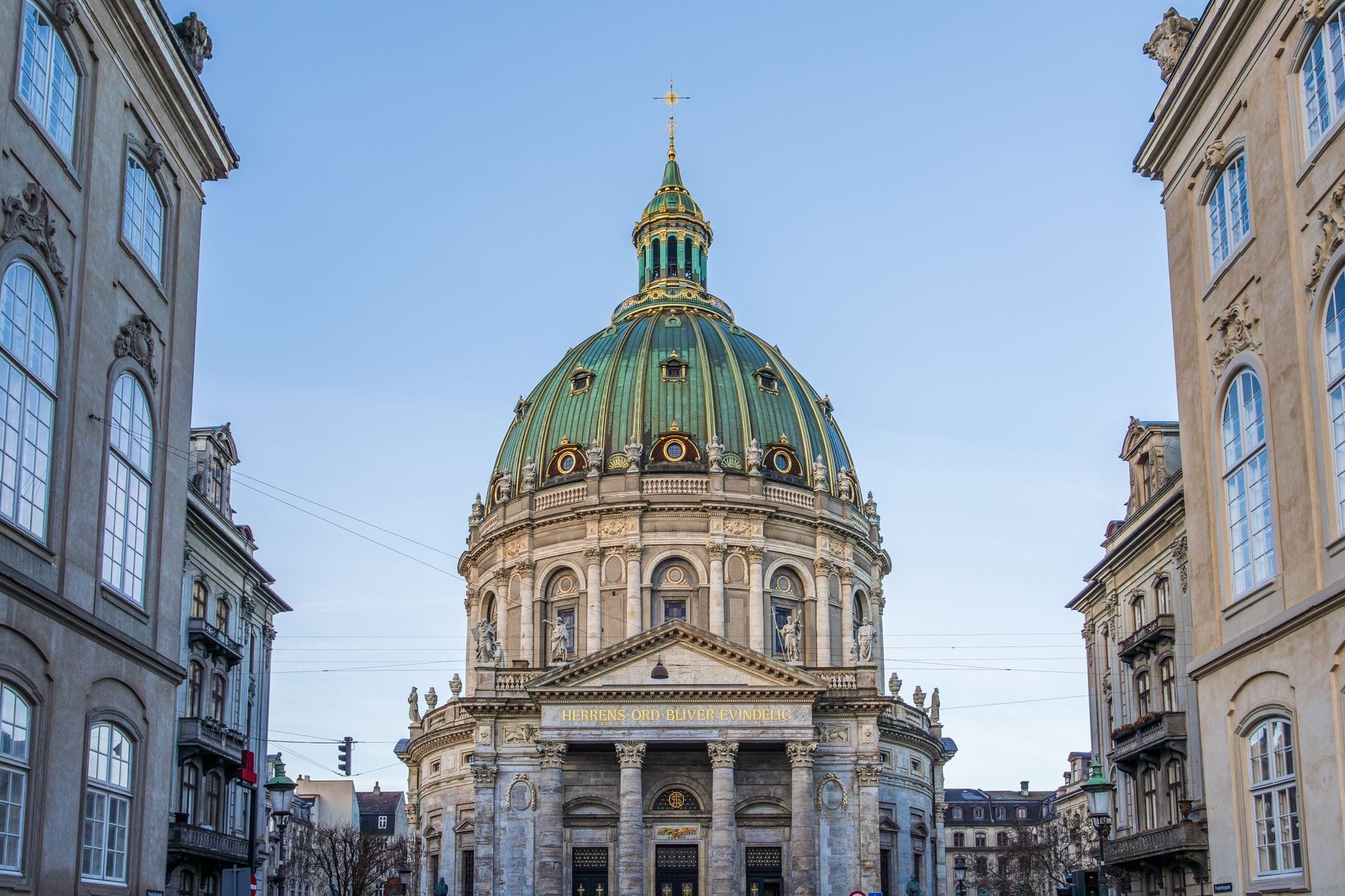
Frederik's Church, known to locals as Marmorkirken or the Marble Church, is one of Copenhagen's most striking pieces of architecture. Rising 79 metres above Frederiksstaden, its green copper dome dominates the skyline east of the city centre. Entry is free, and for a small fee you can climb the dome for some of the best rooftop views in the Danish capital.
Quick Facts
- Location
- Frederiksgade 4, 1265 Copenhagen K — Frederiksstaden district, Indre By
- Getting There
- Walk from Kongens Nytorv Metro station (M1/M2), approx. 9 min. Also walkable from Nyhavn in under 15 min.
- Time Needed
- 30–45 min for the interior; add 30 min if you climb the dome
- Cost
- Church entry: Free. Dome tour: 35 DKK adults / 20 DKK under-18s
- Best for
- Architecture lovers, history buffs, panoramic city views
- Official website
- www.marmorkirken.dk
What Is Frederik's Church?
Frederik's Church, formally Frederiks Kirke and universally referred to as Marmorkirken (the Marble Church), is a Lutheran Evangelical church built as the spiritual anchor of Frederiksstaden, the rococo district laid out in the mid-18th century on King Frederik V's orders. It took nearly 150 years to complete, with the foundation stone laid in 1749 and the doors finally opening on 19 August 1894. That gap between ambition and completion shapes everything about the building: the scale is imperial, the execution is meticulous, and the story behind it is longer and stranger than the polished facade suggests.
With a dome measuring 31 metres in diameter, supported by 12 columns, and an overall height of 79 metres, it draws immediate comparisons to St. Paul's Cathedral in London and the Panthéon in Paris. Those comparisons are intentional. Frederiksstaden was conceived as a northern European statement of power and culture, and the church was meant to be its centrepiece. The original plans called for Norwegian marble throughout, which is partly why costs spiralled and construction stalled for decades. What stands today uses a more practical mix of materials, but the nickname endures.
💡 Local tip
Dome tours run at 13:00 daily during summer months, and at 13:00 on weekends for the rest of the year. Arrive by 12:45 to buy your ticket and be ready at the entrance point.
The Interior: What You See on the Ground Floor
Stepping inside, the first thing you feel is the silence. Copenhagen is a city of constant cyclists and low-level street noise, so the sudden acoustic stillness under that dome is genuinely startling. Your eyes are drawn upward immediately: the ceiling fresco depicting biblical scenes, the circular drum of windows that floods the nave with northern light, and the 12 columns curving around the central space like a stone embrace.
The interior palette is cool and restrained. There is none of the gilded theatricality you find in southern European baroque churches. Instead, the decoration relies on geometry, proportion, and the quality of the stonework itself. The pews are simple. The altar is present but not overwhelming. This is a working church, not a museum, and that distinction matters: on Sunday mornings at 10:30, services are held, and tourist visits on Sundays and public holidays begin only at 13:00 to respect that schedule.
Along the exterior of the church, you will notice a series of bronze statues of significant figures in Danish religious and intellectual history. These ring the building at ground level and are worth a slow circuit before you enter or after you leave.
Tickets & tours
Hand-picked options from our booking partner. Prices are indicative; availability and final rates are confirmed when you complete your booking.
1-hour boat harbour tour in Copenhagen
From 26 €Instant confirmationFree cancellationSmall group 3-hour walking tour in Copenhagen
From 45 €Instant confirmationFree cancellationCopenhagen to Malmo one-day tour
From 56 €Instant confirmationFree cancellationFull-day tour to Forest Tower and Forgotten Giants from Copenhagen
From 110 €Instant confirmationFree cancellation
Climbing the Dome: The View From the Top
The dome tour is the part most visitors remember. The climb involves a staircase rather than a lift, and the route takes you through passages inside the church roof structure before emerging onto the exterior walkway. It is not an extreme climb, but people with limited mobility or a fear of enclosed spaces should note this before committing.
From the top, the view spans Frederiksstaden's formal street grid, the copper rooftops of Amalienborg Palace directly below, the harbour mouth opening toward the Øresund strait, and the flat green landscapes of Amager to the south. On a clear day you can see across to Sweden. It is one of the few elevated vantage points in central Copenhagen that is genuinely open to the public, which makes it unusual in a city that does not go tall.
For context on what you are looking at from the dome, it helps to understand the neighbourhood first. Frederiksstaden was planned as a unified royal quarter in the 1750s, and Amalienborg Palace sits almost directly east, its four identical mansions arranged around an octagonal courtyard aligned with the church's axis. The relationship between church and palace is not accidental: the view from the dome makes the urban planning logic visible in a way that no street-level perspective can.
⚠️ What to skip
The dome walkway is exposed to the weather. On windy days the experience can be uncomfortable, and on wet days the metal surfaces are slippery. Check the forecast before planning your visit around the dome tour.
How the Experience Changes by Time of Day
The church receives most of its visitors between 11:00 and 14:00, when tour groups and walkers coming from Nyhavn and Amalienborg move through the area. If you arrive before 11:00 on a weekday, the interior can be nearly empty and the light through the high drum windows is at its most direct and useful for photography.
Late afternoon, particularly from 15:00 onward, sees a shift in the light quality outside as the sun moves west and catches the dome's copper surface at a lower angle. This is the best time to photograph the exterior from Frederiksgade, with the green dome catching warm light against the sky. The church closes at 17:00, so late afternoon visitors have enough time for the interior but will likely miss the dome tour if they arrive after 14:00.
Early mornings before the church opens are worth a stop simply to study the exterior. The square in front of Frederiksgade 4 is quiet at that hour, the dome dominates the sightline from several directions, and the neighbourhood has a composed, unhurried quality that disappears once the tourist circuit gets going.
Historical Context: Why It Took 145 Years to Build
The story of Frederik's Church is a cautionary tale about ambition and budgets. When King Frederik V commissioned the project in 1749, the plan was for the most expensive building material available: marble. The architect Nicolai Eigtved started the work, but costs became unmanageable almost immediately. By 1770, construction had stalled. The unfinished shell sat for over a century, occasionally used as a ruin-like backdrop for Copenhagen's growing city life, until the Danish financier C.F. Tietgen agreed to fund the project's completion in the 1890s. The architect Ferdinand Meldahl finished it, adapting the original plans but retaining the scale and dome structure.
This long history places the church in an interesting position relative to other Copenhagen landmarks. Rosenborg Castle was completed centuries earlier, and Christiansborg Palace has its own complicated rebuilding history, but no other major Copenhagen landmark has quite the same gap between inception and completion as Marmorkirken. The 1894 consecration date is surprisingly recent for a building that looks like it belongs to an earlier era.
Practical Walkthrough: Getting There and Getting In
The church is located at Frederiksgade 4 in the Frederiksstaden section of Indre By. The most convenient public transport option is the Metro to Kongens Nytorv, followed by about a ten-minute walk northeast through the formal streets of Frederiksstaden. If you are already at Nyhavn, it is a pleasant 12-minute walk heading north along Amaliegade.
Many visitors combine Frederik's Church with a stop at Amalienborg Palace, which is a two-minute walk away, and then continue north to Kastellet and The Little Mermaid. This forms a coherent half-day walk through the historic royal quarter without requiring any additional transit.
Entry to the church hall is free and requires no ticket. The dome tour requires a ticket purchased on-site: 35 DKK for adults, 20 DKK for visitors under 18. Tours depart at 13:00 daily in summer and at 13:00 on weekends year-round.
ℹ️ Good to know
The Copenhagen Card covers many major attractions, but check current terms for Frederik's Church before planning on it for the dome tour. However, the church interior itself is free, so the card provides no advantage here. See whether the card suits the rest of your itinerary before purchasing.
For broader planning around Indre By, the Copenhagen walking tour guide maps out a logical route connecting the key landmarks of this neighbourhood without covering unnecessary distance.
Photography Tips and Practical Notes
The best exterior shot of the church is from Frederiksgade looking directly toward the dome, ideally with the street framing the approach. A standard wide-angle lens covers it comfortably. For interiors, the light is best in the morning on weekdays when the nave is quieter and the high windows deliver even illumination. Flash photography is generally inappropriate in active churches; the natural light is sufficient for most cameras and phones.
From the dome, a wider lens helps capture both the palace rooftops below and the harbour in the middle distance. Midday light is flattering on the copper surfaces. If you are visiting purely for dome photographs, aim for a clear day between late April and August, when the light is strong and the sky tends to cooperate.
Accessibility: the ground floor church interior is accessible and level. The dome tour is staircase-only with no lift access reported, making it unsuitable for visitors with significant mobility limitations or those who cannot manage a multi-storey climb through a narrow stairwell.
Insider Tips
- If you want the dome to yourself, the 13:00 tour on a weekday outside peak summer sees far fewer climbers than the same tour on a weekend. Tour groups almost always prioritise Saturday and Sunday.
- The exterior bronze statue circuit around the church base is ignored by most visitors but takes only five minutes and provides a clear introduction to the figures central to Danish Lutheran history.
- The acoustics inside the dome are notable. Stand at the centre of the nave and speak quietly: the curved ceiling channels sound in ways that feel disproportionate to the effort. It is subtle but worth noticing.
- Frederiksgade, the street leading to the church entrance, is one of the straighter axial streets in this district and offers a clear sightline from a hundred metres back. This is where the formal photograph of the dome works best — not from directly in front of the entrance.
- The church is colder than the street in winter. Even in summer, the thick stone walls keep the interior noticeably cool. Bring a light layer if you plan to spend time inside.
Who Is Frederik's Church (The Marble Church) For?
- Architecture enthusiasts interested in neoclassical and baroque civic planning
- Travellers who want a rooftop view of Copenhagen without the crowds of other viewpoints
- History-focused visitors exploring the 18th-century Frederiksstaden royal quarter
- Budget-conscious travellers looking for free, high-quality cultural experiences
- Photographers working the morning light in central Copenhagen
Nearby Attractions
Other things to see while in Indre By (Old Town):
- Amalienborg Palace
Amalienborg is the official home of the Danish royal family and one of Copenhagen's most architecturally coherent ensembles. Four near-identical Rococo palaces frame a grand octagonal square, with the Amalienborg Museum open to visitors inside Christian VIII's Palace. The daily changing of the guard at noon is a punctual, unhurried ceremony worth timing your visit around.
- The Black Diamond
The Black Diamond is the modern extension of the Royal Danish Library, clad in polished black granite and angled toward the harbour on Slotsholmen. Entry is free, the atrium is genuinely impressive, and the building rewards visitors who take time to understand what they are looking at.
- Botanical Garden of the University of Copenhagen
Tucked behind Nørreport Station in the heart of the city, the Copenhagen University Botanical Garden is a 10-hectare green sanctuary with a Victorian glasshouse complex, a tranquil lake, and around 8,000 plant species. Entry to the grounds is free, making it one of the most rewarding stops in central Copenhagen for any pace of traveler.
- Christiansborg Palace
Christiansborg Palace sits on the Slotsholmen islet in central Copenhagen, serving simultaneously as the home of the Danish Parliament, the Supreme Court, the Prime Minister's Office, and the Royal Reception Rooms. It is widely described as uniquely housing all three branches of Denmark’s national government under one roof, and its 106-metre tower offers one of the best free panoramic views in the city.