Kastellet: Inside Copenhagen's 17th-Century Star Fortress
Kastellet, the Citadel Frederikshavn, is a five-bastion star fortress dating to 1664 that still functions as an active military base while welcoming visitors free of charge. Its moat-encircled ramparts, working windmill, and quiet interior streets make it one of the most unusual open spaces in Copenhagen.
Quick Facts
- Location
- Gl. Hovedvagt, Kastellet 1, 2100 København Ø, Østerbro
- Getting There
- Østerport Station (train/S-tog), directly across the western entrance
- Time Needed
- 45–90 minutes for a full walk of the ramparts and interior
- Cost
- Free — no ticket required to enter the grounds
- Best for
- History enthusiasts, walkers, photographers, families wanting green space
- Official website
- www.forsvaret.dk/da/side/kastellet/
What Is Kastellet?
Kastellet, officially known as Citadel Frederikshavn, is a five-bastion star fortress in the Østerbro district of Copenhagen, and one of the best-preserved Renaissance-era fortifications in northern Europe. Built between 1662 and 1665 under King Frederik III, with Dutch military architect Henrik Rüse directing construction, the citadel replaced an earlier fortification that King Christian IV had ordered built on the same site in 1626. The first soldiers marched through its gates on 28 October 1664, a date still recognized as the fortress's official birthday.
What makes Kastellet genuinely unusual is that it is not a museum in the conventional sense. The Danish Defence continues to operate within its walls, which means visitors walk through a working military installation, past administrative buildings and barracks, while also strolling along grassy rampart paths used by local joggers every morning. That combination, 360 years of fortress architecture and a living institution, gives the site a character that few historic attractions in the city can match.
ℹ️ Good to know
Kastellet is open daily from 06:00 to 20:00 in the winter half-year and from 06:00 to 22:00 in the summer half-year. Entry to the grounds is free. Access to interior military buildings is restricted to authorized personnel.
The Architecture: Reading the Star
From ground level, Kastellet's geometry is hard to grasp. The five-pointed star shape, with its protruding angular bastions, was a deliberate response to the limits of medieval round towers: a star fortress eliminates blind spots by ensuring that cannon fire from each bastion can sweep the walls on either side. Walk the full circuit of the outer ramparts and the logic becomes physical. Every angle covers another; no wall goes undefended.
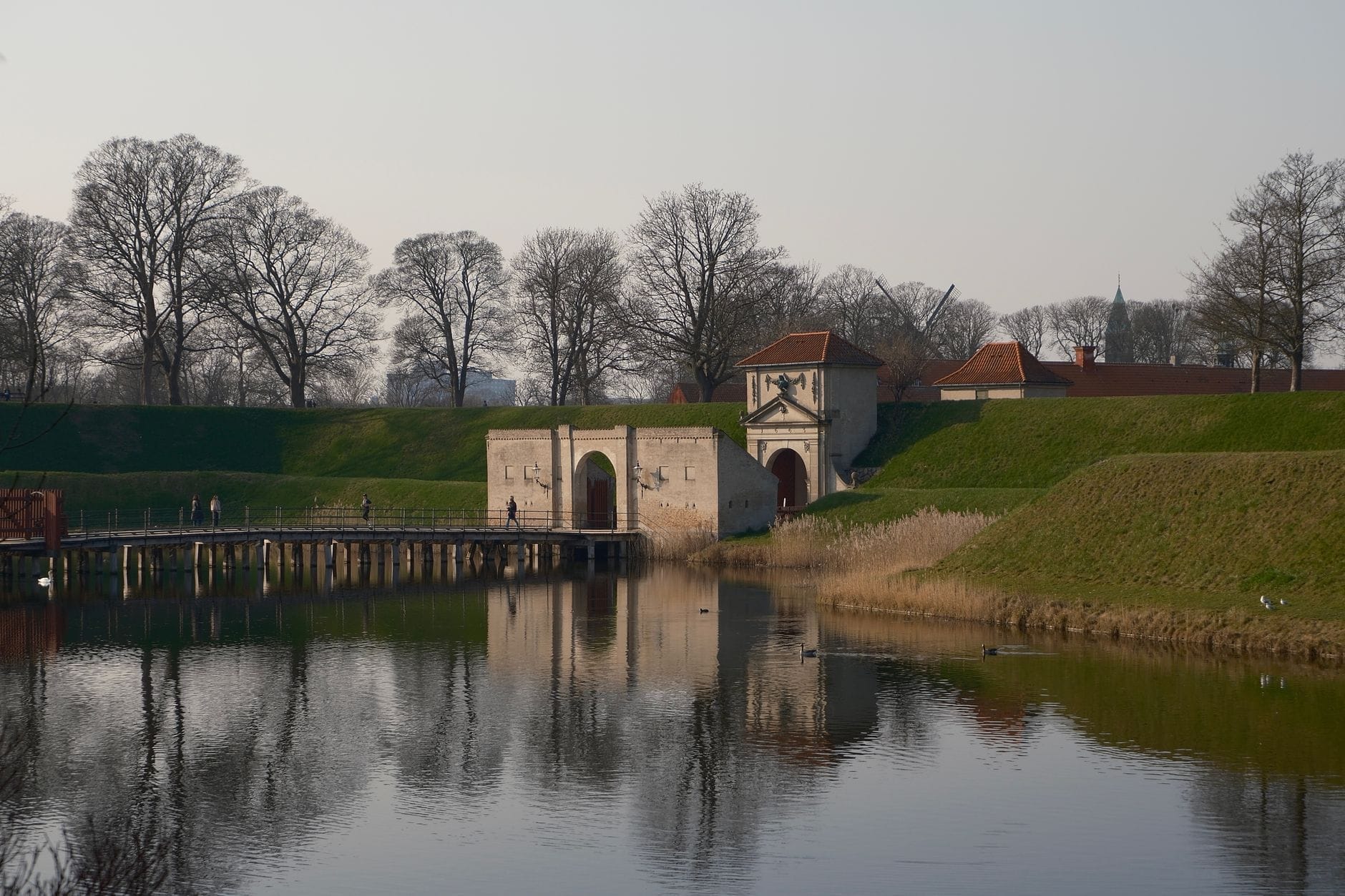
The moat that encircles the fortifications is still filled with water and remains impressively intact. Waterfowl have colonized it thoroughly, and on still mornings the reflections of the earthwork ramparts and old barracks create compositions that draw photographers year-round. The rampart grass is kept trimmed and the paths are wide enough that walkers and cyclists can share them comfortably, though the slopes down to the moat are steep in places.
The architectural style places Kastellet firmly within the Dutch school of fortress design, characterized by earthen ramparts rather than high masonry walls, which absorb cannon fire far better than stone. For more context on how this fits into Copenhagen's broader architectural story, the Copenhagen design and architecture guide covers the city's built heritage from the 17th century to the present day.
Tickets & tours
Hand-picked options from our booking partner. Prices are indicative; availability and final rates are confirmed when you complete your booking.
1-hour boat harbour tour in Copenhagen
From 26 €Instant confirmationFree cancellationSmall group 3-hour walking tour in Copenhagen
From 45 €Instant confirmationFree cancellationCopenhagen to Malmo one-day tour
From 56 €Instant confirmationFree cancellationFull-day tour to Forest Tower and Forgotten Giants from Copenhagen
From 110 €Instant confirmationFree cancellation
Inside the Walls: What You Actually See
Entering through the main western gate from Østerport, visitors cross a short bridge over the moat and pass under a low archway into a cobbled interior that feels unexpectedly quiet given its proximity to the city centre. The internal street plan is straightforward: a central axis runs from the western gate to the eastern gate, lined by long yellow-painted barracks buildings from the 18th century that are still in military use.
The most photographed structure inside is the Kastellet Windmill, an 18th-century mill that stands on the northern rampart and has been carefully restored. It is one of the few windmills left within Copenhagen's city limits and provides a strong compositional anchor for photos from the rampart path. Nearby, the St. Alban's Church, an Anglican church built in 1887 in English Gothic style, sits just outside the eastern gate facing the Churchill Park green. Its spire and red-brick facade contrast sharply with the fortress earthworks.
The churchyard adjacent to St. Alban's contains graves from various periods, and the area just east of the fortress opens toward the parkland around the Museum of Danish Resistance. The transition from fortress interior to open parkland to harbor is seamless on foot, which is part of what makes this corner of Østerbro one of the more rewarding walks in the city.
Time of Day: How Kastellet Changes
Early mornings, from 06:00 to around 08:30, belong almost entirely to locals. Joggers loop the ramparts in a steady stream, dog walkers cut across the interior roads, and the light in spring and summer hits the moat water at a low angle that makes the whole place glow. The cobblestones are damp, the yellow buildings look their richest in morning light, and there are almost no tourists. This is the best window for uncluttered photography.
By mid-morning, particularly between 10:00 and 13:00 on summer days, tour groups arrive from the direction of The Little Mermaid statue, which sits about a five-minute walk away along the waterfront to the northeast. The crowd levels at Kastellet itself rarely become overwhelming, but the eastern gate area can get congested when multiple groups converge. The western gate approach from Østerport stays consistently quieter throughout the day.
Late afternoon light in the golden hour before sunset, especially from May through September, produces the longest shadows across the angular ramparts and reflects warmly in the moat. The fortress grounds close at 22:00, so evening visits in summer allow for extended time in genuinely pleasant conditions after the tour groups have dispersed.
💡 Local tip
For the best combination of light and solitude, arrive before 08:00 in summer or around 09:00 in the shoulder season. The rampart circuit takes roughly 25 minutes at a relaxed pace.
Historical Weight: From Royal Fortress to German Occupation
Kastellet has absorbed more than three centuries of Danish military and political history. It served a defensive function during the Battle of Copenhagen in the early 19th century, and the British bombardment of the city in 1807 left marks on the surrounding area. During World War II, German forces occupied the fortress following the April 1940 invasion of Denmark, using it as a base of operations. The proximity of the Museum of Danish Resistance just outside the eastern gate is no accident: the museum's subject matter is geographically rooted in this part of the city.
The Museum of Danish Resistance is a short walk from Kastellet's eastern gate and covers the occupation period in detail. Combining the two sites makes for a focused half-day on 20th-century Danish history.
Throughout its history, Kastellet also served as a prison. The fortress church, located inside the walls, dates from the 1700s and is one of the older continuously active church buildings in Copenhagen. The interior is not routinely open to tourists, but the exterior and its placement within the fortress geometry are worth noting.
Getting There and Getting Around
Østerport Station is the most direct arrival point. It sits immediately west of the fortress and is served by both S-tog (S-train) lines and regional rail. From Copenhagen Central Station, the S-tog takes under ten minutes. The Metro does not have a station at Østerport, so if arriving by Metro, Kongens Nytorv is the closest stop, from which Kastellet is about a 15-minute walk north along the harbor front, passing Nyhavn on the way.
Cycling is one of the most practical ways to incorporate Kastellet into a longer route. The fortress sits naturally between Nyhavn to the south and The Little Mermaid to the northeast, forming part of a logical harbor-front loop that many visitors do by bike in two to three hours.
The main entrance on the western side is flat and accessible at ground level. The rampart paths involve noticeable gradients, and the cobbled interior surfaces may be uneven in places. Visitors with mobility considerations should note that there are no specific accessibility facilities documented for the site, and the terrain is not uniformly level.
Who Might Be Disappointed
Kastellet is not a museum with guided exhibits, audio tours, or interpretive panels explaining what you are looking at. The history is embedded in the physical fabric of the place, but if you arrive without some background knowledge, much of what you see will look like old yellow barracks and grassy hills. The experience rewards curiosity and preparation rather than passive sightseeing.
Visitors hoping for panoramic views of the city will also find the ramparts modest in height. The sightlines are across the moat and into the green space of Churchill Park, which is pleasant but not dramatic. The fortress sits essentially at sea level, so there is no elevated vantage point over the Copenhagen skyline.
If your priority is a concentrated dose of Danish history with curatorial context, the National Museum of Denmark or the Rosenborg Castle will serve that need more directly. Kastellet works best as part of a broader walk rather than a standalone destination.
Photography and Practical Notes
Given that Kastellet is an active military site, photography of military personnel or restricted buildings should be avoided out of courtesy and in keeping with the site's dual civilian-military character. The fortress grounds, ramparts, moat, windmill, and church are all appropriate subjects, and the site is widely photographed without issue.
Drone photography is subject to Danish aviation regulations, and given the active military use of the site, flying drones over Kastellet without authorization is not advisable. Check current Danish Civil Aviation Authority rules before any aerial photography attempt.
⚠️ What to skip
Kastellet is an active military area. Respect any restricted zones, do not photograph military personnel or classified infrastructure, and stay on designated paths and public areas.
Wear comfortable shoes with grip. The rampart paths can be muddy after rain, particularly in autumn and winter, and the grass slopes leading down to the moat are slippery when wet. There are no cafes or facilities inside the fortress itself, so bring water if visiting in summer.
Insider Tips
- Enter from the western gate near Østerport rather than approaching from the Little Mermaid side. The western approach is quieter, gives you the main axis of the fortress on first entry, and puts you on the most direct path to the windmill on the northern rampart.
- The rampart circuit is best walked counterclockwise from the western gate, which takes you past the windmill early and saves the views over Churchill Park for the return leg when the crowd flow tends to move in the opposite direction.
- Combine Kastellet with the Langelinie waterfront promenade and the Little Mermaid statue in a single 90-minute loop rather than treating them as separate stops. The eastern gate exits directly into the park that connects all three.
- In winter, the moat sometimes partially freezes, and the low winter light creates stark, graphic reflections in the remaining open water. The site is considerably less visited from November to February and has a genuinely different atmosphere worth experiencing.
- The Copenhagen Card covers public transport to Østerport but is not needed for Kastellet entry since it is free. Assess whether the card pays off based on your other planned attractions using the detailed breakdown in the Copenhagen Card guide.
Who Is Kastellet For?
- History enthusiasts with an interest in military architecture and Scandinavian fortress design
- Walkers and cyclists building a harbor-front route connecting Nyhavn to the Little Mermaid
- Photographers looking for geometric compositions, reflections, and morning light without crowds
- Families wanting a green outdoor space with paths and open ramparts where children can run freely
- Visitors on a tight budget looking for substantive sightseeing that costs nothing
Nearby Attractions
Other things to see while in Østerbro:
- Fælledparken
Fælledparken is a sprawling public park in Østerbro, Copenhagen. Free to wander for most visitors at all hours, it draws runners on its 3.5 km perimeter loop, families at the traffic playground, skaters at one of Scandinavia's best-equipped outdoor skateparks, and locals who simply want grass and sky. No ticket required, no crowds to fight.
- Langelinie Promenade
Langelinie is a free, open-air promenade stretching along Copenhagen's inner harbour in Østerbro. It links the Gefion Fountain, Kastellet fortress, and the iconic Little Mermaid statue in a single walkable route — making it one of the city's most visited outdoor spaces, especially on clear mornings and summer evenings.
- Museum of Danish Resistance
The Museum of Danish Resistance tells the story of Denmark's five-year German occupation through immersive reconstructed spaces, personal artifacts, and unflinching historical detail. Located in Churchillparken near Kastellet, it is one of Copenhagen's most thoughtfully designed museums and a genuine counterweight to the city's lighter attractions.
- The Little Mermaid
The Little Mermaid is Copenhagen's most photographed landmark: a modest bronze statue with a surprisingly rich cultural history. Free to visit at any hour, she sits on a rock along the Langelinie waterfront in Østerbro, gazing quietly out over the Øresund strait. Here is exactly what the visit looks like, and how to make it worthwhile.