Fælledparken: Copenhagen's Everyday Park That Actually Delivers
Fælledparken is a sprawling public park in Østerbro, Copenhagen. Free to wander for most visitors at all hours, it draws runners on its 3.5 km perimeter loop, families at the traffic playground, skaters at one of Scandinavia's best-equipped outdoor skateparks, and locals who simply want grass and sky. No ticket required, no crowds to fight.
Quick Facts
- Location
- Øster Allé, 2100 København Ø, Østerbro, Copenhagen
- Getting There
- Multiple city buses stop along Øster Allé and Trianglen; check Rejseplanen for current routes
- Time Needed
- 45 minutes to half a day, depending on activity
- Cost
- Free — no admission fee
- Best for
- Runners, families with children, picnickers, skateboarders, dog walkers
What Fælledparken Actually Is
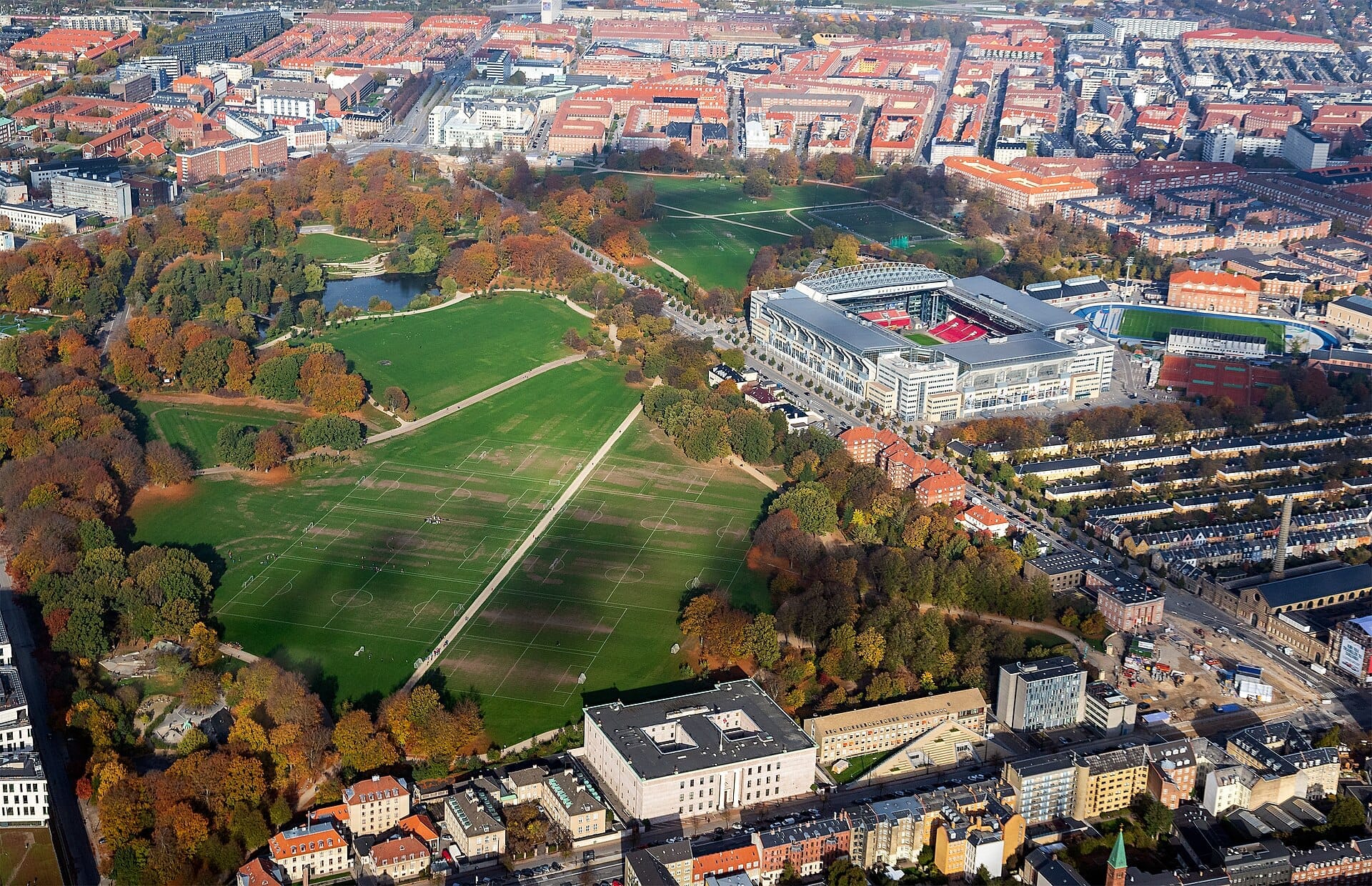
Fælledparken is not a manicured showpiece. It is a working city park in the residential Østerbro district, used daily by the people who live around it. At roughly 58 hectares, it is one of the largest parks in Copenhagen and one of the largest urban green spaces in Denmark. It sits adjacent to Parken, the Danish national football stadium, and that adjacency tells you something about the park's character: this is a place built for active, everyday use.
The park was created between 1906 and 1914 by landscape architect Edvard Glæsel, working with Copenhagen Municipality on land that had previously been open commons, specifically the Nørrefælled and Østerfælled. Those commons had served a practical purpose for centuries, and the park continues that tradition. Around 2009 to 2011, a significant renovation added new play areas and the skatepark, modernizing the space without stripping it of its open, unfussy character.
ℹ️ Good to know
Fælledparken is effectively open at all hours and free to enter. There are no gates, no ticket booths, and for general use there is no closing time. The skatepark is lit and also free.
The Park by Time of Day
Early mornings, roughly 6am to 9am, belong to runners. The perimeter path measures approximately 3.5 km, flat and well-maintained, and on weekday mornings it fills with commuter runners in lycra moving at a serious pace. The grass is often damp with dew, the light comes in low from the east across the open central meadow, and the air smells of cut grass and soil. It is genuinely pleasant, and quieter than you might expect for a park this central.
Midday on a weekday brings dog walkers, parents with small children, and the occasional lunch-break cyclist. On warm weekends between May and August, the dynamic changes completely. The central meadow fills with picnic blankets, footballs appear from nowhere, and the entire space takes on a social energy that feels closer to a community festival than a park visit. Bring your own food and drink because there is no formal café infrastructure to rely on, though a kiosk operates during summer.
Evenings in summer are worth coming back for. The quality of Danish summer light between 7pm and 9pm, golden and low, turns the open meadow into something unexpectedly atmospheric. Groups gather on the grass for drinks. Skaters arrive at the skatepark as the air cools. It is the kind of scene that Copenhagen residents take for granted and visitors consistently underestimate.
⚠️ What to skip
In October through March, the park is much quieter and the meadow can become muddy after rain. Bring waterproof footwear if visiting in autumn or winter. The light fades early and the park, while safe, loses most of its appeal by late afternoon.
Tickets & tours
Hand-picked options from our booking partner. Prices are indicative; availability and final rates are confirmed when you complete your booking.
1-hour boat harbour tour in Copenhagen
From 26 €Instant confirmationFree cancellationSmall group 3-hour walking tour in Copenhagen
From 45 €Instant confirmationFree cancellationCopenhagen to Malmo one-day tour
From 56 €Instant confirmationFree cancellationFull-day tour to Forest Tower and Forgotten Giants from Copenhagen
From 110 €Instant confirmationFree cancellation
The Skatepark and Sports Facilities
The Fælledparken Skatepark, located at Edel Sauntes Allé 3 within the park, is one of the more impressive outdoor skateparks in Scandinavia. It is lit for evening use, free to enter, unsupervised, and open to skateboarders, inline skaters, and BMX riders. The design incorporates bowls, street elements, and larger flow sections that accommodate different skill levels. On weekend afternoons, expect a mix of serious skaters and teenagers still learning kickflips.
Beyond the skatepark, the park has multiple football pitches, tennis courts available for public use, and open space that is regularly used for informal games of frisbee, volleyball, and rounders. The Copenhagen municipal government maintains the facilities, which means the quality is generally high even if the atmosphere is thoroughly unpretentious.
The Traffic Playground: Better Than It Sounds
The Trafiklegepladsen, or Traffic Playground, is one of those facilities that sounds dull on paper and is genuinely excellent in practice. It is an enclosed area designed as a small road network, with junctions, traffic signs, and paved lanes, specifically built for children learning to ride bicycles. Pedal bikes and tricycles are available to borrow. For families traveling with children between roughly three and ten years old, it is one of the better free activities in Østerbro.
Given that Copenhagen is defined by cycling culture, teaching children to navigate a road system is taken seriously as both education and play. If you want to understand the city's relationship with bikes in a concrete way, the traffic playground is a small but telling example. For more on how cycling shapes Copenhagen life, the cycling in Copenhagen guide covers the broader picture.
How to Get There and Getting Around Inside
The park's main address is Øster Allé, 2100 København Ø. Several city bus routes serve the surrounding streets, with stops along Øster Allé and at Trianglen. Check Rejseplanen (rejseplanen.dk) for current bus numbers and schedules before your visit, as routes are subject to change. The park is now directly served by the Metro at Trianglen station on the Cityringen (M3), making it a short walk from the platforms into the park.
Inside the park, the terrain is flat throughout. The main paths are wide, paved, and suitable for pushchairs and wheelchairs. Grass paths and informal routes cross the central meadow. Visitors with mobility considerations should find the main perimeter path and the area around the traffic playground straightforward to navigate. The skatepark area has paved approaches.
Fælledparken sits in Østerbro, a residential district north of the city centre. If you are building an itinerary around this area, the Østerbro neighborhood guide includes context on nearby dining, shopping, and the character of the district.
Photography and Seasonal Notes
The central meadow is the most photogenic part of the park, particularly in early morning light or during the golden hour before sunset in summer. The open space, combined with the relatively modest skyline of the surrounding residential buildings, gives photographs a sense of scale and calm that is harder to find in the more tourist-dense parts of Copenhagen.
In spring, cherry blossoms appear in sections of the park, typically in late April, and attract significant local interest. Autumn brings amber tones to the tree lines from mid-October. Winter visits are possible but the park offers little incentive unless you are using the perimeter path for running, which continues year-round among regular visitors.
For context on what Copenhagen looks like across different seasons, the best time to visit Copenhagen guide breaks down weather patterns and crowd levels month by month.
Who Should Skip Fælledparken
If you have a single day in Copenhagen and your priorities are major cultural institutions or historic architecture, Fælledparken is not a good use of limited time. It is a park. There is no single spectacular view, no iconic structure within it, and no exhibit. Visitors who arrive expecting a designed garden or an experience comparable to Tivoli will be confused.
Fælledparken rewards visitors who want to spend time alongside Copenhagen residents rather than in tourist infrastructure. If that is not your goal, the King's Garden (Kongens Have) near Rosenborg Castle offers a more historically layered park experience in the city centre, or Copenhagen's Botanical Garden provides a more curated green space.
Families traveling without children, solo travelers looking for structured experiences, and visitors on a one-day itinerary have better options available. But for anyone with a half-day to spare, staying in Østerbro, or simply wanting to see how Copenhagen uses its public space, the park earns its time.
Insider Tips
- The perimeter running path is approximately 3.5 km, making it an easy two-loop 7 km run. On weekday mornings before 8am, the path is used heavily by serious runners, so stay to the left if you are moving slowly.
- Summer weekends between late June and August see large informal gatherings on the central meadow. If you want a quieter experience, arrive before 11am or visit on a weekday afternoon.
- The skatepark is busiest on weekend afternoons. Spectating is completely normal and welcomed. If you are traveling with older children or teenagers interested in skating, this is a genuinely impressive facility at no cost.
- There is no reliable food concession inside the park except a seasonal summer kiosk. The streets around Trianglen and along Østerbrogade have multiple bakeries, cafés, and supermarkets within five minutes' walk. Pack your own picnic.
- The park adjoins Parken stadium. If there is a major football match or concert at Parken on the evening you plan to visit, expect crowds arriving and departing through the surrounding streets. Check the Parken events calendar in advance.
Who Is Fælledparken For?
- Runners wanting a flat, measured route away from traffic
- Families with young children, particularly for the Traffic Playground and open meadow space
- Skateboarders and BMX riders looking for a well-designed, free outdoor facility
- Picnickers and social groups, especially on warm summer evenings
- Visitors staying in Østerbro who want to spend a morning or afternoon the way locals do
Nearby Attractions
Other things to see while in Østerbro:
- Kastellet
Kastellet, the Citadel Frederikshavn, is a five-bastion star fortress dating to 1664 that still functions as an active military base while welcoming visitors free of charge. Its moat-encircled ramparts, working windmill, and quiet interior streets make it one of the most unusual open spaces in Copenhagen.
- Langelinie Promenade
Langelinie is a free, open-air promenade stretching along Copenhagen's inner harbour in Østerbro. It links the Gefion Fountain, Kastellet fortress, and the iconic Little Mermaid statue in a single walkable route — making it one of the city's most visited outdoor spaces, especially on clear mornings and summer evenings.
- Museum of Danish Resistance
The Museum of Danish Resistance tells the story of Denmark's five-year German occupation through immersive reconstructed spaces, personal artifacts, and unflinching historical detail. Located in Churchillparken near Kastellet, it is one of Copenhagen's most thoughtfully designed museums and a genuine counterweight to the city's lighter attractions.
- The Little Mermaid
The Little Mermaid is Copenhagen's most photographed landmark: a modest bronze statue with a surprisingly rich cultural history. Free to visit at any hour, she sits on a rock along the Langelinie waterfront in Østerbro, gazing quietly out over the Øresund strait. Here is exactly what the visit looks like, and how to make it worthwhile.