Kongens Have: Copenhagen's Oldest Park and Its Everyday Magic
Kongens Have, or The King's Garden, is Copenhagen's oldest public park, laid out by King Christian IV in 1606 as a Renaissance pleasure garden beside Rosenborg Castle. Free to enter year-round, this roughly 30-acre space in Indre By draws locals and visitors alike for picnics, garden walks, and a close look at one of the city's most photographed historic backdrops.
Quick Facts
- Location
- Øster Voldgade 4, 1350 København K, Indre By, Copenhagen
- Getting There
- Nørreport Station (7-min walk); Kongens Nytorv Metro (10-min walk)
- Time Needed
- 45 minutes to 2 hours depending on pace
- Cost
- Free. Rosenborg Castle (adjacent) requires a separate ticket.
- Best for
- Picnics, garden photography, family outings, castle views, slow mornings
What Is Kongens Have, and Why Does It Matter?
Kongens Have, formally known as The King's Garden or Rosenborg Garden, is the oldest surviving park in Copenhagen, and at roughly 400 years old, it carries more accumulated history than almost anything else you will walk through in Denmark's capital. King Christian IV began laying out the garden in 1606 as a private Renaissance pleasure garden attached to what was then a modest summer pavilion. That pavilion eventually grew into Rosenborg Castle, completed in 1624, and the castle and garden still read as a single composition today.
After the royal family largely abandoned Rosenborg as a residence around 1710, the garden was opened to the public, making it one of the earliest examples in Scandinavia of a royal estate transitioning into civic green space. Today it pulls around 3 million visitors per year, a number that tells you something important: this is not a quiet secret. It is a beloved, well-used city park that happens to have an extraordinary history underneath it.
💡 Local tip
Entrance to Kongens Have is completely free. Rosenborg Castle, which sits at the park's northern end, requires a separate paid ticket and is managed independently.
The Physical Experience: What You Actually Walk Through
The garden covers around 30 acres (approximately 12 hectares), which is large enough to feel genuinely spacious but compact enough to cross at a comfortable pace. The formal structure reflects its Renaissance origins: geometric beds, long straight avenues lined with mature trees, and clearly delineated sections that give the park a composed, ordered quality very different from a naturalistic English landscape garden.
One of the most distinctive features is what is commonly called the English Garden section, home to what landscape historians describe as Northern Europe's longest herbaceous border, running approximately 240 meters (around 787 feet). In summer, this border fills with successive waves of flowering perennials in a carefully timed sequence. The scale of it is genuinely impressive: standing at one end, the planting stretches far enough that the far edge blurs slightly. It rewards slow walking rather than a quick pass.
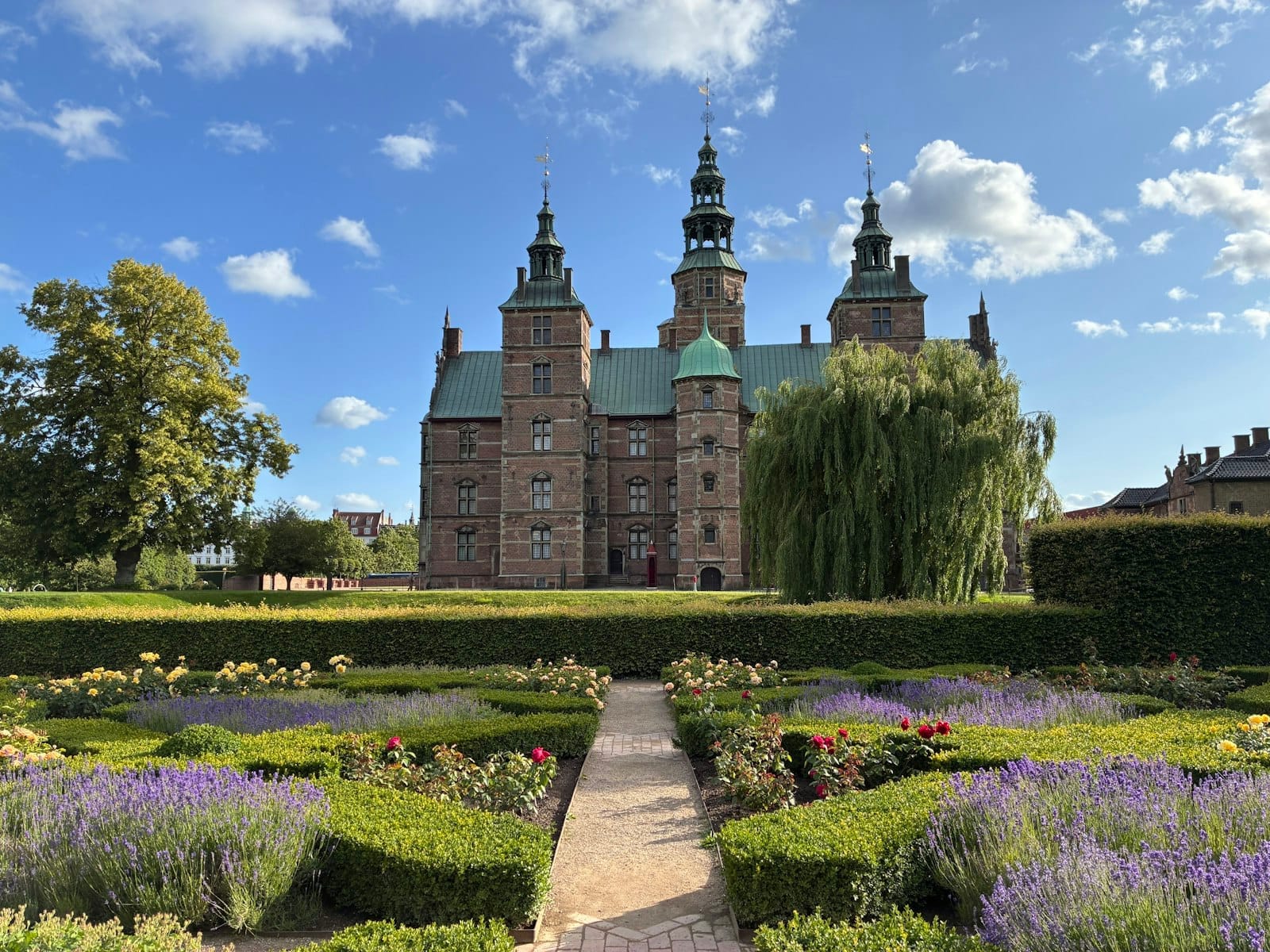
Rosenborg Castle anchors the north‑western portion of the garden visually. The Dutch Renaissance architecture, with its stepped gables, copper-green spires, and warm brick, photographs exceptionally well against a blue sky. The moat surrounding the castle is still intact, and the framing of the castle across the reflective water is one of the more memorable compositions in central Copenhagen.
Tickets & tours
Hand-picked options from our booking partner. Prices are indicative; availability and final rates are confirmed when you complete your booking.
Copenhagen Classic Pass 1-Day comprehensive ticket
From 89 €Instant confirmationCopenhagen card-HOP with 40+ attractions and hop-on hop-ff bus
From 78 €Instant confirmationFree cancellationEscape Tour self-guided, interactive city challenge in Copenhagen
From 30 €Instant confirmationEscape Tour self-guided, interactive city challenge in Copenhagen
From 30 €Instant confirmation
How the Park Changes by Time of Day
Kongens Have behaves very differently depending on when you arrive. Early mornings, particularly on weekdays, are genuinely peaceful. The gravel paths are nearly empty, the light is soft and low through the tree canopies, and the castle grounds feel almost private. This is when the garden's geometry is easiest to read and when photography with the castle as a backdrop is cleanest, before the crowds fill the lawns.
By midday in summer, the open grass areas transform into something closer to a distributed picnic event. Office workers from the surrounding city center arrive with food from nearby shops. Students spread blankets across the lawns. Families stake out spots near the playground. The noise level rises noticeably, and the atmosphere shifts from contemplative to social. This is not a problem, it is actually a very good illustration of how Copenhagen uses its public spaces, but it is worth knowing if your goal is quiet reflection.
Late afternoon, especially in spring and early autumn, offers a middle ground: enough ambient life to feel engaged, but with longer shadows and softer light that improves photography of the castle and the herbaceous borders. By early evening in summer, the park remains open and draws dog walkers and after-work strollers. The light at this hour, coming in low and golden through the avenues, is probably the most photogenic the garden gets.
ℹ️ Good to know
In winter, the garden is much quieter and stripped back to its structural bones: bare avenues, clipped hedges, and the castle in muted tones. It is a legitimate visit for those who appreciate formal garden design, though the experience is significantly colder and less colourful than summer.
Historical and Cultural Context
Christian IV, the Danish king who commissioned both the garden and Rosenborg Castle, is one of the most architecturally prolific monarchs in Danish history. He is responsible for reshaping Copenhagen's skyline in the early 17th century, including the Round Tower and several other landmarks still standing today. The garden he designed was intended as an extension of courtly life outward into cultivated nature, a private landscape that signaled royal sophistication and control over the natural world.
The transition from private royal garden to public park in the early 18th century placed Kongens Have within a long European tradition of opening formerly exclusive spaces to broader civic use. That shift is now so complete that most Copenhagen residents interact with the garden the way they might any neighborhood park: casually, frequently, and without much ceremony. It sits within the Indre By district, Copenhagen's historic core, which means it is surrounded by dense urban fabric on all sides. The park functions as a genuine breathing space within that density.
The garden is also a useful starting point if you are exploring Copenhagen's broader relationship with designed outdoor space. The city has a number of significant parks and green corridors worth understanding in relation to one another. A broader Copenhagen itinerary will typically place Kongens Have alongside Rosenborg Castle as a natural pairing, and rightly so.
Practical Walkthrough: How to Navigate the Garden
The most logical approach from Nørreport Station, the nearest transit hub, is to walk south along Gothersgade and enter the garden through the western gate. This brings you into the main formal avenue, with Rosenborg Castle visible at the far end. Walking toward the castle along this central axis gives you a classic compositional view that rewards a slow pace.
From there, the garden branches logically: the English Garden herbaceous border runs along the eastern edge, the children's playground sits toward the southern portion, and the formal rose beds are clustered in the middle sections. The paths are gravel-surfaced and reasonably level throughout, making the garden accessible for wheelchairs and pushchairs without significant difficulty.
If you plan to visit Rosenborg Castle itself, note that entry requires a separate ticket purchased at the castle entrance. The Copenhagen Card covers Rosenborg Castle admission, which may make it worthwhile if you are visiting multiple paid attractions during your stay.
⚠️ What to skip
The garden's opening hours are generous but not 24 hours. Gate times vary seasonally. Check current hours on the official VisitCopenhagen page before planning an early morning or late evening visit, particularly outside summer.
Photography, Families, and Accessibility
For photography, the castle is the primary subject, but do not overlook the herbaceous border in full summer bloom, the avenue tree canopies in late spring when the leaves are fresh green, and the moat reflections on calm days. The garden's formal structure gives images a strong sense of order and depth. Wide-angle lenses work well along the main avenues; a short telephoto pulls the castle closer from the southern lawns.
Families with children will find the dedicated playground a genuine asset. It is well-maintained and set within the garden in a way that does not feel like an afterthought. The surrounding lawns give children room to run while parents stay seated. For a broader sense of how Copenhagen works for families, the guide to Copenhagen with kids covers additional options across the city.
Accessibility is generally good. The main paths are smooth enough for wheelchairs and strollers, and the park's flat profile means gradients are not a concern. Benches are distributed throughout, making it manageable for visitors who need to rest regularly.
Who Should Reconsider This Visit
If you are primarily seeking solitude, Kongens Have in summer will likely disappoint. The 3 million annual visitors translate to a park that is rarely empty, and on warm weekends the popular lawn areas are dense with people. The experience is social and communal by nature, and that is a genuine quality worth understanding before you arrive.
Similarly, visitors who want immersive natural landscape rather than formal garden design may find the manicured structure limiting. Copenhagen does have more naturalistic green spaces, and Fælledparken in Østerbro offers a larger, less formal alternative for those who prefer open meadow over clipped hedges.
Insider Tips
- Arrive before 9am on a weekday in summer if you want the castle backdrop without a crowd in every frame. The garden is often nearly empty in the first hour after opening.
- The herbaceous border along the eastern edge peaks in July and early August. If your visit falls outside this window, the planting will be significantly less dramatic. Spring bulbs in April are the next best seasonal display.
- There are no cafes inside the garden itself. Pick up food from Torvehallerne, the covered market about a 5-minute walk from Nørreport, and bring it in for a proper picnic rather than relying on whatever is available at the castle perimeter.
- The castle moat reflects the spires cleanly on calm, overcast days when direct sun is not creating harsh shadows. Overcast light is often better for architecture here than full sun.
- If you are visiting Rosenborg Castle, buy your ticket online in advance during peak summer weeks to avoid queuing at the entrance. The garden itself never requires a ticket or queue.
Who Is The King's Garden (Kongens Have) For?
- Travellers who want a genuine Copenhagen experience that does not cost anything and is not staged for tourists
- Families with young children who need a safe, open space with a playground midway through a sightseeing day
- Architecture and history enthusiasts who want to understand Rosenborg Castle within its original designed landscape context
- Photographers looking for formal garden compositions and a photogenic castle backdrop in the heart of the city
- Visitors using Copenhagen in summer who want a picnic setting with a historic backdrop rather than a restaurant lunch
Nearby Attractions
Other things to see while in Indre By (Old Town):
- Amalienborg Palace
Amalienborg is the official home of the Danish royal family and one of Copenhagen's most architecturally coherent ensembles. Four near-identical Rococo palaces frame a grand octagonal square, with the Amalienborg Museum open to visitors inside Christian VIII's Palace. The daily changing of the guard at noon is a punctual, unhurried ceremony worth timing your visit around.
- The Black Diamond
The Black Diamond is the modern extension of the Royal Danish Library, clad in polished black granite and angled toward the harbour on Slotsholmen. Entry is free, the atrium is genuinely impressive, and the building rewards visitors who take time to understand what they are looking at.
- Botanical Garden of the University of Copenhagen
Tucked behind Nørreport Station in the heart of the city, the Copenhagen University Botanical Garden is a 10-hectare green sanctuary with a Victorian glasshouse complex, a tranquil lake, and around 8,000 plant species. Entry to the grounds is free, making it one of the most rewarding stops in central Copenhagen for any pace of traveler.
- Christiansborg Palace
Christiansborg Palace sits on the Slotsholmen islet in central Copenhagen, serving simultaneously as the home of the Danish Parliament, the Supreme Court, the Prime Minister's Office, and the Royal Reception Rooms. It is widely described as uniquely housing all three branches of Denmark’s national government under one roof, and its 106-metre tower offers one of the best free panoramic views in the city.