Museum of Danish Resistance: Copenhagen's Most Sobering WWII Museum
The Museum of Danish Resistance tells the story of Denmark's five-year German occupation through immersive reconstructed spaces, personal artifacts, and unflinching historical detail. Located in Churchillparken near Kastellet, it is one of Copenhagen's most thoughtfully designed museums and a genuine counterweight to the city's lighter attractions.
Quick Facts
- Location
- Esplanaden 13, Churchillparken, Copenhagen (near Kastellet and Østerport)
- Getting There
- Østerport Station (M3/M4, S-train) or Marmorkirken Metro, 5–10 min walk; Bus 23 or 1A also stop nearby
- Time Needed
- 1.5 to 2.5 hours
- Cost
- 130 DKK adults; under 18 free; Copenhagen Card holders free
- Best for
- History enthusiasts, WWII travelers, older teens and adults, visitors seeking depth beyond sightseeing
- Official website
- frihedsmuseet.dk/en
What Is the Museum of Danish Resistance?
The Museum of Danish Resistance, known in Danish as Frihedsmuseet, carries its full official title: Museum for Danmarks Frihedskamp 1940–1945. That subtitle matters. This is not a broad survey of the Second World War. It is a specific, concentrated account of what happened to Danish society during five years of German occupation and how ordinary Danes responded, both through collaboration, quiet compliance, and active resistance.
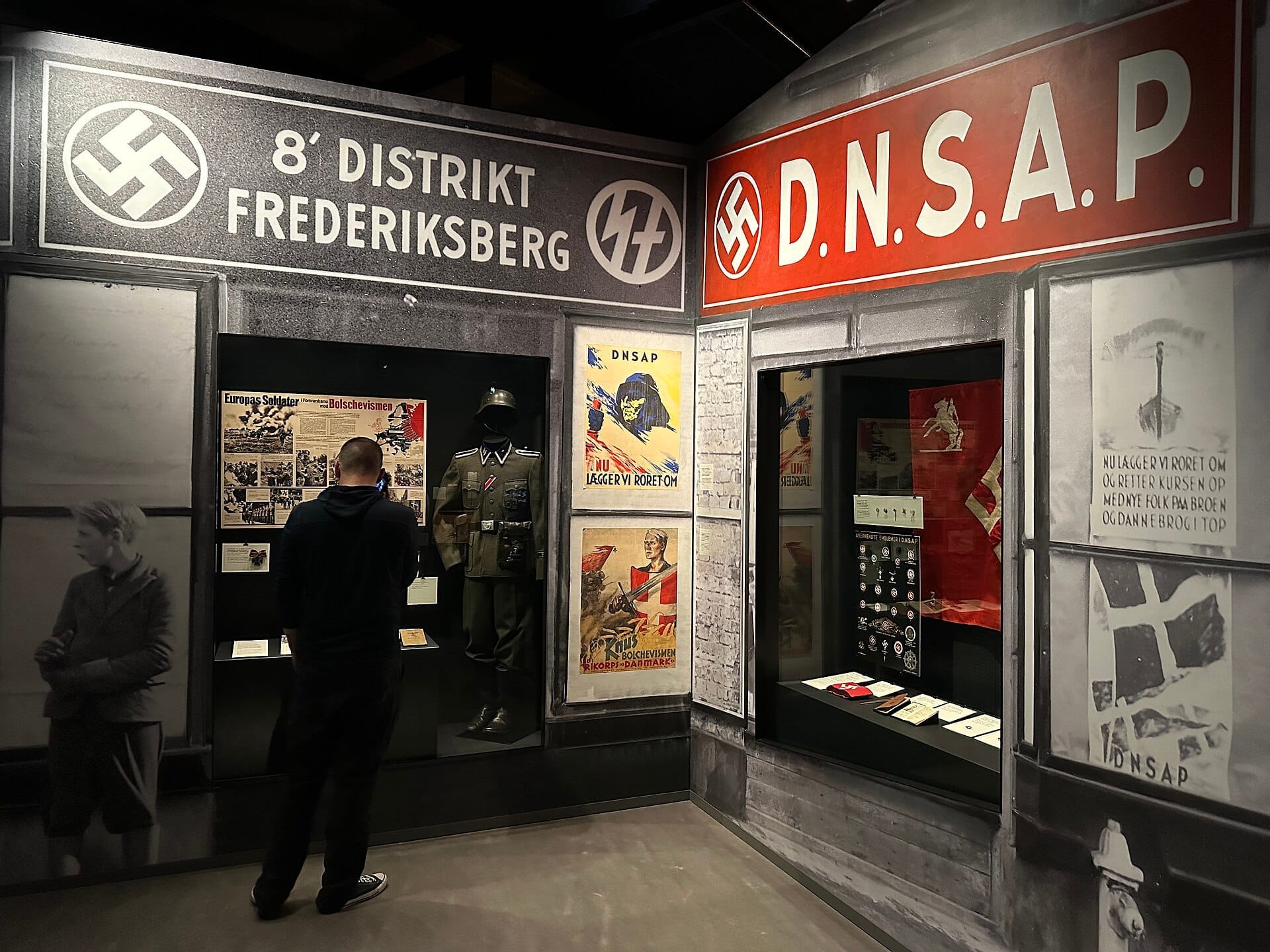
First opened on 15 October 1957, the museum was a gift from the resistance movement itself to the Danish state. It has been part of the National Museum of Denmark from the beginning. The current building, which reopened in July 2020 after a major reconstruction, is a completely reimagined version of the original. The experience is largely underground, with visitors moving through reconstructed occupation-era environments in carefully controlled light. It feels less like a traditional exhibition and more like walking into the period itself.
ℹ️ Good to know
Admission: 130 DKK for adults. Children under 18 enter free. Copenhagen Card holders have free entry. Groups of 10 or more may qualify for a discount, check the official website for current group rates. Hours are 10:00–17:00 daily from April through September; in January–March and October–December the museum is closed on Mondays and open 10:00–17:00 Tuesday–Sunday. Always verify current hours before visiting.
The Experience: Dark Streets, Real Stories
The design concept is the museum's greatest achievement. Rather than rows of glass cases with labels, you enter what feels like a partially reconstructed street from occupied Copenhagen. The lighting is deliberately low. Sounds are used carefully. The atmosphere is not theatrical in a cheap sense — it is considered and restrained, which makes it more effective.
What you encounter includes personal objects belonging to resistance fighters, clandestine printing equipment used to produce illegal newspapers, weapons caches, hidden radios, and documents recovered from the occupation period. Many items were collected by the resistance movement itself and donated in the years after liberation. The provenance is firsthand, and that authenticity changes how objects read.
The museum does not glorify. It is careful to represent the complexity of Danish behavior during the occupation, including the fact that for much of the war, the Danish government continued to function under German oversight. Resistance grew slowly and unevenly. The exhibition acknowledges this without flinching, which gives it credibility that more patriotic narratives often lack.
Tickets & tours
Hand-picked options from our booking partner. Prices are indicative; availability and final rates are confirmed when you complete your booking.
Jewish Quarter private tour with Danish Jewish Museum in Copenhagen
From 221 €Instant confirmationFree cancellation1-hour boat harbour tour in Copenhagen
From 26 €Instant confirmationFree cancellationSmall group 3-hour walking tour in Copenhagen
From 45 €Instant confirmationFree cancellationCopenhagen to Malmo one-day tour
From 56 €Instant confirmationFree cancellation
Setting and Surroundings: Churchillparken and Kastellet
The museum sits inside Churchillparken, a long green strip that runs alongside the old Kastellet citadel in the northern part of the city center. The park itself is quiet and well-maintained, with wide paths and a calm character that contrasts sharply with the denser tourist areas a short distance away.
Arriving on foot from Østerport Station takes roughly five to ten minutes and brings you along Esplanaden, a broad tree-lined road. The walk passes the edge of Kastellet, the 17th-century star-shaped fortress that remains one of the best-preserved military citadels in northern Europe. You pass through this park, not past a parking lot. That approach already sets a contemplative tone before you reach the museum entrance.
The location also means the museum sits within easy walking distance of several other significant sites. The Little Mermaid is a five-minute walk north. Amalienborg Palace is about ten minutes south. If you are spending a morning in this northern corner of the city, combining the museum with a walk through Kastellet and along the harbor front is a natural and rewarding sequence.
Time of Day and Crowd Patterns
The museum's underground and partially reconstructed design means natural light plays almost no role inside. There is no meaningful difference between visiting at 10:00 and visiting at 15:00 in terms of the interior experience. This makes it a practical choice on overcast or rainy days, when outdoor Copenhagen attractions lose their appeal.
Crowds here are manageable compared to the city's most visited museums. Weekday mornings tend to be the quietest. Weekends in summer attract school groups and organized tours, particularly in the late morning slot between 11:00 and 13:00. If you are visiting with children, morning arrivals are easiest. If you want the space largely to yourself, arrive at opening time on a weekday.
💡 Local tip
The immersive design means the museum can feel emotionally intense. Build in time to decompress afterward. The park benches in Churchillparken are a natural place to sit quietly before moving on to the next stop.
Historical Context Worth Knowing Before You Go
Germany occupied Denmark from April 9, 1940 until May 5, 1945. The occupation lasted just over five years and covered nearly the entire duration of Danish civilian life under foreign military control. In the early years, the Danish government remained in place under German oversight, a policy of accommodation that kept daily life partially intact but created profound moral compromises. Active resistance was limited at first, growing significantly from 1943 onward.
Denmark's rescue of its Jewish population in October 1943, during which an estimated 7,000 Jews were smuggled across the Øresund strait to neutral Sweden in fishing boats, is one of the most documented civilian rescue operations of the war. The museum addresses this directly. It also covers the sabotage campaigns carried out by Danish resistance networks, the illegal press that kept counter-narrative information circulating, and the human cost borne by those who were caught.
For visitors who want additional historical grounding before or after the museum, the National Museum of Denmark in the city center provides broader context on Danish history across centuries. The two museums are distinct in scope but complementary.
Practical Walkthrough: Getting There and Planning Your Visit
The most straightforward route from central Copenhagen is the Metro or S-train to Østerport Station, followed by about a ten-minute walk through Churchillparken toward Esplanaden. The route is clearly signposted and passes through pleasant open parkland. Alternatively, the Marmorkirken Metro stop puts you roughly equidistant from the entrance with a slightly different approach through the Bredgade area.
Bus routes 23, 26, and 1A stop near Kastellet and Østerport. If you are arriving from the Nyhavn area or the harbor front, walking takes around fifteen to twenty minutes and is a genuinely enjoyable route along the waterfront before turning north.
If you are using the Copenhagen Card, entry is included and the card also covers your transit fare, making the combined journey essentially free once the card is purchased. For travelers doing multiple museums in a day, the card pays off quickly in this part of the city.
The museum is listed as wheelchair accessible. The underground sections are reached by ramp and elevator access, though the reconstructed street environment involves some uneven surfaces. If mobility is a concern, contacting the museum directly before visiting is advisable.
Photography and What to Bring
Photography policies in immersive museum environments vary, and lighting conditions inside the Museum of Danish Resistance are deliberately low. Even where permitted, smartphone cameras often struggle in these conditions. The experience is not primarily a visual spectacle in a photogenic sense; it is an encounter with objects and stories. Visitors who try to photograph everything tend to absorb less.
There is no strict dress code. Comfortable shoes are fine. The underground sections maintain a consistent temperature, so dressing in layers is sensible if you are moving between outdoor and indoor spaces on a variable-weather Copenhagen day.
⚠️ What to skip
The museum covers difficult subject matter including executions, deportations, and torture. It is not recommended for young children. The immersive design amplifies the emotional weight of the content. This is a museum for visitors ready to engage with serious history, not a general-interest family attraction.
Who Might Not Enjoy This Museum
Visitors looking for a light, easy cultural experience will find this museum challenging. The subject matter is heavy and the design does not soften it. Families with young children should consider whether the content and atmosphere are appropriate. Travelers with only a day or two in Copenhagen and a long list of major landmarks to cover may find a 1.5 to 2.5 hour commitment here difficult to justify alongside Tivoli, Nyhavn, and Rosenborg.
That said, for anyone with an interest in 20th-century European history, wartime resistance movements, or the specific moral questions that occupation raises for a civilian society, this museum is genuinely among the best of its kind in Scandinavia. It does what the very best history museums do: it makes the past feel like something that happened to real people, not an abstraction. Travelers who enjoy museums like the Ny Carlsberg Glyptotek for the depth of curation will find a similar seriousness of purpose here, applied to a completely different subject.
Insider Tips
- Arrive at opening time (10:00) on a weekday to have the reconstructed occupation-era spaces largely to yourself. The immersive effect is significantly stronger when you are not navigating around other visitors.
- Combine the museum with a walk through Kastellet immediately after. The 17th-century fortress is free to enter, takes about thirty minutes to walk around, and provides a physical counterpoint to the underground museum experience.
- If you want to understand the October 1943 rescue of Danish Jews in more depth, ask at the museum desk about any dedicated programming or guided sessions. The museum's coverage of this event is detailed but a guide adds considerable context.
- The Copenhagen Card covers entry and transit, making it straightforward to pair this museum with Amalienborg Palace and a walk along the Langelinie harbor front in a single morning without additional ticket purchases.
- Seasonal Monday hours vary. The museum is currently open daily from April through September, while in January–March and October–December it is closed on Mondays and open Tuesday–Sunday. Always check the official website before visiting if a Monday is your only available day.
Who Is Museum of Danish Resistance For?
- History travelers with a specific interest in World War II and occupation-era Europe
- Adults and older teenagers who want substantive cultural engagement beyond sightseeing
- Visitors on rainy or overcast days when outdoor Copenhagen is less appealing
- Copenhagen Card holders maximizing value across the northern harbor district
- Anyone interested in the ethics of civilian resistance and collaboration during wartime
Nearby Attractions
Other things to see while in Østerbro:
- Fælledparken
Fælledparken is a sprawling public park in Østerbro, Copenhagen. Free to wander for most visitors at all hours, it draws runners on its 3.5 km perimeter loop, families at the traffic playground, skaters at one of Scandinavia's best-equipped outdoor skateparks, and locals who simply want grass and sky. No ticket required, no crowds to fight.
- Kastellet
Kastellet, the Citadel Frederikshavn, is a five-bastion star fortress dating to 1664 that still functions as an active military base while welcoming visitors free of charge. Its moat-encircled ramparts, working windmill, and quiet interior streets make it one of the most unusual open spaces in Copenhagen.
- Langelinie Promenade
Langelinie is a free, open-air promenade stretching along Copenhagen's inner harbour in Østerbro. It links the Gefion Fountain, Kastellet fortress, and the iconic Little Mermaid statue in a single walkable route — making it one of the city's most visited outdoor spaces, especially on clear mornings and summer evenings.
- The Little Mermaid
The Little Mermaid is Copenhagen's most photographed landmark: a modest bronze statue with a surprisingly rich cultural history. Free to visit at any hour, she sits on a rock along the Langelinie waterfront in Østerbro, gazing quietly out over the Øresund strait. Here is exactly what the visit looks like, and how to make it worthwhile.