Chiesa del Redentore: Palladio's Plague Church on Giudecca
Built in 1577 as a vow to God after a devastating plague, the Chiesa del Santissimo Redentore is Andrea Palladio's finest church in Venice. Standing on the island of Giudecca across the canal from Dorsoduro, it rewards visitors with serene interiors, important Renaissance paintings, and one of the most dramatic facades in Italian architecture.
Quick Facts
- Location
- Campo del Santissimo Redentore 195, Giudecca island, Venice
- Getting There
- Vaporetto stop: Redentore (lines serving Giudecca)
- Time Needed
- 45–90 minutes, including the walk along Giudecca's fondamenta
- Cost
- €3.50 standard / €2.50 reduced; Chorus Pass €15 (covers 16 Venetian churches). Verify before visiting.
- Best for
- Architecture enthusiasts, art lovers, and anyone wanting to escape the San Marco crowds
- Official website
- www.chorusvenezia.org
Why the Redentore Matters
The Chiesa del Santissimo Redentore is not just a beautiful church. It is a monument to collective grief and collective relief. Between 1575 and 1577, bubonic plague killed roughly a third of Venice's population, an estimated 50,000 people in a city built on water with nowhere to flee. When the epidemic finally broke, the Venetian Senate made a solemn vow: they would commission a great votive church, and every year the Doge would lead a procession across a bridge of boats to give thanks. That vow produced one of the finest buildings in Italy.
The architect chosen was Andrea Palladio, already celebrated for his villa designs across the Veneto mainland and for the church of San Giorgio Maggiore, which sits across St Mark's Basin. The Redentore, commissioned in 1577 and completed in 1592 by Antonio da Ponte, became the summation of Palladio's ecclesiastical thinking. The Senate's original vote was split: some wanted a Dominican design, others a Franciscan one. The Capuchins won, and Palladio had to accommodate their desire for simplicity alongside the Republic's need for grandeur. The result is one of the most precise tensions in Western architecture.
The Facade: What You See from the Water
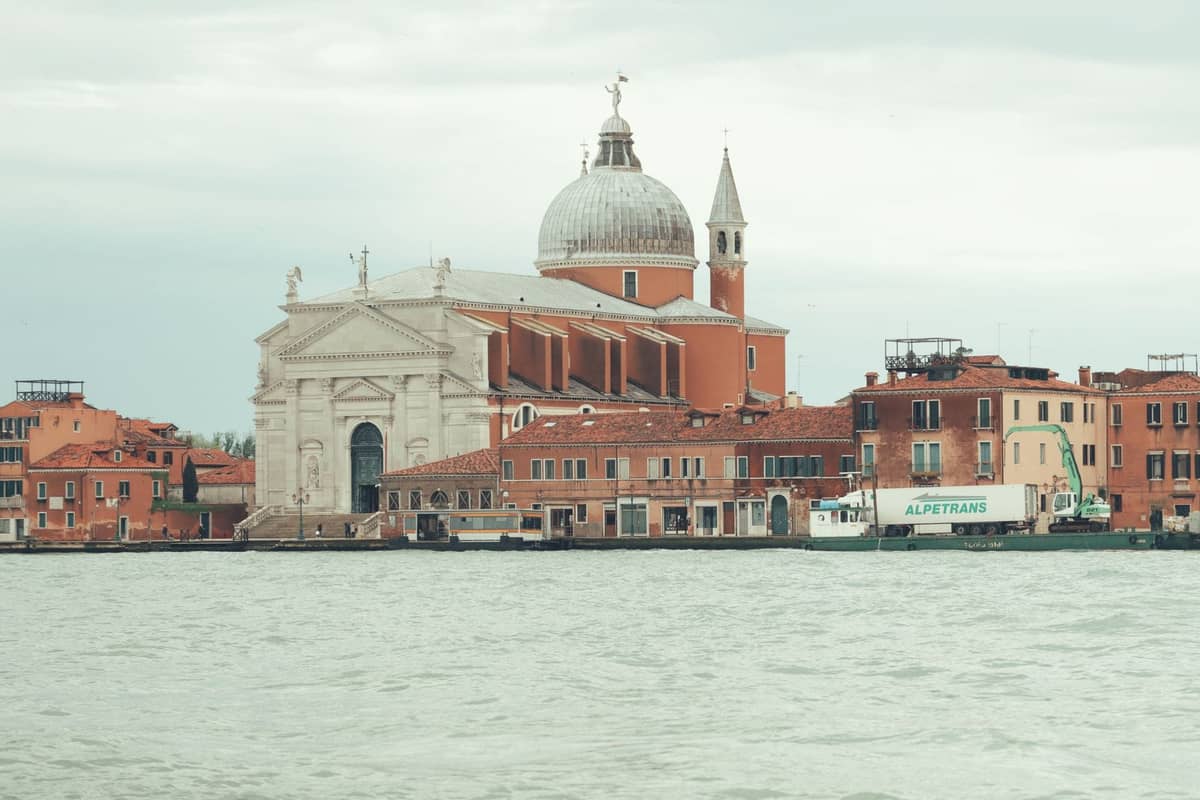
The most famous view of the Redentore is from the water, either from the Zattere promenade on the Dorsoduro side or from a vaporetto crossing the Giudecca Canal. The white Istrian stone facade catches morning light in a way that makes it look almost luminous against the terracotta and brick of the Giudecca shoreline. Palladio solved the perennial Renaissance problem of fitting a classical temple front onto a Christian basilica floor plan by layering two interlocking pediments: a narrow, tall one for the nave, and a lower, wider one for the aisles. The visual effect is of a building that looks complete from every angle and distance.
Three large thermal windows above the entrance flood the interior with diffused natural light. The drum and hemispherical dome behind the facade becomes visible as you approach from the vaporetto, rising cleanly above the roofline. On a clear morning, with the dome pale against the sky and the canal glittering, this is one of Venice's genuinely arresting sights, and because you have to cross to Giudecca to reach it, most day-trippers never see it up close.
💡 Local tip
For the best photographs of the facade, take the vaporetto across and shoot from the water before disembarking. The light is most flattering in the morning. Once you're standing directly in front of the church, the full composition is harder to capture.
Tickets & tours
Hand-picked options from our booking partner. Prices are indicative; availability and final rates are confirmed when you complete your booking.
Scala Contarini del Bovolo Entrance Tickets
From 9 €Instant confirmationScala Contarini del Bovolo Entrance Tickets
From 7 €Instant confirmationVenetian Villas of Riviera del Brenta Guided Tour from Venice
From 140 €Instant confirmationFree cancellationDoge's Palace skip-the-line tour
From 67 €Instant confirmationFree cancellation
Inside the Church: Light, Art, and Silence
The interior is a single long nave ending in a semicircular apse, flanked by chapels rather than aisles. The spatial effect is one of focused verticality. Pale stone, white plaster, and those three thermal windows combine to produce a quality of light that feels almost clinical in its evenness: cool, even, undramatic. This is deliberate. Palladio and the Capuchins wanted an interior that directed attention toward the altar, not toward decoration. By Venetian standards, the Redentore is austere.
The art inside, however, is substantial. The sacristy contains paintings attributed to Palma il Giovane, Tintoretto, and Paolo Veronese, including an Ascension of Christ and a Baptism of Christ attributed to Veronese. A bronze crucifix by Girolamo Campagna stands above the high altar. These works are not displayed with the explanatory apparatus of a museum, so take time to let your eyes adjust and move slowly through the side chapels. The building is still an active place of worship and retains genuinely devotional objects alongside the art historical ones.
The choir area behind the altar is separated by a curved screen of columns and is where the Capuchin friars would pray in their traditional manner, out of sight of the congregation. Walking through into this zone reveals a more intimate space: lower ceilings, worn floor tiles, and a quality of worn ordinariness that contrasts with the formal geometry of the nave. This backstage quality of the Redentore, the sense that you are briefly inside a working religious house rather than a monument, is part of what makes it worth the detour to Giudecca.
Getting There: The Giudecca Crossing
The Redentore is located on the island of Giudecca, separated from the main body of Venice by the wide Giudecca Canal. To reach it, take the ACTV vaporetto to the Redentore stop, which is served by lines running along the Giudecca. The crossing from the Zattere promenade takes only a few minutes but the Giudecca Canal is broad, and the crossing itself is one of the better views of the Dorsoduro skyline. Check current ACTV schedules and fares before you go, as they are updated periodically.
Once on Giudecca, the church is immediately visible from the vaporetto stop. The island is long and narrow, running east to west, and is one of the quieter parts of Venice to walk. There are no major tourist attractions on the scale of the Rialto or Piazza San Marco, which means the fondamenta in front of the Redentore is rarely crowded. You can walk the length of Giudecca's waterfront in about 20 minutes from the Palanca stop near the Zattere end to the Redentore stop near the eastern tip, passing small boatyards, a handful of local bars, and the high wall of the former Molino Stucky flour mill, now a hotel.
ℹ️ Good to know
Opening hours: typically Monday to Saturday, 10:30–17:00. Hours may differ during religious services and on the Festa del Redentore (third Sunday of July). The church is managed by the Chorus Association; a Chorus Pass (€15 full price) covers entry to 16 Venetian churches and may be the better value if you plan to visit several. Verify current hours and prices at chorusvenezia.org before visiting.
The Festa del Redentore: One Night a Year
The annual Festa del Redentore, held on the third Sunday of July, fulfills the original 1577 vow. A temporary pontoon bridge of boats is constructed across the Giudecca Canal, connecting the Zattere to the church, and Venetians and visitors walk across to attend mass. The Saturday night before is when the city really celebrates: hundreds of boats moor in the basin between the Giudecca and San Marco, decorated with lanterns and loaded with food, wine, and friends. A fireworks display over the lagoon, one of the largest in Italy, begins around midnight.
If you are in Venice in mid-July, this is worth arranging your trip around. For context on what to expect and how to participate, see the best time to visit Venice guide, which covers the main seasonal events. The festa transforms the church from an architectural monument into the center of the city's most emotionally resonant annual ritual: a reminder that this building was built from grief, and that the celebration around it has been repeated every July for nearly 450 years.
⚠️ What to skip
During the Festa del Redentore weekend, accommodation and vaporetti are extremely busy. Book transport and lodging well in advance if you plan to attend. The pontoon bridge is pedestrian-only and is typically open from the Saturday morning until Monday morning, then dismantled.
Practical Notes: Timing, Dress, and Accessibility
The Redentore is best visited on a weekday morning, when the interior is quiet and the light through the thermal windows is at its most useful for seeing the paintings clearly. Afternoon visits are fine but the nave gets direct southern light later in the day which can flatten the architectural detail. Access on Sundays may be limited during religious services, so plan accordingly.
As with all Venetian churches, modest dress is required: covered shoulders and knees. Bring a light layer even in summer if you tend to wear sleeveless clothing. Wheelchair access is limited due to the historic structure and uneven stone floors; visitors with mobility requirements should check directly with the Chorus Association before visiting.
The Giudecca crossing also gives you a reason to spend an extra hour or two on the island rather than rushing back. A coffee at one of the canal-side bars, or a walk along the quieter north-facing fondamenta, provides a version of Venice that feels considerably less stage-managed than the area around Piazza San Marco. Visitors who feel worn down by the density and commercial pressure of the main tourist routes often find Giudecca genuinely restorative.
Worth It?
For anyone with a serious interest in Renaissance architecture or Venetian painting, the Redentore is not optional. Palladio's church design here is at least the equal of San Giorgio Maggiore across the basin, and arguably more interesting because of the constraints he worked within. For casual visitors with only one or two days in Venice, it requires a deliberate detour via vaporetto to an island that has nothing else on the scale of the Gallerie dell'Accademia or the Basilica dei Frari. Those visitors might be better served by prioritizing the major museums and churches in the historic center first.
That said, if you are on a second or third visit to Venice and have already covered the obvious ground, the Redentore plus a walk along Giudecca's fondamenta is one of the most satisfying half-days the city offers. It is quieter, the architecture is exceptional, the admission is low, and the view of Venice from the Giudecca waterfront looking north across the canal is one that relatively few visitors ever see.
Insider Tips
- The vaporetto stop is directly in front of the church, but disembark one stop early at Palanca and walk east along the Giudecca fondamenta. The 15-minute walk gives you a ground-level view of the church's dome gradually rising above the roofline as you approach, which is architecturally far more interesting than stepping straight off the boat.
- The Chorus Pass covers a network of Venetian churches (check chorusvenezia.org for the current list and fees). If you plan to visit several participating churches in a single trip, the pass can be better value than individual tickets — but note that major churches such as the Frari are not covered by Chorus.
- The sacristy is often overlooked by visitors who stop at the main nave. Ask at the entrance whether it is open. This is where several of the most important paintings are kept, in a much more intimate setting than a standard museum room.
- If you visit in the week before the Festa del Redentore in July, you can often watch workers beginning to assemble the pontoon bridge from the Zattere side. The engineering of the temporary bridge is worth seeing on its own terms.
- The bar directly on the canal near the Redentore stop has outdoor seating with an unobstructed view of the Dorsoduro skyline across the Giudecca Canal. It is a far less crowded and considerably cheaper place for an afternoon drink than anywhere on the Zattere.
Who Is Chiesa del Redentore For?
- Architecture enthusiasts: Palladio's facade and interior spatial sequence are among the most studied in Italian Renaissance architecture
- Repeat visitors to Venice who have already covered the main sites in the historic center
- Travelers combining multiple Chorus churches under a single pass visit
- Anyone visiting Venice in July who wants to experience the Festa del Redentore procession and fireworks
- Visitors looking for a quieter, less commercial part of Venice without leaving the lagoon entirely
Nearby Attractions
Combine your visit with:
- Burano Island
Eight to nine kilometers north of Venice, Burano Island is a compact, flat island of roughly 21 hectares where fishermen's houses are painted in saturated reds, yellows, and blues. It has a legitimate history in lace-making stretching back to the 16th century, and the 40-minute vaporetto ride across the lagoon is part of the experience.
- Chioggia
Chioggia is an ancient fishing town at the southern entrance of the Venetian Lagoon, built on a cluster of small islands linked by bridges and crossed by canals. Unlike Venice, it functions as a living, working community, and that distinction shapes everything about a visit.
- Giudecca Island
Giudecca Island sits just minutes from the heart of Venice yet feels like a different city entirely. Flat, walkable, and free to explore, it rewards visitors with Palladian architecture, waterfront promenades, and a glimpse of how Venetians actually live.
- Lace Museum Burano (Museo del Merletto)
The Museo del Merletto on Burano island preserves one of Venice's most painstaking craft traditions: needle lace so fine it was once compared to frozen breath. Housed in the former Burano Lace School, this small but authoritative museum rewards patient visitors with extraordinary historical pieces and, sometimes, live demonstrations by the last practitioners of the craft.