Burano Island: Venice's Most Colorful Corner of the Lagoon
Eight to nine kilometers north of Venice, Burano Island is a compact, flat island of roughly 21 hectares where fishermen's houses are painted in saturated reds, yellows, and blues. It has a legitimate history in lace-making stretching back to the 16th century, and the 40-minute vaporetto ride across the lagoon is part of the experience.
Quick Facts
- Location
- Venice Lagoon, approx. 8–9 km north of Venice historic centre
- Getting There
- ACTV Vaporetto Line 12 from Fondamenta Nuove; approx. 40–45 min
- Time Needed
- 2–4 hours for a comfortable visit
- Cost
- Free to explore; pay only for vaporetto tickets and any museum entry
- Best for
- Photography, slow travel, day trips, families, culture
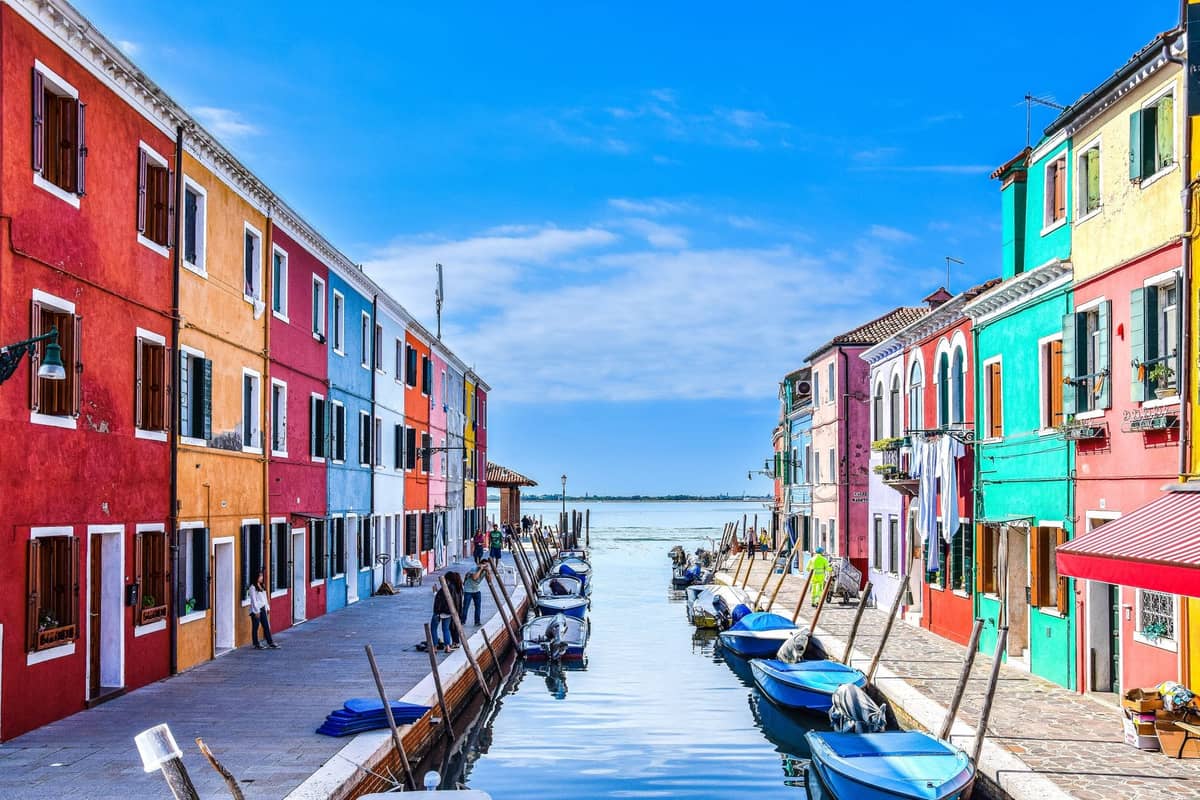
What Burano Actually Is
Burano Island is a residential island in the northern Venetian Lagoon, roughly 9 kilometers from Venice's historic centre. It is not a theme park or a staged attraction. People live here, dry laundry in doorways painted the color of traffic cones, and go to the market on Tuesday mornings. The island consists of four small islets connected by bridges, covering a total area of about 0.21 square kilometers, and it is linked by a long pedestrian bridge to its quieter neighbor, Mazzorbo.
The famous painted facades are real, and they predate Instagram by several centuries. The tradition holds that fishermen painted their houses in bright, distinct colors so they could identify their homes through the lagoon fog. Whether that story is fully accurate or partly folk legend, the result is a streetscape unlike anywhere else in the Veneto: saturated primary and secondary colors applied house by house, with no two adjacent walls in the same shade.
ℹ️ Good to know
Burano is a public island with no admission fee and no closing time. You pay only for the ACTV vaporetto to get there. Verify current ticket prices with ACTV before travel, as fares are subject to change.
Getting There: The Vaporetto Ride Across the Lagoon
Take ACTV Line 12 from Fondamenta Nuove on the northern edge of Venice's historic centre. The journey takes approximately 40 to 45 minutes and travels across open lagoon water, passing the cemetery island of San Michele and the glassmaking island of Murano. It is worth sitting on the exterior deck, especially on clear days, when you can see the shallow lagoon floor in places and watch the channel markers threading between sandbars. For context on the wider lagoon geography, the Venice lagoon islands guide covers the full network of inhabited and uninhabited islands.
Boarding at Fondamenta Nuove involves steps and gangways, and the same applies at Burano's landing stage. Within the island, multiple bridges cross the small canals, all with steps. The island is flat, but step-free routing is limited. Visitors with mobility considerations should consult current ACTV accessibility information before traveling.
💡 Local tip
Buy a 24-hour or 48-hour ACTV travel card rather than single tickets if you plan to use the vaporetto more than twice in a day. It covers the Burano line and all other ACTV routes. Verify current pricing with ACTV directly.
Tickets & tours
Hand-picked options from our booking partner. Prices are indicative; availability and final rates are confirmed when you complete your booking.
Murano glass and Burano lace experience with prosecco wine
From 50 €Instant confirmationFree cancellationMurano, Burano and Torcello day tour from Punta Sabbioni
From 30 €Instant confirmationFree cancellationMurano, Burano and Torcello 1-day tour
From 30 €Instant confirmationFree cancellationVenice, Murano and Burano 1-day tour
From 0 €Instant confirmationFree cancellation
The Island on Foot: What You See and When
The main axis of Burano runs along Via Baldassarre Galuppi, a pedestrian street named after the composer born here in 1706. It is lined with lace shops, cafes, and restaurants serving seafood caught in the lagoon. This is where most day-trippers spend most of their time, and by mid-morning on a weekend it becomes noticeably crowded between the vaporetto landing and the central square, Piazza Baldassarre Galuppi.
The color photography is better in the side streets. The main thoroughfare has souvenir stalls and tourist-facing businesses, but one or two turns off it brings you to quieter residential lanes where the painted walls, window boxes, and moored boats create the compositions that make Burano photogenic. Early morning light, roughly 7 to 9 AM in summer, hits the eastern-facing facades with warm directional light. Overcast days actually suit Burano's colors well: flat light reduces harsh shadows and makes the saturated pigments glow.
By around 11 AM in peak season, the piazza fills with tour groups arriving on organized half-day excursions from Venice. Lunchtime between noon and 2 PM represents the most crowded window of the day. If you arrive on the first vaporetto of the morning or on a weekday in spring or autumn, you will find a quieter, more domestic version of the island, with residents at the fish stalls and children walking to school.
💡 Local tip
For the best light and fewest crowds, take the first Line 12 departure of the day from Fondamenta Nuove. You will have the island largely to yourself for the first hour.
Lace-Making: The History Behind the Craft
Burano's association with lace dates to the 16th century, when the craft became a significant part of the local economy. Burano needle lace, known as punto in aria (literally "stitch in air"), was produced almost entirely by hand and prized across Europe. By the 19th century, the tradition had declined severely. In 1872, a lace school was founded on the island specifically to revive the craft and provide income for local women during an economic crisis in the fishing community.
The Lace Museum (Museo del Merletto) is housed in the original school building and displays examples of historic Burano lace alongside demonstrations and tools. It is the primary indoor attraction on the island and gives real context to the embroidered tablecloths and collars sold in the shops outside. The museum has its own opening hours and an admission fee; verify current information before visiting.
Authentic handmade Burano lace is extremely time-consuming to produce and correspondingly expensive. Most of what is sold in the island's shops is machine-made or imported. If buying lace matters to you, ask specifically whether a piece is handmade punto in aria from Burano, and expect the price to reflect the labor.
Food and Drink on the Island
Burano has a genuine restaurant culture, not just tourist-trap trattorie. The island's fishing history means seafood is the default, and the local risotto di gò, made with a small lagoon fish called gobione (goby), is a dish specific to this stretch of the lagoon. It requires slow cooking and a reasonable level of skill to do well. A handful of restaurants on and around Via Galuppi are known for serving it properly; the quality drops sharply in the establishments closest to the vaporetto landing.
For a broader sense of what Venetian food culture looks like across the city, the Venice food guide covers cicchetti, bacari, and the seasonal produce of the lagoon. Burano's restaurants tend to be more lunch-focused than evening-focused, since most visitors leave by mid-afternoon.
One local bakery staple is bussolà buranello, a ring-shaped or S-shaped butter biscuit with a faint lemony flavor. They are sold in almost every pasticceria on the island, keep well, and travel without crumbling, which makes them a reasonable thing to take back to Venice.
Weather, Seasons, and Honest Expectations
Burano sits fully exposed in the lagoon. In summer, the island bakes under direct sun with little shade in the open piazza or on the bridges; bring water and sun protection. In winter, the wind across the lagoon can be sharp and damp, and the low angle of the light makes the colors look more muted. Autumn and early winter bring the risk of acqua alta, the high-water events that periodically flood parts of Venice and its islands. The streets closest to the canal edges can become temporarily impassable during significant tidal surges.
If you are visiting Venice in autumn or winter, check the acqua alta guide before any day trip to the lagoon islands, as the situation can change within hours and affect vaporetto services.
Spring, roughly April through early June, and September offer the most balanced conditions: manageable crowds, good light, comfortable temperatures, and a better chance of seeing the island functioning as a community rather than purely as a backdrop for day-trippers. July and August are peak season. The island will be at its most crowded, but also its most brightly lit and photogenic in the morning hours.
⚠️ What to skip
Burano can feel genuinely overwhelmed by visitors on summer weekends between 11 AM and 3 PM. If you arrive during this window, the main street and piazza will be tightly packed. Manage expectations or adjust your timing.
Combining Burano with Other Lagoon Islands
ACTV Line 12 also serves Murano and Torcello, making it possible to visit multiple islands in a single day. Torcello, reached from Burano by a short separate vaporetto hop, is the oldest settled island in the lagoon and home to the Torcello Cathedral, with Byzantine mosaics dating to the 11th and 12th centuries. The contrast between Torcello's near-silence and Burano's color and movement is striking, and the two islands make a logical pairing.
Murano, roughly halfway between Venice and Burano on Line 12, is the center of Venice's glass-blowing tradition. Visiting all three islands in one day is possible but rushed; most visitors find two islands more satisfying than three. The day trips from Venice guide includes practical itineraries for combining lagoon islands.
Insider Tips
- The northern end of the island, away from the Via Galuppi axis, has the quietest streets and some of the most photogenic color combinations. Most day-trippers never reach it.
- The bridge connecting Burano to Mazzorbo leads to a substantially quieter island with a working vineyard (Venissa) and almost no tourists. The ten-minute walk across is worth it if you want to decompress after Burano's main street.
- Vaporetto Line 12 can get crowded in both directions during the tourist season. If you miss one boat, the wait for the next can be 30 minutes or more. Check the ACTV timetable before you leave so the return journey does not catch you out.
- The street numbers on Burano follow a single island-wide sequence rather than a street-by-street system, which makes addresses confusing. Navigate by landmarks and canal positions rather than numbers.
- Lace sold with a 'Burano' label is not always handmade locally. Ask specifically for punto in aria fatto a mano (handmade needle lace). Genuine pieces will be priced at hundreds of euros or more and will usually come with documentation.
Who Is Burano Island For?
- Photographers looking for color, texture, and light in a compact walkable setting
- Travelers who want a complete contrast to Venice's urban density and stone-gray palazzi
- Families with children: flat island, open spaces, no traffic, and a visually stimulating environment
- Anyone interested in Italian craft traditions and the history of textile production
- Day visitors who want to see the wider lagoon beyond the historic centre without committing to a full multi-day itinerary
Nearby Attractions
Combine your visit with:
- Chiesa del Redentore
Built in 1577 as a vow to God after a devastating plague, the Chiesa del Santissimo Redentore is Andrea Palladio's finest church in Venice. Standing on the island of Giudecca across the canal from Dorsoduro, it rewards visitors with serene interiors, important Renaissance paintings, and one of the most dramatic facades in Italian architecture.
- Chioggia
Chioggia is an ancient fishing town at the southern entrance of the Venetian Lagoon, built on a cluster of small islands linked by bridges and crossed by canals. Unlike Venice, it functions as a living, working community, and that distinction shapes everything about a visit.
- Giudecca Island
Giudecca Island sits just minutes from the heart of Venice yet feels like a different city entirely. Flat, walkable, and free to explore, it rewards visitors with Palladian architecture, waterfront promenades, and a glimpse of how Venetians actually live.
- Lace Museum Burano (Museo del Merletto)
The Museo del Merletto on Burano island preserves one of Venice's most painstaking craft traditions: needle lace so fine it was once compared to frozen breath. Housed in the former Burano Lace School, this small but authoritative museum rewards patient visitors with extraordinary historical pieces and, sometimes, live demonstrations by the last practitioners of the craft.