Basilica di Santa Maria Assunta, Torcello: One of Venice's Oldest and Most Undervisited Cathedrals
Founded in 639 AD on a near-deserted lagoon island, the Basilica di Santa Maria Assunta predates Venice itself. Its gold-ground Byzantine mosaics rival anything in the city, yet most visitors never make it this far into the northern lagoon.
Quick Facts
- Location
- Fondamenta dei Borgognoni, Torcello, 30175 Venezia, Italy
- Getting There
- Vaporetto Line 12 from Fondamenta Nove (Venice) to Burano, then Line 9 to Torcello
- Time Needed
- 1.5 to 2.5 hours on-site; allow 3.5 to 4.5 hours for the full round trip from Venice
- Cost
- Full ticket €6.00 / Reduced €5.00 (verify before visiting)
- Best for
- History enthusiasts, mosaic art lovers, anyone wanting an escape from central Venice crowds
Why Torcello Cathedral Is Worth the Journey
The Basilica di Santa Maria Assunta sits on an island most people pass on their way to Burano's coloured houses and never actually visit. That is a significant oversight. Torcello is where the story of Venice begins: before the Rialto existed, before the Doge's Palace was built, before the first stone was laid on San Marco, this cathedral already stood in the northern lagoon. It was consecrated in 639 AD under the Byzantine Emperor Heraclius, making it not just old by Venetian standards but ancient by any measure.
Today Torcello is almost entirely depopulated, with only a handful of permanent residents. Where a city of perhaps 20,000 people once thrived, there is now marshland, a short canal path lined with reeds, a couple of restaurants, and this cathedral. The contrast between what the island was and what it has become gives the visit a quality that no amount of museum curation can replicate. You are standing inside a functioning church that is older than the city it technically belongs to.
💡 Local tip
Plan to arrive at opening (10:30 in summer, 10:00 in winter) to have the interior largely to yourself. Tour groups from Burano begin arriving mid-morning, and by noon the small nave can feel congested.
Getting There: The Journey Is Part of the Experience
From Fondamenta Nove on the northern edge of Venice's historic centre, take ACTV Vaporetto Line 12 toward Burano. The journey across the open lagoon takes around 45 minutes and passes the cemetery island of San Michele and the glass-making island of Murano before reaching the open water. On clear mornings the horizon stretches flat in every direction, with only the distant Alps providing any vertical relief. It is an unusually meditative journey by Venetian standards.
At Burano, transfer to Line 9, a short shuttle service that covers the few minutes to Torcello roughly every 30 minutes. Burano itself is worth a brief stop, either on the way out or on the return, though Burano island is a separate destination that deserves its own planning. If you combine the two in a single day, visit Torcello first while you have energy, then let Burano's painted facades and lace shops slow the pace on the way back.
From the Torcello vaporetto stop, walk along the canal path for about ten minutes. There are no cars and no roads on the island. The path is flat, mostly paved, and shaded by low vegetation. You arrive at a small open piazza anchored by the cathedral's brick campanile and the adjacent church of Santa Fosca. The scale is almost disorienting after Venice: everything is low, quiet, and slightly overgrown at the edges.
⚠️ What to skip
Torcello's island path can be muddy after rain, particularly in autumn and winter. Wear shoes you are comfortable getting dirty, not sandals or dress shoes. Acqua alta rarely floods the path itself, but the surrounding marshland can raise ambient moisture significantly.
Tickets & tours
Hand-picked options from our booking partner. Prices are indicative; availability and final rates are confirmed when you complete your booking.
Murano, Burano and Torcello day tour from Punta Sabbioni
From 30 €Instant confirmationFree cancellationMurano, Burano and Torcello 1-day tour
From 30 €Instant confirmationFree cancellationMurano, Burano and Torcello 1-day tour
From 35 €Instant confirmationFree cancellationMurano, Burano and Torcello, the Venetian lagoon on a traditional boat
From 66 €Instant confirmationFree cancellation
Inside the Basilica: Architecture and Mosaics
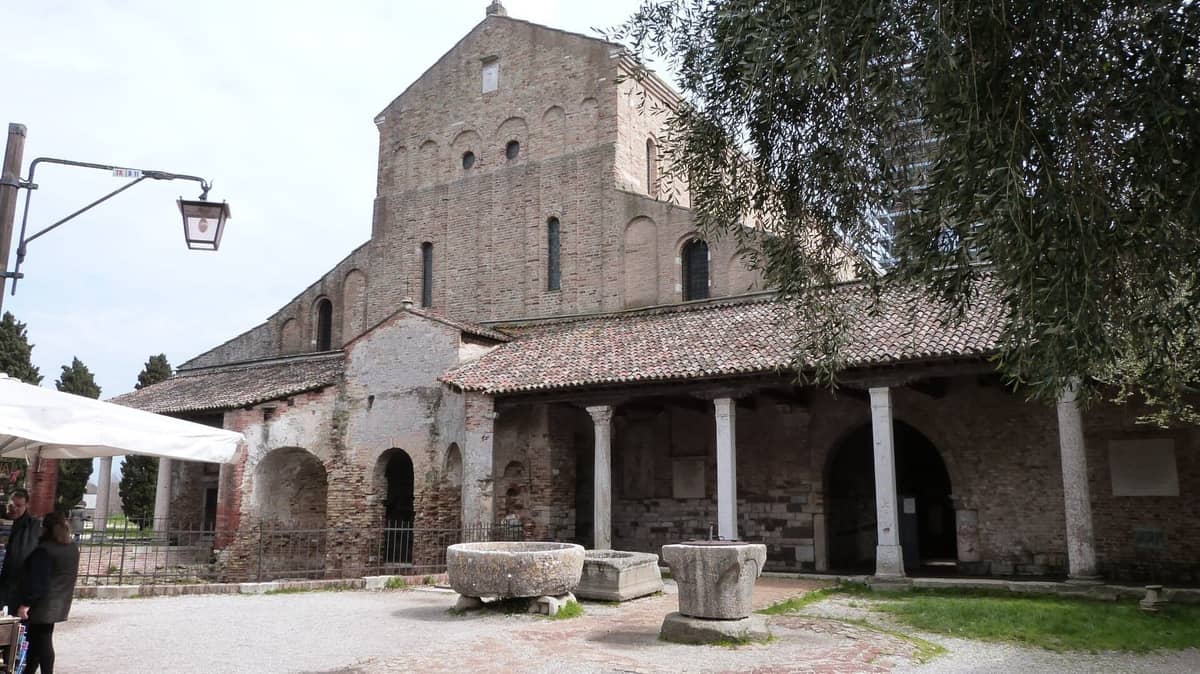
The cathedral's exterior is understated to the point of severity: plain brick, small arched windows, a long nave form that predates Romanesque conventions. The campanile beside it, which can be climbed for lagoon views, is one of the few vertical landmarks visible from the surrounding water. None of this prepares you for the interior.
The Basilica di Santa Maria Assunta is a pivotal example of Veneto-Byzantine architecture, drawing on late Paleochristian traditions while incorporating the gold-ground mosaic technique associated with Byzantine imperial workshops. The nave is divided by columns of Greek marble with carved Corinthian-style capitals. The floor is inlaid with geometric patterns in marble. The stone itself has a warmth and age that no photograph accurately represents: surfaces worn smooth by centuries of use, mortar lines that have shifted and settled across thirteen hundred years.
The western wall carries the cathedral's most overwhelming artwork: a massive Last Judgment mosaic covering almost the entire surface. It is organized in horizontal registers, reading from the Crucifixion and Descent into Hell at the top down through Paradise, Purgatory, and Hell at the base. The detail in the lower registers, depicting the damned in scenes of graphic torment, has a directness that Renaissance painting would later refine into something more theatrical. Here it feels blunt and sincere. The gold tesserae catch and scatter whatever light enters from the nave windows, and in morning hours, when the sun is still low and the interior is quiet, the effect is genuinely arresting.
At the opposite end, the apse holds a gold mosaic of the Madonna and Child in a style that reads as far more serene: a solitary figure against an unbroken gold ground, with the Apostles arranged below in a row. The visual contrast between the crowded horror of the west wall and the austere calm of the apse is not accidental. Walking the nave between them is a complete theological argument rendered in glass and gold.
💡 Local tip
For photography, the apse mosaic of the Madonna photographs well in natural light during the first hour after opening. The Last Judgment wall requires a wide lens or a panoramic stitch; it is too large to capture in a single frame from the nave floor.
Historical Context: Torcello Before Venice
Understanding the cathedral requires understanding why Torcello existed at all. When the cathedral was founded in 639 AD, the mainland cities of the Veneto were under Lombard pressure, and populations fled into the lagoon islands for safety. Torcello became a significant settlement, possibly the most important in the early lagoon, before silting, malaria, and the eventual rise of the Rialto area shifted population toward what would become the historic centre of Venice. The Diocese of Torcello, of which this cathedral was the seat, preceded the Diocese of Venice. For more on the broader lagoon island history, the Venice lagoon islands guide covers the full context of Torcello, Murano, and the outer islands.
The building was modified and expanded over subsequent centuries, with the current main structure reflecting works from the 9th and 11th centuries. The mosaics span multiple periods; some sections date to the 11th and 12th centuries, while others were restored or partially reconstructed in the 19th century. The chair of Attila at the entrance piazza, a stone seat of uncertain origin and function, is a popular stopping point with a far murkier history than local legend suggests. There is no credible evidence it was actually used by Attila the Hun; it was more likely a seat of civic or ecclesiastical authority.
How the Visit Feels at Different Times of Day
At opening, Torcello has a stillness that is almost total. The reed beds surrounding the island rustle with wind and bird calls; herons are frequently visible in the shallows. The cathedral interior smells of old stone, beeswax candles, and the faint mineral trace of the lagoon air that permeates everything in the northern islands. There are usually no more than a handful of other visitors in the first hour, and the audio guide or simple quiet attention to the mosaics is possible without distraction.
By midday the dynamic changes. Torcello appears on many half-day excursion itineraries as a pairing with Burano, and tour groups tend to arrive between 11:00 and 13:00. The nave is not large, and thirty people in it is enough to change the acoustic character and the light conditions. If your schedule is flexible, arriving at opening or after 14:30 gives a noticeably different quality of visit.
In winter, the island has a particular atmosphere that summer visitors miss entirely. The lagoon mist sometimes sits low over the reed beds in the early morning. The reduced hours (closing at 17:00 from November through February) mean the visit is shorter, but the absence of summer crowds and the low winter light on the gold mosaics make a strong case for the off-season trip.
Practical Information for Your Visit
Opening hours vary by season. From 1 March to 31 October, the basilica opens at 10:30 with last admission at 17:30 and closing at 18:00. From 1 November to the end of February, opening is at 10:00, last admission at 16:30, and closing at 17:00. The cathedral is closed on 25 December and 1 January. Full admission is €6.00 and reduced admission is €5.00 (verify current pricing before visiting, as these are subject to change). Group bookings at a discounted rate can be arranged by email through the Patriarchate of Venice.
Dress code follows standard Italian church requirements: covered shoulders and knees are expected. This applies regardless of temperature, so carry a light layer even in summer. The adjacent church of Santa Fosca, a well-preserved Byzantine rotunda from the 11th century, is included in the same visit and is worth twenty minutes of your time. The small Museo di Torcello on the piazza charges a separate admission and holds archaeological finds from the island's history. Combined visits to the basilica and museum are possible. For visitors planning a longer day in the northern lagoon, Burano island is the natural pairing, followed by a return to Venice in the late afternoon.
Accessibility information for visitors with reduced mobility is not detailed in publicly available sources. The canal path from the vaporetto stop to the piazza is mostly flat but includes some uneven paving. Contact the Patriarchate of Venice directly at +39 041 8877441 or turismo@patriarcatovenezia.it before your visit if you have specific requirements.
ℹ️ Good to know
There are two restaurants on Torcello, both near the piazza. They are significantly more expensive than equivalent options in Venice and rely on captive trade. Bring water and a snack from Venice if cost is a consideration, or treat lunch here as a deliberate splurge in an unusually quiet setting.
Who Should Skip This Attraction
Torcello Cathedral is not for everyone. If you have limited time in Venice and are weighing this against the Doge's Palace, the Doge's Palace or the Basilica di San Marco will deliver more concentrated visual spectacle per hour. The round trip to Torcello is a half-day commitment, and the island itself offers almost nothing beyond the cathedral complex and the surrounding landscape. Visitors primarily interested in shopping, nightlife, or a packed itinerary of Renaissance painting should prioritize their time elsewhere.
Families with very young children may find the journey and the quiet island less engaging for the children than options closer to the city centre. The Venice with kids guide offers better-matched alternatives for that context. But for anyone with a serious interest in early medieval art, Byzantine architecture, or the pre-Venetian history of the lagoon, this cathedral belongs near the top of any itinerary.
Insider Tips
- The campanile (bell tower) beside the cathedral can be climbed and offers a sweeping view over the flat northern lagoon, the reed beds, and the distant Dolomites on clear days. It is worth the extra few euros and the narrow staircase.
- If you arrive on a weekday rather than a weekend, the island is noticeably quieter. Saturday and Sunday morning trips from Venice often fill the Line 12 vaporetto; book your return time loosely so you are not racing for the last boat.
- The stone chair in the piazza known as the Throne of Attila is a useful meeting point, but do not let the folklore distract you from actually reading about the island's real history inside the small Museo di Torcello, which explains the settlement pattern clearly with physical artefacts.
- Binoculars are useful inside the cathedral. The upper registers of the Last Judgment mosaic and the details of the apse frieze showing the Apostles are difficult to read with the naked eye from the nave floor, particularly in low winter light.
- The Line 9 shuttle from Burano to Torcello runs roughly every 30 minutes but schedules can shift seasonally. Check current ACTV timetables before your visit rather than assuming a fixed interval, especially if you have an onward connection to make.
Who Is Basilica di Santa Maria Assunta, Torcello For?
- Visitors with a serious interest in Byzantine art and early medieval Christian architecture
- Travellers who have already seen central Venice's major monuments and want depth over spectacle
- Photography enthusiasts seeking gold mosaic interiors without the crowds of San Marco
- Anyone who wants to understand the pre-Venetian history of the lagoon in a physical, unhurried setting
- Off-season travellers in autumn or winter who will find the combination of mist, quiet, and ancient mosaics genuinely moving
Nearby Attractions
Combine your visit with:
- Burano Island
Eight to nine kilometers north of Venice, Burano Island is a compact, flat island of roughly 21 hectares where fishermen's houses are painted in saturated reds, yellows, and blues. It has a legitimate history in lace-making stretching back to the 16th century, and the 40-minute vaporetto ride across the lagoon is part of the experience.
- Chiesa del Redentore
Built in 1577 as a vow to God after a devastating plague, the Chiesa del Santissimo Redentore is Andrea Palladio's finest church in Venice. Standing on the island of Giudecca across the canal from Dorsoduro, it rewards visitors with serene interiors, important Renaissance paintings, and one of the most dramatic facades in Italian architecture.
- Chioggia
Chioggia is an ancient fishing town at the southern entrance of the Venetian Lagoon, built on a cluster of small islands linked by bridges and crossed by canals. Unlike Venice, it functions as a living, working community, and that distinction shapes everything about a visit.
- Giudecca Island
Giudecca Island sits just minutes from the heart of Venice yet feels like a different city entirely. Flat, walkable, and free to explore, it rewards visitors with Palladian architecture, waterfront promenades, and a glimpse of how Venetians actually live.