Lace Museum Burano (Museo del Merletto): The Complete Visitor's Guide
The Museo del Merletto on Burano island preserves one of Venice's most painstaking craft traditions: needle lace so fine it was once compared to frozen breath. Housed in the former Burano Lace School, this small but authoritative museum rewards patient visitors with extraordinary historical pieces and, sometimes, live demonstrations by the last practitioners of the craft.
Quick Facts
- Location
- Piazza Baldassarre Galuppi 187, Burano island, Venice
- Getting There
- Vaporetto Line 12 from Fondamente Nove to Burano stop; approx. 40–45 min from central Venice
- Time Needed
- 45–90 minutes for the museum; allow a half-day to explore Burano fully
- Cost
- Full €7.00 / Reduced €3.50. Museum Pass covers entry. Children 0–5 free. Verify current rates before visiting.
- Best for
- Craft and textile enthusiasts, art historians, anyone combining a day trip to Burano island
- Official website
- museomerletto.visitmuve.it/en/home
What the Museo del Merletto Actually Is
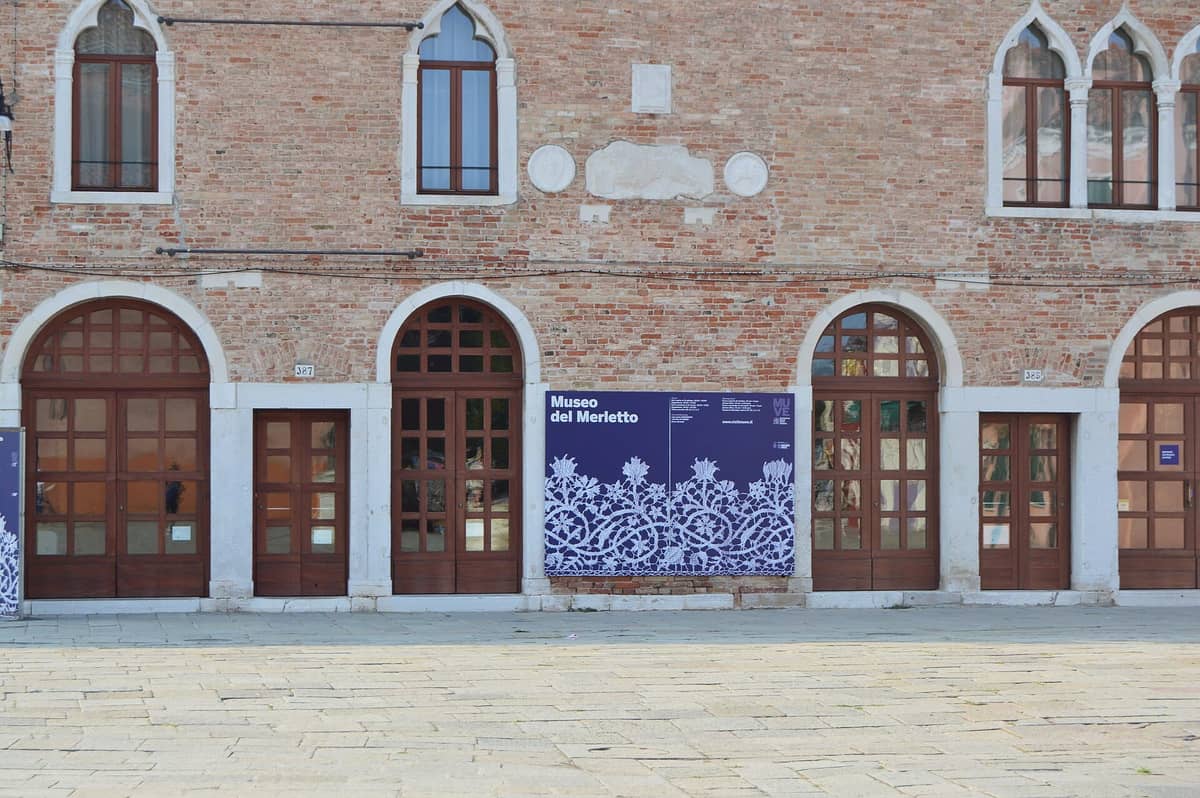
The Lace Museum Burano, officially called the Museo del Merletto, is a civic museum dedicated entirely to Venetian needlepoint lace: its history, its techniques, and its extraordinary survival as a craft tradition. It sits in the Palazzo del Podestà, a stately building on Burano's main square, Piazza Baldassarre Galuppi. The building itself served as the Burano Lace School from 1872 until 1970, and the museum opened formally within those same walls in 1978.
The collection is smaller than many visitors expect, which is not a flaw. The lace preserved here is fragile, centuries-old, and requires close viewing. The museum is designed for careful looking, not quick ticking-off. If you arrive hoping for a large blockbuster collection spread across many rooms, you will leave disappointed. If you arrive genuinely curious about how needlepoint lace was made and why it made Burano famous across Europe for several hundred years, the museum is quietly exceptional.
💡 Local tip
The ticket office closes 30 minutes before the museum closes at 16:00. Arrive by 15:30 at the latest, and earlier if you want unhurried time with the collection. The museum is closed on Mondays and on 25 December, 1 January, and 1 May.
The History Behind the Lace
Burano's association with lacemaking stretches back to at least the 16th century, when Venetian punto in aria (literally 'stitch in air', meaning a needlepoint lace built on no fabric foundation) was among the most coveted luxury goods in Europe. Courts in France, Spain, and England commissioned Venetian lace for collars, cuffs, and altar cloths. At its peak, the craft employed large numbers of women on the island, working in cooperative groups with specialized roles.
By the 19th century, the tradition had nearly collapsed under competition from machine-made lace and changing fashion. In 1872, a formal lace school was established in the palazzo to revive and systematize the craft, deliberately documenting historical patterns and training new generations. That school operated for nearly a century before closing in 1970. The museum's founding in 1978 was an act of cultural preservation: transforming the school's archive and collection into a public institution.
This context matters when you walk through the collection. The pieces on display are not simply decorative objects. They represent moments of rescue: techniques recorded before they could be forgotten, patterns preserved from private collections, and the work of women whose names are largely unremembered.
Tickets & tours
Hand-picked options from our booking partner. Prices are indicative; availability and final rates are confirmed when you complete your booking.
Murano glass and Burano lace experience with prosecco wine
From 50 €Instant confirmationFree cancellationLace Museum entrance ticket
From 0 €Instant confirmationLace Museum entrance ticket
From 0 €Instant confirmationMurano glassblowing and Burano lace-making private boat tour in Venice
From 48 €Instant confirmationFree cancellation
Inside the Museum: What You Will See
The galleries display historical lace pieces spanning several centuries, alongside tools, patterns on paper, and cushions with pins still in mid-work, giving a clear sense of the technical process. The finest pieces are worked in punto in aria, with patterns so densely interlaced that the individual stitches are nearly impossible to distinguish with the naked eye. Magnifying glasses are useful here; some exhibits provide them.
Documentary material traces the history of the lace school and includes photographs of women working in the palazzo during the school's active years. These images ground the collection in lived reality: this was not a genteel hobby but daily skilled labour, carried out in the same building where you are now standing.
On certain days, elderly lacemakers may be present in the museum demonstrating the technique. This is not guaranteed and depends on scheduling, but when it does happen it is the single most compelling thing the museum offers. Watching a needle trace a thread through air to form a structure of mathematical precision is a different experience entirely from reading a label explaining that this was done. Check the museum's official website or enquire on arrival about whether demonstrations are scheduled during your visit.
ℹ️ Good to know
The museum is explicitly accessible for visitors with disabilities, and people with disabilities and one accompanying carer receive free admission. The building is the historic Palazzo del Podestà di Torcello; verify current accessibility arrangements directly with the museum if you have specific requirements.
Getting to Burano: The Journey Matters
Burano is not a short detour. From central Venice, the most direct route is to take vaporetto lines 4.1, 4.2, or 5.2 to Fondamente Nove, then board Line 12 to the Burano stop. The Line 12 crossing through the northern lagoon takes roughly 40 to 45 minutes on its own. From Piazzale Roma or Santa Lucia station, allow at least an hour door-to-door. Plan accordingly: this is a half-day commitment at minimum, and most visitors sensibly make it a full day by pairing the museum with time on the island itself.
Travellers coming from the Lido can take lines 5.1 or 5.2 to Fondamente Nove and change to Line 12. Those planning a broader lagoon circuit might consider combining Burano with nearby Torcello island, which is just a short hop from Burano on Line 9 and contains one of the oldest and most significant Byzantine monuments in the lagoon.
The vaporetto journey through the northern lagoon is itself worthwhile. The view opens out completely: flat water, distant islands, fishing stakes, and the low horizon of the lagoon. It is one of the few moments in Venice where the scale of the lagoon environment becomes physically apparent. Early morning crossings have a particular quality, with low light on the water and the boats less crowded.
⚠️ What to skip
ACTV vaporetto timetables and fares change periodically. Verify current schedules and ticket prices on the official ACTV website before your visit, especially if you plan an early morning or late afternoon crossing.
Timing Your Visit: When to Go and What to Expect
Burano receives significant day-tripper traffic, primarily between 10:00 and 14:00 when tour groups and independent visitors converge. The island's famous painted houses draw photographers who spread across the narrow streets and canals, and the main square can become congested by mid-morning. The museum itself tends to be quieter than the streets outside, partly because the subject requires genuine interest to engage with.
Arriving on the island by 09:30, before the bulk of day-trippers from Venice, gives you the museum in relative peace and the streets in morning light that is noticeably cleaner for photography. The brightly painted facades of Burano read well in direct morning sun. By 15:00 onward, group tours begin thinning out, but you must account for the 16:00 museum closing time.
Spring and early autumn offer the most comfortable conditions for the journey and the island visit. Summer brings heat and humidity on the vaporetto and in the streets. Winter visits are quieter but crossing the open lagoon on a cold, grey day is a specific kind of experience; read about visiting Venice in winter before deciding. The museum closes on Mondays regardless of season.
Burano Beyond the Museum
The museum occupies one corner of a full island experience. The island's food tradition, particularly its butter biscuits called bussolai and local seafood, gives meals here a different register from tourist-facing Venice. The canals are narrow, the houses painted in dense, saturated colours by municipal tradition, and the scale is intimate. If you are building a Venice lagoon islands itinerary, Burano deserves at least three hours of total time, of which the museum occupies one.
Lace sellers operate on the island, ranging from genuine handmade pieces at significant prices to machine-made imports labelled misleadingly. The museum visit is the best preparation for distinguishing between them: once you have seen the tools, the patterns, and the time involved in real needlepoint lace, the pricing of authentic pieces makes immediate sense, and the implausibility of suspiciously cheap alternatives becomes obvious.
Burano's museum also offers useful context if you are visiting the Glass Museum on Murano: both are civic museums within Venice's museum network, both document a lagoon craft tradition that nearly died out, and both can be covered on the same day trip if you plan the vaporetto connections carefully. Line 12 connects Murano to Burano directly.
Practical Details and Photography
The museum is small and the galleries are not always brightly lit, which is deliberate for the preservation of fragile textiles. A macro lens or close-up mode on a phone camera is useful if you want detailed photographs of individual pieces. Ask staff about photography policies on arrival, as these can vary within the collection.
Entry costs €7.00 for a full ticket and €3.50 reduced. Children aged 0 to 5 enter free. If you are visiting multiple civic museums in Venice, the Museum Pass covering the city's civic museum network includes the Lace Museum and may represent better value depending on your itinerary. A combined pass might also cover museums in the San Marco district such as the Museo Correr. Confirm current pass options and pricing on the official visitmuve website before purchasing.
The museum is accessible for visitors with disabilities; one accompanying carer receives free admission alongside a visitor with a disability. Verify any specific requirements directly with the museum if needed, as the building is a historic palazzo and the internal layout may have limitations not captured in general descriptions.
Insider Tips
- Check the museum's official website before visiting to find out whether a live lace demonstration is scheduled. These demonstrations by elderly practitioners are not daily events, but they transform the visit from documentary to visceral.
- If you hold an ICOM card, admission is free. Licensed guides also enter free. Confirm eligibility categories on the official site, as the list of free-admission groups is longer than most visitors realise.
- Combine Burano with Torcello in a single half-day: Line 9 runs between the two islands in under 10 minutes. The Torcello Cathedral's Byzantine mosaics and the Lace Museum make an unexpectedly strong pairing of layered Venetian history.
- Genuine handmade Burano lace costs significantly more than the €10–20 pieces sold at many market stalls on the island. The museum will calibrate your expectations: after seeing the tools and understanding the time involved, you will know immediately when a price is too low to be credible.
- The museum's ticket office closes at 15:30, thirty minutes before the 16:00 closing. Factor this in if you are arriving on the afternoon vaporetto from Venice, which can run slightly behind schedule.
Who Is Lace Museum Burano (Museo del Merletto) For?
- Textile and craft enthusiasts who want to understand the technical history of European needlepoint lace
- Travellers combining a full lagoon islands day trip including Torcello or Murano
- Art historians and design researchers interested in Venetian decorative arts
- Visitors who want a genuine cultural experience on Burano beyond photographing the painted houses
- Families with older children curious about historical craftsmanship; free entry for children under 6 and reduced rates for families
Nearby Attractions
Combine your visit with:
- Burano Island
Eight to nine kilometers north of Venice, Burano Island is a compact, flat island of roughly 21 hectares where fishermen's houses are painted in saturated reds, yellows, and blues. It has a legitimate history in lace-making stretching back to the 16th century, and the 40-minute vaporetto ride across the lagoon is part of the experience.
- Chiesa del Redentore
Built in 1577 as a vow to God after a devastating plague, the Chiesa del Santissimo Redentore is Andrea Palladio's finest church in Venice. Standing on the island of Giudecca across the canal from Dorsoduro, it rewards visitors with serene interiors, important Renaissance paintings, and one of the most dramatic facades in Italian architecture.
- Chioggia
Chioggia is an ancient fishing town at the southern entrance of the Venetian Lagoon, built on a cluster of small islands linked by bridges and crossed by canals. Unlike Venice, it functions as a living, working community, and that distinction shapes everything about a visit.
- Giudecca Island
Giudecca Island sits just minutes from the heart of Venice yet feels like a different city entirely. Flat, walkable, and free to explore, it rewards visitors with Palladian architecture, waterfront promenades, and a glimpse of how Venetians actually live.