Boston Athenæum: Inside One of America's Most Storied Libraries
Founded in 1807 and housed in a landmark 1847 building at 10½ Beacon Street, the Boston Athenæum is part library, part art gallery, and part time capsule. Open to the public for a modest admission fee, it offers a rare glimpse into the intellectual life that shaped New England.
Quick Facts
- Location
- 10½ Beacon Street, Beacon Hill, Boston, MA 02108
- Getting There
- Park Street Station (Red/Green Line, ~3 min walk) or Downtown Crossing (~4 min walk)
- Time Needed
- 1 to 2 hours for a comfortable visit; longer if you use the reading rooms
- Cost
- Adults $11, Students/Military $8, Children ages 13 and under $5 (with adult), Card to Culture $2, Members free (verify before visiting)
- Best for
- History enthusiasts, architecture lovers, slow travelers, and anyone who finds beauty in old books
- Official website
- bostonathenaeum.org
What the Boston Athenæum Actually Is
The Boston Athenæum is not a public library in the municipal sense, and it is not a museum in the conventional sense either. Founded in 1807 by the Anthology Club of Boston, it is one of the oldest independent membership libraries in the United States, a private institution that has always maintained selective public access. Scholars, writers, and Boston's intellectual class have been reading here for more than two centuries.
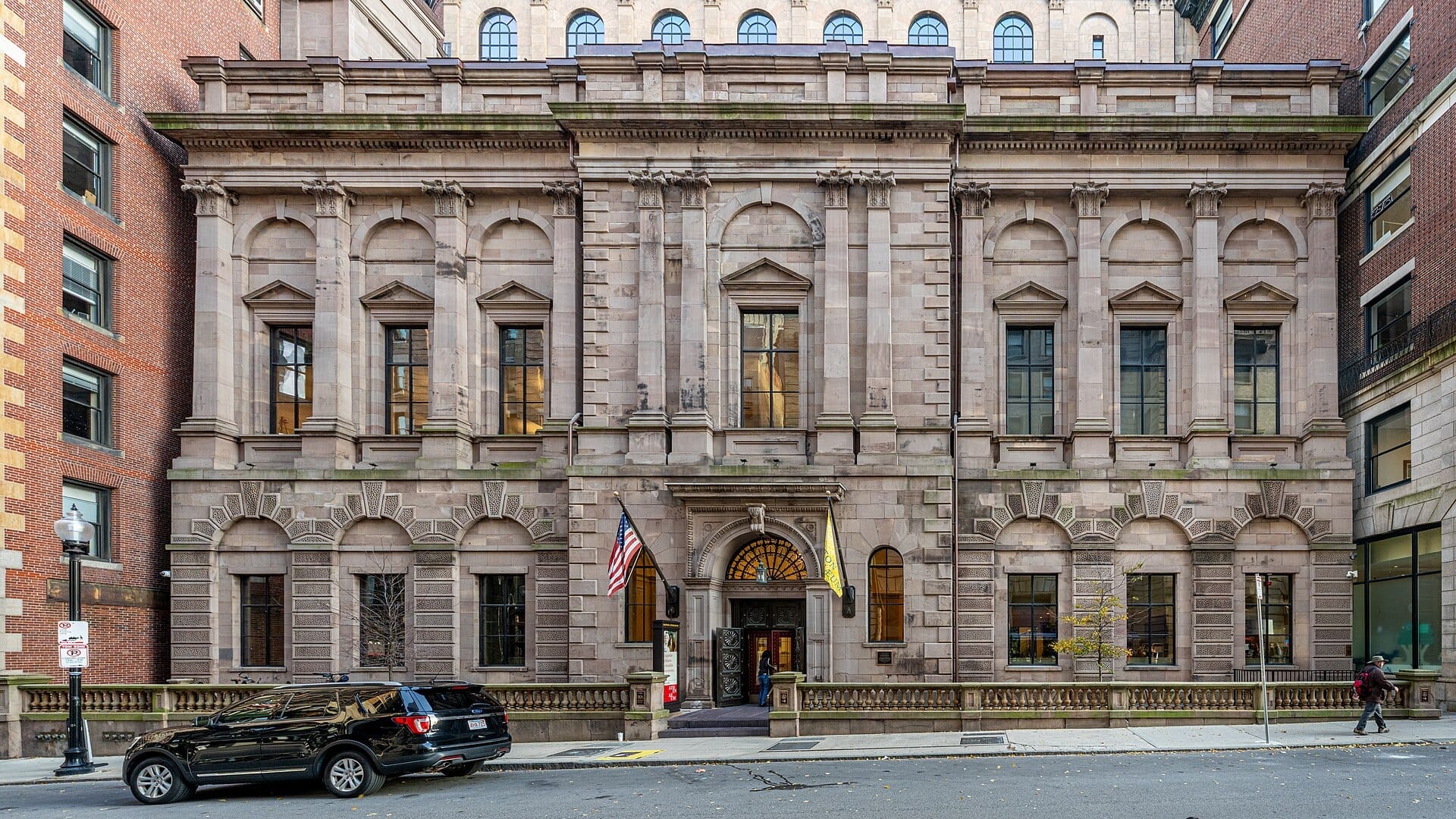
The current building at 10½ Beacon Street was completed in 1847 and is now listed on the National Register of Historic Places. Its Italianate facade, with arched windows and a restrained stone exterior, sits unobtrusively on a stretch of Beacon Street that most pedestrians walk past without a second glance. That anonymity is somewhat intentional. The Athenæum has never needed to advertise itself.
It holds more than half a million volumes, along with rare manuscripts, maps, prints, and art. Rotating exhibitions on the gallery floors draw from both the permanent collection and outside loans. If you are building a fuller picture of Boston's cultural institutions, the Museum of Fine Arts and the Isabella Stewart Gardner Museum offer complementary but very different experiences.
Stepping Inside: The Sensory Experience
The entry process is quiet and deliberate. A small fee is collected at the front desk, and visitors are given a brief orientation. The building does not announce itself with a grand atrium. Instead, you step into a relatively compact ground floor and are left to move upward at your own pace.
The smell is the first thing many people notice: old paper, wood polish, and a faint trace of dust that is not unpleasant. The reading rooms are lit by tall windows that face south toward the Granary Burying Ground, and in the mornings the light falls across wooden reading tables in long, angled bars. The silence is enforced by the building's atmosphere as much as any posted rule. People speak quietly here, if at all.
The fifth floor is perhaps the most memorable. The top-floor reading room, with its coffered ceiling and balcony overlooking the stacks below, has a cathedral-like quality that photographs do not fully capture. In the afternoon, when the light shifts and the room empties slightly, it becomes one of the more atmospheric spaces in Boston.
💡 Local tip
Morning visits, especially on weekdays, offer the quietest experience. By midday the reading rooms fill with members and researchers. If you want the fifth-floor gallery to yourself, arrive shortly after opening.
Tickets & tours
Hand-picked options from our booking partner. Prices are indicative; availability and final rates are confirmed when you complete your booking.
Boston Summer Night Trolley Tour and River Cruise
From 27 €Instant confirmationFree cancellationLEGOLAND Discovery Center Boston tickets
From 26 €Instant confirmationFree cancellationGhosts and Gravestones tour of Boston
From 39 €Instant confirmationFree cancellationBest of Boston tour
From 182 €Instant confirmationFree cancellation
History and Architectural Context
The Anthology Club that founded the Athenæum in 1807 was a group of Boston intellectuals who also published The Monthly Anthology and Boston Review, an early American literary journal. The institution they created was modeled loosely on the literary and philosophical societies of Britain, intended as a private club for the serious accumulation and sharing of knowledge. Early members included John Quincy Adams, Daniel Webster, and Ralph Waldo Emerson.
The 1847 building was designed by Edward Clarke Cabot in collaboration with George Minot Dexter, whose competition-winning proposal drew on Italian Renaissance palazzo architecture. The facade's five arched bays with keystoned windows, the rusticated stonework on the lower floors, and the delicate ironwork on the entry steps are all worth examining closely before you go inside. Cabot was not yet thirty years old when he won the commission.
The Athenæum sits directly adjacent to the Granary Burying Ground, one of Boston's oldest cemeteries, and is less than a two-minute walk from the Massachusetts State House. The institutional density of this short stretch of Beacon Street reflects how deliberately Beacon Hill was built as the seat of civic and intellectual life in early Boston.
What to See on Each Floor
The ground floor houses the gallery spaces, which change several times a year. Past exhibitions have drawn on the Athenæum's own substantial art holdings, which include paintings, sculptures, and works on paper accumulated since the early nineteenth century. The quality and subject matter vary by show, but the curatorial lens is consistently oriented toward American and New England history and culture.
The upper floors contain the stacks and the main reading rooms. Non-members can access the reading rooms on a visitor basis and are welcome to sit, read materials available in the open stacks, and observe. The fifth-floor room, accessed via a small elevator or a narrow staircase, is the architectural highlight. The balcony rail overlooking the lower level is original ironwork.
The Special Collections department holds rare books, manuscripts, and archival materials. Research access is available by appointment and does not require membership, which is worth knowing if you have a specific scholarly interest. The collection includes notable holdings related to the Civil War, New England history, and early American printing.
ℹ️ Good to know
Photography for personal, non-commercial use is generally permitted in the public areas. Flash and tripods are not allowed. Always confirm with staff on arrival, as policies for specific galleries or collections may differ.
Practical Walkthrough: Getting There and Getting In
The Athenæum is located at 10½ Beacon Street, a notation that reflects its positioning between two numbered buildings. The entrance is easy to miss from the street: look for the stone facade with five arched windows and a modest entry with iron railings. There is no large sign.
The closest MBTA stop is Park Street Station, served by both the Red Line and Green Line, roughly a three-minute walk. From the station, walk west along Beacon Street with the Boston Common on your left. The Athenæum appears on your right before you reach the State House. Downtown Crossing Station is a slightly longer four-minute walk. There is no dedicated parking; nearby options are metered street parking and paid garages, and street spaces fill quickly on weekdays.
Opening hours for public visitors are currently Tuesday through Saturday 9:00 am to 5:30 pm, with the building closed to the public on Sundays and Mondays; hours may vary by department and should always be confirmed on the official website before visiting. Hours have been listed inconsistently across third-party sources, so confirm on the official website before visiting, particularly for Sundays.
Admission for visitors ages 14 and up is $11, with discounts available for students, educators, and military with valid ID ($8). Children ages 13 and under pay $5 when accompanied by an adult; Card to Culture participants pay $2, and NARM and ROAM members enter free with proof of membership. All prices should be verified before visiting as they are subject to change.
Accessibility and Who Should Manage Expectations
The building is a National Historic Landmark dating to 1847, which means certain architectural features cannot be easily modified. Visitors with mobility limitations should contact the Athenæum directly before visiting to confirm current elevator access and any constraints within specific gallery spaces. Staff have historically been helpful in accommodating visitors with specific needs, but the building's age does create physical limits.
Visitors hoping for a lively, interactive experience will likely find the Athenæum underwhelming. There are no audio guides, no touchscreen installations, and no children's programming during standard visiting hours. The institution rewards curiosity and patience. If you are traveling with young children or have limited time in Boston, your hours are probably better spent elsewhere.
That said, for travelers with a genuine interest in American intellectual history or the architecture of nineteenth-century Boston, this is exactly the kind of place that does not appear in most itineraries. For a broader look at Boston's history and how this period shaped the city, the Boston history guide provides useful context.
Insider Tips
- The fifth-floor reading room is the architectural centerpiece, but many visitors turn back at the second or third floor without realizing it exists. Take the elevator or the stairs all the way to the top.
- The Athenæum's windows on the upper floors look directly onto the Granary Burying Ground. Bring binoculars if you want to read the inscriptions on the older headstones without walking down to the cemetery.
- Temporary gallery exhibitions are often free for members but included in the general admission price for visitors. Check the current exhibition calendar on the official website before your visit, as quality and relevance to your interests will vary.
- Weekday afternoons between 2:00 pm and 4:00 pm tend to draw the most members using the reading rooms. If you want a quieter, more contemplative visit, Saturday mornings shortly after 9:00 am are typically the least crowded paid-visitor window.
- The Athenæum is a short walk from both the Freedom Trail and the Black Heritage Trail. Combining a visit here with a walk along either route makes for a coherent half-day in Beacon Hill.
Who Is Boston Athenæum For?
- Travelers with a strong interest in American literary and intellectual history
- Architecture enthusiasts drawn to nineteenth-century Italianate design
- Solo travelers who appreciate quiet, unhurried spaces
- Researchers or academics with an interest in New England or Civil War history
- Visitors who have already done the major Boston attractions and want something less trafficked
Nearby Attractions
Other things to see while in Beacon Hill:
- Acorn Street
Acorn Street is a short, private cobblestone lane in Beacon Hill that packs more visual history into half a block than most cities manage in an entire district. Developed in the 1820s and lined with Federal-style brick row houses, it offers a rare, unaltered glimpse of 19th-century Boston streetscape. Entry is free, but the experience depends entirely on when you arrive.
- Black Heritage Trail
The Black Heritage Trail is an approximately 1.5-mile National Park Service walking route through Beacon Hill that connects 14 sites tied to Boston's free Black community in the 1800s. Free to walk anytime, with ranger-guided tours available May through September, it offers one of the most historically substantive walks in the city.
- Massachusetts State House
Perched at the crown of Beacon Hill, the Massachusetts State House is one of America's finest examples of Federal architecture. Designed by Charles Bulfinch and opened in 1798, it remains the working seat of Massachusetts government and offers free guided tours on weekdays.
- Museum of African American History
Occupying two landmark buildings on Beacon Hill, the Museum of African American History preserves the stories of Black Bostonians through the African Meeting House, built in 1806, and the Abiel Smith School, opened in 1835. Together they form one of the most historically significant cultural sites in New England.