Acorn Street: Boston's Most Photographed Cobblestone Lane
Acorn Street is a short, private cobblestone lane in Beacon Hill that packs more visual history into half a block than most cities manage in an entire district. Developed in the 1820s and lined with Federal-style brick row houses, it offers a rare, unaltered glimpse of 19th-century Boston streetscape. Entry is free, but the experience depends entirely on when you arrive.
Quick Facts
- Location
- Acorn Street, off West Cedar Street, Beacon Hill, Boston, MA
- Getting There
- Charles/MGH (Red Line, ~6 min walk) or Park Street (Red & Green Lines, ~7 min walk)
- Time Needed
- 15–30 minutes on the street; allow 1–2 hours to explore surrounding Beacon Hill
- Cost
- Free (no tickets or admission fees)
- Best for
- History lovers, photographers, architecture enthusiasts, and Boston first-timers
- Official website
- http://www.acornstreetassociation.com
What Acorn Street Actually Is
Acorn Street is not a park, a museum, or a formal attraction. It is a functioning residential private way, roughly one block long, running off West Cedar Street in Boston's Beacon Hill neighborhood. The houses are occupied. The cobblestones are old. And on most days, someone is trying to photograph it.
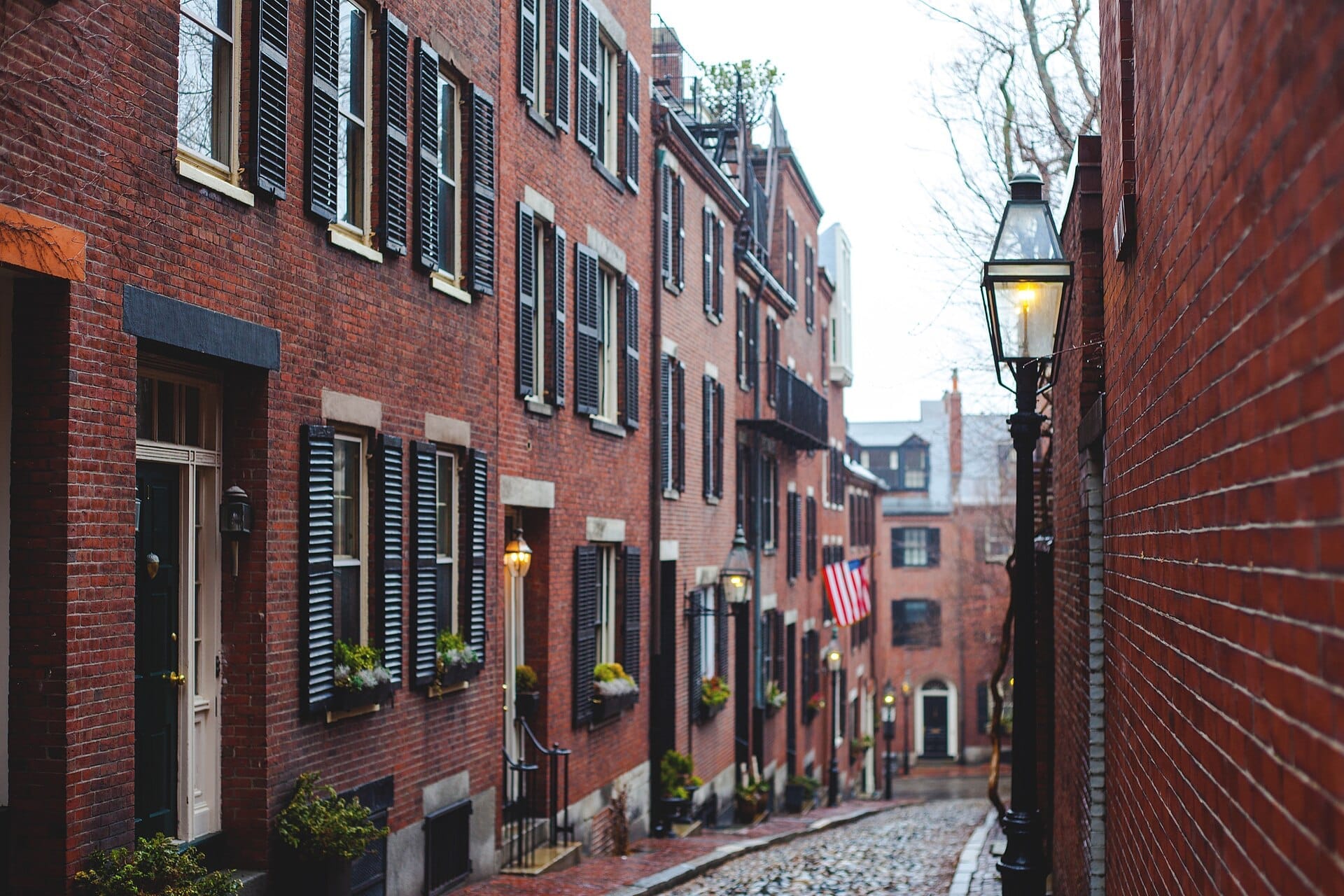
The street was laid out and developed in the 1820s under the name Kitchen Street, a telling detail that explains its original social purpose: the narrow lane housed cooks, coachmen, and domestic workers who served the wealthy families living on adjacent Chestnut and Mount Vernon Streets. The Federal-style brick row houses that line both sides are small and tightly spaced, built for function rather than grandeur. What survives today is the complete picture: original cobblestone pavement, iron boot scrapers by front doors, window boxes, and gas-style lanterns overhead.
Acorn Street sits near the heart of Beacon Hill, one of Boston's oldest and best-preserved neighborhoods. Walking here connects naturally to the broader story of the city's 19th-century development, which you can trace along the Freedom Trail a few blocks away.
💡 Local tip
Arrive before 8 AM on weekdays or before 7:30 AM on weekends to have the street nearly to yourself. By mid-morning, tour groups and individual visitors create a near-constant stream that makes quiet photography difficult and disrupts residents.
The Experience: What You See, Hear, and Feel
The cobblestones underfoot are the first thing you notice physically. They are uneven, rounded granite sets laid in the 19th century, and they shift slightly under your weight in places. The sound of footsteps changes here compared to the smooth sidewalks of nearby Charles Street: a duller, more irregular contact. In wet weather, the stones take on a dark, reflective quality that makes the lane look almost theatrical.
The street is narrow enough that two people walking side by side barely leave room for another pair coming the opposite direction. The brick facades on both sides are close enough to touch from the center. Window boxes with seasonal plantings sit at eye level. On quiet mornings in spring and fall, you can hear birds in the small trees at either end of the lane, and occasionally the sound of a window opening above you from one of the residences.
In summer, the street fills with visitors from roughly 9 AM onward and stays crowded through late afternoon. In winter, particularly after a light snowfall, the atmosphere shifts entirely: the cobblestones disappear under white, the brick goes darker red against the grey sky, and the lane looks closer to its 1820s origins than at any other time of year. Winter visits require good footwear, as the uneven stones become slippery when icy.
⚠️ What to skip
This is an active residential street. Residents live here year-round and have asked visitors repeatedly to keep noise down, avoid blocking doorways, and move through without lingering at private entrances. The Acorn Street Association monitors visitor behavior. Treat it as you would any occupied neighborhood block.
Tickets & tours
Hand-picked options from our booking partner. Prices are indicative; availability and final rates are confirmed when you complete your booking.
Boston Summer Night Trolley Tour and River Cruise
From 27 €Instant confirmationFree cancellationLEGOLAND Discovery Center Boston tickets
From 26 €Instant confirmationFree cancellationGhosts and Gravestones tour of Boston
From 39 €Instant confirmationFree cancellationBest of Boston tour
From 182 €Instant confirmationFree cancellation
Historical Context: From Kitchen Street to Postcard Image
When Beacon Hill was developed in earnest in the early 19th century, its upper streets were home to Boston's merchant class and professional elite. The economics of that world required proximity to service workers. Acorn Street, then called Kitchen Street, provided exactly that: modest row houses within walking distance of the grand Federal mansions on Chestnut Street, where household staff could live cheaply while remaining close to their employers.
The Federal architectural style visible on Acorn Street is characterized by restraint rather than decoration. Brick facades, modest cornices, six-over-six windows, and low stoops reflect the building conventions of the 1820s. The lane was never wealthy, which is precisely why it was never substantially altered. The same market forces that prompted constant renovation elsewhere in the city left Acorn Street largely intact. Its survival as a visual artifact of early 19th-century Boston is in large part a consequence of its original modesty.
Beacon Hill as a whole was added to the National Register of Historic Places as part of a broader effort to protect its architectural fabric. For a deeper understanding of how streets like Acorn Street fit into Boston's layered history, the Boston history guide provides useful context on the city's development from colonial settlement through the 19th century.
Photography: How to Actually Get a Good Shot
Acorn Street is reputedly the most photographed street in the United States, a claim that is difficult to verify but easy to believe on a busy Saturday morning when you count ten people pointing cameras in the same direction simultaneously. The challenge is not finding the composition, it is finding the moment when no one else is standing in it.
The classic view looks east from the West Cedar Street end, capturing the cobblestones receding into the lane with brick facades and iron lanterns on both sides. For this shot, the light is best in the early morning when the sun is low and rakes across the uneven cobblestone surface, creating texture and shadow. Overcast days produce flat, even light that works well for architectural detail but removes the depth from the stones themselves.
A less common angle looks west from inside the lane toward West Cedar Street, framing the exit against the contrast of the broader street beyond. Autumn foliage from nearby trees sometimes enters this frame in October, adding color without overwhelming the architectural subject. A wide-angle lens at lower perspective, roughly crouching height, exaggerates the perspective of the cobblestones and gives the lane more apparent length than it actually has.
💡 Local tip
October mornings, particularly weekdays in the first two weeks of the month, combine lower foot traffic, decent leaf color from surrounding streets, and morning light that hits the cobblestones at a useful angle. This is arguably the single best window for photography on Acorn Street.
Getting There and Getting Around Beacon Hill
Acorn Street is most practically reached on foot from two MBTA Red Line stations. Charles/MGH station puts you on Charles Street at the base of Beacon Hill; from there, walk up any of the residential cross streets heading uphill and turn onto West Cedar Street. The walk takes about six minutes at a normal pace. Park Street station on the Red and Green Lines deposits you at the edge of Boston Common; walk west along Beacon Street to the hill's south slope and navigate up through the residential grid. Both approaches take you through streets worth exploring in their own right.
There is essentially no practical car access for visitors. Parking on Beacon Hill is extremely limited and largely residential permit only. Arriving by rideshare is possible, but being dropped on or near Acorn Street itself is not practical given its residential nature. The walk from either T station is short enough that transit is the obvious choice.
Beacon Hill rewards slow walking. After Acorn Street, consider continuing along West Cedar Street to the African Meeting House,Black Heritage Trail, which covers the neighborhood's significant African American history in the 19th century and is one of the less-visited but substantial historical walks in Boston.
How Acorn Street Fits Into a Larger Boston Day
Acorn Street works best as part of a broader Beacon Hill and downtown morning rather than as a standalone destination. The lane itself takes fifteen minutes at most. What makes the visit worthwhile is treating it as an entry point into the neighborhood's grid of Federal-era streets, which includes some of the best-preserved 19th-century residential architecture on the East Coast.
From Acorn Street, the Massachusetts State House is a ten-minute walk up the hill. The Boston Common is a five-minute walk south, providing a natural place to transition from the intimate scale of Beacon Hill to the open green center of the city. The Freedom Trail passes near both and connects the area to the wider historical circuit.
For visitors building a full first day in Boston, the 3-day Boston itinerary positions Beacon Hill and Acorn Street well alongside other key landmarks without requiring backtracking across the city.
ℹ️ Good to know
Accessibility note: The cobblestone surface of Acorn Street is quite difficult to navigate in a wheelchair or with a stroller. The stones are uneven, there are no curb cuts within the lane, and the narrow width restricts maneuvering. Visitors can view the street from either end without stepping onto the cobblestones, which provides a reasonable vantage point for those who find the surface inaccessible.
Insider Tips
- Weekday mornings before 8 AM in spring or fall offer the closest thing to a crowd-free experience. Weekend mornings draw photographers specifically, so they are paradoxically busier than weekday afternoons in terms of people actively standing in the lane.
- Look down as well as at the facades: the original iron boot scrapers mounted beside several front doors are a small but authentic detail from the 19th century, when unpaved streets meant mud was tracked into houses constantly.
- The lane is private, but the brick sidewalks on either end along West Cedar Street are public and offer clean, unobstructed views of the street without technically entering the residential lane itself. This is particularly useful when foot traffic inside the lane is heavy.
- After a light snowfall, arrive within an hour or two before foot traffic turns the cobblestones to slush. The visual transformation is significant and photographs taken in this window look nothing like the standard summer postcard image.
- If you are combining this with a food stop, Charles Street at the base of the hill has several cafes and bakeries that open early. Getting coffee before walking up to Acorn Street for the early morning light is a logical sequence.
Who Is Acorn Street For?
- First-time visitors to Boston wanting to see a genuine piece of 19th-century streetscape
- Architecture photographers looking for the best early-morning light on historic cobblestones
- History-focused travelers connecting Beacon Hill's domestic worker history to the broader story of 19th-century Boston
- Anyone building a walking morning through Beacon Hill, the State House, and Boston Common
- Travelers who appreciate small-scale urban details over large set-piece attractions
Nearby Attractions
Other things to see while in Beacon Hill:
- Black Heritage Trail
The Black Heritage Trail is an approximately 1.5-mile National Park Service walking route through Beacon Hill that connects 14 sites tied to Boston's free Black community in the 1800s. Free to walk anytime, with ranger-guided tours available May through September, it offers one of the most historically substantive walks in the city.
- Boston Athenæum
Founded in 1807 and housed in a landmark 1847 building at 10½ Beacon Street, the Boston Athenæum is part library, part art gallery, and part time capsule. Open to the public for a modest admission fee, it offers a rare glimpse into the intellectual life that shaped New England.
- Massachusetts State House
Perched at the crown of Beacon Hill, the Massachusetts State House is one of America's finest examples of Federal architecture. Designed by Charles Bulfinch and opened in 1798, it remains the working seat of Massachusetts government and offers free guided tours on weekdays.
- Museum of African American History
Occupying two landmark buildings on Beacon Hill, the Museum of African American History preserves the stories of Black Bostonians through the African Meeting House, built in 1806, and the Abiel Smith School, opened in 1835. Together they form one of the most historically significant cultural sites in New England.