Azkuna Zentroa (Alhóndiga): Bilbao's Most Unexpected Building
Once a 1909 municipal wine warehouse, Azkuna Zentroa is now one of Bilbao's most inventive civic spaces. Designed for transformation by Philippe Starck and reopened in 2010, it houses 43 wildly individual columns, a rooftop pool with a glass floor, cinemas, a media library, and a packed cultural programme. Entry to the building is free.
Quick Facts
- Location
- Plaza Arriquibar 4, central Bilbao (Indautxu area)
- Getting There
- Indautxu metro (4 min walk) or Moyua metro (5 min walk)
- Time Needed
- 1–2 hours for a casual visit; longer if using the pool or cinema
- Cost
- Free entry to public areas; paid tickets for pool, cinema, and events
- Best for
- Architecture enthusiasts, design lovers, families, cultural explorers
- Official website
- www.azkunazentroa.eus
What Is Azkuna Zentroa?
Azkuna Zentroa, still widely known by its original name Alhóndiga, is a multidisciplinary civic centre on Plaza Arriquibar in Bilbao's Ensanche district. It contains a sports centre with a rooftop swimming pool, two cinema screens, an auditorium, a media library, co-working spaces, restaurants, and a rotating programme of contemporary exhibitions and performances. That list alone makes it sound like a dozen other urban cultural centres across Europe. The building is not like a dozen other urban cultural centres across Europe.
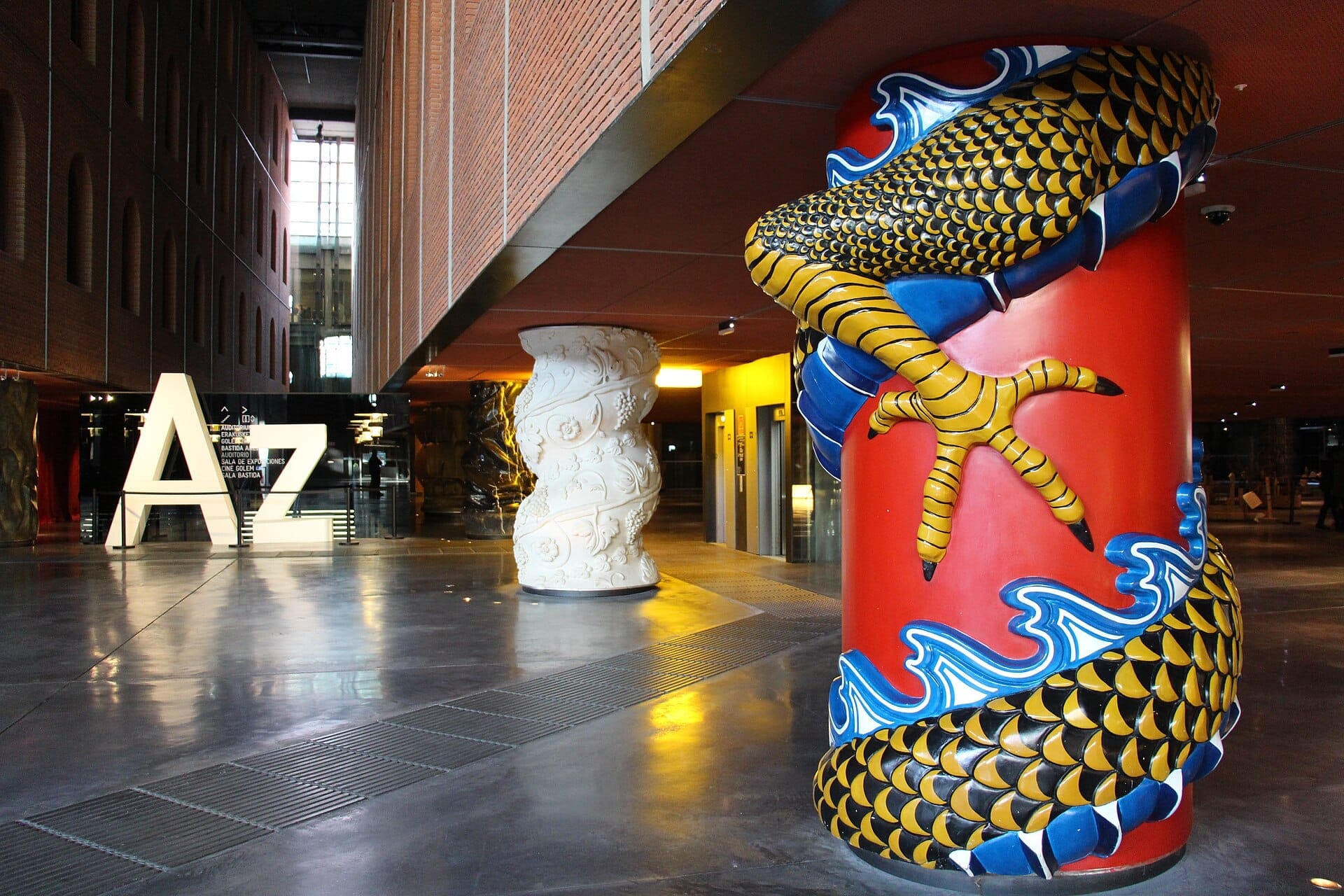
The ground floor atrium stops most first-time visitors in their tracks. Forty-three columns rise from the floor to support the building above, and no two are identical. Each was individually conceived by French designer Philippe Starck, ranging from classical marble shafts to oxidised copper forms to columns clad in what appears to be woven reed or embossed stone. They share nothing except their structural purpose. Walking through the atrium feels less like entering a public building and more like stepping into a curated argument about what architecture can be.
ℹ️ Good to know
Entry to the atrium and public ground-floor areas is completely free, with no reservation required. You can walk in, spend an hour among the columns and cafés, and leave without spending a euro. Activities like the pool, cinema, and fitness centre require separate paid tickets.
From Wine Warehouse to Cultural Icon: The History
The building's origin is more prosaic than its current form suggests. Ricardo Bastida designed the original structure in 1909 as a municipal wine warehouse, known as an alhóndiga, a term for a public commodity exchange or depot. For decades it served that utilitarian role in what was then a thriving industrial port city.
When the warehouse fell out of use, the building spent years in a kind of suspended limbo, recognised as architecturally significant but without a clear future. Bilbao's broader urban renaissance, triggered largely by the 1997 opening of the Guggenheim Museum Bilbao, created both the appetite and the funding for ambitious adaptive reuse projects. The city commissioned Philippe Starck to transform the alhóndiga, and after years of work, it reopened in 2010. A few years later, in 2015, it was officially renamed Azkuna Zentroa, in honour of Iñaki Azkuna, the popular mayor of Bilbao who had championed the project before his death in 2014.
The transformation fits neatly into the story of Bilbao's reinvention from heavy industrial port to design-forward cultural destination. If you want to understand that arc more fully, the Bilbao architecture guide traces it from the 19th-century Ensanche grid through to the contemporary waterfront.
Tickets & tours
Live prices and dates from our booking partner. If you book, we may earn a commission at no extra cost to you.
San Juan de Gaztelugatxe guided tour from Bilbao
From 65 €Instant confirmationFree cancellationSan Sebastian, Hondarribia, Hendaye, and Getaria from Bilbao
From 54 €Instant confirmationFree cancellationGaztelugatxe and Mundaka small group guided tour from Bilbao
From 50 €Instant confirmationFree cancellationBilbao walking tour
From 16 €Instant confirmationFree cancellation
The Columns: Starck's 43-Part Manifesto
The columns are the reason most architecture-minded visitors make the trip, and they reward close attention. Starck worked with scenographer Lorenzo Baraldi to design each one individually. Some reference classical antiquity directly: fluted marble drums, Doric proportions. Others veer into the surreal: columns wrapped in rough jute, columns sheathed in weathered metal that seems to have been salvaged from somewhere industrial, columns whose capitals disappear into abstract geometry.
The effect in person is stranger and more cohesive than photographs suggest. The atrium is large enough that you see many columns at once, and the cumulative impression is not chaotic but oddly harmonious, as if each column has an equally valid claim to occupy the space. Natural light filters in from the roof above, shifting the quality of the stone and metal surfaces throughout the day. Morning visits, when the atrium is quieter and the light rakes in at a lower angle, reveal textures that the flat midday light flattens out.
💡 Local tip
Bring or use your phone camera in portrait mode for individual column details. The contrast between surface textures is much more apparent when you isolate one column from its neighbours. Wide-angle shots of the full atrium work well from the mezzanine level above.
The Rooftop Pool and Sports Facilities
Azkuna Zentroa contains a full sports centre with a gym, squash courts, and a rooftop swimming pool. The pool has become one of Bilbao's minor architectural curiosities for a specific reason: part of its floor is made of glass, and from below, in the atrium, you can look up and watch swimmers suspended above you. The effect is disconcerting in the best possible way.
The sports facilities are primarily used by local members and residents rather than tourists, and that is largely the point. Azkuna Zentroa was never designed as a tourist attraction, even if it functions as one. The pool, gym, and courts require separate paid admission and are subject to their own schedules, which differ from the general centre hours. Check the official website for current pricing and availability before visiting specifically for the pool.
Cinema, Media Library, and Cultural Programme
The centre runs a cinema with two screens that typically programmes independent and arthouse films, often with original-language screenings. It also houses a media library with books, films, music, and digital resources. Both are properly used by Bilbao residents rather than existing purely for visitors, which gives the place a lived-in quality that purpose-built tourist attractions rarely achieve.
The exhibition and events programme shifts constantly. Past programming has included contemporary art exhibitions, dance performances, design retrospectives, and cross-disciplinary festivals. There is no permanent collection to anchor your visit, so the experience varies considerably depending on when you arrive. Checking the programme before you visit is worth the two minutes it takes.
Azkuna Zentroa is located in the Ensanche, Bilbao's 19th-century grid expansion. The wider neighbourhood is one of the city's most walkable, with good cafés, pintxos bars, and the Doña Casilda Park and the Museo de Bellas Artes within easy walking distance. Building a half-day around all three is a logical itinerary.
Visiting in Practice: Hours, Access, and What to Expect
The centre is open Monday to Sunday from 08:00 to 21:00 for general access. Specific facilities like the pool and cinema have their own schedules and should be confirmed on the official site before visiting.
The nearest metro station is Indautxu, about a four-minute walk from the entrance on Plaza Arriquibar. Moyua station is also walkable in roughly five minutes via Calle Elcano or Alameda Recalde. Both stations are on Metro Bilbao lines that connect easily to the Guggenheim area, Casco Viejo, and the main rail hub at Abando.
Getting around the Ensanche and broader city is covered in the guide to getting around Bilbao, including how to use the Barik rechargeable card for discounted fares on the metro and bus network.
Crowd levels vary predictably. Weekday mornings are the quietest time to experience the atrium without school groups or weekend foot traffic. Saturday afternoons bring the most visitors, particularly families. The atrium itself never feels truly overcrowded because the ceiling is very high and the floor plan is generous, but noise levels rise significantly when children are present.
⚠️ What to skip
Azkuna Zentroa does not function as a traditional museum with a permanent collection. If you arrive on a day between major exhibitions, the cultural offering may be limited to the architecture itself, the café spaces, and the media library. Always check the current programme at azkunazentroa.eus before visiting with specific cultural expectations.
Who This Is For, and Who It Is Not
Azkuna Zentroa is most rewarding for visitors with genuine interest in architecture, adaptive reuse, or contemporary design. The columns alone justify the ten-minute detour if you are already in the Ensanche. For that audience, it consistently exceeds expectations.
Visitors looking for a conventional cultural attraction with a clear narrative, a permanent collection, or guided tour options may find the experience underwhelming. The building does not explain itself. There are no informational panels about Starck's design process in the atrium, no audio guide to the columns. You look, and you either find that compelling or you do not.
Travellers focused primarily on Basque art, history, and cultural heritage will likely get more from the Euskal Museoa or the Museo de Bellas Artes de Bilbao than from Azkuna Zentroa. This building is about architecture and civic ambition, not about Basque identity or heritage specifically.
Children generally find the glass pool floor and the variety of column shapes genuinely interesting. The café areas are comfortable and family-friendly. It works well as part of a broader Ensanche afternoon rather than as a standalone full-day destination.
Insider Tips
- Look up from the atrium floor toward the rooftop pool: on days when swimmers are in the water, you can watch them through the glass panel set into the pool's floor. It is one of the stranger visual experiences in any Bilbao building.
- Visit on a weekday morning for the quietest atrium. By 10:00 the café is serving and the light in the columns is at its most nuanced, but the school groups and weekend visitors have not yet arrived.
- The café-restaurant on the ground floor is a legitimate place to eat, not just a tourist-adjacent coffee stop. Prices are reasonable by Bilbao standards and the space, surrounded by columns, is worth lingering in.
- Pick up the printed monthly programme from the AZ Info desk on arrival. It lists all current exhibitions, screenings, and events in a single folded sheet, and it is free. Useful if you want to plan a return visit.
- The mezzanine level offers the best overhead view of the column arrangement. Take the staircase just inside the main entrance and walk along the gallery to appreciate the spatial logic of the atrium from above.
Who Is Azkuna Zentroa (Alhóndiga) For?
- Architecture and design enthusiasts who want to see Philippe Starck's column installation in person
- Travellers combining a broader Ensanche walk with the Museo de Bellas Artes and Doña Casilda Park
- Families looking for a free, stimulating indoor stop that works in any weather
- Arthouse cinema-goers who want to catch a film in a memorable setting
- Visitors curious about Bilbao's urban regeneration story beyond the Guggenheim
Nearby Attractions
Other things to see while in Ensanche:
- Artxanda Funicular & Viewpoint
The Artxanda Funicular has been carrying Bilbao residents up to the hilltop since 1915, covering 770 metres of track in a three-minute trip. At the top, a wide terrace opens up one of the clearest panoramas over the Basque capital and the Nervión estuary. It is straightforward, affordable, and genuinely rewarding on a clear day.
- Parque de Doña Casilda de Iturrizar
Created in 1907 after philanthropist Casilda Iturrizar donated the land to the city, Parque de Doña Casilda Iturrizar is Bilbao's most emblematic green space. Located in the Abando district between Indautxu and the Abandoibarra waterfront, it offers a rare combination of formal garden design, open lawns, and quiet pond paths — all free and open around the clock.
- Museo de Bellas Artes de Bilbao
The Museo de Bellas Artes de Bilbao holds one of Spain's most quietly impressive collections, spanning eight centuries of art from Flemish old masters to Basque modernism. Set inside Parque Doña Casilda, it draws far fewer crowds than the Guggenheim just up the river, which means you can actually stand in front of a painting and think.
Planning a trip? Discover personalized activities with the Nomado app.