Artxanda Funicular & Viewpoint: Bilbao From Above
The Artxanda Funicular has been carrying Bilbao residents up to the hilltop since 1915, covering 770 metres of track in a three-minute trip. At the top, a wide terrace opens up one of the clearest panoramas over the Basque capital and the Nervión estuary. It is straightforward, affordable, and genuinely rewarding on a clear day.
Quick Facts
- Location
- Plaza del Funicular, 48007 Bilbao (lower station); Artxanda summit (upper station)
- Getting There
- Metro Bilbao Line 3, Matiko station (nearest metro; ~5–10 min walk to the lower station)
- Time Needed
- 30–90 minutes total, including the 3-minute ride and time at the viewpoint
- Cost
- €3.50 one-way / €6.00 return (paper ticket); discounted with Barik transit card
- Best for
- City panoramas, families, photographers, afternoon walks
- Official website
- www.bilbaoturismo.net/BilbaoTurismo/en/funicular
What the Artxanda Funicular Actually Is
The Artxanda Funicular (Basque: Artxandako funikularra) is a public transport funicular railway that connects the riverfront area near Zubizuri bridge and Matiko with the summit of Mount Artxanda. Opened in 1915, it was originally built to give city residents access to the cooler, greener hillside above the industrial valley floor. Today it remains part of the integrated Bilbao public transport network, meaning you can use a Barik card to board it just as you would a metro or bus.
The line runs approximately 770 metres at a steep gradient, which is enough that the carriages have a distinctly raked interior. The ride takes about three minutes. The lower station sits at Plaza del Funicular, roughly ten minutes on foot from Bilbao City Hall. The upper station deposits you near the Artxanda hilltop terrace, with the city spread below.
💡 Local tip
If you have a Barik rechargeable transit card, use it — the integrated fare is significantly cheaper than a paper ticket. Cards can be topped up at Metro Bilbao machines across the city.
The Ride Up: Three Minutes, a Clear Gradient, and a Shift in Perspective
The lower station is a modest, functional building. There is no grand entrance ceremony. You queue at the turnstile, tap your card or hand over a ticket, and wait on a small platform for the carriage. Trains depart approximately every 10–15 minutes, with 10-minute frequency during the day and 15 minutes at other times. The carriages themselves are enclosed, with seats that tilt to compensate for the incline, and large windows on both sides. As the car begins to climb, the view behind you opens almost immediately: rooftops, the curve of the Nervión, the glass and titanium of the Guggenheim catching whatever light is available.
The journey is short enough that it never feels like a commitment but long enough that the elevation shift registers physically. There is a slight mechanical hum from the cable system, the smell of the surrounding vegetation through gaps in the doors in warmer months, and the quiet tick of passengers recalibrating their footing on the tilted floor. Children tend to press their faces to the glass. Adults tend to reach for their phones.
Tickets & tours
Hand-picked options from our booking partner. Prices are indicative; availability and final rates are confirmed when you complete your booking.
Visit to the funicular of Artxanda and the Old Town of Bilbao
From 25 €Instant confirmationSan Juan de Gaztelugatxe guided tour from Bilbao
From 65 €Instant confirmationFree cancellationSan Sebastian, Hondarribia, Hendaye, and Getaria from Bilbao
From 54 €Instant confirmationFree cancellationGaztelugatxe and Mundaka small group guided tour from Bilbao
From 50 €Instant confirmationFree cancellation
The Viewpoint: What You Actually See
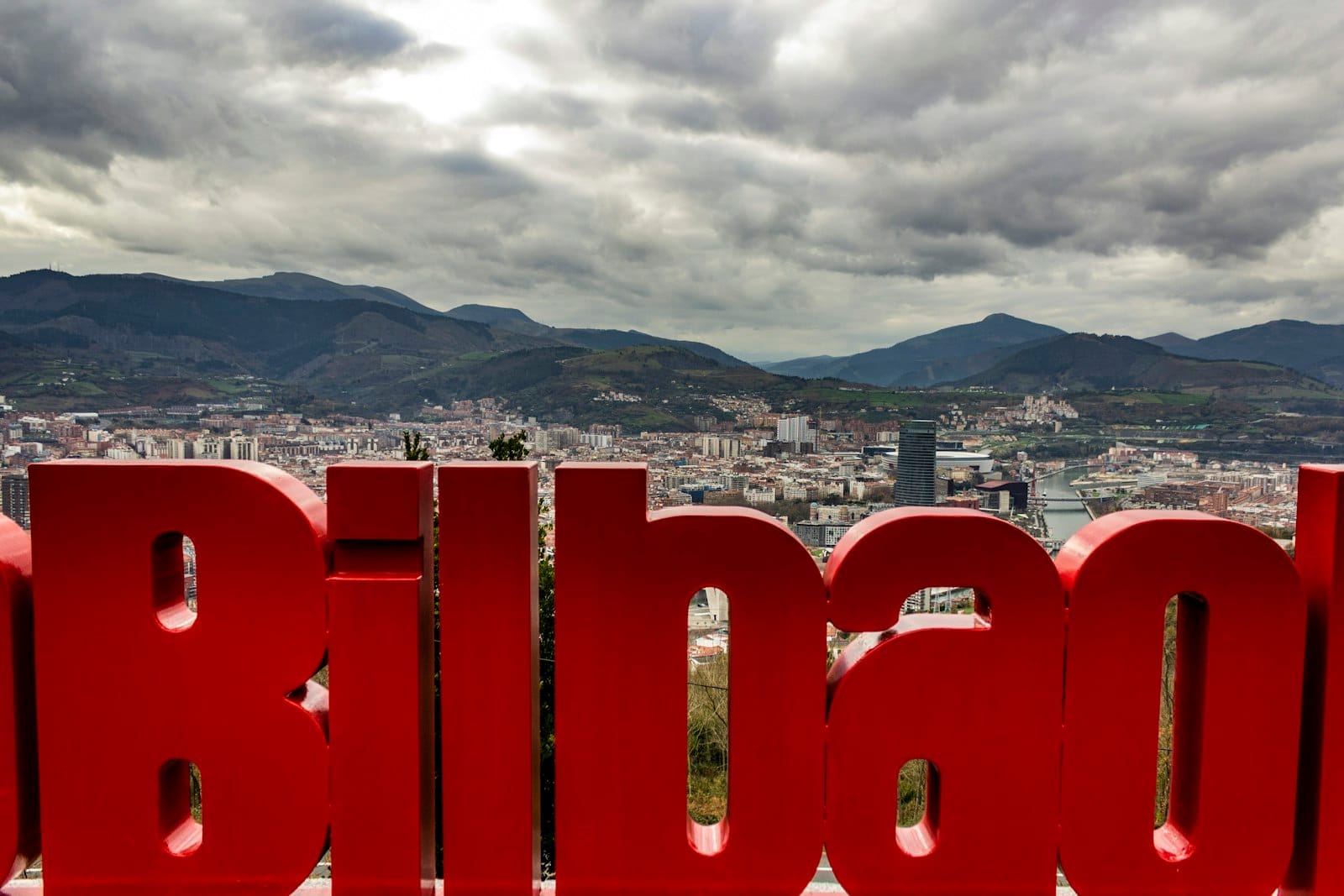
At the top, the main lookout terrace sits just above the upper station. The panorama faces south and southwest across the compact grid of the Ensanche, the older fabric of the Casco Viejo, and the Abandoibarra waterfront where the Guggenheim Museum Bilbao sits in full view. On clear days, you can trace the Nervión estuary as it bends northwest toward the Bay of Biscay. The surrounding hills form a green collar around the city, which helps explain why Bilbao, for all its industrial past, has never felt like a flat, exhausted port town.
The view at midday in summer is bright and comprehensive, useful for orienting yourself geographically. But the most satisfying light arrives in the late afternoon, when the low Atlantic sun catches the tiled rooftops and the titanium panels of the Guggenheim shift from silver to gold. If you plan to photograph the panorama, aim for late afternoon rather than noon. For context on what you are looking at below, a prior walk through the Ensanche district helps considerably.
The summit area is not only a viewpoint. There is a restaurant, a sports complex, a small children's play area, and open grassy space used by locals for picnics and weekend walks. On Sunday mornings in particular, the hilltop takes on an unhurried, neighbourhood quality — dog walkers, families with folding chairs, older residents who have been making this trip for decades. It is a genuinely local space that tourists happen to share, rather than a purpose-built attraction for visitors.
ℹ️ Good to know
Opening hours: Monday–Saturday 07:15–22:00; Sundays and public holidays 08:15–22:00. From 1 June to 30 September, Friday, Saturday and eves of public holidays run to 23:00. Always verify current times with Bilbao Turismo before your visit.
Historical and Urban Context
When the Artxanda Funicular opened in 1915, Bilbao was in the middle of a rapid industrial and demographic expansion. The Nervión estuary had become one of the most productive iron and steel corridors in Europe, and the city's population was growing at a pace that strained the valley floor. The funicular was built partly as practical infrastructure and partly as a leisure corridor, giving workers and their families a way to reach the clean air and open land of the hillside above the smoke.
That combination of utility and recreation is still visible. On weekday mornings, commuters use it. On weekend afternoons, it fills with families heading up for the grass. The funicular's continued integration into the public transport ticketing system — unlike many heritage funiculars elsewhere, which charge premium tourist prices — reflects a persistent attitude in Bilbao toward keeping urban infrastructure genuinely accessible. The same attitude shaped the post-industrial transformation of the waterfront, visible from the hilltop: the Abandoibarra district below was once a working shipyard and is now a cultural and residential zone built around the Guggenheim.
How the Experience Changes by Time of Day
Early morning departures from 07:15 (on most days) to around 09:00 are almost entirely local commuters. The carriage is quiet, purposeful, and gives an unintended but valuable glimpse into ordinary Bilbao. There are no queues at this hour, and the viewpoint at the top is largely empty — useful if you want the panorama without anyone in the frame.
Midday arrivals between roughly 11:00 and 14:00 tend to bring the largest mix of tourists and day-trippers, particularly in summer. The platform at the lower station can develop a queue during peak periods in July and August, though the 15-minute frequency keeps it moving. If you are visiting during the summer festival season, note that Bilbao's Aste Nagusia in August draws significant additional crowds to every attraction in the city.
Late afternoon and early evening, especially from around 17:00 onwards, is when the hilltop feels most alive and the light is most photogenic. Locals come up for a walk before dinner, and the viewpoint has a relaxed, golden-hour energy that is difficult to manufacture elsewhere in the city. In summer, the extended 23:00 closing on Fridays, Saturdays and eves of public holidays allows for night views of the illuminated Ensanche grid below — worth considering if the day has been full.
⚠️ What to skip
Bilbao's oceanic climate means cloud and rain are realistic on any given day. If the hillside is wrapped in low cloud, the panoramic view largely disappears. Check the forecast before making the funicular the centrepiece of your morning. A cloudy ride is still pleasant, but it is not the same experience.
Getting There and Practical Walkthrough
The lower station is at Plaza del Funicular, a short walk northeast of Bilbao City Hall and the Arriaga Theatre. From the Ensanche or Casco Viejo, it is reachable on foot in under fifteen minutes. The nearest metro station is Matiko on Line 3. By Metro Bilbao, get off at Matiko and follow signs on foot; the walk takes roughly five minutes. If you are coming from the Guggenheim area, it is a pleasant 15–20 minute walk through the city centre, or a short metro hop.
At the lower station, there is a small covered waiting area with a ticket window. Paper tickets cost €3.50 one-way or €6.00 return. Paying with a Barik card reduces the fare substantially and avoids any need to handle cash. The Barik card is available at Metro Bilbao stations. Once through the turnstile, you wait on a platform for the next departure. There is no assigned seating. The carriages are comfortable for a 3-minute journey; standing is also fine.
At the top, bear left as you exit the upper station to reach the main terrace and viewpoint. The restaurant is a few minutes further along the hilltop path. The terrain around the summit is mostly flat grass and paved paths, suitable for most fitness levels. Returning is simply a question of walking back to the upper station and boarding the next downward departure.
Travelers with mobility limitations should note that the funicular ride itself is compact and level within the carriage, but specific step-free access details for the stations are not comprehensively documented. Contact Bilbao Turismo directly to confirm accessibility before your visit.
When It Is Worth It, and When It Is Not
The Artxanda Funicular is not a spectacular ride in the way that some alpine or coastal funiculars are. The carriage interior is functional rather than beautiful. The three-minute journey does not give you extended, sweeping views on the way up. What it offers is a quick and inexpensive elevation change that reveals Bilbao's geography in a way that no street-level walk can replicate. For anyone trying to understand how the city relates to its surrounding landscape — the hills, the estuary, the sea beyond — the hilltop view is genuinely clarifying. A good walking tour of Bilbao combined with an afternoon at Artxanda gives a complete physical sense of the city's scale and layout.
Travelers who find hilltop viewpoints generally unengaging, or who have limited time and must choose between this and a major museum, should know that the Artxanda experience is calm and spacious rather than intellectually dense. It does not compete with the Guggenheim or the Euskal Museoa for cultural content. It is an outdoor, atmospheric experience. In poor weather, it can feel like a damp walk with a grey view. In good weather, it is one of the most pleasing hour-long outings Bilbao offers.
Insider Tips
- Take the funicular up and walk down. A hiking path descends from the Artxanda hilltop back to the city in about an hour, passing through green hillside terrain before dropping into the residential streets north of the Ensanche. It is a satisfying way to turn a 15-minute return trip into a half-morning outing.
- Bring something to eat. The hilltop restaurant exists, but the real pleasure on a clear day is buying food or drink at a shop near the lower station and picnicking on the grass at the top. This is exactly what local families do.
- Avoid arriving at 13:00–14:00 on weekends in July and August. This is peak tourist and local-family overlap. The platform queue is manageable but avoidable if you shift your timing to before 11:30 or after 17:00.
- The Barik card saves enough over a few days of public transport use to make it worth buying even for short stays. Load it at any Metro Bilbao machine. You will use it for the metro, buses, tram, and the funicular itself, at current integrated fares.
- Night views in summer are underused. With the last service at 23:00 in June–September, you can ride up after dinner and see the Ensanche grid lit below, and the hilltop is quiet at this hour.
Who Is Artxanda Funicular & Viewpoint For?
- First-time visitors who want a geographic overview of Bilbao before diving into individual neighbourhoods
- Families with children who enjoy the ride itself and the open hilltop space
- Photographers looking for late-afternoon panoramic light over the city and Guggenheim
- Visitors with a half-day gap between major museum visits seeking fresh air and perspective
- Travellers who want to see how Bilbao residents actually use their city, away from tourist circuits
Nearby Attractions
Other things to see while in Ensanche:
- Azkuna Zentroa (Alhóndiga)
Once a 1909 municipal wine warehouse, Azkuna Zentroa is now one of Bilbao's most inventive civic spaces. Designed for transformation by Philippe Starck and reopened in 2010, it houses 43 wildly individual columns, a rooftop pool with a glass floor, cinemas, a media library, and a packed cultural programme. Entry to the building is free.
- Parque de Doña Casilda de Iturrizar
Created in 1907 after philanthropist Casilda Iturrizar donated the land to the city, Parque de Doña Casilda Iturrizar is Bilbao's most emblematic green space. Located in the Abando district between Indautxu and the Abandoibarra waterfront, it offers a rare combination of formal garden design, open lawns, and quiet pond paths — all free and open around the clock.
- Museo de Bellas Artes de Bilbao
The Museo de Bellas Artes de Bilbao holds one of Spain's most quietly impressive collections, spanning eight centuries of art from Flemish old masters to Basque modernism. Set inside Parque Doña Casilda, it draws far fewer crowds than the Guggenheim just up the river, which means you can actually stand in front of a painting and think.