Ayung River: Rafting and nature in Bali's Wildest Jungle Corridor Near Ubud
The Ayung River is Bali's longest river, carving a deep green gorge through the rainforest just west of Ubud. It draws visitors for white-water rafting, riverside resort walks, and some of the most dramatic jungle scenery on the island.
Quick Facts
- Location
- Ayung River Gorge, west of Ubud, Bali
- Getting There
- Private car or scooter to rafting launch points near Sayan or Kedewatan; no direct public transit
- Time Needed
- 2–4 hours for rafting; half-day with transfers
- Cost
- Rafting packages approx. IDR 350,000–700,000 per person depending on operator
- Best for
- Adventure seekers, nature lovers, couples staying at gorge-edge resorts, photographers
What the Ayung River Actually Is
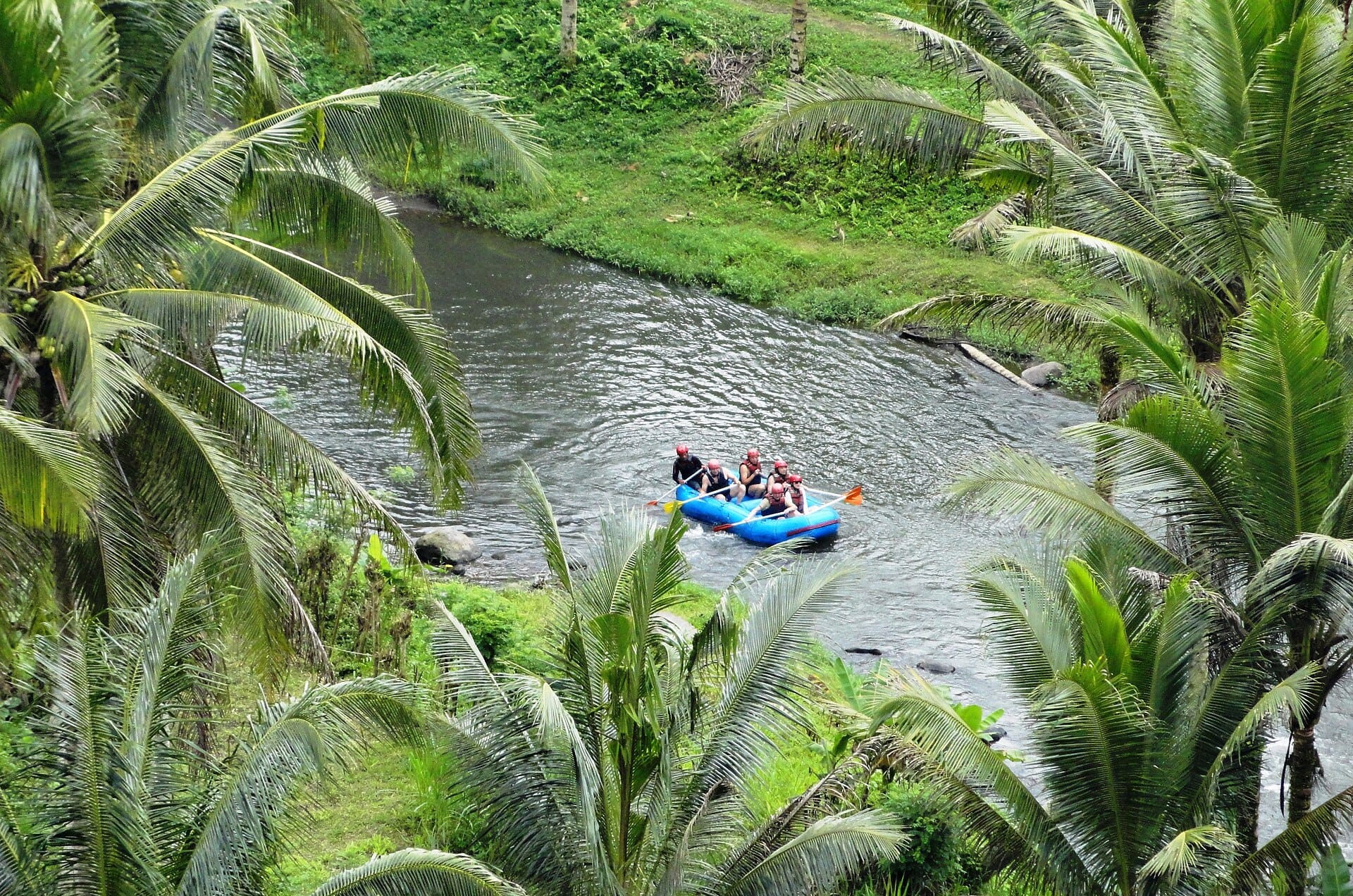
The Ayung River is Bali's longest river, stretching 68.5 kilometres from the volcanic highlands near Mount Batur down through steep jungle gorges before emptying into the sea south of Denpasar. The section that most visitors encounter runs through the Sayan–Kedewatan gorge, just west of Ubud, where the river drops through a series of Class II–III rapids flanked by walls of dense tropical rainforest. This is not wilderness in the remote sense: the gorge is accessible, commercially run, and visited by hundreds of rafters on busy days. But the scenery inside it is genuinely extraordinary.
The river's name appears in Balinese spiritual tradition as well. It is considered a sacred waterway, and the stone carvings along its banks, some depicting Hindu deities and mythological scenes, are not tourist installations. They were carved directly into the rock face, likely during the Majapahit-influenced era of Balinese Hinduism, and they survive because the gorge itself protected them from development. Spotting these carvings mid-rapid is one of the Ayung's defining surprises.
ℹ️ Good to know
The rafting stretch is roughly 9-10 km long, taking 2 to 2.5 hours on the water. The launch point is typically near Tegallalang or Sayan, and the takeout is near Ubud's southern edge, where steps carved into the gorge wall lead back up to the road.
The Rafting Experience: What to Expect on the Water
Ayung River rafting is run by several established operators, including Mason Adventures, Sobek, and Bali Adventure Tours, all of whom provide helmets, life jackets, paddles, and guides. The rapids are graded Class II to III, which means they are energetic and fun but not technically demanding. Children and older travellers with a reasonable fitness level can and do participate. That said, the river does surge considerably after heavy rain, and operators sometimes increase difficulty ratings accordingly.
On the water, the mood shifts quickly. Above the gorge, Ubud sounds like any Balinese town: scooters, roosters, gamelans drifting from temple ceremonies. Below the lip of the gorge, the forest closes in, the temperature drops a few degrees, and the dominant sound is the river itself. Herons stand on midstream rocks. Kingfishers track the current ahead of the raft. The walls rise 50 to 100 metres on both sides, draped in ferns, fig trees, and hanging moss.
The stone carvings appear roughly halfway through the run. They are carved into a protruding cliff face: large bas-relief figures, some over two metres tall, depicting scenes from the Ramayana and local protective spirits. Most operators pause here briefly. Photographing them requires being in a stationary or slow-moving raft while the river tries otherwise, so keep your camera accessible before you approach this section.
💡 Local tip
Bring a dry bag or waterproof phone case. Operators often provide lockers at the starting point, but the river gets into everything. Wear quick-dry clothes and river sandals or old trainers that can get soaked.
Tickets & tours
Live prices and dates from our booking partner. If you book, we may earn a commission at no extra cost to you.
Best Time to Go and How Weather Changes Everything
The Ayung runs year-round, but the experience changes dramatically between dry and wet seasons. From May through October, the river runs clearer and at a more predictable pace. Mornings in this period are particularly good: the light filters down through the gorge canopy in long shafts, the air is cooler, and the rapids feel more playful than forceful.
From November through March, the wet season swells the Ayung considerably. The water turns a murky ochre-brown, the current accelerates, and some operators adjust their routes or temporarily close depending on safety conditions. This is also when the gorge walls are at their most lush, draped in ferns and dripping with recent rain, which appeals to certain photographers. Check conditions with your operator 24 hours before departure. For broader seasonal planning, the best months to visit Bali guide covers rainy season trade-offs in detail.
Early morning departures, usually 8:00–9:00 AM, avoid the midday heat and get you on the water before group tours from Seminyak and Kuta arrive. By 11:00 AM, the river can feel crowded with back-to-back raft groups. If your operator offers an early slot, take it.
The Gorge From Above: Riverside Resorts and Walking Paths
Not everyone wants to raft, and the Ayung gorge rewards those who simply want to look into it. Several of Ubud's most celebrated hotels sit directly on the gorge rim: Alila Ubud, Four Seasons Resort Bali at Sayan, and Komaneka at Bisma all use the gorge as a backdrop in ways that are genuinely spectacular rather than merely scenic. The Four Seasons Sayan, designed by John Heah and completed in 1998, drops down the gorge face in a series of terraces that feel half-sunken into the jungle.
For non-guests who want access, the Campuhan Ridge Walk traces a parallel ridge nearby and gives aerial views of the surrounding gorge landscape without requiring resort access. It is a legitimate alternative for budget travellers who want the visual drama without the price tag of a gorge-side cocktail.
Some operators run guided jungle treks along the gorge rim or down to the river's edge, which gives a slower, quieter perspective than rafting. These treks pass through rice terrace edges, bamboo groves, and small village paths. The sound of the river is constant but muffled from above, like something heard through a wall.
Practical Walkthrough: Booking, Arrival, and the Takeout Climb
Most visitors book rafting through their hotel, through Klook or GetYourGuide, or directly with operators. Prices vary: at the budget end, packages around IDR 350,000 typically include basic equipment and a cold shower facility at the end. Mid-range packages at IDR 550,000–700,000 add hotel transfers, lunch, and better-maintained equipment. Independent booking directly with operators often saves 15–20% over hotel concierge rates.
The starting area typically involves a walk or shuttle down a steep access path to the launch point. At the end of the run, the takeout requires climbing back up to road level, usually via steep concrete or stone steps cut into the gorge wall. This climb takes 10 to 20 minutes and is legitimately tiring. If you have knee problems or limited mobility, it is the part most worth asking about before booking. Some operators have staff who can assist, but the steps themselves cannot be avoided.
⚠️ What to skip
Do not raft alone or with unofficial guides. The Ayung has submerged rocks and hydraulic currents that are not visible from the surface. Stick to licensed operators with safety records and qualified river guides.
Ubud town is roughly 15–20 minutes by car from the main rafting launch points. If you are combining the river with other Ubud activities, consider pairing it with a visit to Tegallalang Rice Terraces in the afternoon, which sits in the same general direction north of town and makes geographical sense as a second stop.
Accessibility, Photography, and Who Should Skip This
Photography on the raft requires either a waterproof camera, a GoPro-style action camera, or accepting that some shots will not happen. The interior of the gorge is shaded for most of the run, which means a phone camera without good low-light performance will produce flat results. The stone carvings section photographs best in a wide angle or moderate zoom; they are large but not close to the centre of the river.
Accessibility is limited by the nature of the terrain. The gorge entry involves uneven paths and steps. Rafting itself requires basic upper-body coordination and the ability to sit on an inflated tube for two-plus hours. Most operators set a minimum age of around 7 years, though this varies. Travellers with serious back or neck conditions, or those in late pregnancy, should check directly with operators before booking.
Travellers who find organised group activities frustrating, who dislike getting wet, or who are primarily interested in cultural immersion may find the river less rewarding than, say, Tirta Empul Temple or a dedicated cooking class in Ubud. The Ayung is fundamentally an outdoor-adventure attraction. It is not overhyped exactly, but it is also not a hidden experience: on any given morning in peak season, dozens of other rafts share the same stretch of water.
Insider Tips
- Book the earliest available departure slot (usually 8:00–8:30 AM) to get ahead of group convoys from Seminyak and Kuta hotels. By 10:30 AM, the river can feel like a queue.
- Ask your operator specifically about the stone carving section before booking. Some cheaper packages rush through this part without stopping, which means you miss one of the gorge's most distinctive features.
- Wear a rash guard or lightweight long-sleeve shirt under your life jacket. The gorge is shaded and can be cooler than expected, and sun protection matters on exposed sections.
- Leave valuables in the lockers at the starting point, not in a dry bag on the raft. Dry bags can and do go overboard during flips, even on Class II water.
- If you are staying in a gorge-rim resort, ask your hotel whether they have a direct trail down to the river's edge. Some properties have private paths that bypass the commercial entry points entirely.
Who Is Ayung River For?
- First-time rafters wanting a scenic, approachable introduction to white water
- Couples combining adventure with the gorge-rim resort experience
- Families with children aged 7 and above looking for a half-day activity
- Photography travellers interested in jungle gorge landscapes and ancient stone carvings
- Travellers spending multiple days in Ubud who want a physical contrast to temple and rice terrace visits
Nearby Attractions
Other things to see while in Ubud:
- Campuhan Ridge Walk
The Campuhan Ridge Walk is a 2-kilometre paved and dirt path tracing a narrow spine above two river valleys, cutting through open grasslands and jungle canopy on the edge of Ubud. It is the closest thing the town has to a proper escape from its own popularity, and it costs nothing to walk.
- Tegallalang Rice Terraces
Tegallalang Rice Terraces is one of Bali's most photographed landscapes, a sweeping cascade of hand-carved paddies north of Ubud shaped by the ancient subak irrigation system. This guide covers what the terraces actually look like up close, when to visit, what it costs, and whether it lives up to its reputation.
- Sacred Monkey Forest Sanctuary
Home to over 1,200 long-tailed macaques and three Hindu temples dating back centuries, the Sacred Monkey Forest Sanctuary is one of Ubud's most photographed and genuinely surprising attractions. It rewards visitors who respect its rules and punishes those who don't.
- Tirta Empul Temple
Tirta Empul Temple in Tampaksiring is where Balinese Hindus have bathed in holy spring water for over a thousand years. The ritual bathing pools, ancient shrines, and mountain air make this one of the most spiritually charged sites on the island. Here is what visiting actually looks like.
- Goa Gajah Elephant Cave
Carved into a hillside near Ubud around the 11th century, Goa Gajah is one of Bali's most significant Hindu archaeological sites. The cave entrance — a gaping stone mouth surrounded by carved demons and foliage — is instantly recognizable, but the full site extends into terraced gardens, bathing fountains, and jungle ravines that most visitors never reach.
- Amed
Amed is a string of fishing villages along Bali's remote northeast coast, known for dramatic black-sand beaches, world-class diving on coral reefs and a WWII Japanese shipwreck, and an unhurried atmosphere that feels like a different island entirely. It rewards travelers willing to make the drive.
- Mount Batur
Mount Batur is an active 1,717-metre volcano in Bali's highland interior, drawing thousands of hikers each year for its pre-dawn ascent and extraordinary crater-rim sunrise. The two-hour climb rewards visitors with sweeping views over Lake Batur, Mount Agung, and, on clear mornings, the distant silhouette of Mount Rinjani on Lombok.
- Sekumpul Waterfall
Sekumpul Waterfall, located in Bali's northern highlands near Singaraja, is widely considered the island's most impressive waterfall system. A steep jungle trek leads to a cluster of seven cascades plunging up to 80 meters into a mist-filled gorge, surrounded by dense tropical forest and the sound of rushing water that you can hear long before you see it.
- Usat Liberty Wreck
The USAT Liberty is a World War II cargo ship resting just off the black-sand shore of Tulamben, on Bali's northeast coast. Lying at depths between 5 and 29 metres, it is one of Southeast Asia's most accessible and rewarding wreck dives, equally suited to beginners snorkelling the shallow superstructure and experienced divers exploring the deep stern.
Planning a trip? Discover personalized activities with the Nomado app.