Goa Gajah (Elephant Cave): Ubud's Ancient Temple Worth the Hype
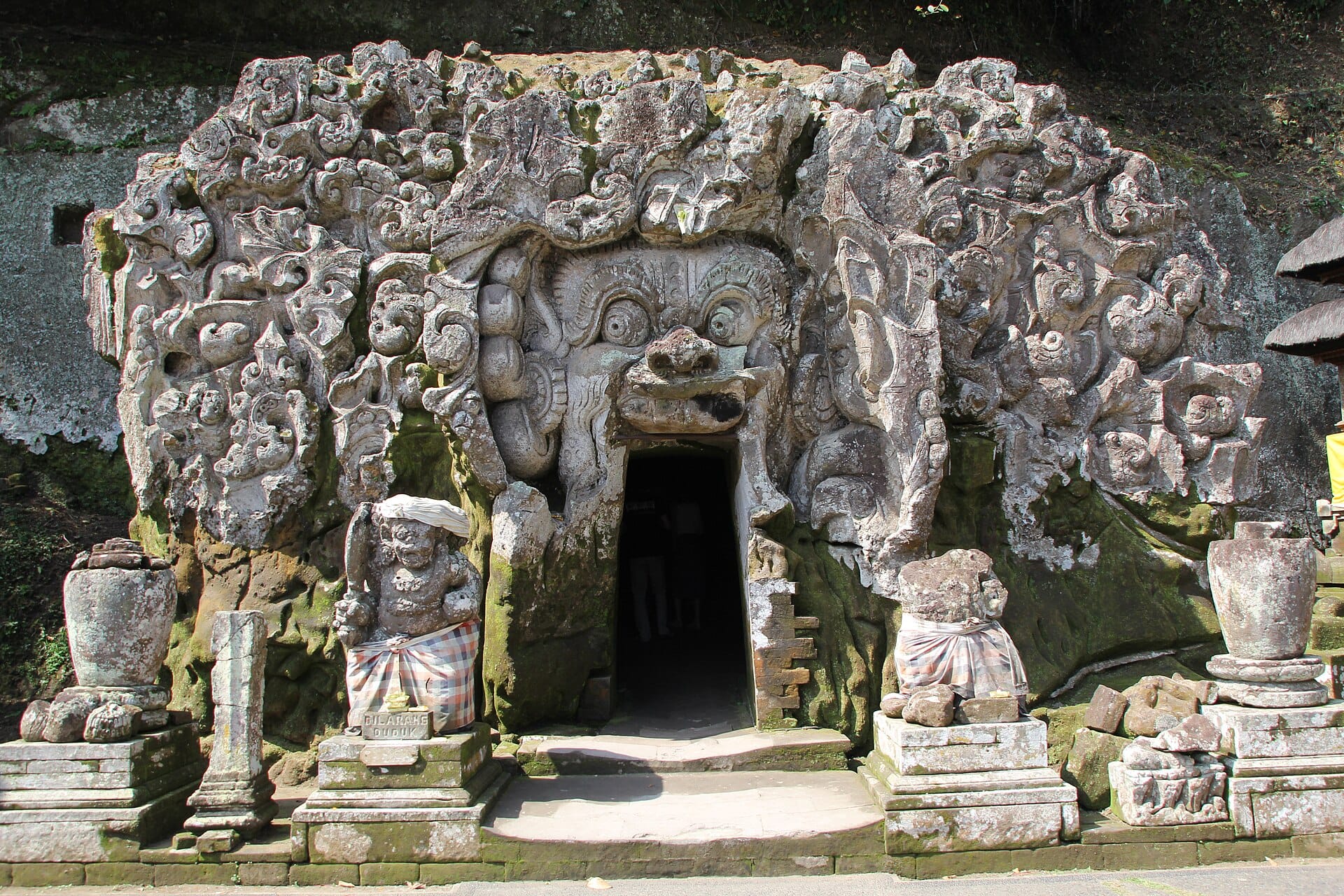
Carved into a hillside near Ubud around the 11th century, Goa Gajah is one of Bali's most significant Hindu archaeological sites. The cave entrance — a gaping stone mouth surrounded by carved demons and foliage — is instantly recognizable, but the full site extends into terraced gardens, bathing fountains, and jungle ravines that most visitors never reach.
Quick Facts
- Location
- Bedulu village, Gianyar Regency – approximately 6 km east of central Ubud
- Getting There
- No direct public transit. Hire a scooter, grab a Gojek/Grab car, or join a morning temple tour from Ubud
- Time Needed
- 1 to 1.5 hours for the full site; 30 minutes if you only visit the cave entrance
- Cost
- IDR 50,000 (includes sarong rental if needed).
- Best for
- History and archaeology enthusiasts, temple lovers, early-morning explorers
What Goa Gajah Actually Is
Goa Gajah, translated as Elephant Cave, is a Hindu temple complex dating to roughly the 11th century. Despite its fame, the name does not come from elephants living here. One theory is that it derives from the nearby Petanu River, once called Lwa Gajah or Lawa Gaja, meaning Elephant River. Others suggest the name references the cave's monstrous carved entrance, which some early visitors mistook for an elephant's face.
The site was rediscovered by Dutch archaeologists in 1923, but its bathing pools remained buried under sediment until 1954, when a joint Indonesian-Dutch excavation uncovered them. This makes the pools — which most tourists now photograph — actually younger in terms of public knowledge than the site's reputation suggests. Archaeologists have also uncovered Buddhist statuary and meditation niches alongside Hindu carvings, evidence that Bali's early religious landscape was more syncretic than it is today.
ℹ️ Good to know
A sarong and sash are required to enter the temple grounds. If you don't have one, rentals are available at the entrance for no additional cost beyond the ticket fee.
The Entrance: What You See First
The cave entrance is the defining image of Goa Gajah, and in person it is genuinely striking. The carved stone facade depicts an enormous demonic face, likely a Kala figure, surrounded by intricate carvings of leaves, human figures, animals, and coiling forms. The mouth of the creature forms the doorway itself, framed low enough that adults must duck slightly to enter. The stone is dark grey and visibly aged, with moss filling the crevices in ways that emphasize the depth of the relief carving.
The interior is a T-shaped cave roughly 13 meters deep. Inside, two separate niches hold religious objects: a Ganesha statue on the left side and a damaged Shiva linga on the right. The cave is actively used for Hindu worship, so you may encounter offerings of flowers, incense, and woven palm-leaf trays placed by local devotees. The air inside smells of incense and damp stone. Natural light reaches the entrance but fades quickly, and the interior relies on artificial lighting. It is narrow and low-ceilinged, which can feel uncomfortable for taller visitors or those sensitive to confined spaces.
⚠️ What to skip
The cave interior is a functioning place of worship. Speak quietly, do not touch the statues or offerings, and always ask before photographing anyone praying inside.
Tickets & tours
Live prices and dates from our booking partner. If you book, we may earn a commission at no extra cost to you.
Bali Private Car Rental With Driver
From 29 €Instant confirmationFree cancellationBest of Ubud private day tour
From 16 €Instant confirmationFree cancellationBali sunrise gate heaven full-day tour
From 53 €Instant confirmationFree cancellationCustomizable Full-Day Tour of Bali with Private Driver
From 16 €Instant confirmationFree cancellation
Beyond the Cave: The Gardens and Bathing Pools
Most visitors photograph the cave entrance, glance inside, and leave. That is a significant mistake. The steps immediately to the right of the cave entrance lead down to a terraced garden area holding the excavated bathing fountains. These consist of a rectangular stone pool fed by water spouts held by six carved stone figures, and the water flows continuously. The stonework here reads differently from the cave entrance: it is intricate but not grotesque, and the pools are set into a lush garden of ferns and flowering plants.
Beyond the pools, a path descends further into a ravine. Stone steps cut into the hillside lead to a small stream and two smaller shrines. This lower section sees a fraction of the foot traffic compared to the main cave. The jungle canopy closes overhead, the air is noticeably cooler and more humid, and the sounds of the road disappear. A Buddha relief carved into a rock face can be found here, a reminder of the site's mixed religious heritage. The path is uneven and can be slippery after rain, so footwear with grip matters here.
The full site connects naturally to a broader exploration of Ubud's temple landscape. If you are spending more time in the area, Tirta Empul Temple in Tampaksiring is one of the most important water temples in Bali and worth pairing with Goa Gajah on the same day.
How the Site Changes by Time of Day
Arrive before 9:00 AM if you want any sense of solitude. Tour buses begin arriving mid-morning, and by 10:30 AM the cave entrance area becomes congested enough that getting an unobstructed photograph requires patience. The light during the first hour after opening is also more forgiving: the cave facade faces roughly east and catches soft morning light that makes the carved details easier to read without harsh shadows.
By early afternoon, the site is at peak capacity. The bathing pools become a focal point for group photography sessions, and queues can form. If you arrive at this time, head directly to the ravine path first while the groups are concentrated near the entrance, then work your way back to the pools as the midday rush eases slightly after 2:00 PM.
Late afternoon visits, roughly between 3:30 and 5:00 PM, see the crowd thin again. The light becomes golden and indirect, which works well for photography around the pools. The site is typically open from 8 AM to 5 PM, but confirm current hours locally as these can shift during religious ceremonies.
💡 Local tip
If you visit during a Balinese religious ceremony, parts of the site may be closed to non-worshippers. The ceremony itself, however, is often worth witnessing respectfully from a distance — the offerings, gamelan music, and procession garments provide context that no guidebook can fully convey.
Practical Walkthrough: Getting There and Moving Through the Site
Goa Gajah sits on Jalan Raya Goa Gajah in Bedulu village, about 6 kilometers from central Ubud. The road is straightforward by scooter or car. Metered apps like Gojek and Grab operate in the Ubud area and can get you here for a reasonable fixed fare. Parking is available at the site and is free.
After paying at the entrance kiosk, you will walk through a small market corridor lined with souvenir stalls. This is unavoidable, but it is short. The vendors here are persistent but not aggressive by Bali standards. Simply keep walking and decline politely if you are not interested. The cave itself is visible from the end of this corridor.
Wear shoes you can easily remove and put back on, as you will need to take them off before entering the cave. Bring a small amount of cash for any purchases inside the market area. The grounds are uneven throughout, and the descent to the ravine section requires reasonable mobility. There are no handrails on parts of the stone staircase, and after rainfall the steps become genuinely slippery. Visitors with limited mobility should assess this section cautiously.
Goa Gajah pairs logically with a broader Ubud day. The Tegallalang Rice Terraces are north of Ubud and can be combined with a morning at Goa Gajah without significant backtracking, depending on your route.
Is Goa Gajah Worth the Crowds?
Honestly assessed: the cave entrance alone would not justify the visit if you have seen several well-preserved Hindu temples already. The carved facade is impressive, but the interior is small and the overall footprint is modest compared to larger Balinese temple complexes. What elevates Goa Gajah is the combination of the cave, the excavated pools, and the ravine descent treated as a single experience rather than a quick photo stop.
Visitors expecting Indiana Jones-level drama may be underwhelmed. The cave is not vast, the interior is dimly lit, and the site is well-managed rather than wild. But for anyone with genuine interest in Balinese history, early Hindu-Buddhist syncretism, or stone carving as an art form, Goa Gajah delivers sustained interest. The layered archaeological history here is more complex than most of Ubud's headline attractions.
If you are building an itinerary around Ubud, the itinerary planning approach used for dense destination days applies equally here: anchor your morning at Goa Gajah, take the ravine path fully, then use midday for the drive to your next stop. Also consider the Campuhan Ridge Walk in Ubud as a contrasting experience that balances temple visits with open-air movement.
Insider Tips
- The bathing fountain area is photographed constantly, but if you walk past the pools and continue down the ravine steps, you will often find yourself completely alone within 60 seconds of the crowd. The carved Buddha relief at the bottom is one of the least-photographed significant monuments in all of Ubud.
- Bring a small flashlight or use your phone torch inside the cave. The official lighting is adequate but poor for seeing the fine detail of the Ganesha statue in the left niche.
- The souvenir stalls at the entrance are pricey by Ubud market standards. If you want Balinese crafts, hold off until you are back in central Ubud where prices are more competitive.
- If you are visiting during Galungan or Kuningan (major Balinese Hindu celebrations), the site takes on a completely different character with elaborate offerings and ceremonial dress. The schedule follows the 210-day Balinese Pawukon calendar, so check dates in advance.
- The descent to the ravine is steep and the steps are slick even in dry weather due to moss. Sandals with flat soles are the single worst choice of footwear here. Sneakers or shoes with grip are strongly recommended.
Who Is Goa Gajah (Elephant Cave) For?
- Travelers with a genuine interest in Hindu-Buddhist history and Balinese archaeology
- Photographers who arrive early and want contrast between carved stone, moss, and tropical light
- Temple-circuit visitors building a half-day Ubud cultural route
- Anyone who wants a site that rewards slowing down rather than speed-touring
- Visitors who read about the 1954 excavations and want to see the bathing pools in context
Nearby Attractions
Other things to see while in Ubud:
- Sacred Monkey Forest Sanctuary
Home to over 1,200 long-tailed macaques and three Hindu temples dating back centuries, the Sacred Monkey Forest Sanctuary is one of Ubud's most photographed and genuinely surprising attractions. It rewards visitors who respect its rules and punishes those who don't.
- Tegallalang Rice Terraces
Tegallalang Rice Terraces is one of Bali's most photographed landscapes, a sweeping cascade of hand-carved paddies north of Ubud shaped by the ancient subak irrigation system. This guide covers what the terraces actually look like up close, when to visit, what it costs, and whether it lives up to its reputation.
- Campuhan Ridge Walk
The Campuhan Ridge Walk is a 2-kilometre paved and dirt path tracing a narrow spine above two river valleys, cutting through open grasslands and jungle canopy on the edge of Ubud. It is the closest thing the town has to a proper escape from its own popularity, and it costs nothing to walk.
- Tirta Empul Temple
Tirta Empul Temple in Tampaksiring is where Balinese Hindus have bathed in holy spring water for over a thousand years. The ritual bathing pools, ancient shrines, and mountain air make this one of the most spiritually charged sites on the island. Here is what visiting actually looks like.
- Amed
Amed is a string of fishing villages along Bali's remote northeast coast, known for dramatic black-sand beaches, world-class diving on coral reefs and a WWII Japanese shipwreck, and an unhurried atmosphere that feels like a different island entirely. It rewards travelers willing to make the drive.
- Ayung River
The Ayung River is Bali's longest river, carving a deep green gorge through the rainforest just west of Ubud. It draws visitors for white-water rafting, riverside resort walks, and some of the most dramatic jungle scenery on the island.
- Mount Batur
Mount Batur is an active 1,717-metre volcano in Bali's highland interior, drawing thousands of hikers each year for its pre-dawn ascent and extraordinary crater-rim sunrise. The two-hour climb rewards visitors with sweeping views over Lake Batur, Mount Agung, and, on clear mornings, the distant silhouette of Mount Rinjani on Lombok.
- Sekumpul Waterfall
Sekumpul Waterfall, located in Bali's northern highlands near Singaraja, is widely considered the island's most impressive waterfall system. A steep jungle trek leads to a cluster of seven cascades plunging up to 80 meters into a mist-filled gorge, surrounded by dense tropical forest and the sound of rushing water that you can hear long before you see it.
Planning a trip? Discover personalized activities with the Nomado app.