Amed: Bali's Quiet Black-Sand Coast Where the Sea Does the Talking
Amed is a string of fishing villages along Bali's remote northeast coast, known for dramatic black-sand beaches, world-class diving on coral reefs and a WWII Japanese shipwreck, and an unhurried atmosphere that feels like a different island entirely. It rewards travelers willing to make the drive.
Quick Facts
- Location
- Northeast Bali, Karangasem Regency — approx. 75 km from Ubud, 95 km from Seminyak
- Getting There
- Private car or scooter hire is the only realistic option; no public transit serves Amed directly. Budget roughly 2–2.5 hours from Ubud, 2.5–3 hours from Kuta
- Time Needed
- At least one overnight stay recommended; day trips are possible but wasteful given the drive
- Cost
- Beach access is free; snorkeling gear rental typically 50,000–80,000 IDR/day; dive trips from around 500,000 IDR per dive depending on operator
- Best for
- Divers, snorkelers, photographers, travelers seeking genuine quiet and volcanic coastal scenery
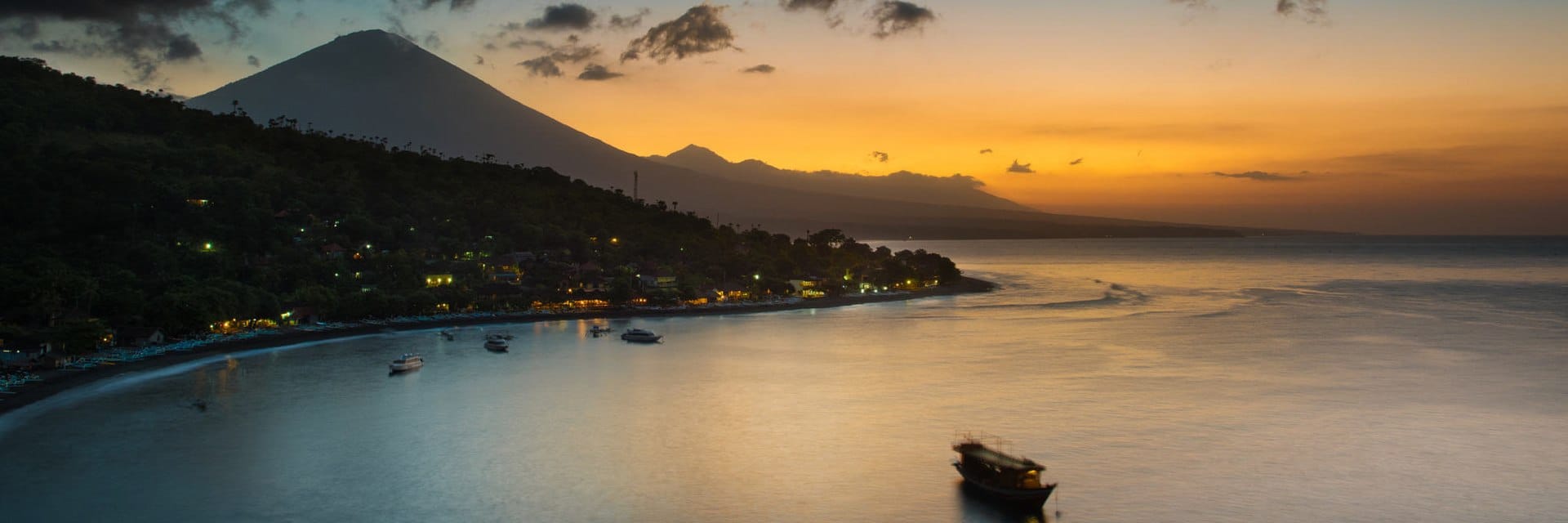
What Amed Actually Is
Amed is not a single village. It is the collective name for a chain of seven small fishing communities stretched along roughly 14 kilometers of coastline in Karangasem Regency — Amed, Jemeluk, Bunutan, Lipah, Lehan, Selang, and Banyuning. Each has its own character, its own cluster of warung and dive shops, and its own sliver of beach where traditional wooden jukung outrigger boats are dragged up onto volcanic sand at the end of each morning's fishing run.
The sand itself is the first thing that reorients your expectations. It is iron-black, composed of volcanic material shed from nearby Gunung Agung, Bali's highest and most sacred volcano. The contrast between that dark foreground, the pale turquoise shallows, and the green ridgeline behind is striking at any hour — and genuinely dramatic at sunrise, when the light arrives low and golden over the Lombok Strait.
ℹ️ Good to know
Amed sits in Bali's rain shadow, making it one of the driest corners of the island. Even during the wet season (November through March), it receives significantly less rainfall than Ubud or the south. This also means it is hotter and more arid — bring sun protection and drink more water than you think you need.
The Underwater World: Why Divers Come Here
The main draw for most foreign visitors is what lies beneath the surface. Amed sits at the edge of the Coral Triangle, one of the world's most biodiverse marine regions, and the reefs here are in measurably better shape than those near Bali's more crowded southern coast. House reef snorkeling is possible directly off the beach at Jemeluk, where the coral garden begins almost immediately at the waterline — no boat required.
The signature dive site is the USAT Liberty wreck at nearby Tulamben, roughly 15 minutes up the coast road. A US Army cargo ship torpedoed by a Japanese submarine in 1942, the Liberty was pushed ashore on the beach, where it rested until the 1963 eruption of Gunung Agung shifted it into the water. It now lies at depths of 3 to 30 meters and is covered in coral growth that took decades to establish. The wreck is genuinely accessible to beginners — large sections sit in very shallow water — while still offering enough depth and complexity for experienced divers. Many Amed-based operators run morning trips to Tulamben before the day-trip buses arrive from the south.
Closer to Amed, the Jemeluk Bay wall dive and the Pyramids (a series of artificial reef structures installed to encourage coral regeneration) offer solid alternatives. Macro photography enthusiasts consistently find nudibranchs, pipefish, and occasional pygmy seahorses on the shallower rubble slopes.
💡 Local tip
Book your first dive at Tulamben for the earliest possible slot — ideally in the water by 7am. Day-trippers from Kuta and Seminyak typically don't arrive until 9:30am, and the wreck feels entirely different when it's just you and a guide.
Tickets & tours
Live prices and dates from our booking partner. If you book, we may earn a commission at no extra cost to you.
Bali Private Car Rental With Driver
From 29 €Instant confirmationFree cancellationBest of Ubud private day tour
From 16 €Instant confirmationFree cancellationBali sunrise gate heaven full-day tour
From 53 €Instant confirmationFree cancellationCustomizable Full-Day Tour of Bali with Private Driver
From 16 €Instant confirmationFree cancellation
The Villages at Different Hours
Amed runs on fishing time, which means the mornings are where the life is. By 5:30am, boats are already returning. The smell of the sea mixes with woodsmoke from small fires where older men sit over tea. Fish are unloaded, sorted, and walked up to the road market while it's still dark enough to need a torch. This is the most photogenic and most authentic hour to be on the beach — not because it performs for tourists, but because it's simply what happens here every morning.
By mid-morning, the beach belongs to swimmers and snorkelers. The water in Jemeluk Bay is typically calm before noon, with visibility that can exceed 20 meters on clear days. Afternoons bring a thermal wind off the land that kicks up small chop and makes snorkeling less comfortable. The light in the late afternoon hits Mount Agung directly and turns the whole ridge a deep amber before the volcano disappears into cloud.
Evenings in Amed are quiet in the best sense. The main strip has a handful of open-air restaurants serving fresh catch — grilled fish ordered by weight, eaten at plastic tables on the sand as the lights of fishing boats appear offshore. There is no nightlife to speak of. That is the point.
Getting to Amed and Getting Around
The distance from Bali's tourist centers is real and should be respected in your planning. From central Ubud, the drive takes approximately 2 to 2.5 hours via the Rendang–Amlapura road, which winds through highland villages and rice country before dropping down the dry east coast. From Seminyak or Kuta, add another 45 minutes. There is no shuttle bus to Amed specifically, though some operators run tourist shuttles to Tulamben that can drop passengers at Amed on request — confirm this when booking.
Once there, a rented scooter is the most practical way to move between the villages along the coast road. The road is narrow and the terrain hilly, but the distances are short enough that a scooter covers the full stretch comfortably. If you're based in Ubud for the duration of your trip and considering a day excursion to Amed, factor in at least 5 hours of driving round-trip alongside sightseeing — an overnight stay makes far better use of the journey.
Beyond the Water: Hiking and Cultural Context
The area above the coastal villages deserves more attention than most visitors give it. The hillsides rising behind Amed are terraced with salt farms — one of the last areas in Bali where traditional sea salt production survives. Workers carry seawater up to shallow evaporation pans using hollowed palm-tree trunks. The process is slow, weather-dependent, and produces small quantities of flaky grey salt that is sold locally. Watching it without intruding is possible from the road above Amed village.
For hikers, the ridges between Amed and Lipah offer steep but rewarding walking with views back over Jemeluk Bay and across to Lombok on clear days. The trails are not formally waymarked, and a local guide is advisable if you want to go beyond the obvious ridge path. Agung looms permanently above the entire scene — its 3,031-meter summit visible from the coast on clear mornings before cloud builds around the peak.
Those who want the volcano experience directly should look to Mount Batur as an accessible trekking option — it lies roughly 45 minutes west of Amed by road and offers organized sunrise hikes with local guides.
Honest Assessment: What Amed Is Not
Amed is not for everyone, and it is worth being direct about this. The beaches are made of coarse volcanic grit, not the powdery white sand of Nusa Dua or the photogenic curves of Padang Padang. Swimming is comfortable but there is no dramatic surf culture and no sprawling resort infrastructure. If you are traveling with young children who need calm resort facilities, or if your priority is beachside dining and nightlife, the south and southwest coasts will serve you better.
The road in can also be tough after heavy rain — occasional landslides on the mountain section near Rendang add unpredictability in the wet season. Check conditions before driving. For timing your overall Bali trip, the best months to visit Bali guide covers the seasonal patterns in useful detail.
The accommodation is mostly mid-range homestays, simple bungalows, and a small number of well-designed boutique properties. Luxury resort options are limited. Budget travelers will find excellent value; travelers expecting five-star amenities should book elsewhere and visit Amed as a day trip.
Practical Notes for Your Visit
- Wear reef-safe sunscreen in the water — chemical sunscreens are actively harmful to the coral here and are increasingly frowned upon by local dive operators
- Bring cash. ATMs exist in Amed but are unreliable. Stock up in Amlapura or Ubud before driving in
- The road into Amed from the south via Tirta Gangga passes through some of the most scenic countryside in east Bali — factor in extra time to stop
- Marine life encounters are significantly better during the dry season (April to October) when visibility peaks
- Most dive operators provide equipment rental; quality varies, so inspect gear before entering the water
⚠️ What to skip
Gunung Agung remains an active volcano. During periods of elevated alert (which have occurred multiple times since the 2017–2018 eruption cycle), ash fall can affect the Amed coast and the road from Rendang may close. Check the current volcanic alert level with the Indonesian Center for Volcanology (PVMBG) before your trip.
For a broader picture of what to do across the island, the things to do in Bali guide is a useful companion when planning how Amed fits into your wider itinerary.
Insider Tips
- The Jemeluk viewpoint above the main bay is reachable on foot in about 20 minutes from the beach road. It offers a full panorama of the bay and is almost always empty — far better for photography than the crowded beach below.
- Ask your accommodation or a local dive shop about night snorkeling in Jemeluk Bay. The coral comes alive after dark with octopus, lobster, and bioluminescent plankton that make the water glow as you move through it.
- The fish market activity along the Amed road peaks between 5:30am and 7am. Arrive before sunrise and you will see the full cycle — boats returning, catch sorted, buyers negotiating — without any tourist structure around it.
- Several small family warung slightly back from the main road serve far better food at lower prices than the beach-front restaurants. Look for places without English-language signage and follow what local workers are eating for lunch.
- If you are driving from Ubud, the route through Tirta Gangga (passing the royal water palace) adds only about 15 minutes and is considerably more scenic than the main highway. The approach to the coast via this road gives you a proper sense of the landscape transition from highland green to arid black-rock coast.
Who Is Amed For?
- Divers and snorkelers who want reef access without crowds and a base close to the Tulamben Liberty wreck
- Photographers drawn to volcanic landscapes, fishing village life, and dramatic sunrise light over the Lombok Strait
- Travelers who have done the standard south Bali circuit and want to experience a different register of the island
- Couples or solo travelers seeking genuine quiet — Amed has no clubs, no Kuta-style strip, and minimal organized tourism infrastructure
- Hikers and nature-focused visitors interested in combining coastal and volcanic landscapes in one base
Nearby Attractions
Other things to see while in Ubud:
- Ayung River
The Ayung River is Bali's longest river, carving a deep green gorge through the rainforest just west of Ubud. It draws visitors for white-water rafting, riverside resort walks, and some of the most dramatic jungle scenery on the island.
- Campuhan Ridge Walk
The Campuhan Ridge Walk is a 2-kilometre paved and dirt path tracing a narrow spine above two river valleys, cutting through open grasslands and jungle canopy on the edge of Ubud. It is the closest thing the town has to a proper escape from its own popularity, and it costs nothing to walk.
- Goa Gajah (Elephant Cave)
Carved into a hillside near Ubud around the 11th century, Goa Gajah is one of Bali's most significant Hindu archaeological sites. The cave entrance — a gaping stone mouth surrounded by carved demons and foliage — is instantly recognizable, but the full site extends into terraced gardens, bathing fountains, and jungle ravines that most visitors never reach.
- Mount Batur
Mount Batur is an active 1,717-metre volcano in Bali's highland interior, drawing thousands of hikers each year for its pre-dawn ascent and extraordinary crater-rim sunrise. The two-hour climb rewards visitors with sweeping views over Lake Batur, Mount Agung, and, on clear mornings, the distant silhouette of Mount Rinjani on Lombok.
Planning a trip? Discover personalized activities with the Nomado app.