USAT Liberty Wreck: Bali's Most Iconic Dive Site
The USAT Liberty is a World War II cargo ship resting just off the black-sand shore of Tulamben, on Bali's northeast coast. Lying at depths between 5 and 29 metres, it is one of Southeast Asia's most accessible and rewarding wreck dives, equally suited to beginners snorkelling the shallow superstructure and experienced divers exploring the deep stern.
Quick Facts
- Location
- Tulamben, Karangasem Regency, northeast Bali (approx. 2.5 hours from Ubud, 3 hours from Kuta)
- Getting There
- Private car or scooter rental is the standard approach; limited public transport to Tulamben. Most visitors book through a dive operator who provides transport from their base.
- Time Needed
- Half day for a single dive; full day for two dives plus snorkelling
- Cost
- Shore entry fee approx. IDR 30,000–50,000; dive packages (2 dives + equipment) typically IDR 500,000–900,000 through local operators. Snorkel rental available from IDR 50,000.
- Best for
- Divers of all levels, snorkellers, underwater photographers, history enthusiasts
What the USAT Liberty Actually Is
The USAT Liberty was a United States Army cargo ship torpedoed by a Japanese submarine on January 11, 1942, while crossing the Lombok Strait during World War II. Damaged but still afloat, she was beached at Tulamben so her cargo could be salvaged. She sat on the sand for over two decades until the 1963 eruption of Mount Agung — Bali's most sacred and volatile volcano — sent lava flows and seismic tremors crashing through the village, rolling the ship off the beach and into the shallow water where she rests today.
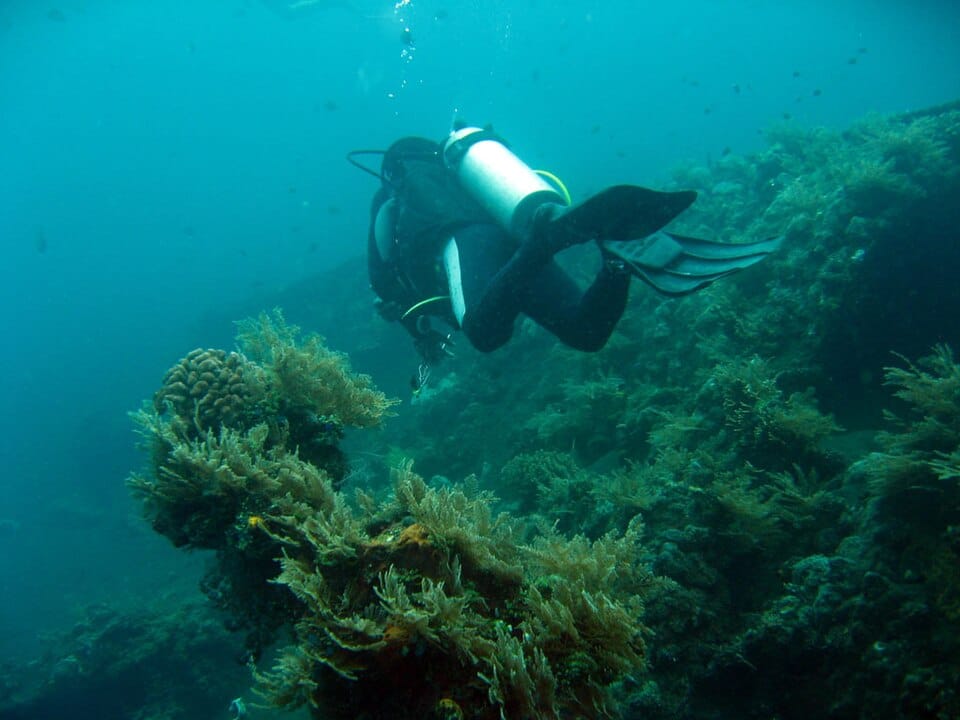
The wreck now lies parallel to the shore, broken into two main sections, stretching roughly 120 metres in length. The shallowest parts of the bow sit at around 5 metres, making them reachable by snorkellers on calm days. The deepest accessible point, near the stern, drops to approximately 29 metres. Six decades of submersion have transformed steel hull into one of Bali's most complex artificial reefs, thick with hard and soft corals, sea fans, barrel sponges, and an extraordinary density of marine life.
💡 Local tip
Arrive before 7:30 AM. The wreck is at its clearest and least crowded in the early morning, and the low-angle light produces exceptional visibility through the shallower sections. By mid-morning, dozens of dive groups can be in the water simultaneously.
Getting Into the Water: The Entry Experience
The beach at Tulamben is unlike the white-sand stretches you find further south. It is composed entirely of rounded black volcanic stones, ranging from pebble-sized to fist-sized, and walking across them in dive booties requires deliberate, flat-footed steps. The crunch underfoot is constant. At dawn, with mist still sitting over the hills and the water glassy, the approach to the shore carries a particular atmosphere — quiet, purposeful, the kind of place that rewards an early start.
Entry is a giant stride or careful wade from the shore. Within 20 metres of the waterline, the wreck's ghostly silhouette begins to emerge from the blue. There are no boats involved, no mooring lines to descend — you simply swim out and drop down. Local porters, most of them from the Tulamben village cooperative, can carry your tanks and equipment to the water's edge for a small tip, which is both appreciated and genuinely useful on the uneven stones.
Tickets & tours
Live prices and dates from our booking partner. If you book, we may earn a commission at no extra cost to you.
Bali Private Car Rental With Driver
From 29 €Instant confirmationFree cancellationBest of Ubud private day tour
From 16 €Instant confirmationFree cancellationBali sunrise gate heaven full-day tour
From 53 €Instant confirmationFree cancellationCustomizable Full-Day Tour of Bali with Private Driver
From 16 €Instant confirmationFree cancellation
What You See Underwater
The wreck is dense with life in a way that photographs rarely capture accurately. The upper sections of the hull host schools of glassfish so thick they move like smoke, parting and reforming around divers. Hunting through them are larger predators: giant trevally, barracuda, and bumphead parrotfish that arrive in shoals of 20 or more at dawn, their blunt foreheads and grinding feeding sounds distinctly audible underwater. Pygmy seahorses have been documented on the sea fans near the stern. Reef sharks make occasional passes along the deeper sections.
The wreck's interior is partially penetrable, though only with a guide and appropriate certification. Cargo holds, the engine room, and sections of the superstructure are navigable for those with overhead environment training. Without penetration, there is still enormous variety: swim-throughs formed by collapsed hull plating, cleaning stations where small wrasse service larger fish, and the eerie geometry of ladders, railings, and portholes draped in encrusting organisms.
Macro photographers will find the Liberty endlessly productive. Nudibranchs, ghost pipefish, frogfish, and ornate ghost pipefish are regularly reported. The site complements the broader marine environment of northeast Bali, which also includes the exceptional black-sand dive sites around Amed, roughly 30 minutes southwest of Tulamben along the coast road.
Diving vs. Snorkelling: An Honest Comparison
Snorkelling the Liberty is genuinely worthwhile, provided conditions are calm. The bow section in particular rises close enough to the surface that a confident snorkeller can peer down into encrusted corridors and observe fish life without scuba equipment. However, the full character of the site exists below 10 metres, where the hull opens up, the fish schools densify, and the structural scale of the wreck becomes apparent. If you have any open-water certification, diving is significantly more rewarding.
If you are not yet certified, several dive operators based in Tulamben offer Discover Scuba Diving introductory experiences specifically designed for this site. The shallow sections make it one of Bali's most practical locations for a first-time dive. That said, be cautious about choosing the cheapest operator you can find. Equipment condition and guide quality vary substantially in Tulamben. Look for operators affiliated with PADI, SSI, or equivalent agencies, and inspect rental equipment before entering the water.
⚠️ What to skip
Currents at the Liberty can strengthen significantly in the afternoon, particularly along the deeper stern section. Beginners and non-swimmers should not attempt snorkelling if surface chop is present. Check conditions with your operator before entry.
How the Experience Changes Through the Day
Dawn dives (starting around 6:00–6:30 AM) offer the greatest reward for multiple reasons. Visibility is typically at its best before boat traffic and diver movement disturb sediment. The bumphead parrotfish are active near the wreck at first light, and the absence of other groups makes navigation along the hull straightforward. The water temperature in the early morning can drop to around 24–26°C at depth, so a 3mm wetsuit is advisable even in the dry season.
By 9:00 AM, the site fills steadily. A busy morning will see 60 to 100 divers from multiple operators in the water at once. This is not dangerous, but it does change the experience: fin kicks from other divers stir silt, visibility in the shallower sections degrades, and the quieter atmosphere of an early dive evaporates. The wreck does not close, but its best version is firmly a morning experience.
Night dives are available through most operators and reveal a completely different wreck. Octopus, lobster, and hunting lionfish emerge after dark. The absence of ambient light transforms the site into something genuinely otherworldly, the beam of your torch cutting across coral-encrusted hulk while the surface above remains invisible. Night dives require advance booking and an experienced guide.
Getting to Tulamben from Ubud and South Bali
Tulamben sits on Bali's northeast coast, about 2.5 hours from Ubud and approximately 3 hours from the south Bali resort areas. The drive from Ubud follows a scenic inland route via Rendang and Duda before descending toward the coast, passing the flanks of Gunung Agung. There is no public transport to Tulamben. Options are a private car hire, a scooter for confident riders (the road is straightforward but long), or booking through a dive operator who bundles transport in the package price — often the most cost-effective approach for solo travellers.
Most divers visit Tulamben as a day trip, leaving their base before 6:00 AM to hit the water early and returning by early afternoon. An increasing number stay overnight in the small collection of guesthouses and dive resorts along the Tulamben strip, which allows for dawn and dusk dives without the transit pressure. Overnight stays are particularly recommended if you plan to do two or more dives or are combining the Liberty with a night dive.
If you are combining the trip with other northeast Bali activities, the coastal road connects Tulamben to Amed, where additional dive sites, beach restaurants, and accommodation provide a logical extension. See our guide to Amed's diving and snorkelling scene for what to add to an itinerary.
Practical Notes for Planning
The best months to dive the Liberty run from April through October, when Bali's dry season keeps surface conditions calmer and visibility typically extends to 15–25 metres. The wet season (November through March) brings occasional rough conditions and reduced visibility, though the site remains diveable on most days. Water temperature year-round ranges from 24°C to 29°C depending on depth and season.
For a broader picture of Bali's seasonal patterns and how they affect outdoor activities, the best months to visit Bali guide covers conditions across all regions, including the northeast coast.
Bring: dive certification card, a 3mm wetsuit (5mm for multiple dives or night diving), reef-safe sunscreen, cash in Indonesian Rupiah (ATMs are not available in Tulamben itself — withdraw before leaving Ubud or Candidasa), and a dry bag for valuables. Underwater cameras and GoPros are well worth bringing; the shallow topography and dense fish life make it one of Bali's most photogenic underwater sites.
ℹ️ Good to know
Accessibility note: The volcanic stone beach presents challenges for visitors with limited mobility. The entry and exit requires walking on uneven, rounded rocks. Some operators can assist with kit carrying and entry support, but the site is not wheelchair accessible.
Who Should Reconsider
The USAT Liberty is not the right choice for travellers looking for a beach day. There is no sand, no facilities beyond small warung food stalls and dive shops, and the surrounding village has limited general tourism infrastructure. Visitors expecting a polished resort experience will find Tulamben functional rather than comfortable. Non-swimmers who cannot snorkel will find little to do beyond watching from the shore. And anyone who wants to avoid crowds entirely should note that this is Bali's most popular dive site: true solitude is not available here, only relative quiet in the early hours.
Insider Tips
- Book an operator who launches at 6:00 AM rather than 8:00 AM. The difference in crowd density and visibility is significant enough to change the entire quality of the dive.
- Ask your dive guide specifically to take you to the stern section early in the dive, while you have the most air. The bow section, which is shallower, is easier to explore at the end on reduced tank pressure.
- The local porter cooperative operates on a fixed tip system. Bringing exact change in small denominations avoids awkward negotiations on the beach with fins and a tank strapped to your back.
- If you are combining two dives, use the surface interval to eat at one of the warung stalls directly behind the beach. The nasi campur is cheap, freshly cooked, and gives you a genuine reason to sit on the volcanic shore and watch the operation of Bali's dive tourism economy up close.
- Night dive bookings fill quickly during peak months (July and August). If a night dive is important to your trip, confirm and pay a deposit at least a day in advance.
Who Is Usat Liberty Wreck For?
- Certified scuba divers of all experience levels seeking accessible wreck diving
- Underwater photographers hunting macro subjects and schooling fish
- First-time divers doing a Discover Scuba experience in a structured, shallow environment
- History-minded travellers interested in Pacific War material culture
- Multi-day itineraries combining northeast Bali's coast with Amed or Gunung Agung
Nearby Attractions
Other things to see while in Ubud:
- Amed Diving and Snorkelling
Amed is a string of fishing villages along Bali's remote northeast coast, known for dramatic black-sand beaches, world-class diving on coral reefs and a WWII Japanese shipwreck, and an unhurried atmosphere that feels like a different island entirely. It rewards travelers willing to make the drive.
- Mount Batur
Mount Batur is an active 1,717-metre volcano in Bali's highland interior, drawing thousands of hikers each year for its pre-dawn ascent and extraordinary crater-rim sunrise. The two-hour climb rewards visitors with sweeping views over Lake Batur, Mount Agung, and, on clear mornings, the distant silhouette of Mount Rinjani on Lombok.
- Tirta Empul Temple
Tirta Empul Temple in Tampaksiring is where Balinese Hindus have bathed in holy spring water for over a thousand years. The ritual bathing pools, ancient shrines, and mountain air make this one of the most spiritually charged sites on the island. Here is what visiting actually looks like.
- Tegallalang Rice Terraces
Tegallalang Rice Terraces is one of Bali's most photographed landscapes, a sweeping cascade of hand-carved paddies north of Ubud shaped by the ancient subak irrigation system. This guide covers what the terraces actually look like up close, when to visit, what it costs, and whether it lives up to its reputation.
- Ayung River
The Ayung River is Bali's longest river, carving a deep green gorge through the rainforest just west of Ubud. It draws visitors for white-water rafting, riverside resort walks, and some of the most dramatic jungle scenery on the island.
- Campuhan Ridge Walk
The Campuhan Ridge Walk is a 2-kilometre paved and dirt path tracing a narrow spine above two river valleys, cutting through open grasslands and jungle canopy on the edge of Ubud. It is the closest thing the town has to a proper escape from its own popularity, and it costs nothing to walk.
- Goa Gajah (Elephant Cave)
Carved into a hillside near Ubud around the 11th century, Goa Gajah is one of Bali's most significant Hindu archaeological sites. The cave entrance — a gaping stone mouth surrounded by carved demons and foliage — is instantly recognizable, but the full site extends into terraced gardens, bathing fountains, and jungle ravines that most visitors never reach.
- Sacred Monkey Forest Sanctuary
Home to over 1,200 long-tailed macaques and three Hindu temples dating back centuries, the Sacred Monkey Forest Sanctuary is one of Ubud's most photographed and genuinely surprising attractions. It rewards visitors who respect its rules and punishes those who don't.
Planning a trip? Discover personalized activities with the Nomado app.