Tirta Empul Temple: Bali's Sacred Spring and Purification Ritual
Tirta Empul Temple in Tampaksiring is where Balinese Hindus have bathed in holy spring water for over a thousand years. The ritual bathing pools, ancient shrines, and mountain air make this one of the most spiritually charged sites on the island. Here is what visiting actually looks like.
Quick Facts
- Location
- Tampaksiring, Gianyar Regency, Bali (approx. 40 km north of Kuta, 18 km north of Ubud)
- Getting There
- Best reached by hired driver or scooter. No public transit runs directly to the site. Taxis and ride-share apps can drop you here, though return rides from the area can be harder to book.
- Time Needed
- 1.5 to 2.5 hours, or longer if you participate in the purification ritual
- Cost
- Small entrance donation typically requested (IDR 50,000 for foreign visitors); sarong rental or loan included at entry if needed
- Best for
- Spiritual seekers, cultural travelers, photographers interested in living religious practice
- Official website
- tirtaempultemple.com
What Tirta Empul Actually Is
Tirta Empul Temple is not a museum or a scenic backdrop. It is a functioning Hindu temple that has been in continuous religious use since 962 AD, during the reign of King Sri Chandrabhaya Warmadewa of the Warmadewa dynasty. The name translates directly from Balinese: tirta means holy water, empul means to spring up. The spring itself, which feeds into a series of bathing pools called petirtaan, is considered sacred because the water rises from the earth without any single obvious source, an occurrence the Balinese have long interpreted as a divine gift.
The temple complex sits in a cool river valley at Tampaksiring, above the Pakerisan River gorge, surrounded by rice terraces and secondary forest. The altitude gives the air a noticeably different texture from coastal Bali: cleaner, cooler, carrying the smell of incense and wet stone rather than sea salt. Priests conduct daily ceremonies here. Balinese families drive hours from across the island for significant purification rituals. This context matters enormously for how you should approach the visit.
ℹ️ Good to know
Visitors are required to wear a sarong and sash inside the temple. These are available to borrow at the entrance at no extra charge. Shoulders should be covered. Respectful, quiet behavior in the inner compound is expected, not optional.
The Purification Pools: What You Will See
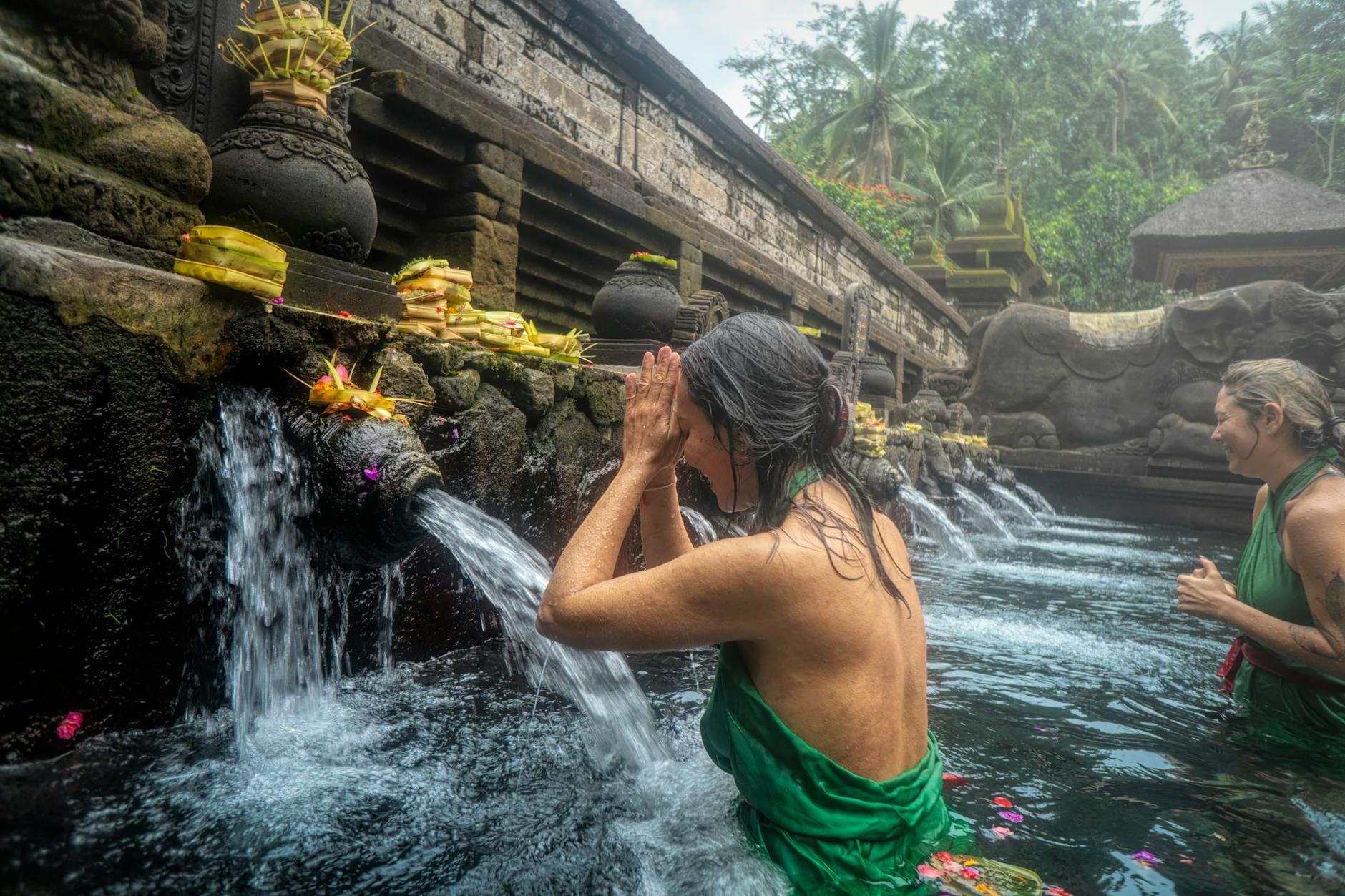
The heart of the temple is the large rectangular bathing complex, divided into separate pools for men and women, each fed by a row of stone spouts carved with symbolic motifs. The water is cold and clear, flowing continuously from the natural spring beneath the temple. Each spout carries a specific name and ritual purpose, and Balinese worshippers move systematically from spout to spout, submerging their heads, cupping water over themselves, and offering prayers with precision.
Watching this is genuinely affecting. The ritual is not performed for visitors. The people in the pools are focused entirely inward, many of them weeping quietly or moving their lips in prayer. Offerings of flowers and fruit float on the water's surface. On busy ceremonial days, the pools are packed and the sound of chanting and gamelan music drifts across the compound from the inner shrines.
Respectful visitors are sometimes permitted to enter the pools and participate in a simplified version of the ritual. If you choose to do this, follow the guidance of the temple attendants, do not wear waterproof sunscreen or insect repellent into the water (it pollutes a sacred spring), and bring a change of clothing. The experience of standing in the cold spring water while Balinese worshippers pray beside you is unlike anything else on the island.
⚠️ What to skip
Do not apply sunscreen or bug spray before entering the bathing pools. These chemicals contaminate a spring that has sacred significance and is used by local worshippers. Apply them before you leave your accommodation and rinse them off before entering the water.
Tickets & tours
Live prices and dates from our booking partner. If you book, we may earn a commission at no extra cost to you.
How the Experience Changes by Time of Day
Early morning, roughly 7 to 9 AM, is when the temple feels most like itself. The light falls at a low angle through the surrounding trees, the tour groups have not yet arrived, and the pools are occupied mostly by Balinese worshippers who began their journey before dawn. The air smells strongly of frangipani and incense smoke. The stone surfaces are damp with mist and the overflow from the pools. This is the most photographically rewarding window and the most spiritually coherent one.
By 10 AM, the first large tour groups arrive and the dynamic shifts considerably. The paths between the outer and inner compounds become congested. The pools are still in use but the meditative atmosphere is harder to find. If you are visiting primarily for cultural immersion rather than crowd observation, arriving early is not just advisable, it is the difference between two entirely different experiences.
Late afternoon, after 3 PM, sees another shift. Tour operators have usually moved on and local Balinese families return, sometimes for evening prayers. The light becomes golden and the shadows in the carved stone archways deepen dramatically. Photographers often find this the better window for architectural shots of the inner shrines.
The Temple Layout and What to Look For Beyond the Pools
The complex is organized across three compounds, moving from the outer (jaba) to the middle (jaba tengah) to the inner (jeroan) courtyard. Most visitors spend all their time around the pools and miss the inner compound entirely. The jeroan contains tall multi-tiered meru towers built to honor specific deities, and the shrines here are decorated with fresh offerings every morning. The layered thatched roofs of the meru, made from sugar palm fiber, have a distinctive silhouette that appears in virtually every image associated with classical Balinese Hinduism.
The Pakerisan River runs directly below the temple complex. A stairway near the back of the compound leads down to the riverbank, where additional small shrines are carved into the stone cliff face. Few visitors make it down here. The carvings are moss-covered and partially eroded, and the sound of the river drowns out everything from above. It is a good place to spend ten quiet minutes away from the main site.
Immediately above the temple on the hillside sits the Tampaksiring Presidential Palace, built during the Sukarno era in the 1950s and still used as an official residence. It is not open to the public, but its presence is visible from the upper terraces. If you are spending a full day in this area, combining Tirta Empul with a visit to the Tegallalang Rice Terraces makes geographic and logistical sense, as both lie north of Ubud along the same road corridor.
Getting There and Combining the Visit
Tirta Empul is about 18 kilometers north of Ubud center, which sounds manageable but translates to 40 to 60 minutes by scooter or car because of road conditions and traffic. Hiring a driver for the day is the most practical option for most visitors: it allows you to combine the temple with other sites in the Gianyar highlands without being stranded at the roadside waiting for a ride-share that may not come.
If you are basing yourself in Ubud, most guesthouses and hotels can arrange a driver for a half-day or full-day trip north. Typical half-day driver rates in Bali cover two or three stops. A common pairing is Tirta Empul in the morning followed by Tegallalang Rice Terraces on the way back south.
Scooter rental from Ubud is straightforward if you are confident riding in Bali traffic. The road north passes through quiet villages, coffee plantations, and occasional temple gates. Parking at the temple is available and costs a small fee. Going by scooter gives you flexibility to stop at roadside warungs and smaller shrines along the route that a driver itinerary would skip.
💡 Local tip
Book a local driver the evening before your planned visit and specify you want to arrive at Tirta Empul before 8:30 AM. Many drivers will accommodate early starts. This single decision determines whether you see the temple as a place of worship or as a tourist attraction.
Photography, Accessibility, and Honest Caveats
Photography is permitted in most areas of the complex, but common sense and basic courtesy apply. Do not push a camera into the face of someone actively praying. Do not position yourself to block a worshipper's path to a spout. The best shots of the pools are taken from the raised stone pathways around the perimeter, using a slightly elevated angle to capture both the spouts and the people below. A wide-angle lens handles the full pool layout well. In the inner compound, longer focal lengths help isolate shrine details without disturbing ceremonies.
Accessibility is limited. The paths through the complex are uneven stone, often wet and slippery from pool overflow. There are steps throughout the compound and the river stairway is steep and unrailed. Visitors with mobility limitations can see the outer compound and pools from the perimeter paths without difficulty, but access to the inner shrines and riverbank requires navigating irregular terrain.
An honest note on expectations: Tirta Empul draws large numbers of tourists, and on busy days it can feel overwhelming. If your interest is primarily in peaceful spiritual atmosphere rather than cultural observation, consider visiting on a weekday and arriving with the first hour of opening. If large crowds at sacred sites make you uncomfortable, or if you are skeptical about the ethics of watching private religious practice, this may not be the right place for your itinerary. That is a legitimate calculation to make.
For travelers building a wider Bali itinerary, the best time to visit considerations apply here too: Bali's dry season from April through October sees fewer rain interruptions, though the temple remains fully operational year-round. The Sacred Monkey Forest Sanctuary in central Ubud offers a very different kind of temple encounter for those who want variety in their cultural itinerary.
Insider Tips
- Bring two sets of clothes if you plan to enter the pools. The changing rooms are basic and the walk back to the parking area in wet clothes is uncomfortable. A lightweight change of clothes in a dry bag solves this completely.
- The temple is most atmospherically photographed from the far end of the pools, looking back toward the stone spouts with the inner compound shrines visible in the background. Most visitors shoot from the entrance end and miss this angle entirely.
- If you see a ceremony in progress in the inner compound, pause at the threshold and observe quietly rather than walking through. Priests and families appreciate this. It also gives you a far better view than pushing forward would.
- The small warungs and food stalls just outside the main temple gate sell coconut water and traditional Balinese snacks at local prices. There is no reason to eat at the more tourist-oriented restaurants further up the road unless you specifically want them.
- Check the Balinese calendar before you go. Odalan, the temple's anniversary ceremony, falls every 210 days and draws enormous numbers of worshippers. Attending during Odalan is extraordinary but requires arriving very early and accepting that the pools may be largely inaccessible to non-worshippers.
Who Is Tirta Empul Temple (Tampaksiring) For?
- Travelers with genuine interest in Balinese Hinduism and living religious practice
- Photographers looking for authentic ritual and architectural subjects in natural light
- Those seeking a spiritual or reflective experience and open to participating in the purification ritual
- Visitors on a highland day trip who want cultural depth alongside rice terrace scenery
- Travelers who have already seen the main Ubud attractions and want to go further north into the Gianyar highlands
Nearby Attractions
Other things to see while in Ubud:
- Tegallalang Rice Terraces
Tegallalang Rice Terraces is one of Bali's most photographed landscapes, a sweeping cascade of hand-carved paddies north of Ubud shaped by the ancient subak irrigation system. This guide covers what the terraces actually look like up close, when to visit, what it costs, and whether it lives up to its reputation.
- Sacred Monkey Forest Sanctuary
Home to over 1,200 long-tailed macaques and three Hindu temples dating back centuries, the Sacred Monkey Forest Sanctuary is one of Ubud's most photographed and genuinely surprising attractions. It rewards visitors who respect its rules and punishes those who don't.
- Amed
Amed is a string of fishing villages along Bali's remote northeast coast, known for dramatic black-sand beaches, world-class diving on coral reefs and a WWII Japanese shipwreck, and an unhurried atmosphere that feels like a different island entirely. It rewards travelers willing to make the drive.
- Ayung River
The Ayung River is Bali's longest river, carving a deep green gorge through the rainforest just west of Ubud. It draws visitors for white-water rafting, riverside resort walks, and some of the most dramatic jungle scenery on the island.
- Campuhan Ridge Walk
The Campuhan Ridge Walk is a 2-kilometre paved and dirt path tracing a narrow spine above two river valleys, cutting through open grasslands and jungle canopy on the edge of Ubud. It is the closest thing the town has to a proper escape from its own popularity, and it costs nothing to walk.
- Goa Gajah (Elephant Cave)
Carved into a hillside near Ubud around the 11th century, Goa Gajah is one of Bali's most significant Hindu archaeological sites. The cave entrance — a gaping stone mouth surrounded by carved demons and foliage — is instantly recognizable, but the full site extends into terraced gardens, bathing fountains, and jungle ravines that most visitors never reach.
Planning a trip? Discover personalized activities with the Nomado app.