Sacred Monkey Forest Sanctuary, Ubud: What to Know Before You Go
Home to over 1,200 long-tailed macaques and three Hindu temples dating back centuries, the Sacred Monkey Forest Sanctuary is one of Ubud's most photographed and genuinely surprising attractions. It rewards visitors who respect its rules and punishes those who don't.
Quick Facts
- Location
- Jl. Monkey Forest, Ubud, Bali
- Getting There
- 10-min walk south from Ubud Palace; short ride by ojek or hired driver
- Time Needed
- 1.5 to 2.5 hours
- Cost
- IDR 100k adults / 80k children (weekdays); 120k / 100k (weekends)
- Best for
- Wildlife encounters, temple photography, nature walks
- Official website
- monkeyforestubud.com
What the Sacred Monkey Forest Actually Is
The Sacred Monkey Forest Sanctuary, formally known as Mandala Suci Wenara Wana, is a nature reserve, active Hindu temple complex, and wildlife habitat compressed into approximately 12.5 hectares of old-growth forest in the heart of Ubud. It is managed by the village of Padangtegal, which treats it as a living sacred site rather than a tourist attraction with animals as props. That distinction matters for how you experience it.
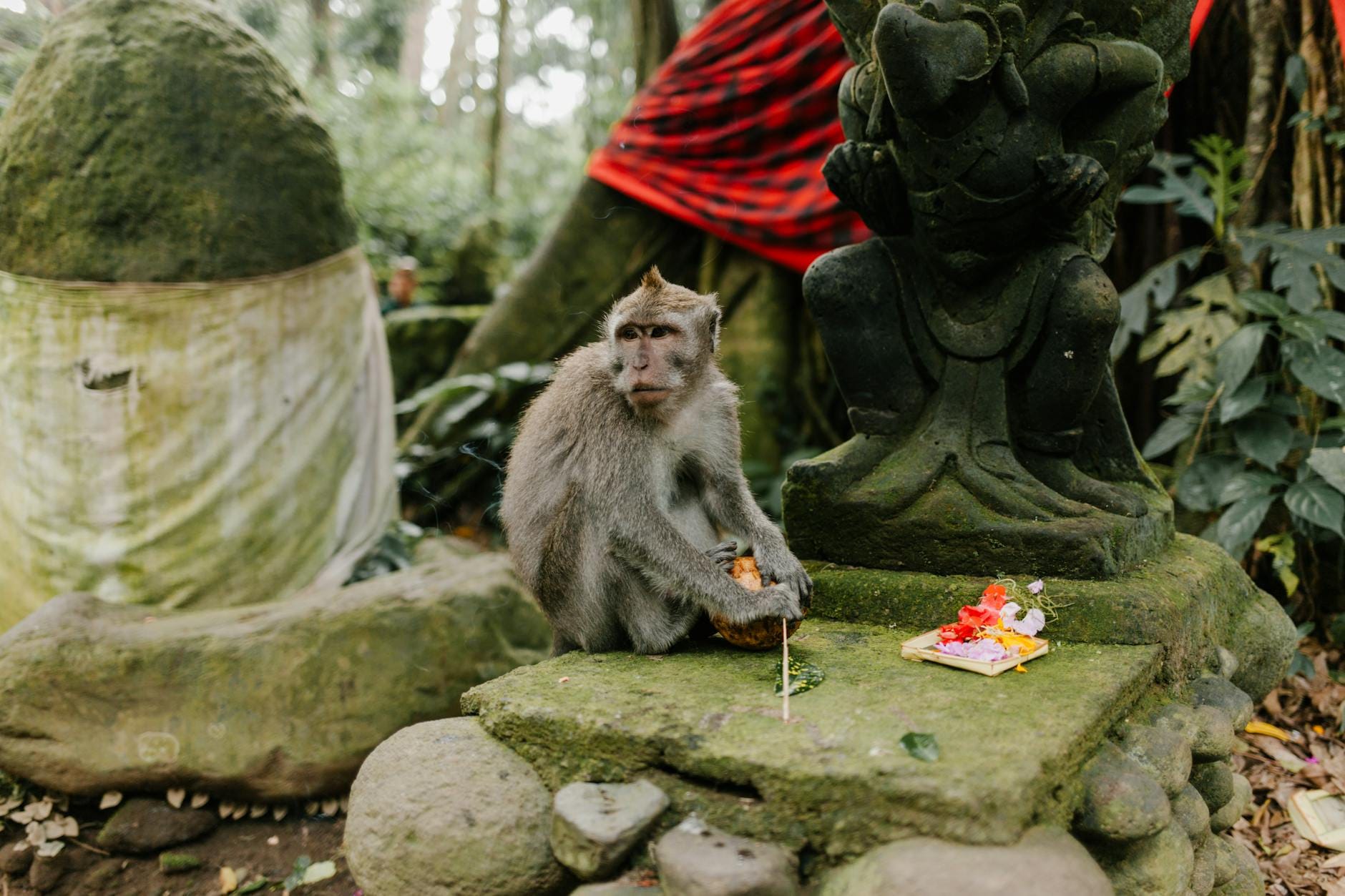
Three temples sit within the grounds: Pura Dalem Agung Padangtegal, Pura Beji, and Pura Prajapati. All three remain in active ceremonial use, and on auspicious days in the Balinese calendar you may see processions, offerings, and priests moving through paths that are also shared with macaques and tourists. This overlap of the sacred and the chaotic is the defining quality of the place.
ℹ️ Good to know
The sanctuary is officially open daily from 9:00 am to 6:00 pm (last admission at 5:00 pm). Opening hours and entry fees are managed locally and can change during Balinese religious holidays. Check the official Monkey Forest Ubud website or confirm at the gate before planning your day around it.
The Macaques: Behavior, Risks, and Reality
There are over 1,200 Balinese long-tailed macaques (Macaca fascicularis) living in six social groups within the sanctuary. They are not tame. They are habituated to humans, which is a different thing. A macaque that approaches you calmly can escalate to biting or scratching in a second if it perceives threat, competition for food, or a chance to grab something shiny.
The most common incidents involve food and eyewear. Do not bring bananas, snacks, or any food into the sanctuary. Secure earrings, remove dangling necklaces, and hold your glasses or sunglasses firmly if a monkey approaches. Water bottles in outer bag pockets are frequently grabbed. Staff sell bananas at designated feeding stations inside if you want a controlled interaction, which is the safer and more respectful way to do it.
⚠️ What to skip
Do not make direct eye contact with macaques, bare your teeth in a smile near them, or try to grab one that has taken your belongings. Crouch down if a monkey becomes aggressive and let staff handle retrieval. Bites require immediate medical attention, including rabies post-exposure assessment.
That said, the monkeys are genuinely extraordinary to observe. Watching a group of juveniles wrestle in the roots of a banyan tree, or a mother nursing while a grooming session unfolds behind her, is the kind of wildlife encounter most travelers never get close to in the wild. The key is patience and restraint.
Tickets & tours
Live prices and dates from our booking partner. If you book, we may earn a commission at no extra cost to you.
The Forest and Temples: What You Are Actually Walking Through
The canopy here is thick enough that even at noon the paths feel shaded and ten degrees cooler than Ubud's main street. The ground cover is lush, the roots of enormous banyan and nutmeg trees push through stone paths, and in the wet season small streams run alongside some walkways. The forest smells of damp earth, frangipani from scattered offerings, and occasionally the unmistakable musk of macaque territory.
Pura Dalem Agung, the largest temple, is dedicated to the god of death and sits at the southern end of the reserve near a small creek. Its stone carvings are among the most intricate in the Ubud area, depicting demons, deities, and scenes from Hindu cosmology. Photography of the outer areas is generally permitted, but entering temple inner sanctums requires a sarong, which staff will lend you at the entrance.
The path network is not complicated but it is easy to circle back on yourself. The main route runs roughly north to south, with offshoots to each temple. A complete walk covering all three temples and the creek crossing takes about 45 minutes at a relaxed pace. Plan for more if you stop to watch monkey behavior, which you will.
The sanctuary sits at the southern edge of Ubud, and the surrounding streets are full of restaurants and galleries if you want to eat or browse before or after your visit. Monkey Forest Road, which runs north from the sanctuary entrance, is one of the more pleasant walking streets in the area.
Time of Day: How the Experience Changes
Early morning, between 09:00 and 10:30, is the quietest window. Tour groups from the south of the island typically arrive after 10:00, and by 11:00 the main paths can feel genuinely crowded. In the early hours, the monkeys are more active and the light filtering through the canopy has the quality that makes forest photography actually work.
Midday is the low point of the experience. Crowds peak, macaques become lethargic in the heat, and the paths near the entrance feel more like a theme park than a sanctuary. If you can only visit midday, push deeper into the southern paths near the creek, where tour groups rarely linger.
Late afternoon, from about 15:30 onward, brings a second window of quality. Light softens, crowds thin, and the monkeys become active again in preparation for their evening feeding rhythms. The temple areas are particularly atmospheric in this light. Note that the sanctuary closes at 6PM, so budget your time accordingly.
Getting There, Tickets, and Logistics
The sanctuary is about a 10 to 15 minute walk south from Ubud Palace along Monkey Forest Road. The walk itself passes a good stretch of Ubud's shops and warung, so it is worth doing on foot at least one direction. If you prefer a ride, any ojek (motorbike taxi) or hired driver in Ubud can take you there in minutes.
Tickets are purchased at the main entrance gate and are priced in Indonesian Rupiah. Adult entry is around IDR 100,000 (weekdays) or IDR 120,000 (weekends), with reduced rates for children. Prices are reviewed periodically by the local village administration, so verify current rates at the gate.
Wear closed-toe shoes or sturdy sandals. The paths are uneven stone and can be slippery in the wet season (October through March). A lightweight layer is unnecessary given the heat, but a small backpack is better than a bag with accessible outer pockets, given the macaques' tendency to investigate anything reachable.
💡 Local tip
Bring small denomination rupiah notes. The entrance fee is paid in cash, and staff may not always have change for large bills. There is no reliable ATM immediately at the gate.
Photography: What Works and What Doesn't
The forest is photogenic but technically demanding. The combination of deep shade and bright patches of sky means a camera or phone that handles high-contrast scenes well will get much better results. Shoot in the early morning or late afternoon when the light is more even under the canopy. Midday photos tend toward blown-out backgrounds and underexposed subjects.
Macro shots of carvings and temple stonework reward patience. Many of the surfaces are covered in moss and lichen in patterns that photograph beautifully up close. For monkey portraits, a medium zoom lens gives enough distance to avoid triggering defensive behavior while still capturing detail.
Honest Assessment: Who This is For, and Who Should Skip It
The Sacred Monkey Forest delivers on its core promise: close-range encounters with wild primates in a forest setting that also contains genuinely significant Hindu architecture. For travelers who find wildlife interactions meaningful, or who want to understand how Balinese communities integrate nature and spirituality into daily life, this is one of the more substantive stops in Ubud.
It is not for everyone. Travelers with a fear of animals, particularly unpredictable ones, will find the experience stressful rather than rewarding. Parents with very young children need to be careful: toddlers at macaque eye-level are unpredictable targets for investigation or mild aggression. Travelers expecting pristine, peaceful forest solitude will find the main paths too trafficked during peak hours.
If you are building a wider Ubud itinerary, the Monkey Forest pairs well with a walk through central Ubud's market and palace area, and the town's food scene is worth your evening.
Insider Tips
- Arrive at 09:00 when the gate opens. You will have 30 to 45 minutes before the first tour groups arrive, and the monkeys are most active in the cool morning air.
- Staff at the banana feeding stations know which groups currently have infants. Ask to be directed there. A mother macaque with a newborn clinging to her chest is one of the more remarkable things you can witness at close range.
- If a macaque grabs your belongings, do not pull or chase. Crouch, look away, and wait. Monkeys typically lose interest quickly when the target stops reacting. Staff can also assist with retrieval using distraction techniques.
- The creek path near Pura Dalem Agung at the southern end of the sanctuary sees a fraction of the foot traffic of the main entrance path. Follow signs toward the temples rather than staying on the obvious central loop.
- The sarongs provided at the entrance are functional but basic. If visiting multiple temples in Ubud on the same day, carrying your own sarong is more hygienic and saves time at each entrance.
Who Is Sacred Monkey Forest Sanctuary For?
- Wildlife enthusiasts who want a close but genuinely wild primate encounter
- Travelers interested in active Balinese Hindu temple culture in a forest setting
- Photographers looking for atmospheric jungle and stone carving subjects
- Visitors spending a full day in Ubud who want variety beyond galleries and rice fields
- Curious travelers willing to follow rules and observe carefully rather than just tick a box
Nearby Attractions
Other things to see while in Ubud:
- Amed
Amed is a string of fishing villages along Bali's remote northeast coast, known for dramatic black-sand beaches, world-class diving on coral reefs and a WWII Japanese shipwreck, and an unhurried atmosphere that feels like a different island entirely. It rewards travelers willing to make the drive.
- Ayung River
The Ayung River is Bali's longest river, carving a deep green gorge through the rainforest just west of Ubud. It draws visitors for white-water rafting, riverside resort walks, and some of the most dramatic jungle scenery on the island.
- Campuhan Ridge Walk
The Campuhan Ridge Walk is a 2-kilometre paved and dirt path tracing a narrow spine above two river valleys, cutting through open grasslands and jungle canopy on the edge of Ubud. It is the closest thing the town has to a proper escape from its own popularity, and it costs nothing to walk.
- Goa Gajah (Elephant Cave)
Carved into a hillside near Ubud around the 11th century, Goa Gajah is one of Bali's most significant Hindu archaeological sites. The cave entrance — a gaping stone mouth surrounded by carved demons and foliage — is instantly recognizable, but the full site extends into terraced gardens, bathing fountains, and jungle ravines that most visitors never reach.
Planning a trip? Discover personalized activities with the Nomado app.