Alameda Central: Over 400 Years at the Heart of Mexico City
Founded in 1592, Alameda Central is the oldest public park in the Americas and the green centerpiece of Mexico City's historic center. Flanked by the Palacio de Bellas Artes and a ring of colonial-era institutions, it offers free entry, shaded walkways, and a front-row seat to everyday city life.
Quick Facts
- Location
- Av. Hidalgo s/n, Colonia Centro, Cuauhtémoc, Mexico City
- Getting There
- Bellas Artes (Lines 2 & 8) — steps from the park's east entrance
- Time Needed
- 30–90 minutes depending on pace; longer if combining with nearby museums
- Cost
- Free. No ticket, no gate.
- Best for
- History lovers, afternoon strollers, families, photographers
- Official website
- mexicocity.cdmx.gob.mx/venues/alameda-central/?lang=en
What Is Alameda Central?
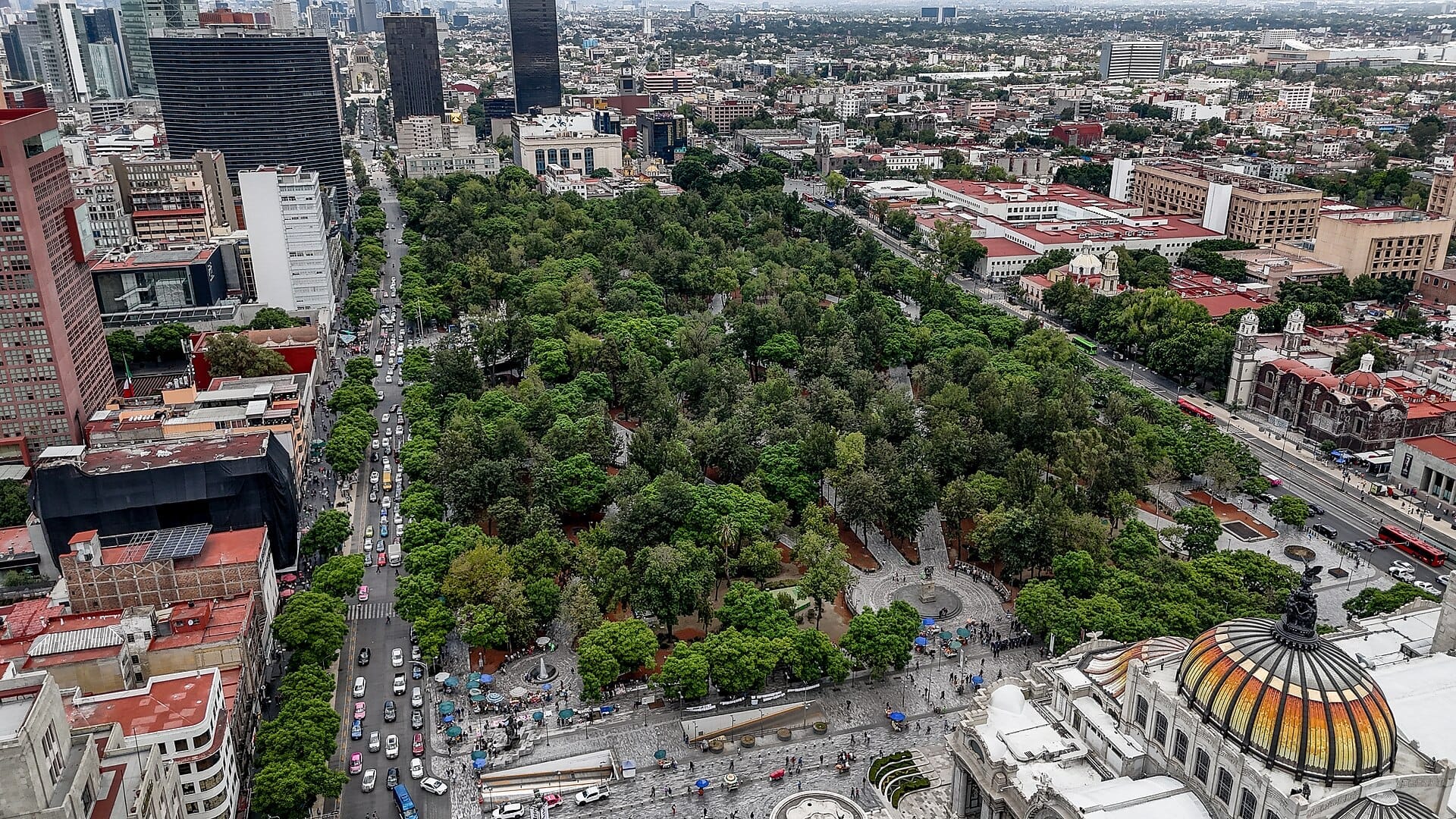
Alameda Central is a formal urban park occupying a full city block in the heart of Mexico City's historic center, bounded by Avenida Hidalgo to the north and Avenida Juárez to the south. It was established in 1592 by Viceroy Luis de Velasco II, making it the oldest public park in the Americas, predating most of Europe's great public gardens by decades. That fact alone gives it a certain weight you feel before you even step inside.
The park sits immediately west of the Palacio de Bellas Artes, one of Mexico City's most photographed buildings, and forms part of the broader cultural corridor that defines the Centro Histórico. Visitors moving between the Zócalo and the western edge of the historic center pass through or alongside the Alameda almost by default. It is not a secret or a detour. It is a fixed point in the city's geography.
💡 Local tip
The Bellas Artes Metro station (Lines 2 and 8) surfaces directly at the park's eastern boundary. Exit the station and you are already inside the Alameda's orbit. No navigation required.
How the Park Changes Through the Day
Mornings at Alameda Central are quiet by Mexico City standards. From around 8:00 AM, the park opens to a mix of older residents doing slow circuits of the main promenade, vendors arranging their carts along the perimeter, and a handful of office workers cutting through on their way east. The air at this elevation, around 2,240 meters above sea level, is noticeably cool and carries the faint smell of damp stone and freshly watered soil from the irrigation that happens early in the day. The light is soft, the shadows long, and the park's formal geometry of paths, fountains, and pruned trees reads most clearly in the morning stillness.
By midday the character shifts. Food carts concentrate near the main entrances, the benches fill with people eating lunch, and the central fountain becomes a focal point for families with children and couples. On weekdays the crowd is largely local. On weekends, especially Sunday, the park becomes dense: balloon sellers, street performers, families from across the metropolitan area, and a constant low hum of conversation and music from competing speakers. If you want to observe the park as a working social institution rather than a garden, Sunday afternoon is exactly the right time. If you want photographs of the trees and statuary without people in every frame, come on a weekday before 10:00 AM.
By early evening, the light turns golden and the park takes on a more relaxed quality. Joggers appear. The bench crowd thins slightly as vendors begin packing up. The park officially closes at 10:00 PM, and the glow from the Bellas Artes building across the street makes the eastern end photogenic well into the night.
Tickets & tours
Live prices and dates from our booking partner. If you book, we may earn a commission at no extra cost to you.
Puebla and Cholula guided tour from Mexico City with optional lunch
From 43 €Instant confirmationFree cancellationXochimilco, Coyoacan and Frida Kahlo Museum with skip-the-line tickets
From 63 €Instant confirmationFree cancellationMexico City exploration game and tour in Chimalistac
From 10 €Instant confirmationFree cancellationCuernavaca and Taxco Guided Tour with Optional Lunch
From 40 €Instant confirmationFree cancellation
The Park's Layout and What You'll See
Alameda Central is designed in a formal European style, which reflects the colonial-era preference for ordered public space over naturalistic landscape. Wide paved promenades cut the park into sections, lined with tall shade trees that form a near-continuous canopy. The tree cover is one of the park's most practical qualities: on warm spring afternoons, when temperatures in central Mexico City can reach the mid-20s Celsius, the shade inside the park is noticeably cooler than the surrounding streets.
Several fountains punctuate the interior, the most prominent being a central basin that anchors the park's main east-west axis. Benches are abundant and usually occupied. Scattered through the park are marble statues and ornamental urns from different periods of the park's history, giving it a layered, slightly museum-like quality underfoot. None of this is labeled in any systematic way, so unless you have specific historical interest, it functions mostly as pleasant ambient detail.
Near the park's western end, the Museo Mural Diego Rivera sits directly adjacent. It houses one of Rivera's most celebrated murals, 'Dream of a Sunday Afternoon in the Alameda Central,' which depicts the park's social life across centuries of Mexican history. It is worth treating as an extension of your park visit rather than a separate destination, since the mural directly references the ground you just walked.
Historical and Cultural Context
When Viceroy Luis de Velasco II ordered the park's creation in 1592, the site had previously been used as a marketplace and reportedly as the location of Inquisition-related executions. The transformation into a regulated public promenade was deliberate: it imposed order, signaled European civic values, and gave the colonial capital a formal space for social display. Access in the early centuries was not universal. The park was initially reserved for the Spanish elite and operated under social rules that excluded many residents of the city.
Over the following four centuries the park passed through periods of neglect and renovation, reflecting the political upheavals of Mexican history: the Reform War, the French Intervention, the Porfiriato (during which the park received much of its current formal landscaping and statuary), the Revolution, and multiple rounds of post-earthquake reconstruction. The 1985 earthquake caused significant damage to the surrounding area, and the Alameda was part of the broader reconstruction of the historic center that followed.
Today the park is classified as part of the UNESCO World Heritage Site that encompasses the historic center of Mexico City and Xochimilco, recognized in 1987. This designation covers the broader historic center rather than the park alone, but it underscores Alameda Central's role as a component of one of the most significant urban heritage zones in the Americas. For more on the surrounding area, the Metropolitan Cathedral and Templo Mayor are both within a fifteen-minute walk east.
Weather, Seasonality, and What to Bring
Mexico City has a subtropical highland climate, which means temperatures are mild year-round but the difference between the dry season (roughly November to April) and the rainy season (May to October) matters for an outdoor visit. During the dry season, the park is reliably usable at any hour. The air can be hazy due to atmospheric inversions in winter, particularly December through February, but the park itself is comfortable.
During the rainy season, afternoon thunderstorms are common from around 4:00 PM onward. They are usually intense but short. The park's canopy provides partial shelter, but if you want to avoid getting wet you either need to visit in the morning or be prepared to wait out a 20-minute downpour under a tree. The upside: the park is greenest and most lush from June through September, and the post-rain light in the late afternoon is good for photography.
⚠️ What to skip
Mexico City sits at 2,240 meters above sea level. First-time visitors sometimes underestimate how quickly sun exposure affects them at this altitude. Bring water and sunscreen even if the temperature feels moderate.
What's Around It: The Surrounding Cultural Cluster
Alameda Central's value increases significantly when combined with its immediate neighbors. The Palacio de Bellas Artes at the park's eastern edge is Mexico's premier fine arts venue, housing murals by Rivera, Orozco, and Siqueiros on its upper floors, with a concert hall that hosts the Ballet Folklórico de México. Even if you don't enter for a performance, the building's exterior, a combination of Art Nouveau and Art Deco that took three decades to complete, is worth close examination.
One block further east, the Museo Franz Mayer occupies a 16th-century hospital building on the north side of the park and holds one of Mexico's finest collections of decorative arts. It is an often-overlooked stop that rewards visitors interested in colonial-era craftsmanship. The museum's courtyard café is a useful rest point if your feet need a break from the pavement.
The Museo de Arte Popular is a short walk south of the Alameda on Calle Revillagigedo and offers a thorough survey of Mexican folk art and craft traditions, organized by region. It pairs well with the Alameda as part of a half-day route through this corner of the historic center.
Worth Your Time?: Who Will Enjoy This, Who Won't
Alameda Central is not a destination park in the way that, say, Chapultepec is. It does not have a forest, a lake, a castle, or a zoo. It is a formal urban garden, roughly rectangular, with trees, fountains, and benches. If you are expecting a large green escape from the city, you will be disappointed. The surrounding streets are busy and the city noise is always present.
What the park offers is atmosphere, history, and convenience. For travelers building a route through the historic center, it is a natural rest point between monuments, a place to eat something from a cart, sit in the shade, and watch Mexico City operate at ground level. Paired with a visit to the Bellas Artes and the Diego Rivera Mural Museum, it forms a coherent and rewarding morning. As a standalone destination, it works best for people who enjoy parks as social spaces rather than those looking for nature. For broader context on how to fit it into a visit, see our 3-day Mexico City itinerary.
Insider Tips
- The park's northwest corner, near the Museo Franz Mayer entrance, is consistently less crowded than the central fountain area and the southeast corner near Bellas Artes. If you want a bench to yourself, head northwest.
- Street food quality near the park perimeter varies considerably. The elote (corn) and esquites carts that appear in the afternoon tend to be more reliable than the packaged snack vendors near the Metro exit. Look for carts with a visible queue from locals.
- The best exterior photographs of the Palacio de Bellas Artes use the Alameda's tree line as a foreground frame. Position yourself on the main east-west path inside the park, roughly at the midpoint, and shoot toward the dome in the early morning when the facade catches direct light.
- If you visit on a Sunday, the area around the park becomes significantly more animated from around noon onward. Street musicians, folk dance groups, and craft markets sometimes appear on the adjacent pedestrian sections of Avenida Juárez. Check in advance whether any scheduled cultural events coincide with your visit through the Mexico City government's events calendar.
- The Museo Mural Diego Rivera, directly to the park's west, charges a small admission fee but is small enough to see in 30 minutes. Rivera's mural depicts the Alameda itself and is best viewed after you have walked the park, since you will recognize the spatial references in the painting.
Who Is Alameda Central For?
- Travelers building a walking route through the Centro Histórico who want a shaded midpoint rest
- History-focused visitors interested in colonial urban planning and its legacy
- Families looking for free outdoor space in the center of the city
- Photographers working the Bellas Artes exterior and wanting multiple angles and foreground options
- Anyone visiting the Museo Mural Diego Rivera or Museo Franz Mayer, both immediately adjacent
Nearby Attractions
Other things to see while in Centro Histórico:
- Calle Madero
Avenida Francisco I. Madero connects the Zócalo to the Torre Latinoamericana along one of the oldest streets in the Americas. Free to walk at any hour, it layers colonial architecture, street performance, and everyday city life into a single corridor that doubles as an open-air history lesson.
- Casa de los Azulejos
Casa de los Azulejos is one of the most photographed facades in Mexico City, its exterior wrapped in blue-and-white Talavera tiles from Puebla. With documented origins in the 16th century and operating as a Sanborns restaurant since 1919, it offers free entry and a rare chance to step inside a baroque palace that has survived centuries of history.
- La Ciudadela Artisan Market
The Mercado de Artesanías de La Ciudadela is one of Mexico City's largest and best-known handicraft markets, with more than 350 vendors selling handmade goods from across 22 states. Entry is free, quality ranges from tourist trinkets to serious collector pieces, and knowing how to navigate the stalls makes all the difference.
- Mercado de San Juan
Mercado de San Juan, formally known as Mercado de San Juan Ernesto Pugibet, is a specialty food market in the heart of Centro Histórico where vendors sell imported cheeses, exotic meats, fresh seafood, Japanese ingredients, and hard-to-find spices alongside traditional Mexican produce. It operates as a public municipal market with no admission fee, making it one of the most accessible gourmet destinations in the city.
Planning a trip? Discover personalized activities with the Nomado app.