Templo Mayor: Mexico City's Aztec Heart, Buried and Rediscovered
Templo Mayor is the excavated ceremonial core of Tenochtitlan, the Aztec capital that once stood where Mexico City now rises. The site pairs open-air ruins with a world-class on-site museum, making it one of the most historically charged stops in Latin America.
Quick Facts
- Location
- Seminario 8, Centro Histórico, Mexico City (northeast corner of the Zócalo)
- Getting There
- Metro Zócalo/Tenochtitlán (Line 2), approx. 1-minute walk
- Time Needed
- 2 to 3 hours for both the ruins and museum
- Cost
- Paid admission in MXN (site + museum combined); set by INAH — verify current price before visiting
- Best for
- History lovers, archaeology enthusiasts, travelers wanting to understand Mexico City's pre-colonial foundations
- Official website
- www.inah.gob.mx
What Is Templo Mayor?
Templo Mayor was the principal temple of the Mexica civilization, the people commonly called the Aztecs. It stood at the center of Tenochtitlan, the island capital they built in the middle of Lake Texcoco starting around 1325 CE. When Hernán Cortés and Spanish forces completed their conquest in 1521, the temple complex was systematically dismantled, and its stones were repurposed to construct the colonial city that would become Mexico City. The ruins sat buried beneath streets and colonial buildings for nearly 450 years.
The site reemerged in 1978 when electrical workers digging near the Metropolitan Cathedral struck a massive circular stone monolith depicting the dismembered goddess Coyolxauhqui. That discovery triggered a large-scale excavation project under INAH (Instituto Nacional de Antropología e Historia), which eventually cleared the area and opened the Museo del Templo Mayor in 1987. Today the site spans an entire city block in the Centro Histórico, just steps from the Zócalo, yet it occupies a completely different temporal dimension.
ℹ️ Good to know
Opening hours: Tuesday to Sunday, 9:00–17:00; last entry typically 16:30. Closed Mondays. Mexican residents may be eligible for free admission on certain days — confirm directly with the site or via INAH before visiting, as policies change.
The Ruins: What You're Actually Looking At
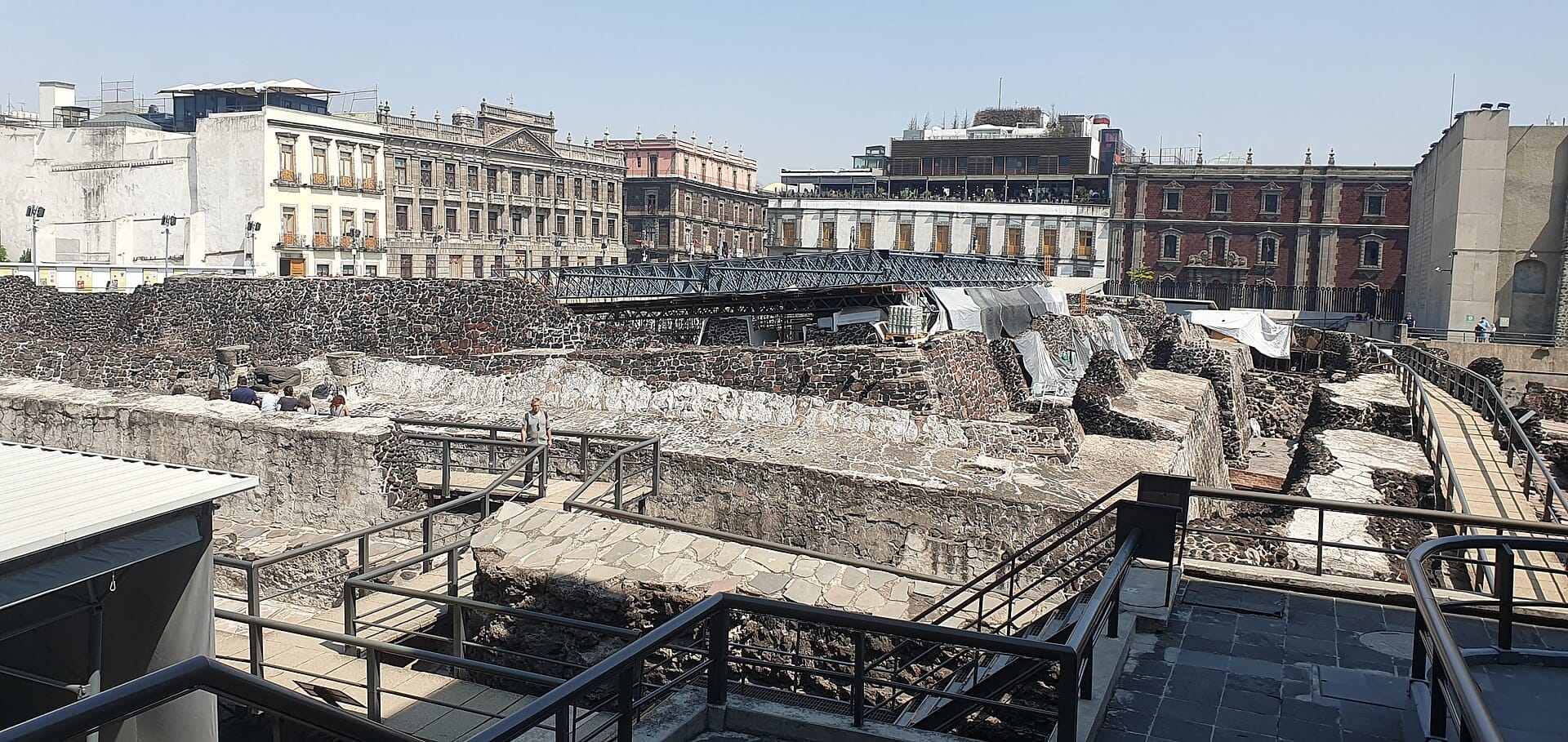
Entering the archaeological zone, the first thing most visitors notice is the layering. The Mexica rebuilt Templo Mayor at least seven times, each new structure encasing the previous one like a set of nested boxes. What you see are cross-sections of those phases: sloped talud walls, ceremonial platforms, stone serpent heads, and the eroded but legible outlines of stairways that once climbed to twin shrines at the summit. One shrine was dedicated to Huitzilopochtli, god of war and the sun; the other to Tlaloc, god of rain and agriculture.
The walkways through the site are raised metal platforms, which keeps foot traffic above the ruins while allowing close inspection. The stones are exposed but not sterile. Lichen edges some surfaces. A few sacrificial platforms still show their characteristic rounded fronts, and nearby you can see remains associated with skull racks (tzompantli) used for displaying human skulls. The scale is more intimate than many visitors expect — you are not looking at towering pyramids but at the excavated foundations and mid-level construction phases of what was once a temple rising high above the city center.
For context on what the full pyramid would have looked like at its peak, the site works well alongside a visit to Tenochtitlan's older neighbor, Teotihuacan, where structures remain largely intact at height. The two sites together give a far richer picture of pre-Columbian urbanism in central Mexico.
Tickets & tours
Live prices and dates from our booking partner. If you book, we may earn a commission at no extra cost to you.
Puebla and Cholula guided tour from Mexico City with optional lunch
From 43 €Instant confirmationFree cancellationXochimilco, Coyoacan and Frida Kahlo Museum with skip-the-line tickets
From 63 €Instant confirmationFree cancellationMexico City exploration game and tour in Chimalistac
From 10 €Instant confirmationFree cancellationCuernavaca and Taxco Guided Tour with Optional Lunch
From 40 €Instant confirmationFree cancellation
The Museum: Don't Rush Past It
The Museo del Templo Mayor, housed in a modern building on the northeast edge of the site, is not an afterthought. It is one of the strongest archaeological museums in the country, and many visitors who budget only an hour for the whole complex leave regretting they didn't spend more time inside.
The museum contains thousands of objects recovered from the excavation: carved stone vessels, ceramic figurines, obsidian blades, shell ornaments, flint sacrificial knives still showing traces of red pigment, and elaborate feathered headdress reconstructions. The centerpiece is the Coyolxauhqui Stone, a roughly 3.25-meter diameter monolith showing the dismembered moon goddess, displayed in a dedicated chamber at the museum's heart. The carving's detail and scale are striking. Give it five full minutes, not a passing glance.
Exhibit text is in Spanish throughout, with English translations in the main galleries. Signage quality is high, and the curatorial logic moves clearly from the cosmological framework of Aztec religion through the archaeological layers and into specific artifact groups. If you read slowly, factor in closer to ninety minutes for the museum alone.
💡 Local tip
Start with the museum before walking the outdoor ruins. Understanding the iconography and construction sequence inside makes the exterior site significantly more readable.
How the Experience Changes by Time of Day
Arriving at opening time, around 9:00, gives you the ruins largely to yourself. Morning light comes from the east and falls directly across the stone surfaces, sharpening texture and shadow in a way that midday sun flattens completely. The air in the Centro Histórico at that hour carries the smell of bread from nearby bakeries and exhaust from delivery trucks, a reminder of the living city pressing against the excavation on all sides.
By 11:00, school groups begin to arrive in numbers. They move through in clusters with guides, often gathered around specific features like the Tzompantli or the eagle warrior sculptures. Early afternoon, roughly 12:00 to 14:00, is when the site sees its highest volume of visitors, and queuing at the ticket window can add fifteen minutes to your wait. The outdoor sections can feel crowded on the narrow platforms during peak hours.
Arriving after 14:00 offers another quieter window. Guided tour groups have largely cleared out, and you can move through the ruins at your own pace. The museum stays comfortable throughout the day since the building is climate controlled, which matters: Mexico City sits at roughly 2,240 meters above sea level, and even mild sun exposure in the open-air sections can tire visitors more quickly than expected.
⚠️ What to skip
Mexico City's altitude (around 2,240 m / 7,350 ft) affects visitors arriving from sea level. If you feel lightheaded or short of breath early in your trip, take breaks in the shaded or indoor sections rather than pushing through the outdoor route quickly.
Historical and Cultural Context
At its height in the early 16th century, Tenochtitlan was one of the largest cities on Earth, with a population that various estimates place between 200,000 and 300,000. The Templo Mayor sat at the literal axis of this city, understood in Aztec cosmology as the navel of the universe. Its dual dedication to Huitzilopochtli and Tlaloc was not arbitrary: the pairing represented the two fundamental concerns of the Mexica state, military expansion and agricultural sustenance, inscribed in stone at the center of everything.
The Spanish decision to build the new colonial capital directly over Tenochtitlan was both practical and symbolic. The Metropolitan Cathedral, visible from the ruins across a narrow street, was constructed using stones taken from the Templo Mayor complex itself. Standing at the edge of the excavation and looking at the cathedral's baroque facades, you are looking at reused material, a physical record of one civilization erasing and overwriting another.
The Centro Histórico neighborhood holds this layering everywhere you look. The Metropolitan Cathedral leans visibly because of subsidence from the drained lakebed below. The National Palace occupies the site of Moctezuma II's palace. Templo Mayor is just the most explicit and excavated layer of a city that is archaeologically continuous with its pre-Columbian past.
Practical Walkthrough and Logistics
Getting here is straightforward. Metro Line 2 stops at Zócalo/Tenochtitlán, and the site entrance on Seminario is a three-minute walk northeast from the station exit. If you are coming from Roma or Condesa, a taxi or ride-hailing app to the Zócalo takes between fifteen and thirty minutes depending on traffic. Parking in the Centro Histórico is limited and congested; public transit is the practical choice.
Wear comfortable shoes with grip. The raised platform walkways are generally level, but some sections of the ruins involve shallow uneven steps, and the tile floors in the museum entrance can be slippery when wet. Carry water. The ticket window accepts cash in Mexican pesos; card payment availability can vary so bring cash as a backup. Photography is allowed throughout the outdoor site and in most of the museum, without flash near sensitive artifacts.
If you have time after visiting, the surrounding streets reward a short walk. Calle Madero runs west from the Zócalo and passes the Palacio de Bellas Artes and the Casa de los Azulejos. The historic center rewards slow exploration, and Templo Mayor makes a natural anchor point for a half-day in the area. For a broader look at pre-Hispanic collections in the city, the Museo Nacional de Antropología in Chapultepec houses one of the world's great archaeological collections and covers civilizations well beyond the Mexica.
Who Should Consider Skipping This
Travelers with no interest in pre-Columbian history or archaeology may find the experience less rewarding than expected. The ruins are excavated foundations and mid-level construction, not towering intact structures, and visitors hoping for dramatic visual scale comparable to Teotihuacan or Chichen Itza will be underwhelmed by the exterior. The site is also not suitable for visitors with significant mobility limitations, as portions of the archaeological zone involve stairs and uneven surfaces that are not fully accessible.
Families with young children can have a good experience here, particularly in the museum where the large stone carvings and well-lit display cases hold attention easily. But the detailed interpretive content is aimed at adults and older students. Children under five may struggle with the pace and lack of interactive elements.
Insider Tips
- Request an audio guide at the ticket desk if available — the site's spatial layout makes self-guided visits with only the posted signage feel incomplete, especially in the outdoor sections where context is sparse.
- The Coyolxauhqui Stone chamber in the museum has a mezzanine-level viewing gallery. Most visitors only see it from the ground floor. Take the stairs up for the overhead perspective, which reveals the full circular composition of the carving far more clearly.
- Check INAH's calendar before visiting. The site occasionally closes sections for ongoing excavation work or conservation, and holiday closures are not always announced far in advance. A quick check of the INAH website saves a wasted trip.
- If you want photographs of the ruins without people in the frame, arrive within the first thirty minutes of opening on a Tuesday or Wednesday. Weekend mornings fill quickly, even early.
- The small café near the museum entrance is a decent place to stop after your visit. The plaza outside gets noisy and crowded in the afternoon; this interior option is quieter and cooler.
Who Is Templo Mayor For?
- Travelers with a serious interest in Aztec history, religion, or Mesoamerican archaeology
- First-time visitors to Mexico City who want to understand the city's pre-colonial foundations
- Museum visitors who appreciate curatorially strong permanent collections over rotating exhibitions
- History-oriented travelers combining the site with a broader Centro Histórico walking route
- Students or researchers with context in Mesoamerican studies looking for direct engagement with primary material
Nearby Attractions
Other things to see while in Centro Histórico:
- Alameda Central
Founded in 1592, Alameda Central is the oldest public park in the Americas and the green centerpiece of Mexico City's historic center. Flanked by the Palacio de Bellas Artes and a ring of colonial-era institutions, it offers free entry, shaded walkways, and a front-row seat to everyday city life.
- Calle Madero
Avenida Francisco I. Madero connects the Zócalo to the Torre Latinoamericana along one of the oldest streets in the Americas. Free to walk at any hour, it layers colonial architecture, street performance, and everyday city life into a single corridor that doubles as an open-air history lesson.
- Casa de los Azulejos
Casa de los Azulejos is one of the most photographed facades in Mexico City, its exterior wrapped in blue-and-white Talavera tiles from Puebla. With documented origins in the 16th century and operating as a Sanborns restaurant since 1919, it offers free entry and a rare chance to step inside a baroque palace that has survived centuries of history.
- La Ciudadela Artisan Market
The Mercado de Artesanías de La Ciudadela is one of Mexico City's largest and best-known handicraft markets, with more than 350 vendors selling handmade goods from across 22 states. Entry is free, quality ranges from tourist trinkets to serious collector pieces, and knowing how to navigate the stalls makes all the difference.
Planning a trip? Discover personalized activities with the Nomado app.