Museo Nacional de Antropología: What to See, When to Go, and Why It Matters
The Museo Nacional de Antropología is widely regarded as one of the most important anthropology museums in the Americas, housing a world‑class collection of ancient Mesoamerican artifacts. Set inside Chapultepec Park, it demands at least half a day and rewards visitors who come prepared.
Quick Facts
- Location
- Av. Paseo de la Reforma y Calzada Gandhi, Chapultepec Polanco, Mexico City
- Getting There
- Metro Auditorio (Line 7) or Chapultepec (Line 1), approx. 1.3 km walk; or Metrobús Gandhi (Line 7, closest stop)
- Time Needed
- 3 to 5 hours minimum; a full day for serious visitors
- Cost
- MX$210 general admission; MX$105 for nationals and foreign residents; free Sundays for Mexican nationals and legal residents; free for under-13s, seniors 60+ (INAPAM ID), teachers, and people with disabilities
- Best for
- History enthusiasts, archaeology lovers, first-time Mexico City visitors, families with older children
- Official website
- mna.inah.gob.mx
What the Museo Nacional de Antropología Is
The Museo Nacional de Antropología, known by its initials MNA, is not simply a large museum with old things inside. It is the institutional memory of a civilization. Inaugurated on 17 September 1964 and designed by architect Pedro Ramírez Vázquez, the building itself is a monument: a vast concrete structure organized around an open-air patio covered by a single cantilevered stone umbrella supported by one central column, over which water cascades continuously. The sound of that fountain is the first thing you notice as you step through the entrance into the central courtyard.
The museum contains 22 permanent exhibition halls, arranged across two floors, along with spaces for temporary exhibitions. The ground floor covers the pre-Hispanic cultures of Mexico in geographical and chronological order, from the earliest human presence in the Americas through the Aztec empire. The upper floor is dedicated to ethnographic displays of living indigenous cultures across Mexico today. Most visitors focus almost entirely on the ground floor, which is where the most famous objects are housed, including the Aztec Sun Stone and the tomb of the Mayan ruler Pakal.
💡 Local tip
The museum opens from 09:00 to 18:00 Tuesday through Sunday and is closed on Mondays. Arrive within the first 30 minutes of opening to walk the ground-floor halls without the afternoon crowds that arrive after tour buses begin arriving around 10:30.
The Collection: What You Will Actually See
The scale of the collection is quite difficult to absorb in a single visit. Twenty-two permanent halls cover cultures including the Preclassic Period, Teotihuacan, Toltec, Mexica (Aztec), Oaxacan, Gulf Coast, Maya, and several northern and western Mexican civilizations. Each hall functions almost as its own self-contained museum, with artifacts, scale models, murals, and explanatory panels in both Spanish and English.
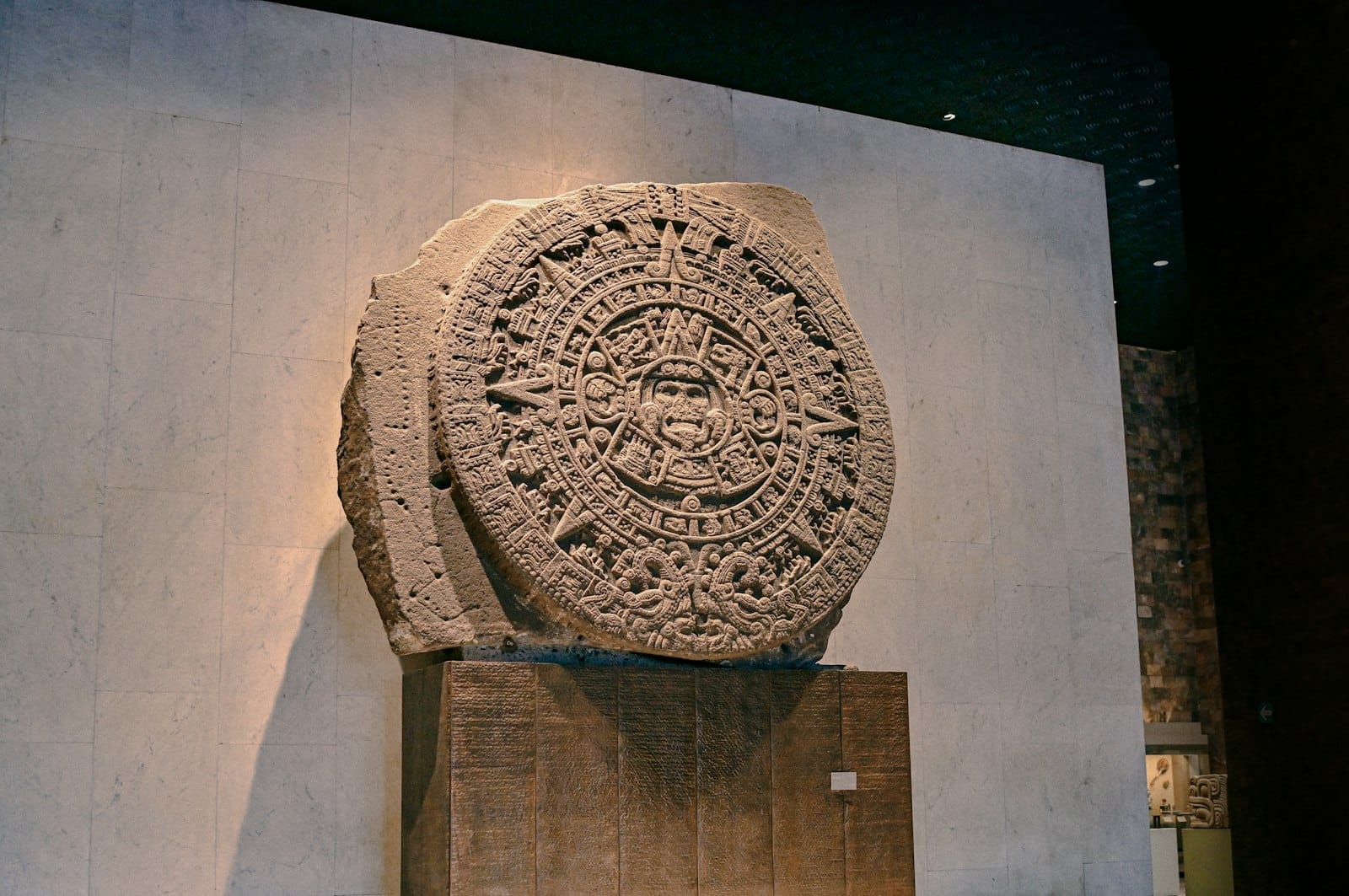
The Mexica Hall, also called the Aztec Hall, is the largest and the emotional center of the museum. The Piedra del Sol, commonly called the Aztec Sun Stone or Aztec Calendar Stone, dominates the room from a wall mount at eye level. At roughly 3.6 meters in diameter and weighing approximately 24 tons, it is more arresting in person than any photograph suggests. The carvings are extraordinarily fine for an object carved from basalt in the late 15th century. There is usually a small crowd in front of it, but the hall is wide enough that you can find an unobstructed angle.
The Maya Hall contains one of the museum's most quietly stunning spaces: a full reconstruction of the tomb of K'inich Janaab' Pakal, the 7th-century ruler of Palenque, discovered by archaeologist Alberto Ruz Lhuillier in 1952. You descend a sloped corridor to reach a reproduction of the burial chamber, and then view the actual jade burial mask, jade suit, and funerary objects in a dedicated display case. The contrast between the theatrical reconstruction and the delicate physical objects a few meters away is deliberately effective.
The Teotihuacan Hall deserves more time than most visitors give it. Teotihuacan was one of the largest cities in the ancient world, and the objects on display here, including painted murals removed from temple walls, give a sense of a metropolis with sophisticated urban planning, trade networks, and artistic traditions. If your visit to the museum inspires an interest in Teotihuacan itself, the site is reachable as a day trip. See the full guide to the Teotihuacan archaeological site for logistics and what to prioritize.
Tickets & tours
Live prices and dates from our booking partner. If you book, we may earn a commission at no extra cost to you.
Xochimilco, Coyoacan and Frida Kahlo Museum with skip-the-line tickets
From 63 €Instant confirmationFree cancellationFrida Kahlo and Diego Rivera legacy visit to three museums with skip-the-line tickets
From 67 €Instant confirmationFree cancellationSix Flags Amusement Park tickets and transportation
From 87 €Instant confirmationFree cancellationMexico City National Museum of Anthropology guided tour
From 57 €Instant confirmationFree cancellation
How the Visit Changes by Time of Day
At opening, around 09:00 to 10:00, the museum is noticeably quiet. The light in the central courtyard is cool and diffuse, the fountain sounds clearly over ambient noise, and the halls are largely empty. The air smells faintly of stone and the damp of the courtyard plants. This is when you can stand in front of the Sun Stone alone, read the wall panels without someone blocking your view, and think.
By 11:00 the character shifts. School groups arrive in waves, often 40 to 60 children moving through the halls with guides speaking at full volume. Tour groups from the Zócalo hotels add a second layer. The Mexica Hall becomes particularly crowded and the acoustics, already reverberant in those high-ceilinged spaces, make concentration harder. The café near the main entrance gets a queue.
The late afternoon, roughly 15:30 to closing at 18:00, offers a second window of calm. Most tour groups have left and the light changes in the courtyard as shadows lengthen across the stone. The upper ethnographic floor is almost always quieter than the ground floor at any hour, and on weekday afternoons you can walk through the Oaxaca, Purépecha, and Nahua ethnographic halls almost in solitude.
⚠️ What to skip
Sundays are free for Mexican nationals and legal residents with FM documentation. This means Sunday attendance is significantly higher than on weekdays. If you are paying general admission and want space to think, a Tuesday or Wednesday morning is the quietest option.
The Architecture and the Courtyard
The building designed by Pedro Ramírez Vázquez, Rafael Mijares, and Jorge Campuzano was completed in an extraordinary 19 months. The central patio is around 100 meters long and the cantilevered roof structure, called the paraguas (umbrella), spans approximately 82 by 54 meters supported by that single column. Water flows from the top of the column down its sides continuously, a feat of engineering that doubles as a sensory landmark: you always know where you are in the building relative to the sound of falling water.
The interior layout reflects a deliberate philosophy. Cultures are arranged so that you move from general (human origins, early Mesoamerica) to specific (individual civilizations), and the halls open onto the courtyard at intervals, giving natural pause points. The combination of indoor gallery and open-air courtyard means the museum does not feel claustrophobic even when it is full. On warm days, the courtyard benches in the shade of the paraguas are occupied by people resting between halls.
The museum is set within Chapultepec Park, Mexico City's largest urban park, which means the walk from the entrance gate through tree-lined paths before you reach the museum building is itself a pleasant decompression from city traffic. The park entrance on Reforma is about 500 meters from the museum's main door.
Practical Walkthrough: Getting There and Moving Around
The closest public transit stop is Metrobús Antropología on Line 7, which stops essentially at the museum's front gate on Reforma. This is the most direct option if you are coming from Roma, Condesa, or the Paseo de la Reforma corridor. Alternatively, Metro Line 1 (Chapultepec station) and Metro Line 7 (Auditorio station) are both within a walk of approximately 1.3 kilometers through the park.
Bags larger than a small backpack must be checked at the free cloakroom, which operates from 09:00 to 18:00. Wheelchairs are available free of charge from the main lobby, and the building has elevators and stair lifts for visitors with mobility needs. The museum is reasonably accessible in its infrastructure, though some of the older display cases are low and can be difficult to see from a seated position.
Photography without flash is permitted throughout the museum. Tripods are not permitted without prior authorization. The lighting in most halls is sufficient for smartphone photography, though the Pakal tomb reconstruction area is dim. Audio guides are available for rent at the museum, and the museum's official app provides additional content for several rooms. English-language signage covers all major exhibits.
ℹ️ Good to know
The museum has a café and a dedicated restaurant on-site, so a full day visit does not require leaving the premises for food. There is also a bookshop near the main entrance with an extensive selection of Mexican archaeology and anthropology titles, including some not commonly found elsewhere in the city.
Historical and Cultural Weight
The MNA was not the first version of Mexico's national anthropology museum. The institution traces its origins to the 19th century, when collections were first assembled in the former Royal and Pontifical University and later moved to the Monolith Gallery. The 1964 building was designed deliberately to reframe Mexico's relationship with its pre-Hispanic past: not as something distant and archaeological, but as a foundational identity. President Adolfo López Mateos inaugurated the building, and the choice to include the living ethnographic cultures of modern indigenous Mexico on the upper floor was an explicit statement that these civilizations did not end with the Conquest.
Understanding the objects in this museum becomes richer if you have already walked through the places they came from. The Templo Mayor in the historic center is the excavated remains of the main Aztec temple, and seeing those ruins before or after visiting the MNA gives the collection a physical anchor. Similarly, a visit to the National Palace murals by Diego Rivera, which depict much of the same history, provides a 20th-century artistic interpretation of what the museum presents archaeologically.
The museum has not been without controversy. In 1985, a thief stole 140 objects in a single night, including irreplaceable Mayan jade pieces and Monte Albán goldwork. Some were recovered years later, others remain missing. The theft prompted significant changes to the museum's security systems. The episode is a reminder that this collection, while institutional, is finite and irreplaceable.
Who This Museum Is For, and Who Might Leave Disappointed
Visitors who arrive with context get vastly more from the MNA than those who walk through without any preparation. Reading even a basic overview of Aztec, Mayan, and Teotihuacan history before you go transforms the objects from impressive but opaque to easy to read. The English-language panels are informative, but they cannot substitute for the mental framework that background knowledge provides.
Families with children under 10 should think carefully before committing to the full museum. The collection is not designed for young children, the halls are large and tiring, and there are limited interactive elements for that age group. The Papalote Museo del Niño nearby is a better fit for small children. Older children and teenagers with an interest in history, however, often respond strongly to the MNA, particularly the Pakal tomb reproduction and the scale of the Mexica Hall.
If you are visiting Mexico City for only two or three days and are primarily interested in food, nightlife, or contemporary culture, the MNA may not be the highest priority. It is an intense, cerebral experience that requires several hours and real engagement. Visitors who treat it as a quick checkbox will leave underwhelmed by what is, in fact, one of the world's truly exceptional museums.
Insider Tips
- Start your visit in the Teotihuacan Hall rather than the Mexica Hall. Most visitors head directly to the Aztec rooms, meaning those halls are crowded from opening. Starting at Teotihuacan and moving chronologically means you reach the Mexica Hall after the first rush has thinned.
- The upper ethnographic floor is almost always uncrowded, even on busy days. If you need a break from the packed ground floor, go upstairs. The Nahua and Maya ethnographic halls are especially interesting and almost always quiet.
- The museum bookshop carries scholarly publications on Mexican archaeology, many published by INAH, that are not easily found in general bookshops. If you are interested in deeper reading, budget time for the shop before you leave.
- Bring a layer. The museum's large halls and high ceilings can feel cool, especially in the morning or during the rainy season months when outside temperatures drop after afternoon storms. The central courtyard is open-air, so temperatures follow the weather.
- The audio guide covers the major highlights but skips many rooms entirely. If you want to use one effectively, listen to it in the Mexica and Maya halls, then explore other halls on your own using the printed museum map and the bilingual wall panels.
Who Is Museo Nacional de Antropología For?
- First-time visitors to Mexico City who want historical context for everything else they see
- Archaeology and pre-Hispanic history enthusiasts who could spend a full day with the collection
- Travelers planning a trip to Teotihuacan, Oaxaca, or the Yucatan who want to understand the civilizations before visiting the sites
- Photography visitors with an interest in monumental sculpture and architectural spaces
- Students and researchers with access to INAH resources or the museum's library
Nearby Attractions
Other things to see while in Chapultepec & Polanco:
- Avenida Presidente Masaryk
Avenida Presidente Masaryk is Polanco's main commercial artery, a roughly 2.8-kilometer stretch of luxury flagships, design showrooms, and terrace restaurants. Free to walk, open around the clock, and easily reached by Metro Line 7.
- Chapultepec Castle
Chapultepec Castle sits atop Cerro del Chapulín, the only royal castle in continental North America still standing in its original location. Once home to emperors and presidents, it now houses the Museo Nacional de Historia, with sweeping views over Mexico City and rooms preserved from the era of Maximilian I.
- Bosque de Chapultepec
Covering roughly 686 hectares in the heart of Mexico City, Bosque de Chapultepec is far more than a city park. It holds world-class museums, a hilltop castle dating to 1785, a free zoo, and lakes where families rent rowboats on weekends. Entry to the park itself is free, and the depth of what's inside rewards as many hours as you can give it.
- Chapultepec Zoo
The Zoológico de Chapultepec sits inside Bosque de Chapultepec and admits visitors free of charge Tuesday through Sunday. With roughly 2,000 animals across 250-plus species, it draws large local crowds on weekends and offers a well worthwhile morning for families and curious travelers alike.
Planning a trip? Discover personalized activities with the Nomado app.