Chapultepec Castle: Mexico City's Palace on the Hill
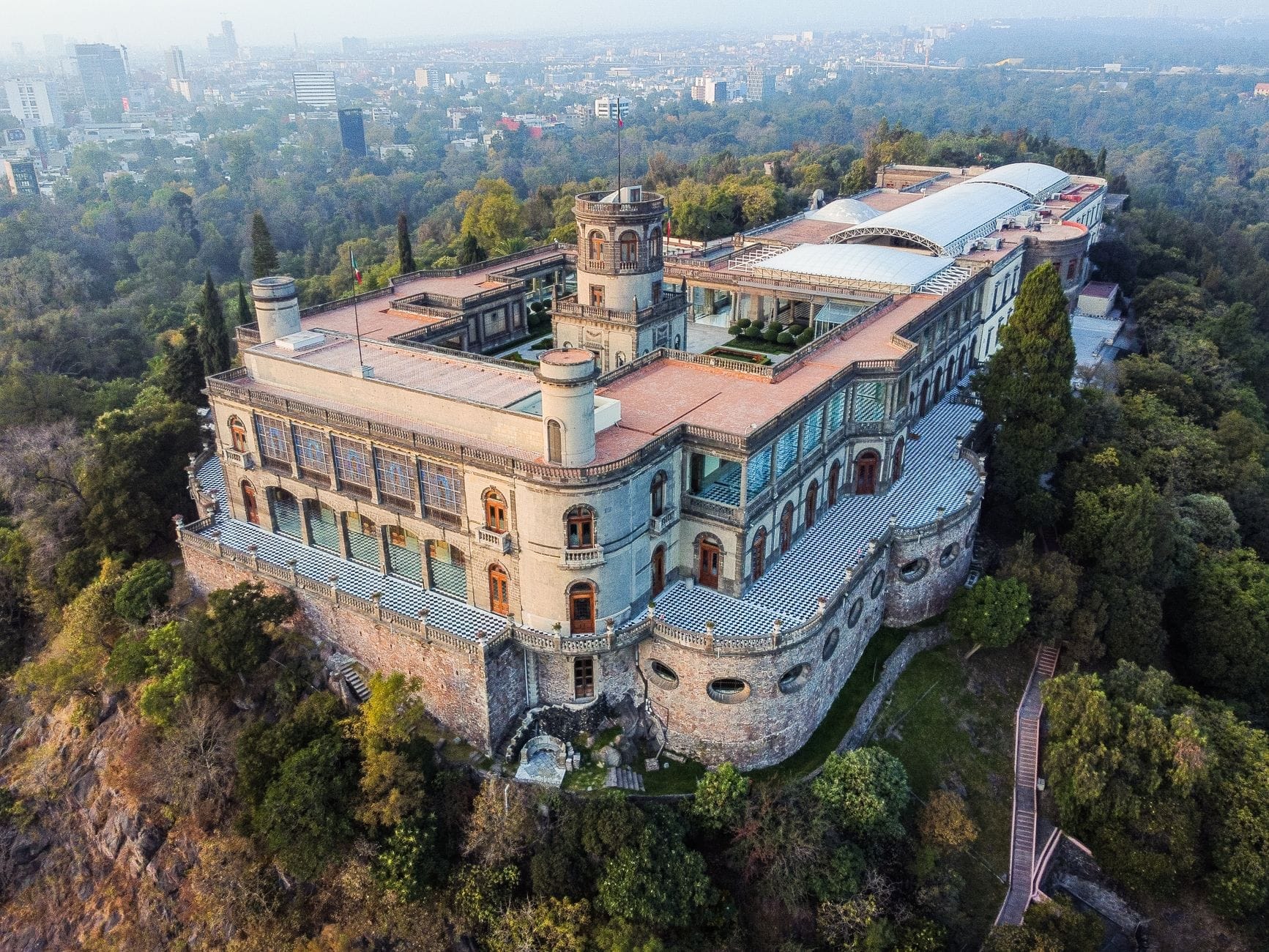
Chapultepec Castle sits atop Cerro del Chapulín, the only royal castle in continental North America still standing in its original location. Once home to emperors and presidents, it now houses the Museo Nacional de Historia, with sweeping views over Mexico City and rooms preserved from the era of Maximilian I.
Quick Facts
- Location
- Primera Sección del Bosque de Chapultepec, Alcaldía Miguel Hidalgo, CDMX
- Getting There
- Metro Chapultepec (Line 1); or Metro Auditorio (Line 7) + Metrobús Line 7 to Gandhi
- Time Needed
- 2 to 3 hours for the castle; add 30–60 min to walk through the park
- Cost
- $85 MXN general admission. Free on Sundays for Mexican nationals and foreign residents with proof of residence. Free for under-13s, over-60s, students, teachers, and people with disabilities.
- Best for
- History enthusiasts, architecture lovers, panoramic city views, families with older children
- Official website
- mnh.inah.gob.mx
What Is Chapultepec Castle?
The Museo Nacional de Historia, housed inside Chapultepec Castle, occupies one of the most symbolically loaded sites in the entire country. The castle crowns Cerro del Chapulín — Grasshopper Hill — rising about 60 meters above the valley floor in the western part of the city. The hill itself has been considered significant since at least the 13th century, used by the Mexica long before Spanish colonizers arrived. The building that stands today began as a colonial-era military academy and was transformed into an imperial residence in the 1860s before eventually opening as a national museum in 1944.
This is not a reconstructed historical site. You are walking through actual rooms where Emperor Maximilian I and Empress Carlota slept, dined, and held court, and through halls where successive Mexican presidents lived before Los Pinos became the official residence. That layering — pre-Hispanic significance, colonial construction, imperial grandeur, republican government, and finally public museum — makes the castle unlike almost anything else in Latin America.
ℹ️ Good to know
The castle is open Tuesday to Sunday, 9:00–17:00 (rooms begin to clear at 16:45). It is closed on Mondays year-round. Admission is $85 MXN. Sundays are free for Mexican nationals and foreign residents with proof of residence (expect larger crowds). Payment is in Mexican pesos only; tickets can also be purchased online via the INAH portal.
The Climb Up and What You Notice First
Access to the castle requires walking through the first section of Bosque de Chapultepec and then ascending a paved ramp up the hillside. The ramp is not steep in gradient, but it is a sustained uphill walk. At roughly 2,240 meters above sea level — Mexico City's base altitude — visitors who are not yet acclimatized may find the ascent more tiring than expected. Plan to take it slowly, especially on warm afternoons.
On weekday mornings, the path up is quiet. The city noise from Paseo de la Reforma drops away behind the trees, and the main sounds are birds and the occasional child on a school trip. On weekend mornings, particularly Sundays when admission is free for residents, the ramp fills early with families and Mexican visitors of all ages. If your priority is experiencing the rooms without crowds, Tuesday or Wednesday before noon is consistently the calmest window. For more context on timing your visit to the broader neighborhood, the guide to Chapultepec and Polanco covers how the area shifts across the week.
💡 Local tip
Wear comfortable, closed-toe shoes. The cobblestone courtyards and uneven stone floors inside the castle can be slippery, and the ramp benefits from grip. A light layer is advisable even in warmer months, as the hilltop catches wind.
Tickets & tours
Live prices and dates from our booking partner. If you book, we may earn a commission at no extra cost to you.
Inside the Castle: Two Distinct Worlds
The museum's approximately 30 exhibition rooms divide into two unmistakably different experiences. The first is the historical narrative of Mexico from the Spanish Conquest through the Revolution of the early 20th century. The second is the preserved imperial and presidential apartments, where original furniture, objects, and decorative schemes remain largely intact.
The historical galleries contain murals, documents, weapons, banners, and period artifacts that trace the arc from colonial rule through independence, the Reform War, the French Intervention, and the upheaval of 1910. The murals by Juan O'Gorman depicting Mexican history are among the most visually striking pieces in the collection. The rooms are labeled in Spanish with some English-language interpretation available in certain sections.
The imperial apartments are a separate atmosphere entirely. Maximilian of Habsburg and Carlota of Belgium occupied the castle from 1864 to 1867, and the rooms they used retain European-imported furniture, gilded mirrors, embroidered textiles, and the particular quality of light that comes through tall windows overlooking the park and the city beyond. These spaces feel less like a museum display and more like a residence where someone simply stopped living. The contrast between the ornate Habsburg interiors and the Revolutionary-era exhibits one corridor away is itself a compressed lesson in Mexican history.
The Terraces and the View
The castle's outdoor terraces are among the best elevated viewpoints in the city that do not require a tower ticket or reservation. From the upper level, the panorama takes in Paseo de la Reforma stretching toward the historic center, the silhouette of the Torre Latinoamericana visible in the distance, and on clear days the volcanic peaks of Popocatépetl and Iztaccíhuatl to the southeast.
Clarity is seasonal. The dry months from November to April generally produce the sharpest views, especially in the mornings before vehicle and industrial emissions build. The rainy season (May to October) brings afternoon thunderstorms that dramatically reduce visibility but occasionally clear the air immediately after. For a broader comparison of city viewpoints, the Mexico City viewpoints guide covers rooftops, towers, and hilltops across the capital.
Photography on the terrace works best in the first two hours after opening, when the sun is behind you for shots looking east toward the city. By midday the light is harsh and flat. Late afternoon creates warmer tones but the park below becomes more backlit. There is no drone policy publicly indicated; assume recreational drone use is prohibited over the archaeological and park zone.
Historical and Cultural Weight
Few sites in Mexico concentrate this much contested history in one location. The Mexica considered Cerro del Chapulín a place of ritual importance. Spanish viceroys established a summer retreat here. A military college was built in the early 19th century, and it was at this college that the Niños Héroes — young military cadets — died defending the castle against US forces during the Mexican-American War in 1847. Their story is embedded in Mexican national identity and commemorated by a monument at the base of the hill.
The castle's transformation into a presidential residence meant that for decades it functioned as both a home and a seat of power, a combination that shaped how its interiors were maintained. Understanding this site in context is easier if you have already visited the National Palace in the historic center, which holds Diego Rivera's famous murals and represents a different register of Mexican political history. Together, the two sites form a coherent arc through the country's post-independence identity.
Practical Walkthrough: Getting There and Moving Through
The most straightforward metro access is via Chapultepec station on Line 1 (the pink line). From the exit, you enter the first section of Bosque de Chapultepec and follow the main avenue toward the hill. Signage is present but inconsistent; the hill is visible once you are inside the park, so orientation is generally easy. The walk from the metro exit to the castle entrance takes roughly 15 to 20 minutes at a comfortable pace.
The castle does not have dedicated parking. Visitors arriving by car should use street parking or paid lots near the park perimeter, though these fill quickly on weekends. The broader Chapultepec Park is large and contains several major attractions, so it is worth planning which sections you want to visit in the same trip. The Museo Nacional de Antropología is a 10-minute walk through the park and is frequently combined with the castle into a full-day itinerary, though doing both thoroughly in one day is ambitious.
Accessibility: The ramp up to the castle is navigable for wheelchairs and mobility aids, though it is long and inclined. Inside, some sections involve uneven stone and stairs without ramps. Visitors with significant mobility limitations should expect that not all rooms will be equally accessible. People with disabilities receive free admission.
⚠️ What to skip
The castle is closed every Monday without exception. Arriving on a Monday is one of the most common visitor mistakes in Chapultepec. If your Mexico City schedule is tight, confirm the day before your visit.
Worth Your Time?: Is It Worth Your Time?
For visitors with a serious interest in Mexican history, the answer is unambiguous: yes, and allow at least two hours. The combination of well-preserved 19th-century interiors, significant historical murals, and a setting with actual panoramic value makes this one of the more substantive museum experiences in the city.
For visitors primarily interested in pre-Hispanic Mexico, the castle skews post-conquest. It will not scratch that itch in the way that Templo Mayor or a trip to Teotihuacán does. The historical narrative inside the museum also assumes some baseline familiarity with Mexican history, and without context, portions of the exhibit can feel like a series of artifacts without clear connective tissue.
Those with very limited time in the city and a three-day itinerary will need to make a deliberate choice between the castle and other major sites. The 3-day Mexico City itinerary can help prioritize if your schedule is tight.
Insider Tips
- Buy tickets online through the INAH portal before you go, especially on weekends. The in-person queue can be slow, and buying ahead lets you walk straight to the entrance.
- The gardens on the south side of the castle, including the formal French-style parterre terraces, are often overlooked by visitors moving directly to the museum rooms. They offer the best unobstructed photography of the castle exterior and the city view without crowds.
- Sundays are free for Mexican nationals and foreign residents with proof of residence, which means the castle is significantly more crowded. If you qualify for free entry and want a quieter visit, come on a Tuesday or Wednesday instead.
- The audio guide, available in Spanish and English, significantly improves the imperial apartment section where English wall text is sparse. It is available for hire at the entrance.
- Combine the castle with the lake area of Chapultepec in the afternoon — by the time you finish the museum, the park crowds are thinning and the water reflects the late-day light well for a post-visit walk.
Who Is Chapultepec Castle For?
- History travelers who want to understand Mexico beyond pre-Hispanic civilizations
- Architecture enthusiasts interested in 19th-century European-influenced interiors in a Mexican context
- Visitors seeking a genuine panoramic city view without paying for a commercial observation deck
- Families with children aged 10 and up who are ready for a museum-length visit with outdoor space before or after
- Photographers working on golden-hour city skyline compositions from an elevated, open platform
Nearby Attractions
Other things to see while in Chapultepec & Polanco:
- Avenida Presidente Masaryk
Avenida Presidente Masaryk is Polanco's main commercial artery, a roughly 2.8-kilometer stretch of luxury flagships, design showrooms, and terrace restaurants. Free to walk, open around the clock, and easily reached by Metro Line 7.
- Bosque de Chapultepec
Covering roughly 686 hectares in the heart of Mexico City, Bosque de Chapultepec is far more than a city park. It holds world-class museums, a hilltop castle dating to 1785, a free zoo, and lakes where families rent rowboats on weekends. Entry to the park itself is free, and the depth of what's inside rewards as many hours as you can give it.
- Chapultepec Zoo
The Zoológico de Chapultepec sits inside Bosque de Chapultepec and admits visitors free of charge Tuesday through Sunday. With roughly 2,000 animals across 250-plus species, it draws large local crowds on weekends and offers a well worthwhile morning for families and curious travelers alike.
- Museo de Arte Moderno
The Museo de Arte Moderno (MAM) occupies two striking circular buildings inside Chapultepec Park, housing some of the finest 20th-century Mexican painting and sculpture in the country. With free admission on Sundays and a sculpture garden connecting the two structures, it rewards both art lovers and casual visitors who happen to be exploring the park.
Planning a trip? Discover personalized activities with the Nomado app.