Teotihuacán: The Ancient City That Still Demands Respect
Roughly 50 kilometers northeast of Mexico City, the Pre-Hispanic City of Teotihuacán once held an estimated 125,000 to 200,000 people and remains the most-visited archaeological site in Mexico. The Pyramid of the Sun, the Pyramid of the Moon, and the Avenue of the Dead are all here — older, wider, and more physically demanding than most visitors expect.
Quick Facts
- Location
- Municipality of Teotihuacán, State of Mexico — approx. 40–50 km northeast of Mexico City
- Getting There
- Direct buses from Terminal Central del Norte (Mexico City); tours depart from most major hotels. No Metro connection.
- Time Needed
- 4–6 hours minimum to cover the main monuments; a full day is more comfortable
- Cost
- Paid admission in MXN, managed by INAH; verify current prices at the ticket office or via official channels before visiting
- Best for
- History travelers, archaeology enthusiasts, photographers, families with older children
- Official website
- whc.unesco.org/en/list/414
What Teotihuacán Is
The Pre-Hispanic City of Teotihuacán is a UNESCO World Heritage Site and the most-visited archaeological attraction in Mexico, drawing around 2.5 million visitors per year. At its peak around 400 CE, it covered roughly 20 square kilometers and supported an estimated 125,000 to 200,000 inhabitants, making it one of the largest cities anywhere in the world at that time. It was built and occupied between approximately the 1st and 7th centuries CE, flourishing from around 100 BCE until its decline around 650 CE.
Despite its fame, Teotihuacán remains one of archaeology's great unsolved puzzles. The identity of its builders is still debated. The Aztecs, who arrived centuries after the city's collapse, named it — 'Teotihuacán' in Nahuatl roughly translates to 'the place where the gods were created' or 'the place where men become gods.' They treated it as a sacred ruin, not a living memory. That sense of encountering something both monumental and fundamentally mysterious is exactly what makes the site so unusual.
ℹ️ Good to know
The site is managed by Mexico's Instituto Nacional de Antropología e Historia (INAH). Admission fees are paid in Mexican pesos at the ticket booths. Prices change periodically — confirm the current rate at the gate or via official INAH channels before your visit.
The Three Monuments That Define the Site
Pyramid of the Sun
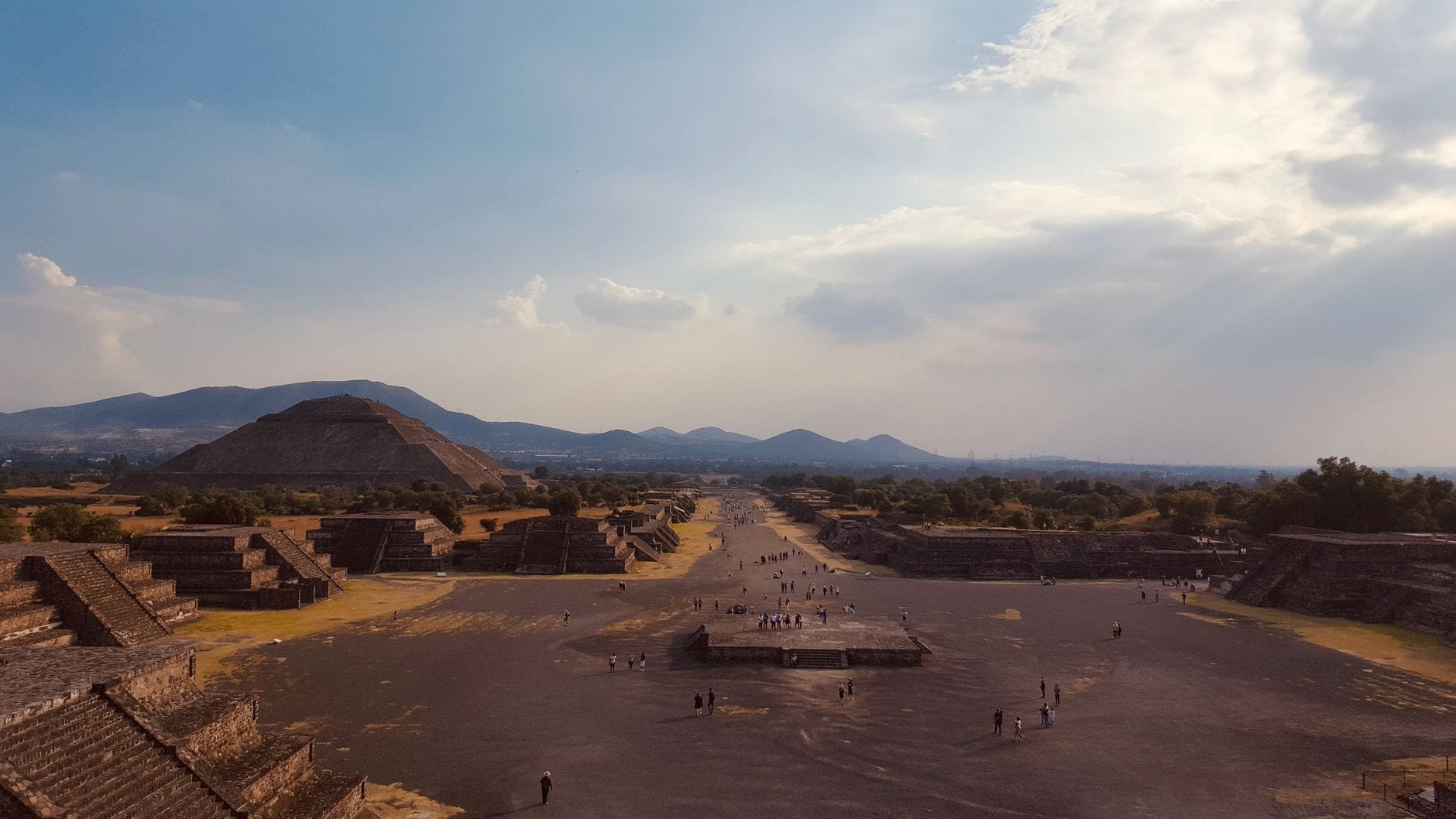
The Pyramid of the Sun is the third-largest pyramid in the world by volume. Standing roughly 65–70 meters tall with a base of about 220 meters per side, it dominates the site visually from almost every angle. Climbing the stairways has been prohibited since 2021, but walking around the base still gives a clear sense of its scale. On clear days, the view from the Plaza of the Moon at the northern end of the site stretches across the entire Teotihuacán Valley, with the surrounding mountains sharp on the horizon.
The base of the Pyramid of the Sun can get crowded by mid-morning, particularly on weekends when tour groups arrive together. If you reach it early, before 9:30 AM, you'll have a clearer view of the Avenue of the Dead stretching south toward the Pyramid of the Moon.
Pyramid of the Moon
Smaller but arguably more dramatic in setting, the Pyramid of the Moon sits at the northern end of the Avenue of the Dead and frames the entire processional axis. Access to the Moon Pyramid summit is restricted, but the Plaza of the Moon at its base still offers the site's best straight-down view of the Avenue itself — the long, wide ceremonial corridor that served as the city's spine.
Temple of Quetzalcoatl (Ciudadela)
The Ciudadela complex, home to the Temple of Quetzalcoatl, sits at the southern end of the site and receives far fewer visitors than the two main pyramids. The facade here is the most visually intricate stonework at Teotihuacán: carved feathered serpent heads and rain deity figures alternate in rows across the stepped tiers. It takes about 15 minutes to walk from the main ticket entrance. Many visitors skip it or pass through quickly — which means you'll often have it in relative quiet, even on busy days.
Tickets & tours
Live prices and dates from our booking partner. If you book, we may earn a commission at no extra cost to you.
Early Teotihuacan guided tour
From 58 €Instant confirmationFree cancellationMexico City Historic Center, Pyramids of Teotihuacan and Drink Tasting
From 53 €Instant confirmationFree cancellationTeotihuacan pyramids hot air balloon ride
From 227 €Instant confirmationFree cancellationTeotihuacan pyramids guided excursion and hot air balloon ride
From 253 €Instant confirmationFree cancellation
How the Site Changes Through the Day
The site currently opens at 8:00 AM daily. In the first hour, the air is cool and the light is low and directional — ideal for photography, and pleasant for walking. The Avenue of the Dead, stretching roughly 2 kilometers between the main pyramids, is still mostly empty at this hour, and the scale of the place becomes clear without the distraction of dense foot traffic.
By 10:30 AM, tour buses from Mexico City have arrived and the Pyramid of the Sun fills up steadily. Midday — especially between 11 AM and 2 PM — is the hardest time to be here. The site has almost no shade on its main avenue, the stone radiates heat, and the crowds are at their thickest. The site currently closes at 5:00 PM, and late afternoon — from about 3:30 PM onward — sees a second quieter window as day-trippers depart, though the light by then is less useful for photography of the western-facing structures.
💡 Local tip
Arrive at opening time (8:00 AM) for the best combination of cool temperatures, soft light, and minimal crowds. Reach the Pyramid of the Sun and the Plaza of the Moon before 10 AM, when tour groups concentrate. Plan to be at the Ciudadela last, in the early afternoon, when the crowds have moved north.
Getting There from Mexico City
Teotihuacán is about 50 km northeast of Mexico City and is not served by the Metro system. The most practical independent option is a direct bus from Terminal Central del Norte, the northern long-distance bus terminal in Mexico City (accessible via Metro Line 5, Autobuses del Norte station). Buses to Teotihuacán run frequently and the journey typically takes about one to 1.5 hours depending on traffic. This is a reliable and inexpensive route used by locals and independent travelers alike.
Organized tours depart from the city's main hotel zones and typically include transport, a guide, and sometimes entry to additional sites. These are worth considering if you want historical context narrated on-site rather than read off a panel. For planning your trip to Mexico City more broadly, the Teotihuacán day trip guide covers transport options, timing, and what to combine with a visit.
If you're driving or using a ride-hailing service, note that the site has multiple entrance gates numbered 1 through 5. Gate 1 is nearest the Ciudadela, while Gate 2 is closest to the Pyramid of the Sun and Gate 3 is at the northern end, near the Pyramid of the Moon. Most tour buses use Gate 1. Arriving at Gate 2 or 3 by private transport can give you a slightly less congested start.
Practical Realities: What to Bring and What to Expect
This is an outdoor archaeological site with almost no natural shade on the main avenue. The combination of sun exposure, altitude (Teotihuacán sits at roughly 2,300 meters above sea level, similar to Mexico City), and the physical exertion of walking the long Avenue of the Dead in direct sun makes hydration critical. Bring at least 1.5 liters of water per person. Vendors sell water and snacks throughout the site, but at marked-up prices.
Wear comfortable closed-toe shoes with grip — the pyramid steps are worn smooth in places and can be slippery if damp. Sun protection (hat, sunscreen, sunglasses) is not optional. Visitors arriving in sandals or flip-flops often regret it halfway up the first staircase. If you're traveling with children, the Mexico City with kids guide has notes on managing the site with younger travelers.
Accessibility: The flat sections of the Avenue of the Dead are manageable for visitors with limited mobility, but the pyramid stairways are closed to climbing; the Avenue of the Dead and Ciudadela are more accessible, though uneven stone surfaces remain challenging for wheelchair users or those with serious mobility limitations. The Ciudadela courtyard is largely flat and is the most accessible major monument at the site.
⚠️ What to skip
The site sits at high altitude. If you've just arrived in Mexico City and haven't acclimatized, strenuous walking at ~2,300 m elevation can cause dizziness or shortness of breath. Give yourself a day or two in the city first. See notes on altitude adjustment in the Mexico City altitude guide.
Photography and What You'll Actually See
The best light for the Pyramid of the Sun is in the morning (it faces west, so afternoon light flattens it). The Pyramid of the Moon photographs well from the Avenue of the Dead looking north, framed by the mountains behind it. The Ciudadela facade, with its carved serpent heads casting strong shadows, works best when the sun is moderately high — late morning or around noon.
Drone use is not permitted at the site. Tripods technically require a permit. Most smartphone and camera photography is unrestricted for personal use. For context on the broader landscape of archaeological sites accessible from Mexico City, the Mexico City pyramids guide compares Teotihuacán to smaller nearby sites.
Is It Worth It? Worth Your Time?
Yes, but with realistic expectations. Teotihuacán is impressive — the scale, the precision of the urban planning, and the age of the structures are difficult to process standing inside the site. The Avenue of the Dead at ground level, with the Pyramid of the Moon at its north end and the Pyramid of the Sun rising to the east, is one of the most powerful spatial experiences in pre-Columbian archaeology.
However, the site is also heavily touristed, frequently crowded, and physically demanding. The pyramids themselves have relatively sparse interpretive signage in English. If you visit without a guide or prior reading, much of the historical context will be missing. The vendor corridor between monuments can feel aggressive. None of this diminishes the site — but it explains why some visitors feel underwhelmed when they arrive expecting a tranquil ruin.
Visitors who want more interpretive depth should consider reading about the site's history in advance or pairing the visit with a stop at the Museo Nacional de Antropología in Mexico City, which houses a dedicated Teotihuacán hall with scale models and original artifacts. Seeing the museum first makes the site itself significantly more legible.
Who should skip it: visitors who struggle with heat exposure, those with significant mobility limitations, and travelers with only one day in Mexico City who haven't yet seen the historic center. The half-day round trip (including transit) is a meaningful chunk of a short itinerary.
Insider Tips
- Gate 2 is the least-used entrance and deposits you midway along the Avenue of the Dead, letting you walk north to the Pyramid of the Moon first and then south — the reverse of most tour groups, which means you're moving against the crowd flow.
- The on-site Museo de Sitio (site museum) near Gate 1 is included with admission and is worth 30 minutes of your time. Most visitors walk past it. It contains original murals, ceramics, and obsidian artifacts that explain the city's trade networks and social organization.
- Vendors outside the gates sell obsidian figurines and replicas at inflated prices. Better-quality obsidian crafts at fairer prices are available at the La Ciudadela market back in Mexico City.
- If you visit on a weekend, the site fills fastest between 10 AM and 1 PM. Arriving Friday morning is noticeably quieter than Saturday or Sunday.
- Bring cash in Mexican pesos. While some vendors accept cards, the ticket offices, site museum, and most food stalls operate on cash. ATMs near the site are unreliable.
Who Is Teotihuacán For?
- Archaeology and pre-Columbian history enthusiasts who want to walk the most significant ancient city in North America
- Photographers working with early-morning light and wide architectural subjects
- Travelers on a 3-day Mexico City itinerary who want one major day trip outside the city
- Families with children aged 8 and up who can handle several hours of walking on uneven stone
- Anyone who has visited the Museo Nacional de Antropología and wants to see the source material in situ
Nearby Attractions
Combine your visit with:
- Acuario Inbursa
Built beneath Plaza Carso in the Nuevo Polanco district, Acuario Inbursa holds 1.6 million litres of seawater and roughly 14,000 specimens across more than 230 species. It opened in 2014 and remains one of the most technically ambitious aquariums in Latin America. Here is what the visit actually involves, and whether it is worth your time.
- Arena México
Inaugurated in 1956 and holding up to roughly 16,800 spectators, Arena México is the home of CMLL and the most storied lucha libre venue in the world. Matches run on Tuesday, Friday, and Sunday evenings in Colonia Doctores, making it one of the most accessible live spectacles in Mexico City.
- Basilica of Our Lady of Guadalupe
The Basilica of Our Lady of Guadalupe is one of the most visited Catholic shrines on earth, receiving over 20 million pilgrims and visitors each year. Built around the 1531 apparition site on Tepeyac Hill, it holds the venerated tilma of Juan Diego and offers a rare encounter with living Mexican faith at its most intense.
- Cineteca Nacional
The Cineteca Nacional de México is the country's national film archive and its most important arthouse cinema complex. Rebuilt after a devastating 1982 fire and transformed in 2012 into a world-class cultural campus, it combines 10 indoor screens, a large open-air screening forum, galleries, a bookshop, and restaurants in a single destination that attracts cinephiles, students, and casual visitors alike.
Planning a trip? Discover personalized activities with the Nomado app.