Basilica of Our Lady of Guadalupe: Mexico City's Sacred Heart
The Basilica of Our Lady of Guadalupe is one of the most visited Catholic shrines on earth, receiving over 20 million pilgrims and visitors each year. Built around the 1531 apparition site on Tepeyac Hill, it holds the venerated tilma of Juan Diego and offers a rare encounter with living Mexican faith at its most intense.
Quick Facts
- Location
- Fray Juan de Zumárraga No. 2, Villa Gustavo A. Madero, Mexico City
- Getting There
- La Villa–Basílica (Line 6), approx. 5-minute walk
- Time Needed
- 1.5 to 3 hours for the full complex
- Cost
- Free (no admission fee to the basilica or grounds)
- Best for
- Cultural immersion, religious history, architecture, photography
- Official website
- basilicadeguadalupe.org.mx
What the Basilica of Guadalupe Is
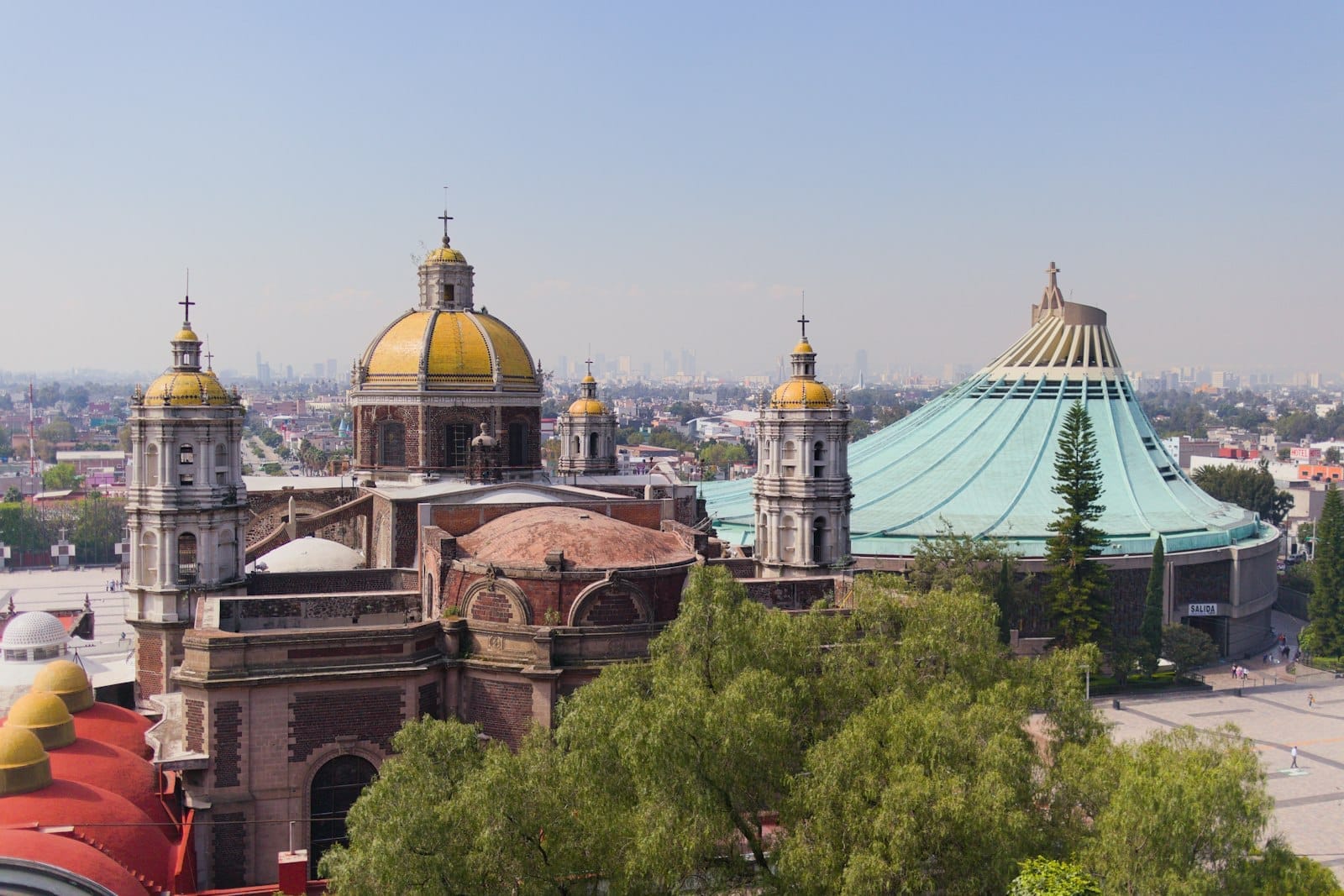
The Basílica de Nuestra Señora de Guadalupe is not a single church. It is a sprawling religious complex on the northern edge of Mexico City, centered on Tepeyac Hill, where Juan Diego Cuauhtlatoatzin reportedly received apparitions of the Virgin Mary in December 1531. The complex includes the striking circular modern basilica completed in 1976, the tilting 18th-century Old Basilica, several hilltop chapels, gardens, and a broad ceremonial plaza called Atrio de las Américas. Together, they form one of the most important Catholic pilgrimage sites in the world.
At the center of the entire pilgrimage tradition is a single garment: the tilma, a cloak of rough woven fabric belonging to Juan Diego, on which an image of the Virgin is said to have miraculously appeared. This image is displayed inside the new basilica behind the main altar, positioned above a moving walkway that slowly carries visitors past it so that no one lingers too long. The experience of watching thousands of people file past that image, many weeping or crossing themselves, is unlike anything else in the city.
ℹ️ Good to know
Entrance to the entire basilica complex is free. Online 'tickets' you may see sold on third-party sites are for guided tours or transport packages only, not for admission.
The Architecture: Old and New Side by Side
The contrast between the two main basilicas is one of the most striking things about the site. The Old Basilica, built in the 18th century, is a Baroque structure that has sunk unevenly into Mexico City's soft lakebed soil, tilting so visibly that stepping inside produces a faint but genuine sense of disorientation. The floor is not level. The columns lean at slightly different angles. It now functions largely as a space for religious art and devotion rather than as the primary site for major liturgical celebrations, though its interior is richly detailed with gilded altars and centuries-old paintings.
Directly beside it, the new basilica was designed by Mexican architect Pedro Ramírez Vázquez, the same architect responsible for the Museo Nacional de Antropología. Completed in 1976, it is a circular building with a distinctive tent-like copper roof that can accommodate roughly 10,000–12,000 worshippers at once. The design is deliberately non-traditional: there are no columns to obstruct sightlines, and the altar with the tilma above it is visible from virtually every seat. On Sundays and feast days, the building fills to capacity and loudspeakers carry the Mass across the entire plaza outside.
For visitors interested in Mexican religious architecture more broadly, the Metropolitan Cathedral in the Centro Histórico offers a fascinating contrast: a centuries-long construction project with equally dramatic structural subsidence problems.
Tickets & tours
Live prices and dates from our booking partner. If you book, we may earn a commission at no extra cost to you.
How the Experience Changes by Time of Day
Early mornings are when the basilica shows a different face entirely. Before 9:00, the plaza is occupied mostly by pilgrims who have traveled through the night, some arriving from other Mexican states or Central America on organized coach trips. Groups kneel together on the stone plaza, some using their knees to inch the final distance to the basilica entrance as an act of devotion. The light at this hour is soft and gray, and the smell of copal incense mixes with the exhaust from the surrounding streets. The mood is solemn and intensely personal.
By mid-morning on weekdays, the complex transitions into something closer to a managed tourist site. School groups arrive. Vendors set up near the perimeter selling religious items, food, and souvenirs. The new basilica runs continuous Masses, and the moving walkway beneath the tilma operates steadily. Midday on weekends can feel overwhelming: the plaza becomes densely crowded, particularly around the entrance to the new basilica and near the decorative fountain at the center of the atrium.
Late afternoon on weekdays is arguably the most manageable time for visitors who want to observe quietly rather than join active worship. The crowds thin slightly, the light shifts warmer, and the hilltop chapels accessible by funicular or a set of steep paths become more approachable. From the hill, there is a clear view over the entire complex and across a wide swath of northern Mexico City.
⚠️ What to skip
December 12, the Feast of Our Lady of Guadalupe, draws millions of pilgrims in a single 24-hour period. The complex operates around the clock on this date, and crowds are extreme. Unless you are specifically there for the religious event, it is not a practical day for a first visit.
The Tilma and Its Significance
The tilma attributed to Juan Diego is the spiritual and physical focal point of the entire site. It hangs in a gold-framed vitrine above the altar in the new basilica, lit so that the image is clearly visible even from a distance. The image shows a dark-skinned young woman in a blue starred mantle, hands clasped in prayer, standing on a crescent moon. For Mexican Catholics, this is not a copy or a representation: it is the original miraculous image, and the act of standing before it carries enormous spiritual weight.
The moving walkway that carries visitors beneath the tilma is a practical concession to the sheer volume of people who want to see it. The ride takes around a minute at a slow walking pace. You cannot stop on the walkway, and photography from it is technically discouraged during Masses, though this rule is not uniformly enforced. For visitors who want more time to observe the image, the lateral balconies of the basilica offer a stationary viewpoint from a slightly greater distance.
Juan Diego himself was canonized by Pope John Paul II in 2002 during a Mass celebrated at this basilica, the first indigenous Mexican to be declared a saint by the Catholic Church. A small chapel at the base of Tepeyac Hill is dedicated to him, and his face appears throughout the complex in murals, mosaics, and devotional imagery.
Navigating the Complex: A Practical Walkthrough
From the La Villa–Basílica metro station on Line 6, the walk to the complex entrance takes about five minutes through a street lined with religious goods shops selling rosaries, candles, embroidered textiles, and framed prints of the Virgin. This short stretch prepares you for the scale of what is ahead.
Enter through the main gates onto the Atrio de las Américas, a large open plaza. The new basilica is directly ahead. The Old Basilica is to the right. A funicular operates on one side of Tepeyac Hill, providing access to the hilltop chapels for those who prefer not to climb the path. The Capilla del Pocito, an 18th-century baroque chapel with a distinctive elliptical dome decorated in blue and white Talavera tiles, is worth seeking out near the foot of the hill. It marks the spot of a sacred spring associated with the apparition story.
Allow at least 90 minutes to see the main basilica interior, walk the Old Basilica (now the museum), and reach at least one of the hilltop viewpoints. A full visit including the museum, Capilla del Pocito, and the hilltop chapels is closer to three hours. Wear comfortable shoes: the hilltop path is cobbled and uneven, and the plaza is large.
💡 Local tip
To reach the basilica by metro, take Line 3 to Deportivo 18 de Marzo, then transfer to Line 6 heading toward Martín Carrera and exit at La Villa–Basílica. The journey from central Mexico City takes roughly 30 to 40 minutes depending on your starting point.
Photography, Dress Code, and Practical Notes
Photography is generally permitted throughout the complex and on the plaza. Inside the new basilica during active Mass, be discreet: many worshippers are in a state of genuine devotion, and intrusive photography is considered disrespectful. The tilma itself is photographed by virtually every visitor, and no one will stop you from taking a photo of the vitrine. The most compelling photographs of the site are often not of the buildings but of the pilgrims: families traveling together, individuals praying in the plaza, elderly women in regional dress walking on their knees.
Modest dress is expected as a matter of courtesy in any active place of worship. This means covered shoulders and knees for both men and women. The complex is outdoors in large part, so consider the weather: at 2,240 meters above sea level, Mexico City mornings can be cold even in apparent summer, and afternoon rain showers are common from May through October. A light jacket and compact rain cover are practical items to bring.
If you are planning your visit as part of a broader Mexico City itinerary, the 3-day Mexico City itinerary includes the basilica alongside the city's other major cultural landmarks.
Who This Attraction Is and Is Not For
The Basilica of Guadalupe is significant regardless of your religious background. As a window into Mexican identity, national devotion, and the intersection of indigenous and Catholic culture, it has few equals in the country. The scale of pilgrimage activity here, the architecture of both centuries of basilicas, and the sensory intensity of a major feast day visit are all compelling for secular travelers as much as religious ones.
That said, visitors who are uncomfortable in active religious spaces, who dislike large and sometimes dense crowds, or who have difficulty with uneven terrain should factor those considerations in. The site is also in the northern part of the city, away from the main tourist districts of Centro Histórico and Roma and Condesa, so it requires a deliberate journey rather than a casual detour.
If your interest is primarily in Mexican religious art and colonial architecture rather than pilgrimage culture, the Museo Franz Mayer and the Metropolitan Cathedral in the historic center may satisfy that interest more efficiently. The basilica, by contrast, is primarily a living sacred site where the art is secondary to the act of worship.
Insider Tips
- Access to the moving walkway beneath the tilma may be restricted or briefly paused during active Mass. If you want an unobstructed viewing experience, time your visit to arrive between scheduled services or use the lateral balconies inside the basilica.
- The funicular on the side of Tepeyac Hill is not always operational; check before counting on it. The pedestrian path to the hilltop chapels is manageable for most visitors in about 10 minutes but involves uneven cobblestones.
- The small religious goods market just outside the main gates is cheaper than most souvenir shops in tourist areas. Embroidered items, Talavera-style religious tiles, and devotional candles are all sold here.
- Weekday mornings between 9:00 and 11:00 offer the best balance of manageable crowds and active pilgrimage atmosphere. Avoid Saturday and Sunday afternoons if you want space to move and observe.
- The Old Basilica museum inside the tilted 18th-century building contains some remarkable colonial religious paintings and ex-votos (small retablos painted by devotees to commemorate miracles), largely overlooked by visitors who go straight to the new basilica.
Who Is Basilica of Our Lady of Guadalupe For?
- Travelers interested in Mexican culture, identity, and religious tradition at their most concentrated
- Architecture enthusiasts wanting to compare colonial Baroque and 1970s modernist sacred design side by side
- Photographers looking for authentic, emotionally rich subject matter beyond tourist-facing spectacle
- Families traveling with children who want a meaningful cultural experience that requires no prior knowledge to engage with
- Anyone visiting during December who wants to witness the buildup to the December 12 feast day atmosphere, short of the day itself
Nearby Attractions
Combine your visit with:
- Acuario Inbursa
Built beneath Plaza Carso in the Nuevo Polanco district, Acuario Inbursa holds 1.6 million litres of seawater and roughly 14,000 specimens across more than 230 species. It opened in 2014 and remains one of the most technically ambitious aquariums in Latin America. Here is what the visit actually involves, and whether it is worth your time.
- Arena México
Inaugurated in 1956 and holding up to roughly 16,800 spectators, Arena México is the home of CMLL and the most storied lucha libre venue in the world. Matches run on Tuesday, Friday, and Sunday evenings in Colonia Doctores, making it one of the most accessible live spectacles in Mexico City.
- Cineteca Nacional
The Cineteca Nacional de México is the country's national film archive and its most important arthouse cinema complex. Rebuilt after a devastating 1982 fire and transformed in 2012 into a world-class cultural campus, it combines 10 indoor screens, a large open-air screening forum, galleries, a bookshop, and restaurants in a single destination that attracts cinephiles, students, and casual visitors alike.
- Desierto de los Leones National Park
Parque Nacional Desierto de los Leones is Mexico's first national park, a 1,867-hectare pine-and-oak forest rising to 3,700 meters on the city's western rim. At its heart stands a hauntingly preserved 17th-century Carmelite ex-convent, surrounded by cool ravines, morning mist, and trails that feel nothing like the megacity an hour away.
Planning a trip? Discover personalized activities with the Nomado app.