Arena México: Inside the Cathedral of Lucha Libre
Inaugurated in 1956 and holding up to roughly 16,800 spectators, Arena México is the home of CMLL and the most storied lucha libre venue in the world. Matches run on Tuesday, Friday, and Sunday evenings in Colonia Doctores, making it one of the most accessible live spectacles in Mexico City.
Quick Facts
- Location
- Dr. Lavista 189, Colonia Doctores, Alcaldía Cuauhtémoc, Mexico City
- Getting There
- Mexico City Metro to Cuauhtémoc (Line 1) or Doctores (Line 8); short walk to venue
- Time Needed
- 3 to 4 hours (full event card)
- Cost
- Tickets vary by seat category and event; purchase via Ticketmaster or at the box office. Verify current prices before attending.
- Best for
- Sports fans, culture seekers, first-time visitors wanting a uniquely Mexican experience
- Official website
- cmll.com/arenas/arena-mexico
What Is Arena México?
Arena México is the premier lucha libre venue in the world, home to Consejo Mundial de Lucha Libre (CMLL), the oldest professional wrestling promotion on the planet. Completed and inaugurated on April 27, 1956, and built by CMLL founder Salvador Lutteroth, the arena holds approximately 16,800 spectators and has been the stage for some of the most celebrated matches in the history of Mexican professional wrestling. It is known throughout the sport as the Catedral de la Lucha Libre, the Cathedral of Lucha Libre, a nickname it has earned through decades of weekly shows, generational rivalries, and theatrical spectacle.
Lucha libre is a form of professional wrestling distinct from its American counterpart in speed, acrobatics, and costume. The masks worn by luchadores are not decorative accessories; they carry deep cultural weight. Losing a mask in a wager match (apuesta) is considered one of the most significant events a wrestler can experience. For a fuller picture of how this tradition fits into Mexican popular culture, the lucha libre Mexico City guide covers the history, terminology, and how to get tickets in detail.
Show Schedule and When to Go
Arena México does not operate as a traditional attraction open during the day. It runs on an event schedule, and for regular CMLL shows the doors open before three main show nights per week: Tuesday evenings at 7:30 p.m., Friday evenings at 8:30 p.m., and Sunday afternoons at 5:00 p.m. Special events, anniversary shows, and inter-promotional cards run on different dates and times, so always verify the current card on the CMLL website or Ticketmaster before planning your visit.
The Friday and Sunday shows tend to draw the largest and most energetic crowds. Sunday afternoons are particularly good for families, with an earlier start time and a slightly more relaxed atmosphere in the surrounding neighborhood. Tuesday shows are smaller in scale and a bit more accessible for first-timers who want to absorb the experience without the peak-night pressure. Friday nights attract a committed regular audience, with vocal fan sections who know the wrestlers by reputation and respond to every sequence with expert timing.
💡 Local tip
If it's your first lucha libre show, Sunday at 5:00 p.m. is the most beginner-friendly option: an earlier finish, a mix of families and tourists, and typically a full card of several bouts spanning different weight classes.
Tickets & tours
Live prices and dates from our booking partner. If you book, we may earn a commission at no extra cost to you.
Puebla and Cholula guided tour from Mexico City with optional lunch
From 43 €Instant confirmationFree cancellationMexico City exploration game and tour in Chimalistac
From 10 €Instant confirmationFree cancellationFolkloric ballet of Mexico skip-the-line VIP tickets with transportation
From 109 €Instant confirmationFree cancellationLuggage Storage in Mexico City
From 7 €Instant confirmationFree cancellation
Inside the Arena: What the Experience Actually Feels Like
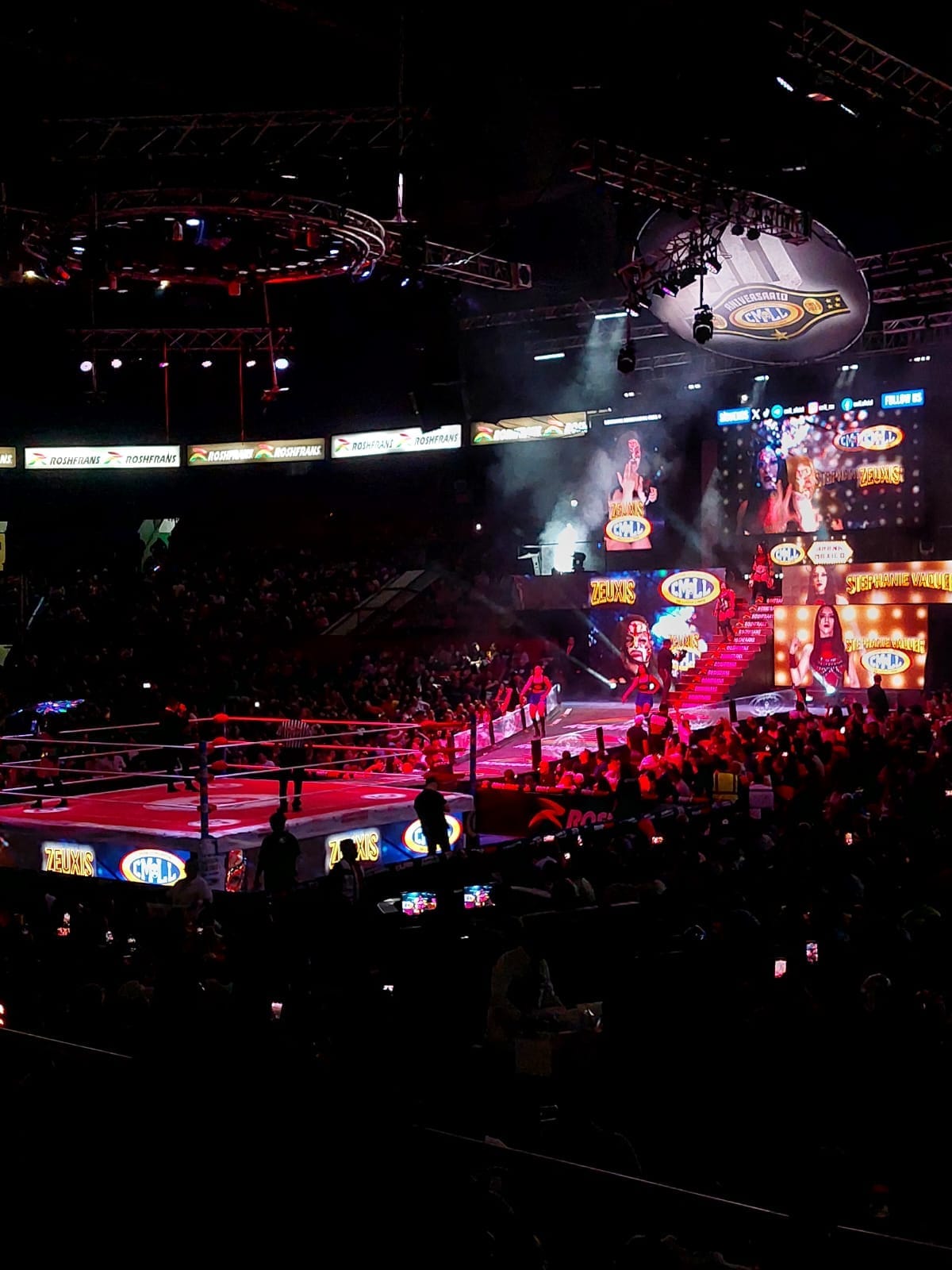
The building itself is a mid-century concrete structure, functional rather than ornate, with steeply raked seating that brings the upper tiers surprisingly close to the action. The ring sits at the center of the floor, ringed by the lowest and most expensive seats, with the arena rising sharply around it. The lighting is deliberately theatrical: strong white light over the ring, the rest of the space in relative shadow, which gives the bouts an almost cinematic quality.
The smell on event night is a combination of concrete, cooking oil from the vendors outside, and the faint sweet scent of the candies and snacks sold in the aisles. Vendors circulate continuously through the stands selling beer, corn snacks, and drinks. The noise level rises sharply the moment a recognizable wrestler's entrance music begins, and for popular rudo (villain) characters, the booing is loud and sustained in a way that is clearly part of the ritual rather than genuine hostility.
A standard card runs through several bouts before the main event, with matches growing in length and complexity as the night progresses. The earlier bouts often feature younger or lower-card wrestlers whose high-speed exchanges and aerial maneuvers can be just as exciting as the headline match. Many visitors find that by the time the main event arrives, the crowd's collective knowledge and enthusiasm has become part of the spectacle itself.
ℹ️ Good to know
Arena México's seating is divided into categories by proximity to the ring and tier height. Ringside and lower-bowl seats provide the clearest view but also the most noise and proximity to the action. Upper-tier seats are cheaper and still offer a full sightline to the ring, though you will be further from the entrance ramps.
Historical and Cultural Context
CMLL was founded in 1933, making it the oldest continuously operating professional wrestling promotion in the world. The original Arena México building predates the current structure; the 1956 venue replaced an earlier facility and was designed to accommodate the rapidly growing popularity of lucha libre in post-war Mexico City. In the decades since, the arena has hosted masked legends including El Santo, Blue Demon, and Mil Máscaras, figures whose influence extended far beyond wrestling into film, comic books, and popular iconography.
The venue sits in Colonia Doctores, a working-class neighborhood south of the Centro Histórico that has historically been closely associated with the sport. The streets around the arena on show nights take on a particular energy: vendors selling masks and merchandise set up outside the entrance, and the crowd arriving on foot from nearby Metro stations is a cross-section of the city spanning age groups and backgrounds. Lucha libre in Mexico occupies a cultural space that has no direct equivalent elsewhere, sitting somewhere between sport, theater, and folk tradition. For those exploring less-visited sides of Mexico City, a Tuesday night at Arena México connects you to a part of the city's identity that most tourist itineraries skip entirely.
Getting There and Practical Logistics
Arena México is located at Dr. Lavista 189, Colonia Doctores, Alcaldía Cuauhtémoc. The Mexico City Metro system provides the most reliable access; the nearest stations are Cuauhtémoc on Line 1 and Doctores on Line 8, and the arena is a short walk from either station. Ride-hailing apps including Uber, DiDi, and Cabify all operate in this part of the city and are a reasonable option for the return journey late at night, particularly on Fridays when the show ends after midnight.
For questions about accessible seating or facilities, CMLL lists a contact phone number for Arena México: 55 5588 0385. The CMLL website and official event listings are the most reliable source for current ticket availability. For a broader overview of moving around the city by Metro and bus, the getting around Mexico City guide covers all transit options in detail.
⚠️ What to skip
Ticket prices and availability vary significantly by event. Special anniversary shows and apuesta matches sell out well in advance. Always check Ticketmaster or the CMLL site before your intended visit date, particularly during major events. Do not rely on scalpers outside the venue for guaranteed entry.
Photography and What to Bring
The lighting inside Arena México is designed for drama rather than photography. Compact cameras and smartphones will struggle with the contrast between the brightly lit ring and the darker seating areas, particularly from the upper tiers. Ringside and lower-bowl positions give the best angles and the most consistent light on the wrestlers. Most visitors capture the atmosphere rather than technically precise action shots, and the masks and costumes photograph well even in mixed lighting.
Bring cash for vendors inside the arena, as not all concession points accept cards. Wear comfortable, casual clothing. The arena is not air-conditioned to the same standard as a modern arena, and on warm evenings it can get humid in the lower sections. On cooler nights, the upper tiers can be drafty. Colonia Doctores is a practical, non-tourist neighborhood, so there are few upscale dining options within immediate walking distance of the arena; plan to eat before you arrive or take advantage of the street food vendors near the entrance.
Who This Is Not For
Visitors expecting a sport governed by the same conventions as American professional wrestling or MMA will need to adjust their frame of reference. Lucha libre has its own logic, its own vocabulary of moves and storytelling, and its own relationship between performer and crowd. If theatrical performance within a sport context does not appeal to you, the experience may feel confusing rather than exciting.
The arena is also a loud, crowded, and sensory-intense environment. For travelers sensitive to noise, large crowds, or venues without consistent air conditioning, an evening show at Arena México will require some tolerance for discomfort. The Colonia Doctores neighborhood, while well-connected by transit, is not a dining or nightlife destination in itself, so the visit is best treated as a standalone evening event rather than part of a wider neighborhood itinerary.
Insider Tips
- The cheapest seats in the upper tiers still provide a complete view of the ring and often put you near the most vocal regular fans, whose real-time commentary on the action is part of the experience.
- Arrive at least 30 minutes before the listed start time. The earlier bouts often begin close to schedule and the undercard matches can be just as technically impressive as the main event.
- Masks and merchandise are sold by vendors outside the arena entrance before each show. Prices are negotiable and quality varies, but buying a mask from a street vendor outside Arena México is a more authentic souvenir experience than purchasing from a tourist shop.
- For the Sunday show, the surrounding streets in Colonia Doctores are busy with foot traffic in the afternoon. It is a good time to observe the neighborhood without the late-night logistical concerns of a Friday card.
- Special events including Aniversario CMLL, the promotion's annual anniversary show held each September, are the most significant nights of the CMLL calendar. If your travel dates align, these shows draw the biggest cards and the most intense crowd reactions of the year.
Who Is Arena México For?
- First-time visitors to Mexico City who want a local cultural experience beyond the standard museum circuit
- Sports and performance fans interested in spectacle with deep cultural roots
- Travelers who have already covered the main historic sites and are looking for something less predictable
- Groups looking for a high-energy shared evening out that does not require Spanish fluency to enjoy
- Anyone with an interest in Mexican popular culture, folk iconography, or the history of the sport
Nearby Attractions
Combine your visit with:
- Acuario Inbursa
Built beneath Plaza Carso in the Nuevo Polanco district, Acuario Inbursa holds 1.6 million litres of seawater and roughly 14,000 specimens across more than 230 species. It opened in 2014 and remains one of the most technically ambitious aquariums in Latin America. Here is what the visit actually involves, and whether it is worth your time.
- Basilica of Our Lady of Guadalupe
The Basilica of Our Lady of Guadalupe is one of the most visited Catholic shrines on earth, receiving over 20 million pilgrims and visitors each year. Built around the 1531 apparition site on Tepeyac Hill, it holds the venerated tilma of Juan Diego and offers a rare encounter with living Mexican faith at its most intense.
- Cineteca Nacional
The Cineteca Nacional de México is the country's national film archive and its most important arthouse cinema complex. Rebuilt after a devastating 1982 fire and transformed in 2012 into a world-class cultural campus, it combines 10 indoor screens, a large open-air screening forum, galleries, a bookshop, and restaurants in a single destination that attracts cinephiles, students, and casual visitors alike.
- Desierto de los Leones National Park
Parque Nacional Desierto de los Leones is Mexico's first national park, a 1,867-hectare pine-and-oak forest rising to 3,700 meters on the city's western rim. At its heart stands a hauntingly preserved 17th-century Carmelite ex-convent, surrounded by cool ravines, morning mist, and trails that feel nothing like the megacity an hour away.
Planning a trip? Discover personalized activities with the Nomado app.