Cineteca Nacional: Mexico City's Arthouse Cinema and Film Archive
The Cineteca Nacional de México is the country's national film archive and its most important arthouse cinema complex. Rebuilt after a devastating 1982 fire and transformed in 2012 into a world-class cultural campus, it combines 10 indoor screens, a large open-air screening forum, galleries, a bookshop, and restaurants in a single destination that attracts cinephiles, students, and casual visitors alike.
Quick Facts
- Location
- Av. México Coyoacán 389, Colonia Xoco, Alcaldía Benito Juárez, Mexico City
- Getting There
- Metro Coyoacán (Line 3), approx. 11-minute walk
- Time Needed
- 2–4 hours for a film plus the complex; longer for multiple screenings or events
- Cost
- General approx. 70 MXN; reduced approx. 50 MXN (students, under-25, 60+). Verify current prices at the box office or official site.
- Best for
- Film lovers, architecture enthusiasts, cultural explorers, afternoon hangouts
- Official website
- www.cinetecanacional.net
What Is the Cineteca Nacional?
The Cineteca Nacional de México is not simply a cinema. Since its founding in 1974, it has served simultaneously as Mexico's official national film archive, a major arthouse exhibition space, and a public cultural campus. The complex preserves, restores, and screens Mexican and international cinema, making it the institutional backbone of serious film culture in the country.
The original facilities suffered a catastrophic fire in 1982 that destroyed thousands of films and much of the infrastructure. The rebuilt complex reopened in 1984 with four theaters. The real transformation came in 2012, when a major renovation and expansion rechristened it the Cineteca Nacional del Siglo XXI, adding indoor screening rooms to bring the total to 8, constructing a large open-air forum for outdoor screenings, and building out a digital restoration laboratory, video library, documentation center, gallery spaces, and a bookshop. The result is a campus-scale destination rather than a single-purpose venue.
💡 Local tip
Showtimes change weekly. Check the official program at cinetecanacional.net before you visit — the outdoor forum screenings can sell out or be affected by rain, while indoor tickets can disappear quickly on weekends.
The Architecture and Campus Layout
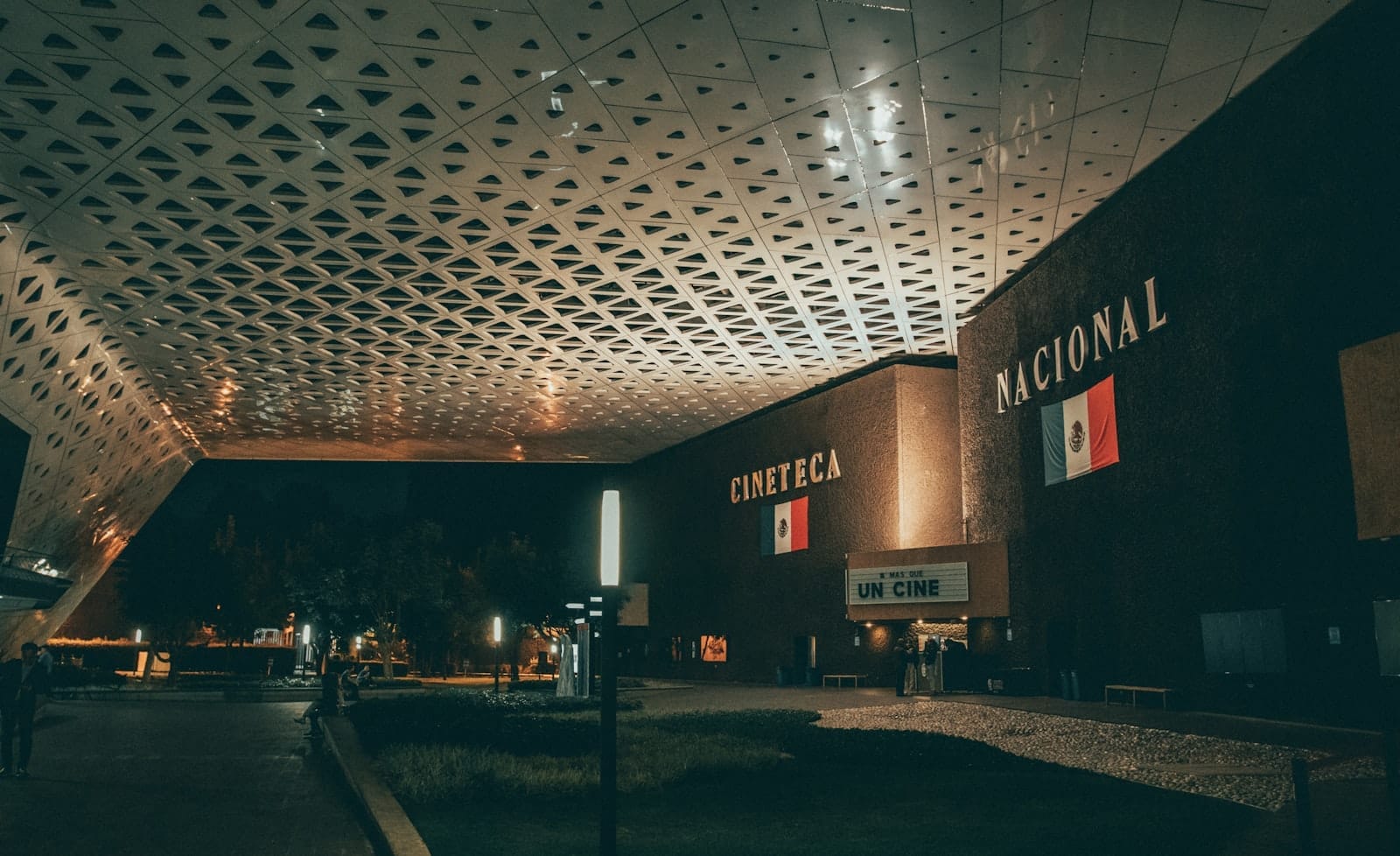
The 2012 redesign gave Cineteca Nacional a coherent open-air character that sets it apart from enclosed multiplex cinemas. Arriving from Avenida México Coyoacán, you step into a broad plaza with tall trees providing shade across concrete walkways. The indoor theaters are housed in clean, low-profile contemporary structures, while the outdoor screening forum dominates a central open area that can accommodate large audiences on warm evenings.
The campus includes seating areas, a bookshop specializing in film and arts publications, and several restaurant and café options where visitors gather before and after screenings. The overall feel is closer to a university arts campus than a commercial entertainment venue. Signage is in Spanish throughout, which is worth knowing in advance if your Spanish is limited.
The complex sits in Colonia Xoco, a quiet residential area in Benito Juárez borough. The surrounding streets lack the restaurant density of Roma or Condesa, so most visitors eat and drink on site rather than exploring the immediate neighborhood.
Tickets & tours
Live prices and dates from our booking partner. If you book, we may earn a commission at no extra cost to you.
Puebla and Cholula guided tour from Mexico City with optional lunch
From 43 €Instant confirmationFree cancellationXochimilco, Coyoacan and Frida Kahlo Museum with skip-the-line tickets
From 63 €Instant confirmationFree cancellationMexico City exploration game and tour in Chimalistac
From 10 €Instant confirmationFree cancellationCuernavaca and Taxco Guided Tour with Optional Lunch
From 40 €Instant confirmationFree cancellation
What to Expect at Different Times of Day
Weekday mornings are the quietest window. The complex opens at 11:00 Monday through Friday, and for the first few hours it has the feel of a reading room: students with laptops sit in the café areas, the bookshop is unhurried, and the plaza is largely empty. This is the best time to browse the documentation center or the gallery without crowds.
Late afternoons draw a different crowd: film students, young professionals leaving early, and couples treating it as an alternative to commercial multiplex cinemas. The café fills up and the box office queues begin forming around an hour before evening screenings. On Friday and Saturday evenings the outdoor forum can feel festive when a popular retrospective or film festival is running, with the smell of coffee and food from the on-site vendors mixing with the open night air of the plaza.
On weekends the complex opens at 9:00 and stays open until around 22:00–22:30, depending on the last screening. Sunday afternoons tend to attract families and couples rather than the film-student crowd that dominates weekdays. The box office can get congested, and popular screenings sell out. Arriving 30 minutes before your target film is a reasonable buffer.
⚠️ What to skip
Outdoor screenings depend on weather. Mexico City's rainy season runs roughly May through October, with afternoon and evening thunderstorms common from June to September. If you are planning specifically for the outdoor forum, check the forecast and have an alternative screening in mind.
The Film Program: What Actually Screens
The programming at Cineteca Nacional covers arthouse releases, international festival films, retrospectives of major directors, and Mexican cinema both classic and contemporary. Unlike a commercial multiplex, you will not find Hollywood blockbusters filling the main screens. The emphasis is on films that struggle to get distribution elsewhere in the country: recent winners from Cannes, Berlin, and TIFF, restorations of Mexican classics, cycles devoted to individual cinematographers or national cinemas, and documentary seasons.
A significant portion of the program is in languages other than Spanish, screened with Spanish subtitles. Films in English, French, Korean, Japanese, and other languages are a regular part of the rotation. For non-Spanish-speaking visitors, this actually makes Cineteca Nacional one of the more accessible cultural venues in the city, since international films appear here in their original language far more reliably than at commercial venues.
The Cineteca also hosts major film festivals and special events across the year, including FICUNAM (the national university film festival) and retrospectives tied to international cultural institutes. During these periods the venue gets significantly busier and advance booking is strongly recommended.
The Archive, Gallery, and Bookshop
Beyond the screening rooms, the complex holds a documentation center and video library where researchers can access materials related to Mexican film history. This part of the institution is less relevant to casual visitors but is worth knowing about if you have a specific research interest in Latin American cinema.
The on-site gallery space hosts rotating exhibitions related to film, photography, and visual arts. These tend to be compact but well-curated, and admission is generally free or very low cost. The quality varies with the program, so check what is showing before building your visit around it.
The bookshop is well worth a browse even if you are not seeing a film. It stocks film criticism, theory, and photography books that are hard to find elsewhere in the city, along with design and arts publications. It sits alongside the café, making the combination a reasonable afternoon stop in its own right. For context on other cultural spaces in the city, the best museums in Mexico City guide covers institutions with similar cultural depth across different disciplines.
Getting There and Practical Logistics
The most straightforward transit option is Metro Line 3 to Coyoacán station, followed by an approximately 11-minute walk north along Avenida México Coyoacán. The walk is flat and straightforward, passing through a quiet residential stretch. Alternatively, ride-hailing apps (Uber, DiDi, Cabify) drop you directly at the entrance on Avenida México Coyoacán 389. For a broader overview of navigating the city, see the guide on getting around Mexico City.
The complex is in Benito Juárez borough, south of Roma and Condesa. If you are based in those neighborhoods, a ride-hailing trip takes roughly 10–20 minutes depending on traffic. The Cineteca is also a natural complement to a day in Coyoacán: the historic center of Coyoacán with its plazas and markets is about 15 minutes by taxi or ride-hailing from the Cineteca, making a combined visit feasible.
Opening hours are approximately Monday–Friday 11:00–22:30 and Saturday–Sunday 9:00–22:30. Ticket prices are approximately 70 MXN for general admission and 50 MXN for reduced (students, adults under 25, and those 60 and over), though these figures should be confirmed at the box office or on the official site, as they are subject to change. Some outdoor and special screenings are free or low-cost. The free things to do in Mexico City guide has more options if you are working with a tight budget.
ℹ️ Good to know
Accessibility: The 2012 redesign included broad public circulation zones and plazas. For specific services such as wheelchair access or assistive listening, verify current provisions directly with the Cineteca via their official website before your visit.
Worth Your Time?: Who This Is For
Cineteca Nacional is one of the better-value cultural experiences in Mexico City, and the low ticket prices relative to a commercial cinema make it easy to justify even if you are uncertain about the program. The combination of the outdoor plaza, bookshop, and café means there is enough to occupy a couple of hours even without a specific film in mind.
That said, visitors who do not speak Spanish and are not interested in international arthouse cinema will find the appeal limited. The program is not aimed at general tourists, and the complex is not a spectacle in the way that, say, Palacio de Bellas Artes or Museo Nacional de Antropología are. If you are on a short trip and prioritizing maximum visual impact per hour, the Cineteca is probably not your first stop. But if you want to experience where educated, culturally engaged Mexico City residents actually spend their evenings, this is one of the most genuine answers to that question.
The venue sits in a part of the city less traveled by tourists, which adds to its authenticity. Combining it with nearby Coyoacán makes for a full-day itinerary that covers both the historic colonial atmosphere of the south and one of the city's best contemporary cultural institutions.
Insider Tips
- Buy tickets online or arrive at least 30 minutes early on Friday and Saturday evenings. Popular retrospectives and festival screenings sell out, and the box office queue can cost you a screening you planned around.
- The outdoor forum screenings are free or very low cost during certain seasonal programs. Check the website for the 'Foro al Aire Libre' schedule before your visit, especially in the cooler dry months (November to April) when weather is most reliable.
- The café and bookshop area functions as a meeting point for Mexico City's film community. If you sit with a coffee on a weekday afternoon, you are very likely to overhear conversations about production, distribution, or criticism from people who work in the industry.
- Films screen in their original language with Spanish subtitles. If your film knowledge is stronger than your Spanish, you may actually understand the film better than some of the Spanish-speaking audience around you, since international titles are not dubbed.
- The documentation center and video library are accessible for research purposes. If you have a serious interest in Mexican or Latin American film history, contact the Cineteca in advance to arrange access rather than simply showing up.
Who Is Cineteca Nacional For?
- Cinephiles seeking arthouse, festival, and restored classic films unavailable at commercial cinemas
- Travelers wanting an authentic local cultural experience away from tourist circuits
- Film and media students with an interest in Latin American cinema history
- Visitors combining a cultural afternoon with a day in Coyoacán
- Budget-conscious travelers looking for high-quality cultural programming at very low cost
Nearby Attractions
Combine your visit with:
- Acuario Inbursa
Built beneath Plaza Carso in the Nuevo Polanco district, Acuario Inbursa holds 1.6 million litres of seawater and roughly 14,000 specimens across more than 230 species. It opened in 2014 and remains one of the most technically ambitious aquariums in Latin America. Here is what the visit actually involves, and whether it is worth your time.
- Arena México
Inaugurated in 1956 and holding up to roughly 16,800 spectators, Arena México is the home of CMLL and the most storied lucha libre venue in the world. Matches run on Tuesday, Friday, and Sunday evenings in Colonia Doctores, making it one of the most accessible live spectacles in Mexico City.
- Basilica of Our Lady of Guadalupe
The Basilica of Our Lady of Guadalupe is one of the most visited Catholic shrines on earth, receiving over 20 million pilgrims and visitors each year. Built around the 1531 apparition site on Tepeyac Hill, it holds the venerated tilma of Juan Diego and offers a rare encounter with living Mexican faith at its most intense.
- Desierto de los Leones National Park
Parque Nacional Desierto de los Leones is Mexico's first national park, a 1,867-hectare pine-and-oak forest rising to 3,700 meters on the city's western rim. At its heart stands a hauntingly preserved 17th-century Carmelite ex-convent, surrounded by cool ravines, morning mist, and trails that feel nothing like the megacity an hour away.
Planning a trip? Discover personalized activities with the Nomado app.