Palacio de Bellas Artes: Architecture, Murals, and Opera in Mexico City's Historic Center
The Palacio de Bellas Artes is Mexico City's most celebrated cultural monument, combining Art Nouveau marble facades, Art Deco interiors, and monumental murals by Diego Rivera, José Clemente Orozco, and other Mexican muralists. Whether you visit for a performance, the murals, or simply the architecture, this building rewards attention at every level.
Quick Facts
- Location
- Av. Juárez y Eje Central Lázaro Cárdenas, Centro Histórico, CDMX
- Getting There
- Bellas Artes (Lines 2 & 8) or San Juan de Letrán (Line 8)
- Time Needed
- 1.5 to 3 hours for the interior; add time for performances
- Cost
- General admission fees vary; some events ticketed via Ticketmaster. Verify current prices at official site.
- Best for
- Architecture lovers, mural enthusiasts, classical music and opera audiences
- Official website
- palacio.inba.gob.mx
What the Palacio de Bellas Artes Is
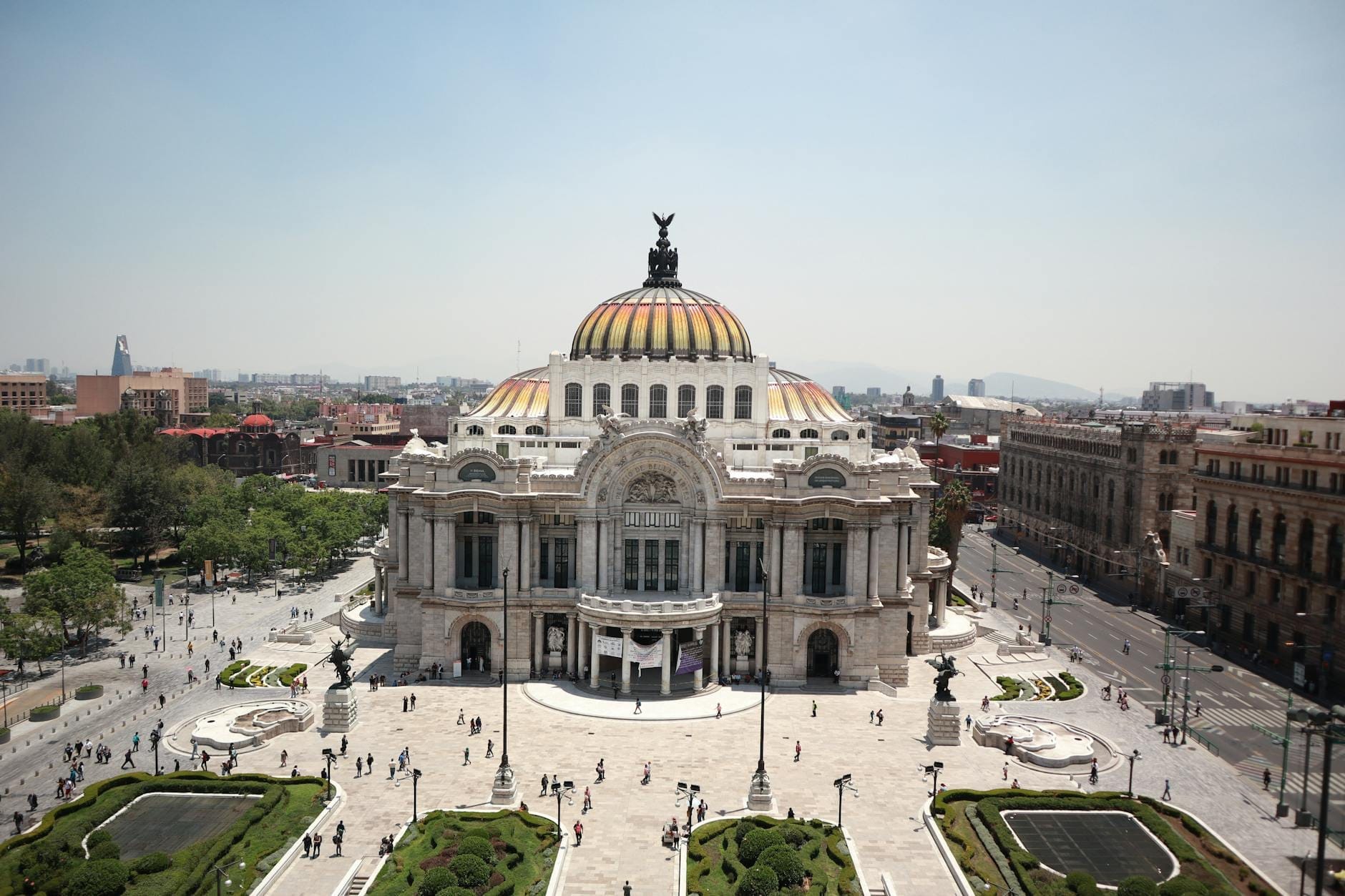
The Palacio de Bellas Artes is not simply a pretty facade. It is the headquarters of Mexico's national fine arts institution, a museum of muralist painting, and arguably the most architecturally ambitious structure in the entire country. Rising from the eastern edge of Alameda Central, its white Carrara marble exterior catches the morning light in a way that few buildings in Latin America can match, shifting from bright cream in the early hours to a warm amber by late afternoon.
Construction began in 1904 under Italian architect Adamo Boari, who was commissioned by dictator Porfirio Díaz to create a building worthy of a modernizing nation. The 1910 revolution, the sinking of the building into the soft lakebed soils beneath the historic center, and World War I all interrupted the work. It was ultimately completed in 1934 under Mexican architect Federico Mariscal, which is why the exterior reads as Art Nouveau while the interior is unmistakably Art Deco: two distinct stylistic eras fused into one complex whole.
ℹ️ Good to know
The building has sunk more than four meters into the old lakebed beneath Mexico City since construction began. This is visible when you stand on Avenida Juárez: the building appears to sit lower than the surrounding street level, which itself has settled unevenly over decades.
The Exterior: Marble, Sculpture, and Scale
The first thing most visitors notice is scale. The dome, clad in tiles of iridescent glass and topped with an eagle, is visible from several blocks away along Paseo de la Reforma and from the upper decks of Torre Latinoamericana. Up close, the facade is covered in allegorical sculptural groups: Boari's Art Nouveau vocabulary of female figures, serpents, and feathered motifs drawn from both European and Mesoamerican imagery. The blending is intentional and, seen without knowing the history, slightly surprising.
Photographing the exterior well requires timing. Midmorning, when the sun is still relatively low and to the east, the west-facing portions of the facade fall into soft shadow while the dome catches direct light from above. By midday, the marble reads flat and overexposed in photographs. Late afternoon, from roughly 16:00 onward, the building turns golden and the dome takes on a richer color. The reflecting pools in Alameda Central, just across the street, can provide foreground interest in certain compositions.
The surrounding area matters for context. The Palacio sits at the junction of the historic center and Alameda Central, one of the oldest public parks in the Americas. To the east along Calle Madero you can walk directly toward the Zócalo in under ten minutes, passing the Casa de los Azulejos and the Templo Mayor along the way.
Tickets & tours
Live prices and dates from our booking partner. If you book, we may earn a commission at no extra cost to you.
Puebla and Cholula guided tour from Mexico City with optional lunch
From 43 €Instant confirmationFree cancellationXochimilco, Coyoacan and Frida Kahlo Museum with skip-the-line tickets
From 63 €Instant confirmationFree cancellationMexico City exploration game and tour in Chimalistac
From 10 €Instant confirmationFree cancellationCuernavaca and Taxco Guided Tour with Optional Lunch
From 40 €Instant confirmationFree cancellation
Inside: Murals You Cannot See Anywhere Else
The interior is where the Palacio justifies serious time. The main hall, which seats approximately 1,700 people, has a curtain designed by Tiffany Studios of New York using nearly a million pieces of colored glass depicting the Valley of Mexico with Popocatépetl and Iztaccíhuatl volcanoes. The curtain is rarely displayed, but when it is lowered for special occasions it is extraordinary.
The upper floors house a museum dedicated to Mexican muralism. The collection includes Diego Rivera's Man, Controller of the Universe, a recreated version of the Rockefeller Center mural destroyed in New York in 1934 after the Lenin figure controversy. The painting is dense with imagery: industrial machinery, social classes, scientific symbols, and political figures arranged in a symmetrical composition that rewards slow, close reading rather than a quick glance.
Other murals by José Clemente Orozco and Rufino Tamayo line the upper galleries. Siqueiros's New Democracy (1944) fills an entire curving staircase wall with a figure of a woman breaking free from chains, painted with the kind of aggressive foreshortening that makes it feel physically imposing at close range. Plan at least 45 minutes for the murals alone if you want to look properly rather than photograph and move on.
💡 Local tip
Arrive when the box office opens on Sunday mornings (from 8:00) or on weekdays when office hours begin at 11:00. Sunday mornings see lighter tourist crowds before the midday rush from nearby Alameda Central.
Performances: Opera, Ballet, and the Ballet Folklórico
The Palacio de Bellas Artes is home to the National Opera Company, the National Dance Company, the National Symphony Orchestra, and the Ballet Folklórico de México. The Ballet Folklórico performances, which stage traditional dances from different Mexican regions in elaborate costumes, are by far the most popular with international visitors. These typically run on Wednesday evenings and Sunday mornings, though schedules change seasonally and must be confirmed on the official site or via Ticketmaster, where tickets are sold with a handling fee.
For the performing arts, the experience of the building is inseparable from the program. The main hall interior is a layered Art Deco space of yellow onyx, marble columns, and bronze ornamental work. The acoustics are good for unamplified orchestral and operatic performance. If you have any interest in classical music or dance, attending even a single performance here adds a dimension to the visit that the murals and architecture alone cannot provide.
The physical ticket office is open Monday through Saturday from 11:00 to 18:00, and on Sundays from 8:00 to 18:00. It is closed on public holidays. When a performance is scheduled, the box office remains open until tickets for the last show are sold out. Online purchasing through Ticketmaster is available but adds handling fees. Note that the official website does not publish a single general admission price for the building; costs vary by event and seating category.
Crowds, Timing, and Practical Logistics
The building draws both domestic and international visitors in significant numbers, particularly on weekends. The ground floor lobby and exterior plaza are often crowded from mid-morning onward on Saturdays and Sundays. Weekday mornings between 11:00 and 13:00 tend to be noticeably calmer, and the mural galleries on the upper floors are rarely as crowded as the lobby would suggest.
Getting there is straightforward. The Bellas Artes Metro station (served by Lines 2 and 8) and San Juan de Letrán station (Line 8) are both within easy walking distance. Both stations are busy commuter hubs, so keep an eye on belongings during peak hours. Ride-hailing apps drop off on Avenida Juárez or Eje Central without difficulty.
⚠️ What to skip
The area around the Palacio and Alameda Central sees significant foot traffic throughout the day, including vendors and informal hawkers directly outside. Confirm any tickets through official channels only, and be cautious of anyone offering discounted entry or unsolicited tour services.
Accessibility information is not prominently documented on the official site. Visitors with mobility requirements should contact the institution in advance to confirm current arrangements, as the building's age and ongoing conservation work can affect elevator and ramp access at any given time.
If this is part of a broader day in the historic center, the natural route combines the Palacio with the Alameda Central park immediately to the west, then continues east toward the Metropolitan Cathedral and Templo Mayor. The full walk from the Palacio to the Zócalo takes about 15 minutes at a relaxed pace.
Who Will Love It, and Who Might Not
The Palacio rewards visitors who slow down. If you spend twenty minutes on a single mural panel, reading the figures and symbols rather than photographing the whole wall from a distance, the experience is substantially richer. Visitors who are primarily interested in moving through the historic center efficiently and ticking off landmarks may find the mural museum more demanding than expected.
Families with young children will find the exterior and lobby interesting but may struggle with the museum galleries, which are quiet, formal spaces without interactive elements. The building itself is large enough that managing small children through multiple floors can be tiring.
Travelers who want context before visiting would do well to read about Mexican muralism and the three major muralists (Rivera, Siqueiros, Orozco) beforehand. For a broader cultural itinerary, the best museums in Mexico City guide covers how the Palacio fits alongside other major institutions across the city.
Insider Tips
- If you want to see the Tiffany glass curtain, check the performance schedule in advance. It is lowered only for certain special events, not for every performance.
- The cafe inside the building is a practical spot to rest between the murals and a performance, and is far less crowded than the restaurants immediately outside on Avenida Juárez.
- For photography of the dome interior, a wide-angle lens (or the widest setting on a phone camera) is essential. The dome is taller than it appears from ground level and close-range shots rarely capture it well.
- Sunday morning performances of the Ballet Folklórico typically start earlier than evening shows. Arriving at the box office when it opens at 8:00 on Sundays gives you the best chance at good remaining seats without Ticketmaster fees.
- The building continues to sink gradually due to the soft subsoil beneath central Mexico City. Stand across the street on Alameda Central and look at the base of the building relative to street level: the settlement is visible to the naked eye and is one of the more striking urban geology stories in the city.
Who Is Palacio de Bellas Artes For?
- Architecture enthusiasts drawn to the rare fusion of Art Nouveau and Art Deco in a single building
- Art history visitors wanting to see Diego Rivera's Man at the Crossroads in its permanent home
- Classical music and opera audiences seeking a world-class venue with exceptional acoustics
- Photographers looking for one of the most photogenic exteriors in the entire city
- Travelers building a full-day itinerary through the Centro Histórico
Nearby Attractions
Other things to see while in Centro Histórico:
- Alameda Central
Founded in 1592, Alameda Central is the oldest public park in the Americas and the green centerpiece of Mexico City's historic center. Flanked by the Palacio de Bellas Artes and a ring of colonial-era institutions, it offers free entry, shaded walkways, and a front-row seat to everyday city life.
- Calle Madero
Avenida Francisco I. Madero connects the Zócalo to the Torre Latinoamericana along one of the oldest streets in the Americas. Free to walk at any hour, it layers colonial architecture, street performance, and everyday city life into a single corridor that doubles as an open-air history lesson.
- Casa de los Azulejos
Casa de los Azulejos is one of the most photographed facades in Mexico City, its exterior wrapped in blue-and-white Talavera tiles from Puebla. With documented origins in the 16th century and operating as a Sanborns restaurant since 1919, it offers free entry and a rare chance to step inside a baroque palace that has survived centuries of history.
- La Ciudadela Artisan Market
The Mercado de Artesanías de La Ciudadela is one of Mexico City's largest and best-known handicraft markets, with more than 350 vendors selling handmade goods from across 22 states. Entry is free, quality ranges from tourist trinkets to serious collector pieces, and knowing how to navigate the stalls makes all the difference.
Planning a trip? Discover personalized activities with the Nomado app.