Metropolitan Cathedral, Mexico City: What to Expect Before You Visit
The Catedral Metropolitana de la Asunción de la Santísima Virgen María a los cielos dominates the north side of the Zócalo and is widely regarded as the largest and one of the most important cathedrals in Latin America. Built over nearly 250 years on the ruins of the Aztec capital Tenochtitlan, it layers baroque, neoclassical, and neo-renaissance styles into one slowly sinking monument. Entry is free.
Quick Facts
- Location
- Plaza de la Constitución S/N, Centro Histórico, Cuauhtémoc, CDMX
- Getting There
- Zócalo/Tenochtitlan station, Metro Line 2 — short walk north across the plaza
- Time Needed
- 45 minutes to 1.5 hours depending on interior exploration
- Cost
- Free entry; small donation or fee requested for access to areas such as the choir, sacristy, crypt, or bell towers
- Best for
- Colonial architecture, religious art, Mexican history, photography
- Official website
- http://www.catedralmetropolitanademexico.mx/
What the Cathedral Is
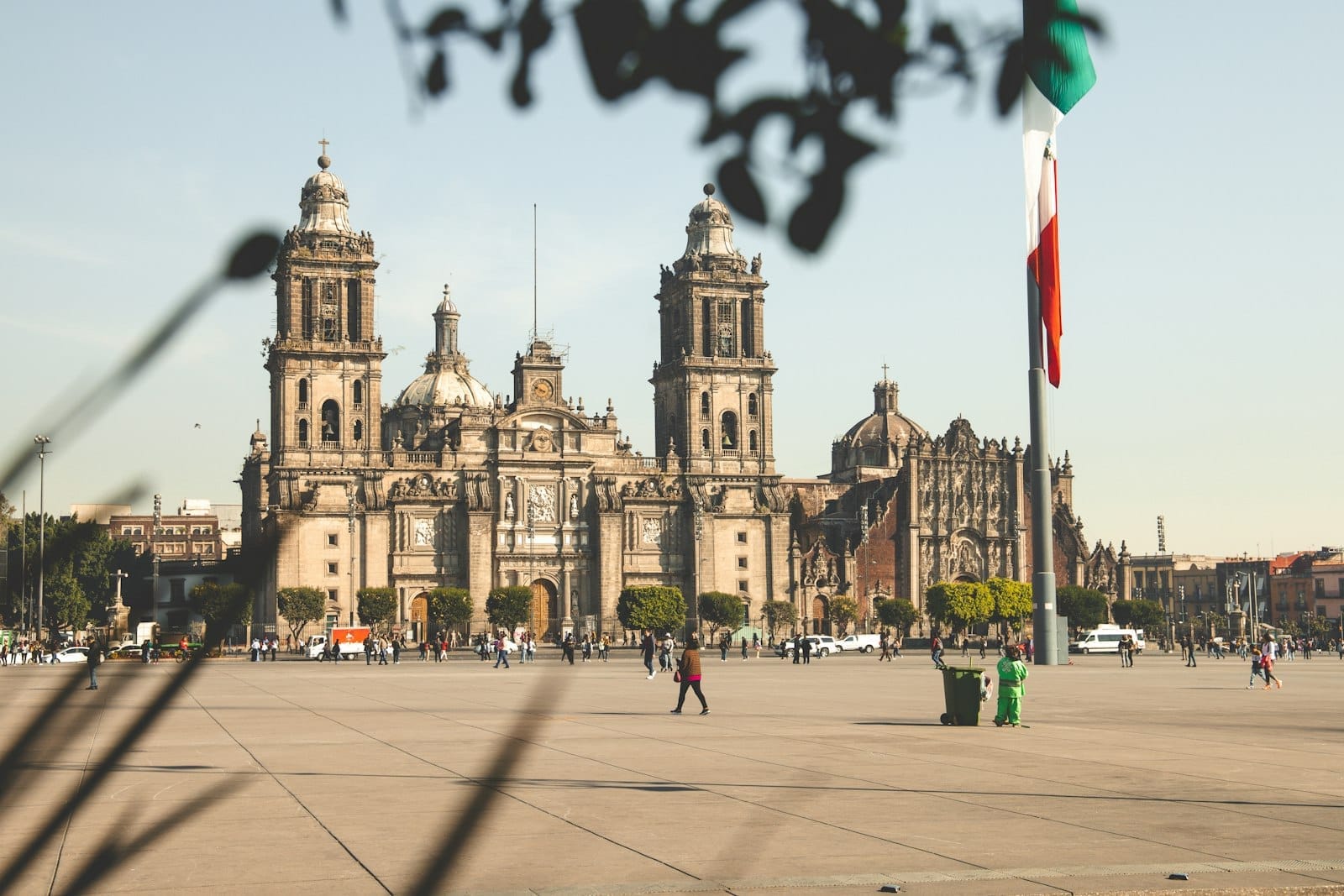
The Mexico City Metropolitan Cathedral — officially the Catedral Metropolitana de la Asunción de la Santísima Virgen María a los cielos — is the cathedral church of the Roman Catholic Archdiocese of Mexico and one of the largest religious structures in the Americas. It occupies the entire northern edge of the Zócalo, Mexico City's central plaza, and its twin bell towers and pale stone facade are visible from nearly every angle of the square. This is not a quiet, tucked-away church. It is a civic monument, a living place of worship, and an open-air architectural textbook all at once.
What makes the cathedral unusual is the ground it stands on. Spanish colonial planners built it directly over the ceremonial heart of Tenochtitlan, the Aztec capital, deliberately repurposing sacred indigenous geography. Immediately to the east, the ruins of the Templo Mayor were excavated mainly in the late 20th century, with the museum and site opening to the public in 1987. Standing between the two sites, you are looking at nearly 700 years of layered history compressed into a single city block.
ℹ️ Good to know
Entry to the main cathedral is free. A small donation or fee is requested to access specific interior areas such as the choir, sacristy, crypt, or bell towers. Hours are commonly listed by tourism sources as daily 8:00–20:00 for the building, though access to specific areas often follows a shorter 9:00–17:30 visiting window and can shift around religious services and special events. Verify on arrival.
Three Centuries of Construction, All Visible at Once
Construction began in 1573 and was not completed until 1813 — a span of about 240 years. That duration explains the architectural complexity. The lower facade shows the influence of Herreran baroque, named after the Spanish architect Juan de Herrera. Move up to the towers and the clock face and you are looking at neoclassical work completed under architect Manuel Tolsá, who also added the central dome and the statue of Faith that crowns the pediment. Inside, chapels built across different centuries carry their own stylistic fingerprints, from heavily gilded altarpieces to restrained neoclassical decoration.
The most immediately striking interior feature is the Altar of the Kings (Altar de los Reyes), a churrigueresque retablo at the far end of the nave. Churrigueresque is an extreme form of Spanish baroque characterized by dense, almost frenzied ornamental carving. The altar's surface is covered floor to ceiling in gilded wood relief — paintings of kings and saints embedded within carved columns, arches, and vegetal decoration. It is overwhelming in scale and detail. Budget time to stand in front of it without rushing.
The cathedral contains 16 chapels along its nave walls, each dedicated to a different saint or religious theme, and each decorated with its own retablo and devotional objects. Given the free entry and long construction history, it rewards slow exploration in a way that many Mexico City museums do not. For context on the broader architectural legacy of the historic center, the Centro Histórico has dozens of colonial buildings within walking distance.
Tickets & tours
Live prices and dates from our booking partner. If you book, we may earn a commission at no extra cost to you.
Puebla and Cholula guided tour from Mexico City with optional lunch
From 43 €Instant confirmationFree cancellationXochimilco, Coyoacan and Frida Kahlo Museum with skip-the-line tickets
From 63 €Instant confirmationFree cancellationMexico City exploration game and tour in Chimalistac
From 10 €Instant confirmationFree cancellationCuernavaca and Taxco Guided Tour with Optional Lunch
From 40 €Instant confirmationFree cancellation
The Sinking Problem: Uneven Floors and What Causes Them
The cathedral is sinking. This is not metaphor or exaggeration — it is a documented engineering reality. Mexico City was built on the lakebed of the former Lake Texcoco, and the soft, water-saturated clay beneath the historic center has been compressing under the weight of colonial-era buildings for centuries. The cathedral's foundation shows this dramatically: the floor inside is visibly uneven, tilting in different directions depending on where you stand. Columns lean. The geometry is subtly wrong in ways that become more apparent the longer you look.
Major structural rescue work was carried out beginning in the 1990s, involving the controlled extraction of soil beneath the foundation to level the structure. The cathedral has been stabilized, but differential sinking continues at a much slower rate. This is relevant for visitors with mobility limitations: the interior floors are irregular, there are level changes between areas, and specific accessibility details are not widely documented in official sources. Come prepared for uneven walking surfaces.
⚠️ What to skip
Visitors with limited mobility should be aware that the cathedral's interior has notably uneven floors due to decades of differential sinking into former lakebed. Specific step-free access details are not confirmed in available official sources — contact the cathedral directly if this is a concern before visiting.
How the Experience Changes by Time of Day
Early morning, before 10:00, is the quietest time to visit. The Zócalo itself is still relatively calm, the light on the stone facade is soft and warm, and the interior is populated mainly by worshippers rather than tour groups. The smell of incense is strongest at this hour, carried through the nave from morning masses. The sound profile is remarkable: the ambient noise of a city of over nine million people disappears almost completely once you step through the heavy wooden doors. What you hear instead is the echo of footsteps on stone floors, murmured prayers, and the occasional toll of one of the 35 bells housed in the two towers.
Midday is the busiest period. Tour groups move through the chapels, vendors operate just outside the entrance on the plaza side, and the Zócalo itself reaches peak foot traffic. If you are visiting primarily for photography or quiet reflection, this is the least rewarding window. That said, the afternoon light entering through the upper windows and lantern dome creates strong contrast on the gilded altarpieces — worth noting if interior photography is a priority.
Late afternoon, especially in the dry season months from November through April, offers a second quieter window. The tour groups thin out after 16:00, and the lower sun angle warms the exterior stonework. The plaza fills with a different crowd at this hour: locals passing through, street performers, and food vendors. Many accounts note that access to some visitor areas winds down by late afternoon, so arriving after 16:30 can leave limited time inside even though general opening hours are often listed until 20:00.
The Zócalo Context: Why This Location Matters
The cathedral cannot be separated from its setting. It faces the Zócalo, formally the Plaza de la Constitución, which is among the largest public plazas in the world by area. On most days the plaza hosts a giant Mexican flag at its center, and the surrounding buildings — the National Palace, the federal government offices — frame a square that has been the seat of political and religious power for centuries. The cathedral's placement is deliberate: its main facade opens south onto the Zócalo, and its twin towers read as vertical anchors for the entire composition of the square.
Just to the east of the cathedral, accessible through a dedicated entrance and paid ticket, the Templo Mayor archaeological site reveals the Aztec structures that were destroyed to build this colonial city. Visiting both on the same day is one of the more historically resonant things you can do in Mexico City — the contrast between what was destroyed and what was built in its place is stark and uncomfortable in useful ways.
The National Palace occupies the entire eastern edge of the Zócalo and contains Diego Rivera's famous murals depicting Mexican history. Most visitors pair the cathedral and the National Palace in the same morning. The walk between them is less than 200 meters.
Photography, Practical Walkthrough, and What to Bring
Photography is generally permitted inside the cathedral without flash, though this can vary during active religious services. The most photogenic interior elements are the Altar of the Kings, the ceiling of the central nave, and the ornate pipe organ. For the facade, the best exterior shots come from the southeast corner of the Zócalo where you can capture both towers and the central pediment in one frame. A wide-angle lens is useful inside; the nave is broad but the chapels are narrow.
Dress modestly. Shoulders and knees should be covered as a matter of courtesy — this is an active place of worship, not only a tourist attraction. Light layers are useful year-round at Mexico City's elevation of approximately 2,240 meters above sea level: mornings can be noticeably cool even in spring, and the interior of the cathedral maintains a consistent chill regardless of outdoor temperature.
Getting there is straightforward. Metro Line 2 stops at Zócalo/Tenochtitlan station, which exits almost directly onto the plaza. The walk to the cathedral entrance takes under three minutes. For broader orientation on moving around the historic center and the city, the guide to getting around Mexico City covers Metro logistics in detail.
Who Should Manage Expectations
The cathedral is not overhyped — its scale and historical weight are genuine. But visitors expecting the interior grandeur of European cathedrals may find parts of it surprisingly worn. Centuries of sinking, restoration work, and continuous active use have left some areas looking patched rather than polished. Several chapels are cordoned off during preservation work, and lighting in some sections is dim enough to make the art difficult to read. This is not a museum-quality presentation. It is a working church that happens to contain museum-quality objects.
Visitors who dislike crowds and prefer controlled, well-lit environments should either arrive before 10:00 or accept that the midday atmosphere will test their patience. The plaza outside, while impressive, is not a tranquil space — it is a major transit and gathering point for one of the world's largest cities, and the noise level outside the cathedral doors is significant.
Insider Tips
- If you want to see the choir, ask at the entrance about access — a small donation is typically requested and the carved wooden choir stalls are among the finest colonial woodwork in the country, but many visitors miss them entirely by not asking.
- The Sagrario Metropolitano, the smaller parish church attached to the cathedral's eastern facade, has a churrigueresque portal that many visitors walk past without noticing. Take 10 minutes to study it up close — the level of stone carving detail is exceptional.
- Come on a weekday morning rather than a weekend. Sunday masses fill the cathedral with worshippers, which makes the space feel alive but limits circulation through the chapels.
- The exterior stone is a warm tezontle (volcanic red stone) mixed with pale grey stone, and the color shifts noticeably in different light conditions. The best exterior light for photography is between 08:00 and 09:30 when the sun is low and the Zócalo is not yet crowded.
- Altitude affects energy levels, especially if you have just arrived in Mexico City. The cathedral is an ideal early-trip stop because it requires almost no physical exertion but rewards close attention — a good introduction to the pace the city demands of visitors.
Who Is Metropolitan Cathedral For?
- History travelers who want to understand the Spanish colonial project in a single building
- Architecture enthusiasts interested in baroque and neoclassical styles across different construction periods
- Photographers looking for dramatic scale and ornamental detail without an entry fee
- First-time visitors to Mexico City building their orientation around the Zócalo
- Anyone combining the cathedral with a Templo Mayor visit for a layered pre-Hispanic and colonial half-day
Nearby Attractions
Other things to see while in Centro Histórico:
- Alameda Central
Founded in 1592, Alameda Central is the oldest public park in the Americas and the green centerpiece of Mexico City's historic center. Flanked by the Palacio de Bellas Artes and a ring of colonial-era institutions, it offers free entry, shaded walkways, and a front-row seat to everyday city life.
- Calle Madero
Avenida Francisco I. Madero connects the Zócalo to the Torre Latinoamericana along one of the oldest streets in the Americas. Free to walk at any hour, it layers colonial architecture, street performance, and everyday city life into a single corridor that doubles as an open-air history lesson.
- Casa de los Azulejos
Casa de los Azulejos is one of the most photographed facades in Mexico City, its exterior wrapped in blue-and-white Talavera tiles from Puebla. With documented origins in the 16th century and operating as a Sanborns restaurant since 1919, it offers free entry and a rare chance to step inside a baroque palace that has survived centuries of history.
- La Ciudadela Artisan Market
The Mercado de Artesanías de La Ciudadela is one of Mexico City's largest and best-known handicraft markets, with more than 350 vendors selling handmade goods from across 22 states. Entry is free, quality ranges from tourist trinkets to serious collector pieces, and knowing how to navigate the stalls makes all the difference.
Planning a trip? Discover personalized activities with the Nomado app.