Acuario Inbursa: Mexico City's Underground Ocean
Built beneath Plaza Carso in the Nuevo Polanco district, Acuario Inbursa holds 1.6 million litres of seawater and roughly 14,000 specimens across more than 230 species. It opened in 2014 and remains one of the most technically ambitious aquariums in Latin America. Here is what the visit actually involves, and whether it is worth your time.
Quick Facts
- Location
- Av. Miguel de Cervantes Saavedra 386, Col. Granada, Miguel Hidalgo, Mexico City
- Getting There
- Metro Polanco (Line 7) or Metro San Joaquín (Line 7), then a short taxi or rideshare to Plaza Carso
- Time Needed
- 1.5 to 2.5 hours
- Cost
- Around MXN $359 general admission (verify current rate); children under 3 free
- Best for
- Families with children, school groups, marine life enthusiasts, visitors seeking indoor activity on rainy days
- Official website
- www.acuarioinbursa.com.mx
What Acuario Inbursa Is
Acuario Inbursa is a public aquarium located beneath Plaza Carso in the Nuevo Polanco area of Mexico City. It opened on 8 June 2014 and was designed as a large-scale cultural and educational attraction, financed through the Inbursa financial group. The facility spreads across approximately 3,500 square metres of exhibition space divided into four underground levels, and it holds around 1.6 million litres of seawater sourced from the Gulf of Mexico. With roughly 14,000 individual specimens representing more than 230 species across 48 exhibits, it is one of the largest aquariums in Latin America by water volume.
The location matters. Acuario Inbursa sits in the same plaza as Museo Soumaya and Museo Jumex, two of Mexico City's most architecturally striking cultural buildings. This means that even if the aquarium is not your primary interest, the surrounding area rewards a combined visit. The plaza itself is open, clean, and pedestrian-friendly, which makes the approach noticeably different from scrambling through Centro Histórico traffic.
💡 Local tip
Buy tickets online before you arrive. The official site at acuarioinbursa.com.mx allows date-specific booking, which reduces wait times at the entrance, especially on weekends and school holidays when queues at the door can stretch considerably.
The Layout: Descending Into Four Levels
The experience works in reverse from what most visitors expect. You enter at ground level, then descend to the lowest floor before working your way back up through each level. The descent itself sets the tone: the lighting drops, the ambient sound shifts from plaza noise to the low electrical hum of filtration systems and the echo of water, and the temperature cools noticeably compared to outside. On a warm Mexico City afternoon, this transition feels deliberate and theatrical.
Each level is themed around distinct marine ecosystems. Exhibits move through coastal and reef environments, open ocean species, and species native to Mexican waters including the Gulf of Mexico and the Pacific. The tanks vary significantly in scale, from small, close-up cylindrical displays showing delicate invertebrates and juvenile fish to the large panoramic tanks where rays and sharks move at an unhurried pace in front of floor-to-ceiling acrylic panels.
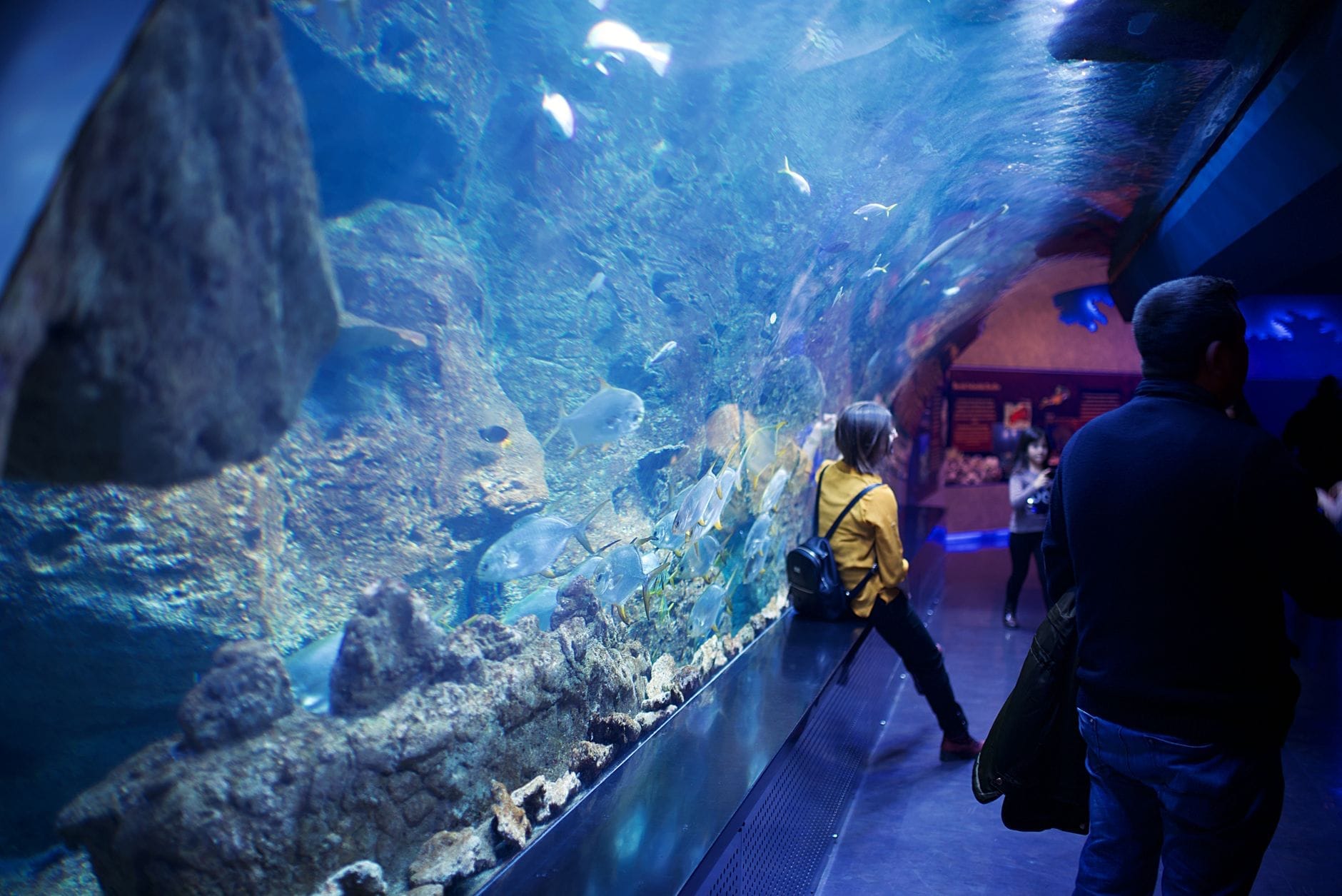
The tunnel exhibit, where the walkway passes through an acrylic tube surrounded on all sides by water and larger pelagic species, is the centrepiece moment. Rays pass directly overhead. Sharks circle at eye level. The effect is technically impressive, particularly given that Mexico City sits at about 2,240 metres above sea level, making the engineering required to maintain a stable marine environment here unusual.
ℹ️ Good to know
The aquarium is entirely indoors and underground, which makes it one of the more practical choices in Mexico City's cultural calendar during the May to October rainy season, when afternoon thunderstorms can shut down outdoor activities with little warning.
Tickets & tours
Live prices and dates from our booking partner. If you book, we may earn a commission at no extra cost to you.
Puebla and Cholula guided tour from Mexico City with optional lunch
From 43 €Instant confirmationFree cancellationXochimilco, Coyoacan and Frida Kahlo Museum with skip-the-line tickets
From 63 €Instant confirmationFree cancellationMexico City exploration game and tour in Chimalistac
From 10 €Instant confirmationFree cancellationCuernavaca and Taxco Guided Tour with Optional Lunch
From 40 €Instant confirmationFree cancellation
Best Times to Visit and Crowd Patterns
Acuario Inbursa is open Monday through Sunday from 10:00 to 18:00. Weekday mornings between 10:00 and 12:00 offer the calmest conditions. The lower levels are naturally dim regardless of time of day, but the reduced crowd allows you to linger at exhibits without the press of school groups or weekend families moving the flow along involuntarily.
Saturdays and Sundays from roughly 11:00 to 15:00 are the busiest windows. The tunnel section in particular can become congested, with children pressing against the acrylic and groups stopping for photos. If you arrive on a weekend, aim for opening time. The first 45 minutes typically see far fewer visitors than the midday peak.
Mexican school holidays, including Semana Santa in April and the summer break from July into August, bring large organised groups. These periods are not ideal for visitors seeking a quieter, slower look at the exhibits. The aquarium functions perfectly well as a family attraction during these periods, but it becomes often crowded in a way that affects the viewing experience at key tanks.
Sensory Details and Atmosphere
Compared to outdoor attractions in Mexico City, the sensory register here is contained and controlled. The air smells faintly of salt and filtered water. The lighting is predominantly blue-tinted and low throughout the exhibit floors, shifting only at interactive stations and the gift shop. The sound design leans on ambient underwater recordings layered over the constant mechanical background of the life-support systems.
For younger children, the hands-on touch pool is usually the most kinetically engaging section. Depending on the day and the care staff rotation, visitors can observe feeding sessions at some of the larger tanks. These are not guaranteed at a fixed schedule in publicly posted information, so treat any feeding display as a bonus rather than an expectation.
Photography here requires patience and a willingness to adjust settings. The low light and constant motion of the animals combine to frustrate phone cameras in auto mode. Using the dedicated aquarium or night mode on a modern smartphone produces better results. Flash is prohibited throughout, both for the welfare of the animals and because it produces nothing useful through glass and acrylic anyway.
⚠️ What to skip
Some visitors find the enclosed underground environment claustrophobic, particularly on busy days when the lower levels fill with school groups. If tight, crowded indoor spaces are an issue, visiting on a weekday morning significantly reduces that risk.
Getting There and Practical Logistics
The aquarium's address is Av. Miguel de Cervantes Saavedra 386, Colonia Granada, Alcaldía Miguel Hidalgo. It sits within Plaza Carso, which is visible from several major avenues in the Nuevo Polanco area. The nearest Metro stations are Polanco and San Joaquín, both on Line 7 (the orange line). Neither station is a direct walk to the aquarium; the most practical approach is to take the Metro to either station and then use a rideshare app or a short taxi ride to Plaza Carso.
For visitors already spending time in the Polanco and Chapultepec zone, the aquarium fits naturally into a day that also includes Museo Soumaya or Museo Jumex, both of which share the same Plaza Carso footprint. Combining two or three of these in a single afternoon is logistically straightforward and avoids repeated transit trips across the city.
If you are planning a broader itinerary for the city, the 3-day Mexico City itinerary positions this area well alongside Chapultepec and the cultural corridor running west from the historic centre. The aquarium works best as a half-day activity rather than a standalone full-day commitment.
Parking is available in the Plaza Carso structure, which is useful if you are driving. Rideshare apps including Uber and Didi operate throughout Mexico City and are typically the most convenient option for visitors unfamiliar with the city's road layout. For broader context on moving around, the guide to getting around Mexico City covers your main transit options in detail.
Who This Attraction Suits and Who Should Pass
Acuario Inbursa is well designed for families with children between roughly 4 and 14 years old. The tunnel section, the touch pool, and the visual scale of the larger tanks hold attention at most ages. It also works for adults with a specific interest in marine biology or aquatic ecosystems, and for anyone looking for a reliable indoor activity on a day when Mexico City's afternoon rains have cancelled outdoor plans. If you are travelling with kids and looking for more family-specific options across the city, the guide to Mexico City with kids puts this in context alongside other child-focused venues.
Visitors primarily focused on Mexico City's deep cultural and historical identity may find the aquarium a weaker use of time compared to the Museo Nacional de Antropología or the archaeological sites scattered across the city. The aquarium does not engage with Mexican history or culture in a meaningful way. It is a well-executed contemporary aquarium, not a cultural institution in the traditional sense.
Adults travelling without children who have limited days in Mexico City and are prioritising art, history, or street-level exploration may find the time-to-reward ratio lower than other options in the same part of the city. The admission price, while not excessive for the scale of the facility, represents a real cost relative to some of Mexico City's free or low-cost museums.
💡 Local tip
The café and food options inside the aquarium are adequate but not exceptional. If you are planning to eat nearby, the Nuevo Polanco area around Plaza Carso has a solid range of restaurants at different price points within easy walking distance.
Insider Tips
- The lowest level, reached first on the tour route, is almost always the least crowded because most visitors are still dispersing from the entrance area. Spend extra time here before the groups catch up.
- The tunnel section becomes a bottleneck on weekends. If you reach it and it is crowded, continue to the next section and loop back. The flow of visitors tends to move in one direction, so doubling back often gives you a quieter pass through.
- The acrylic on several of the large tanks reflects overhead lighting in a way that creates unwanted glare in photos. Positioning your phone or camera lens directly against the surface, without a gap, eliminates most of this reflection.
- Combining Acuario Inbursa with Museo Soumaya and Museo Jumex in the same Plaza Carso visit is the most efficient way to use this part of the city. The Soumaya is free to enter, which partially offsets the aquarium admission in a combined budget.
- Verify opening hours and any temporary closures directly with the aquarium or on the official site before visiting. Special events and private functions occasionally affect access to portions of the facility.
Who Is Acuario Inbursa For?
- Families with children aged 4 to 14 looking for an immersive indoor experience
- Visitors caught in Mexico City's afternoon rainy season downpours who need a reliable covered activity
- Travellers combining a cultural afternoon in the Plaza Carso area alongside Museo Soumaya or Museo Jumex
- Marine biology enthusiasts curious about Gulf of Mexico and Pacific species displayed in a technically sophisticated facility
- School and educational groups for whom the 48 curated exhibits provide structured learning content
Nearby Attractions
Combine your visit with:
- Arena México
Inaugurated in 1956 and holding up to roughly 16,800 spectators, Arena México is the home of CMLL and the most storied lucha libre venue in the world. Matches run on Tuesday, Friday, and Sunday evenings in Colonia Doctores, making it one of the most accessible live spectacles in Mexico City.
- Basilica of Our Lady of Guadalupe
The Basilica of Our Lady of Guadalupe is one of the most visited Catholic shrines on earth, receiving over 20 million pilgrims and visitors each year. Built around the 1531 apparition site on Tepeyac Hill, it holds the venerated tilma of Juan Diego and offers a rare encounter with living Mexican faith at its most intense.
- Cineteca Nacional
The Cineteca Nacional de México is the country's national film archive and its most important arthouse cinema complex. Rebuilt after a devastating 1982 fire and transformed in 2012 into a world-class cultural campus, it combines 10 indoor screens, a large open-air screening forum, galleries, a bookshop, and restaurants in a single destination that attracts cinephiles, students, and casual visitors alike.
- Desierto de los Leones National Park
Parque Nacional Desierto de los Leones is Mexico's first national park, a 1,867-hectare pine-and-oak forest rising to 3,700 meters on the city's western rim. At its heart stands a hauntingly preserved 17th-century Carmelite ex-convent, surrounded by cool ravines, morning mist, and trails that feel nothing like the megacity an hour away.
Planning a trip? Discover personalized activities with the Nomado app.