Museo Jumex: Free Contemporary Art in the Heart of Polanco
Museo Jumex is the public home of Colección Jumex, one of Latin America's largest private collections of contemporary art. Housed in a striking 2013 building by British architect David Chipperfield, the museum offers free admission and rotating exhibitions in the Granada area of Polanco in Mexico City.
Quick Facts
- Location
- Av. Miguel de Cervantes Saavedra 303, Granada, Polanco, Mexico City
- Getting There
- Nearest Metro: Polanco (Line 7); ride-share recommended for the final stretch to Granada
- Time Needed
- 1 to 2 hours for a focused visit; 2.5 hours if you read exhibition text carefully
- Cost
- Free (general admission). Verify before visiting as special programs may differ.
- Best for
- Contemporary art lovers, architecture enthusiasts, and anyone wanting a culturally rich stop without an admission charge
- Official website
- www.fundacionjumex.org/en
What Museo Jumex Is
Museo Jumex is the public exhibition platform of Fundación Jumex Arte Contemporáneo, a foundation created by the Servitje family of the Jumex fruit-juice empire to steward one of the most significant contemporary art collections in Latin America. The collection, known as Colección Jumex, spans several thousand works by Mexican and international artists and reaches back to the early 1990s, when founder Eugenio López Alonso began acquiring work with a seriousness that eventually demanded its own institution.
The museum opened in November 2013 in the Granada area of Polanco, on a triangular urban site wedged between a residential tower and the nearby Soumaya museum. It is not a permanent-collection display in the traditional sense: exhibitions rotate and the programming tends toward focused thematic or monographic shows that draw from the collection and often incorporate international loans. On any given visit, the works on view will be different from those shown six months earlier, which rewards repeat visits.
ℹ️ Good to know
Opening hours: Tuesday–Friday 10:00–17:00, Saturday 10:00–19:00, Sunday 10:00–17:00. Closed Monday. Admission is free. Always verify on the official site before visiting, as special programs can affect access.
The David Chipperfield Building
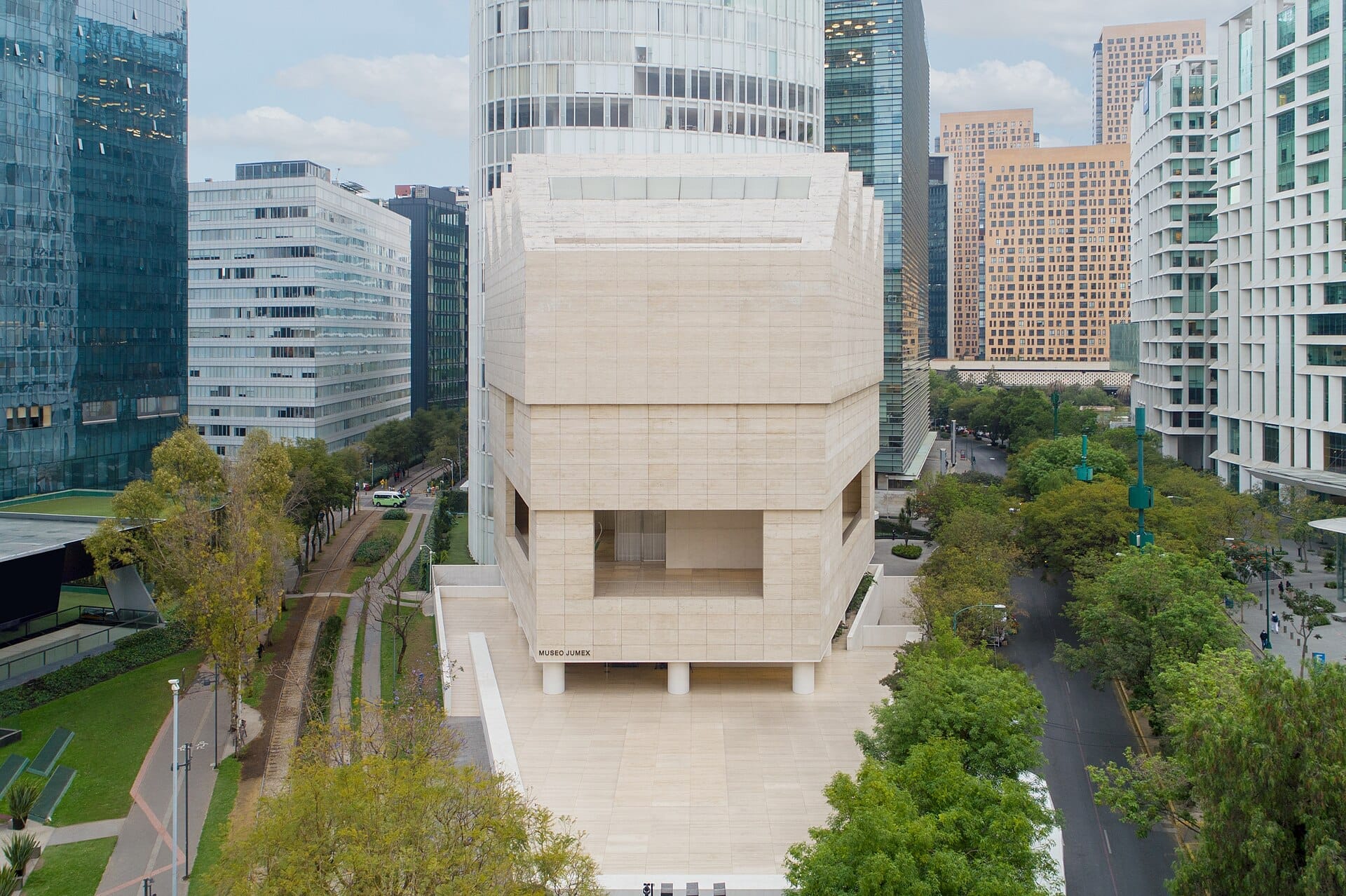
The architecture here is worth arriving for on its own terms. David Chipperfield Architects designed the building with a commission that began in 2009 and was completed for the 2013 opening. The gross floor area is approximately 4,000 square metres, distributed across several floors of gallery space, an auditorium, and bookshop. The exterior is faced in precast concrete panels with a stepped, sawtooth roofline that filters natural light into the upper galleries through clerestory windows, a strategy Chipperfield has used elsewhere to avoid the harsh glare that skylights can introduce.
From the street, the building reads as restrained and slightly monumental, occupying its triangular plot with a deliberate blankness that resists the commercial noise of the neighborhood. The facade's cool grey geometry sits in direct visual conversation with the Museo Soumaya next door, designed by Fernando Romero, which is all curved silver panels and performative spectacle. The contrast is pointed and probably intentional. Where Soumaya announces itself, Jumex quietly asks you to come inside.
The interior circulation is straightforward: galleries are arranged on multiple floors connected by a central staircase. Natural light in the upper floor gives those rooms a warmer, more domestic feeling than the lower gallery spaces, which rely on controlled artificial lighting suited to installations and video works. The ceiling heights are generous throughout, and the concrete finishes are smooth enough to feel refined without approaching the sterile perfection of some private art foundations.
If you are interested in the architectural geography of Polanco more broadly, note that the area around the museum is one of the most architecturally layered in the city. The nearby Avenida Presidente Masaryk gives a sense of how the neighborhood balances luxury commerce and cultural investment.
Tickets & tours
Live prices and dates from our booking partner. If you book, we may earn a commission at no extra cost to you.
Xochimilco, Coyoacan and Frida Kahlo Museum with skip-the-line tickets
From 63 €Instant confirmationFree cancellationFrida Kahlo and Diego Rivera legacy visit to three museums with skip-the-line tickets
From 67 €Instant confirmationFree cancellationSix Flags Amusement Park tickets and transportation
From 87 €Instant confirmationFree cancellationMexico City National Museum of Anthropology guided tour
From 57 €Instant confirmationFree cancellation
What Visiting Feels Like at Different Hours
Tuesday and Wednesday mornings are the quietest windows. By 10:30, the light in the upper galleries is at its best, the bookshop staff are unhurried, and the works can be read without competition from school groups or weekend crowds. The building's sound profile is worth noting: the concrete floors and high ceilings mean sound carries, so a single group of visitors talking at normal volume creates an ambient hum. Early weekday mornings, you may have entire rooms to yourself.
Saturday afternoons draw a noticeably different crowd. The museum extends its hours until 19:00 on Saturdays, which makes it a workable option for visitors doing the Polanco-Soumaya circuit later in the day. By 17:00 on a Saturday the galleries fill with Mexico City residents treating the museum as a late-afternoon social ritual rather than a dedicated art excursion. The energy is looser and the lighting in the upper galleries becomes particularly atmospheric as natural light fades.
Rain has no real effect on the experience since the museum is entirely indoors, but it does change the quality of the natural light in the upper gallery. Overcast days produce an even, diffuse illumination that some visitors find better suited to painting and works on paper. The exterior plaza becomes temporarily unusable in heavy rain, which matters if you are planning to sit outside before or after.
The Collection and Exhibition Programming
Colección Jumex is often cited as one of the largest private contemporary art collections in Latin America, with holdings that include major works by artists such as John Baldessari, Olafur Eliasson, Maurizio Cattelan, and a significant number of Mexican artists working from the 1990s onward. The full collection is not permanently on display: the museum presents rotating exhibitions that draw from the collection and frequently incorporate borrowed works from other institutions and private holdings.
The programming tends toward serious curatorial ambition rather than populist blockbusters. Exhibitions are typically accompanied by well-produced catalogues and public programs including talks, film screenings, and educational workshops. The bookshop carries a strong selection of art catalogues, critical theory, and Mexican art publications, and it functions as a useful resource even for visitors who are not primarily museum-goers.
Because the collection covers several thousand works and the building has roughly 4,000 square metres of floor area, any single exhibition occupies only a fraction of what the foundation holds. This means the experience varies substantially across visits, and arriving without fixed expectations about which works you will see is the most useful mental frame.
For context on the broader landscape of contemporary and modern art institutions in Mexico City, the guide to the best museums in Mexico City places Jumex alongside institutions like Museo Tamayo and MUAC in terms of curatorial ambition.
Getting There and Practical Logistics
The museum's address is Avenida Miguel de Cervantes Saavedra 303, Colonia Granada, in the Miguel Hidalgo borough. Granada sits just north of Polanco proper, and while the neighborhood is considered part of the broader Polanco area, it is not immediately walkable from the main Polanco Metro station without some orientation. Metro Line 7 stops at Polanco, which leaves a short ride-share hop to reach the museum.
The most practical approach for most visitors is Uber or Didi directly to the door, particularly if combining Jumex with the adjacent Soumaya. Both museums are near Plaza Carso, which also contains retail and food options, so the area has enough infrastructure to support a half-day visit without needing to move far.
💡 Local tip
If you are doing the Polanco museum circuit, visit Museo Jumex before Museo Soumaya. Jumex's quieter, more considered spaces work best when you are fresh. Soumaya's collection is larger and more eclectic, and its ground floor atrium makes a good endpoint.
The surrounding Chapultepec and Polanco area also contains Museo Tamayo, the Museo Nacional de Antropología, and Chapultepec Park, making it one of the most museum-dense zones in the city. A full day can be built around this corridor without doubling back.
Photography, Accessibility, and Who Should Skip This
Photography policies vary by exhibition, as some works are on loan under restricted terms. As a general rule, photography for personal use without flash is permitted in most of the gallery spaces, but this should be confirmed at the entrance on the day of your visit since borrowed works often carry specific prohibitions. The architecture itself, including the staircase, lobby, and exterior, can always be photographed.
The museum's official website does not clearly publish a detailed accessibility statement at the time of writing. Visitors with specific accessibility requirements, including step-free access, elevator availability, or hearing loop provision, are advised to contact the museum directly before visiting via the contact details on the official site.
This museum is not the right choice for every traveler. If your interest in art is broad and casual rather than specifically focused on contemporary work from the last three decades, the Museo Nacional de Arte or the Museo Franz Mayer in the historic center may offer a more immediately legible experience. Families with young children who need interactive programming will likely find the Museo de Arte Popular more engaging. Jumex rewards visitors who are willing to spend time with individual works rather than moving quickly through a survey of objects.
Visitors interested in other significant private art foundations in Mexico City can also explore the Museo Soumaya, which is nearby and offers free admission with a very different collecting philosophy.
Insider Tips
- Check the Fundación Jumex website for public programming before you visit. Talks, screenings, and guided tours are often free and can completely reframe what you see in the galleries.
- The bookshop on the ground floor stocks publications that are difficult to find elsewhere in Mexico City, including catalogues from past Jumex exhibitions and critical texts on Latin American contemporary art. Budget time for it separately from the galleries.
- The upper gallery floor receives natural light through its sawtooth clerestory windows, and the quality of that light changes meaningfully throughout the day. If you have flexibility, aim for late morning on a clear weekday when the light is angled and warm without being harsh.
- The exterior plaza between Jumex and Soumaya has seating and a coffee kiosk on most days. It functions as a useful decompression space between the two museums, especially on warm afternoons.
- Parking is available at the Plaza Carso complex nearby if you are driving, but weekend availability is tight. On weekday mornings, access is straightforward.
Who Is Museo Jumex For?
- Contemporary art enthusiasts who follow international exhibition programming
- Architecture visitors interested in David Chipperfield's approach to museum design
- Travelers combining a Polanco cultural day with Museo Soumaya and Chapultepec Park
- Anyone looking for a serious, free cultural stop in Mexico City
- Art students and researchers interested in Latin American collecting history
Nearby Attractions
Other things to see while in Chapultepec & Polanco:
- Avenida Presidente Masaryk
Avenida Presidente Masaryk is Polanco's main commercial artery, a roughly 2.8-kilometer stretch of luxury flagships, design showrooms, and terrace restaurants. Free to walk, open around the clock, and easily reached by Metro Line 7.
- Chapultepec Castle
Chapultepec Castle sits atop Cerro del Chapulín, the only royal castle in continental North America still standing in its original location. Once home to emperors and presidents, it now houses the Museo Nacional de Historia, with sweeping views over Mexico City and rooms preserved from the era of Maximilian I.
- Bosque de Chapultepec
Covering roughly 686 hectares in the heart of Mexico City, Bosque de Chapultepec is far more than a city park. It holds world-class museums, a hilltop castle dating to 1785, a free zoo, and lakes where families rent rowboats on weekends. Entry to the park itself is free, and the depth of what's inside rewards as many hours as you can give it.
- Chapultepec Zoo
The Zoológico de Chapultepec sits inside Bosque de Chapultepec and admits visitors free of charge Tuesday through Sunday. With roughly 2,000 animals across 250-plus species, it draws large local crowds on weekends and offers a well worthwhile morning for families and curious travelers alike.
Planning a trip? Discover personalized activities with the Nomado app.