Museo Mural Diego Rivera: One Room, One Mural, One Masterpiece
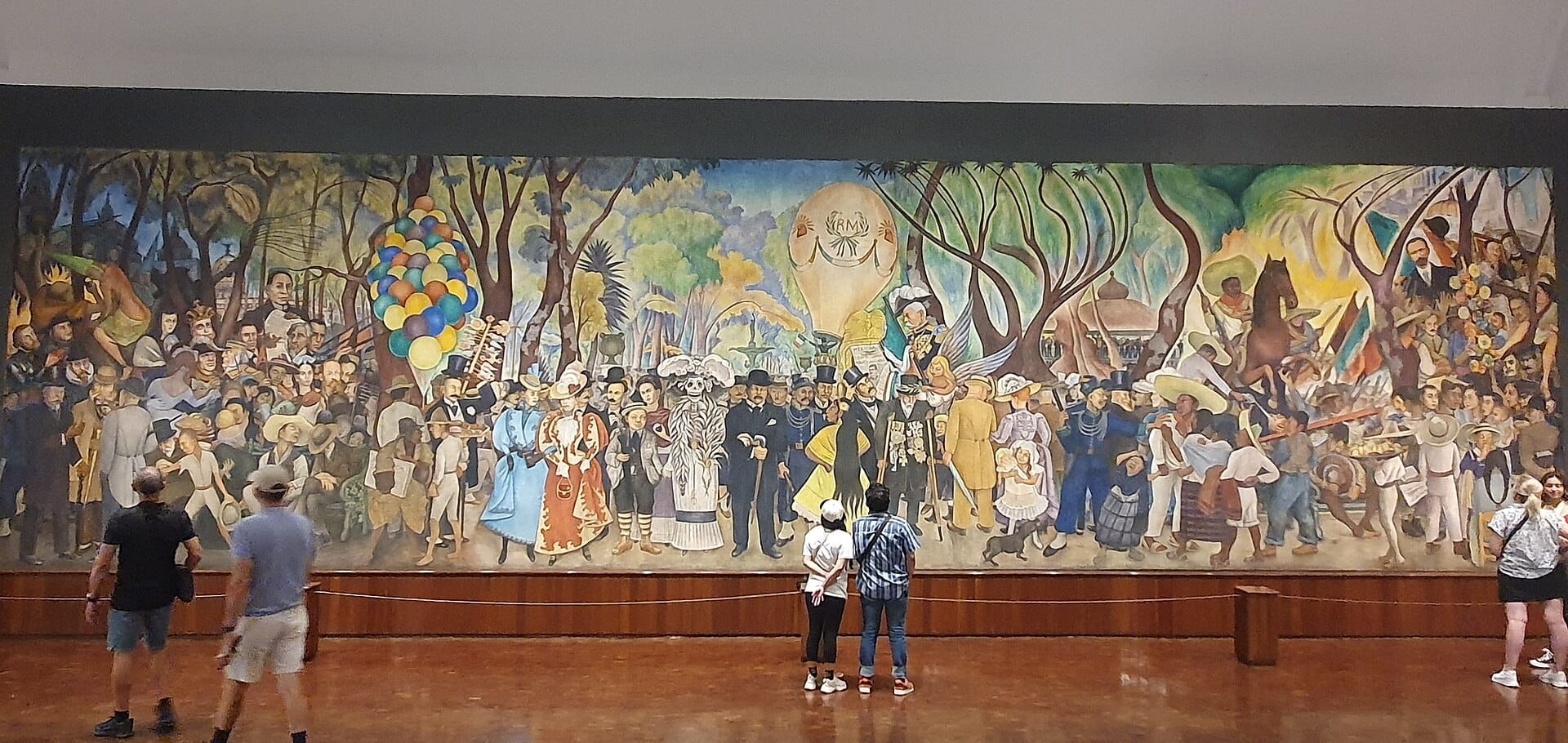
Built around a single painting, the Museo Mural Diego Rivera in Mexico City's Centro Histórico houses Diego Rivera's monumental 1947 mural 'Dream of a Sunday Afternoon in the Alameda Central.' Small in footprint, enormous in impact, it is one of the most focused and satisfying museum experiences in the city.
Quick Facts
- Location
- Balderas S/N, Centro Histórico, CDMX
- Getting There
- Metro Hidalgo (Lines 2 & 3), approximately 1 minute on foot
- Time Needed
- 30–60 minutes
- Cost
- MXN $45 general admission; free Sundays and for visitors over 60, under 13, students, and teachers with ID
- Best for
- Art lovers, history enthusiasts, first-time visitors to Mexico City
- Official website
- museomuraldiegorivera.bellasartes.gob.mx
What This Museum Is
The Museo Mural Diego Rivera is not a conventional museum with rotating galleries, gift-shop distractions, or sprawling floor plans. It is a single room built around a single work of art: Diego Rivera's 'Sueño de una tarde dominical en la Alameda Central' ('Dream of a Sunday Afternoon in the Alameda Central'), a fresco mural measuring approximately 15 meters in length. The building exists solely to protect and display that painting. That focus makes it unlike almost any other cultural institution in the city.
Rivera painted the mural in 1947 for the lobby of the Hotel del Prado, which stood on Avenida Juárez along the edge of the Alameda Central park. When the catastrophic 1985 earthquakes devastated large sections of the historic center and left the hotel structurally irreparable, the mural survived. The building around it did not. Authorities made the decision to rescue the fresco, and the museum was inaugurated on 19 February 1988 in the Plaza de la Solidaridad specifically to house it. That the mural survived while so much of the city did not gives the visit an additional layer of weight that guidebooks rarely convey.
ℹ️ Good to know
Opening hours: Tuesday to Sunday, 10:00–18:00. Closed Mondays. Admission is MXN $45. Sundays are free for all visitors. Photography and video permits cost extra.
The Mural Itself: What You Are Looking At
Standing in front of 'Dream of a Sunday Afternoon in the Alameda Central' for the first time requires a moment of adjustment. The mural spans so much horizontal space that the eye does not know where to begin. Rivera compressed roughly 400 years of Mexican history into this single scene, set within the Alameda Central park — Mexico City's oldest public park, located barely 300 meters from the museum's current location.
The composition is populated by approximately 150 historical figures, some identifiable by label cards on the wall beside the mural and others discoverable through close looking. Hernán Cortés appears alongside colonial-era clergy. Independence heroes and Reform War figures occupy the 19th-century sections. Rivera placed himself at the center as a boy, holding the hand of the skeletal 'La Catrina' figure in her feathered hat — a figure originally invented by printmaker José Guadalupe Posada, who also appears in the mural. Frida Kahlo stands behind Rivera, her hand resting on his shoulder. Benito Juárez, Porfirio Díaz, and foreign dignitaries from the Díaz era crowd the later sections. The mural ends with the Mexican Revolution.
Take time to move slowly from left to right along the full length of the piece. The lighting in the room is designed to eliminate glare on the fresco surface, so visibility is consistently good across the entire panel. Details that look like background texture from a distance resolve into carefully rendered faces, period clothing, and political satire when viewed up close. A small display along the opposite wall identifies key figures and provides historical context in Spanish.
💡 Local tip
A non-professional photo permit costs MXN $5 and video recording MXN $30. Photography without flash is the standard condition. This is one of the cheapest photo permits of any major museum in the city.
Tickets & tours
Live prices and dates from our booking partner. If you book, we may earn a commission at no extra cost to you.
Frida Kahlo and Diego Rivera legacy visit to three museums with skip-the-line tickets
From 67 €Instant confirmationFree cancellationFrida Kahlo and Diego Rivera's legacy private tour with tickets to three museums
From 170 €Instant confirmationFree cancellationShared Tour to Xochimilco, Coyoacan and UNAM Murals
From 32 €Instant confirmationFree cancellationXochimilco, Coyoacan and Frida Kahlo Museum with skip-the-line tickets
From 63 €Instant confirmationFree cancellation
The Experience at Different Times of Day
The museum is small enough that even a modest increase in visitors alters the atmosphere noticeably. Midmorning on weekdays, around 10:30 to 11:30, tends to offer the quietest conditions: you may share the room with only a handful of other visitors, which makes standing back to take in the full 15-meter composition much easier. The gallery temperature stays cool relative to the street outside, which in the warmer months of March through May can feel like a genuine relief.
On Sundays, when admission is free, the museum draws a noticeably larger crowd, including local families who might not otherwise pay to visit. The atmosphere becomes more social and less contemplative, but it also reflects exactly the kind of popular ownership of culture that Rivera intended his murals to embody. If you visit on a Sunday, arrive close to opening time at 10:00 to have a relatively unobstructed view before the room fills.
School groups visit regularly on weekday mornings. The presence of a knowledgeable guide explaining the mural to children can actually enhance the visit for adult travelers standing nearby, since guides often point out figures and historical references that casual visitors overlook. That said, if the room is occupied by two or three school groups simultaneously, the noise level rises substantially and the space around the mural becomes crowded.
Getting There and the Surrounding Area
The museum sits on Plaza de la Solidaridad, immediately west of the Alameda Central park. Metro Hidalgo station (Lines 2 and 3) exits almost directly onto the plaza, making the walk from the turnstiles to the museum entrance roughly one minute. This is one of the most accessible museum locations in the entire city.
The surrounding streets are part of the Centro Histórico, which means the walking context is dense with other worthwhile stops. The Palacio de Bellas Artes is less than 200 meters to the east, facing the Alameda from the opposite side. The combination of the mural museum and the Bellas Artes — which contains Rivera's 'Man at the Crossroads' and other major murals on its upper floors — makes for a logical half-day focused on Mexican muralism.
Avenida Juárez, the street running along the south side of the Alameda, connects the museum area westward toward Paseo de la Reforma within a 10-minute walk. Coming from the east, the street leads toward the Zócalo in roughly 15 minutes on foot. The neighborhood immediately around the museum is heavily trafficked and commercially active during the day, with street vendors and food stalls on adjacent corners. The smell of corn and chili from those stalls hits you the moment you step outside, a sharp contrast to the cool, quiet interior you just left.
💡 Local tip
Pair this visit with the Palacio de Bellas Artes for a focused muralism morning. Both are within easy walking distance, and combined they take about two to three hours without rushing.
Practical Details Worth Knowing
Admission is MXN $45 for general visitors. Entry is free on Sundays for everyone, and free at all times for visitors over 60 years of age, children under 13, people with disabilities, retirees, pensioners, and active teachers and students presenting valid identification. ICOM members receive a 50% discount with a current membership card. All transactions are cash only, in Mexican pesos.
The museum is operated by the Instituto Nacional de Bellas Artes (INBA), the federal body that manages many of Mexico City's major cultural spaces. The building is single-story and compact. Official information confirms free entry for visitors with disabilities, though specific details about ramps and physical accessibility features are not published on the official site. Visitors with mobility requirements may want to contact the museum directly before visiting.
If you are building a broader itinerary for the historic center, see the 3-day Mexico City itinerary for how to structure a full day in this part of the city. The museum's compact format means it works well as an early morning anchor before moving on to heavier sites like the Templo Mayor or the National Palace, both of which are less than a kilometer away.
Who Should and Should Not Visit
If you have any interest in Mexican history, political art, or 20th-century muralism, this museum deserves a place in your itinerary. The admission price is negligible, the time commitment is modest, and the work itself is one of Rivera's most ambitious and historically layered compositions. First-time visitors to Mexico City who want a compact but substantive introduction to the country's cultural narrative will find the mural useful precisely because it spans so much time in a single, readable image.
Travelers with no particular interest in painting or Mexican history may find 30 minutes in a single room with one artwork underwhelming, especially if they are comparing it against larger institutions. The museum does not have a permanent collection beyond the mural itself, a small number of interpretive panels, and occasional temporary exhibitions in a secondary space. If you are already pressed for time and forced to choose between this and the Museo Nacional de Antropología or the Bellas Artes, consider your priorities accordingly. That said, for what it sets out to do, the museum does it exceptionally well.
For travelers interested in Rivera's work across the city, the Museo Casa Estudio Diego Rivera in San Ángel offers a different dimension: the physical space where Rivera and Kahlo lived and worked. The two visits complement each other well for anyone tracing his legacy across CDMX.
Insider Tips
- The figure identification panel on the opposite wall is essential: scan it before you approach the mural so you know which faces to look for, especially the subtler political satire in the Porfiriato-era section.
- Rivera originally painted the phrase 'God does not exist' on a scroll held by a figure in the mural, which caused a public controversy in 1948. The phrase was later painted over at Rivera's own request. Look for the scroll held by the young Rivera figure — the wording visible today is the amended version.
- The plaza outside the museum, Plaza de la Solidaridad, commemorates solidarity after the 1985 earthquakes. A small monument in the plaza marks this connection, which links the museum's own origin story to its surroundings.
- If you visit on a weekday, the museum's secondary exhibition space sometimes hosts smaller temporary shows by contemporary artists working in the muralist tradition. Check the INBA website before visiting since these change without much advance notice.
- For the best photographs of the full mural, step to the far left of the viewing area and use a wide angle. The room's width is limited, so a standard phone lens will not capture the full 15-meter span from directly in front. Moving to the edge gives you the best perspective for a single frame.
Who Is Museo Mural Diego Rivera For?
- First-time visitors to Mexico City wanting a condensed but serious introduction to Mexican history through art
- Art and muralism enthusiasts tracing Diego Rivera's major works across CDMX
- Travelers on a tight budget: admission is among the lowest of any major cultural site in the city
- Families with children over 8 who can engage with the visual storytelling of the mural's historical figures
- Anyone combining a half-day walk through the Centro Histórico and Alameda area
Nearby Attractions
Other things to see while in Centro Histórico:
- Alameda Central
Founded in 1592, Alameda Central is the oldest public park in the Americas and the green centerpiece of Mexico City's historic center. Flanked by the Palacio de Bellas Artes and a ring of colonial-era institutions, it offers free entry, shaded walkways, and a front-row seat to everyday city life.
- Calle Madero
Avenida Francisco I. Madero connects the Zócalo to the Torre Latinoamericana along one of the oldest streets in the Americas. Free to walk at any hour, it layers colonial architecture, street performance, and everyday city life into a single corridor that doubles as an open-air history lesson.
- Casa de los Azulejos
Casa de los Azulejos is one of the most photographed facades in Mexico City, its exterior wrapped in blue-and-white Talavera tiles from Puebla. With documented origins in the 16th century and operating as a Sanborns restaurant since 1919, it offers free entry and a rare chance to step inside a baroque palace that has survived centuries of history.
- La Ciudadela Artisan Market
The Mercado de Artesanías de La Ciudadela is one of Mexico City's largest and best-known handicraft markets, with more than 350 vendors selling handmade goods from across 22 states. Entry is free, quality ranges from tourist trinkets to serious collector pieces, and knowing how to navigate the stalls makes all the difference.
Planning a trip? Discover personalized activities with the Nomado app.