Museo Casa Estudio Diego Rivera y Frida Kahlo: The Studio Where Two Icons Worked
Designed in 1931 by architect Juan O'Gorman and completed in 1932, this pair of linked studio-houses in San Ángel is where Diego Rivera and Frida Kahlo lived and created some of their most important work. One of Latin America's first functionalist buildings, it offers an unusually intimate look at how two of Mexico's greatest artists actually worked, rather than how they chose to be remembered.
Quick Facts
- Location
- Diego Rivera 2, esquina Altavista, Col. San Ángel Inn, Álvaro Obregón, Mexico City
- Getting There
- Metro Barranca del Muerto (Line 7), then bus, taxi, or rideshare to San Ángel
- Time Needed
- 45–90 minutes
- Cost
- MXN $50 general; free Sundays; free for students, teachers, over-60s (INAPAM), children under 13, and visitors with disabilities (valid ID required)
- Best for
- Art lovers, architecture enthusiasts, fans of Rivera and Kahlo, design history
- Official website
- http://www.estudiodiegorivera.bellasartes.gob.mx
What This Place Is
The Museo Casa Estudio Diego Rivera y Frida Kahlo is not a biography rendered in paint and plaques. It is a working space preserved almost exactly as Rivera and Kahlo left it, which makes it feel less like a shrine and more like an interruption: as if the two artists have just stepped out. Administered by the Instituto Nacional de Bellas Artes (INBA), the museum occupies a compact complex of three structures on a site of around 380 square meters in the San Ángel Inn neighborhood of Álvaro Obregón borough.
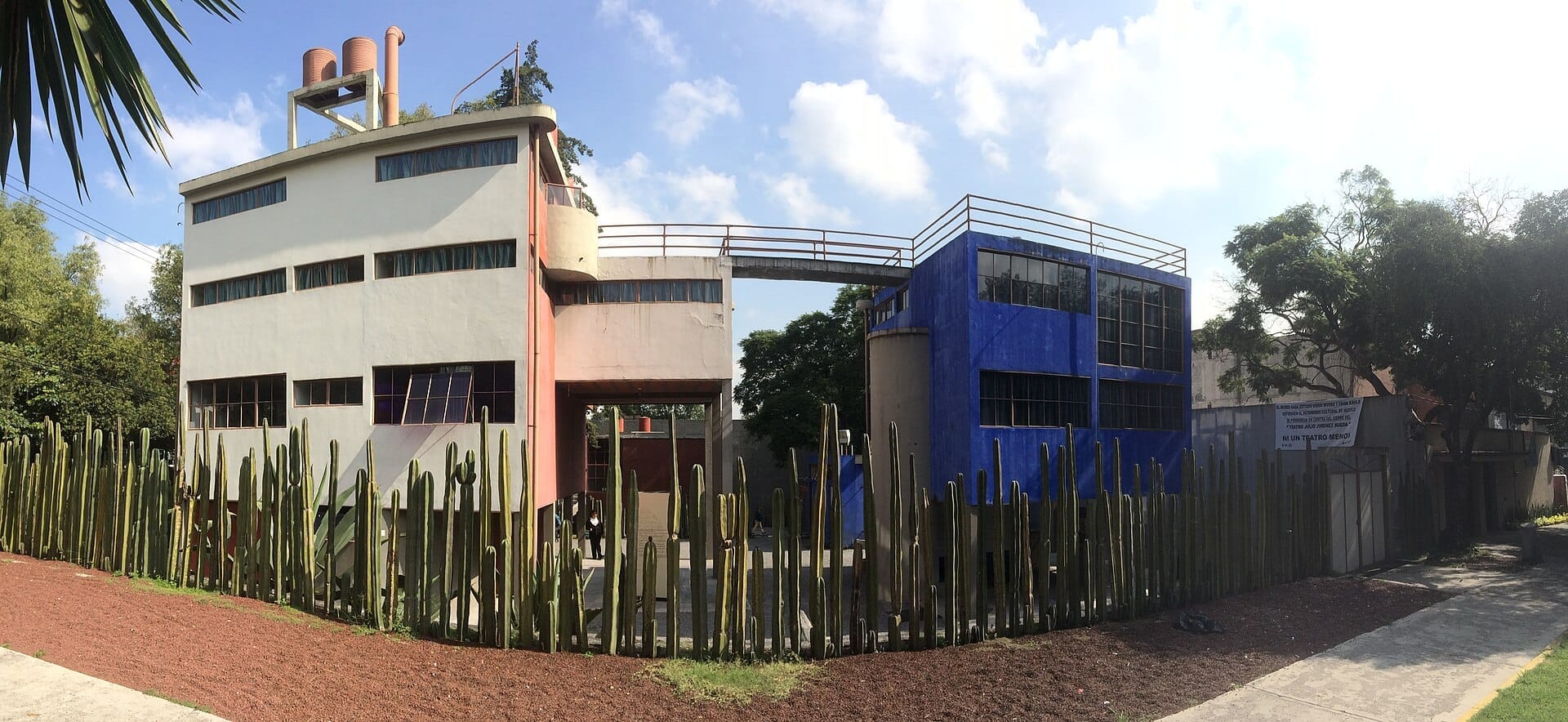
The site consists of two separate studio-houses, one larger (Rivera's) and one smaller (Kahlo's), connected by a rooftop bridge, plus a photographic laboratory building. The separation was deliberate: when the couple moved in in 1934, Rivera insisted on distinct spaces for work and solitude. That architectural decision tells you more about their relationship than almost any caption in the museum.
ℹ️ Good to know
Opening hours: Tuesday to Sunday, 10:00–17:30. Closed Mondays and on some official holidays. Free entry on Sundays for all visitors. Confirm current hours at the official INBA site before visiting, as schedules can change.
The Architecture: A Radical Building in a Quiet Street
Juan O'Gorman designed both studio-houses in 1931, completing construction in 1932. They are considered among the first functionalist buildings in Latin America, and arriving at the complex still produces a small jolt of surprise. On a street of colonial-era San Ángel, where rough stone walls and bougainvillea are the norm, you encounter two brightly painted cubic volumes in coral pink and electric blue, rising on pilotis (load-bearing stilts) above a cactus garden. There are no decorative flourishes: the aesthetic is pure utility pushed until it becomes its own kind of beauty.
O'Gorman was a disciple of Le Corbusier's principles, but the result here is distinctly Mexican. The industrial steel-frame construction and flat roofs coexist with the cactus garden below, which Rivera planted with native species including towering nopal and various agaves. The color palette, the choice of local plants, and the pre-Columbian objects Rivera placed throughout connect this radical modernist box to a specifically Mexican visual tradition.
If you are already interested in Mexican modernist architecture, this visit pairs well with Casa Luis Barragán across the city, which represents a very different but equally significant strand of the same mid-century conversation. Between the two, you get a real sense of how fractured and productive that debate was.
Tickets & tours
Live prices and dates from our booking partner. If you book, we may earn a commission at no extra cost to you.
Inside Rivera's Studio: Scale, Light, and Unfinished Business
Rivera's studio-house is the larger of the two. The main painting space on the upper floor is enormous by any standard: double-height ceilings, north-facing clerestory windows that flood the room with the even, shadowless light muralists need, and a floor plan open enough to accommodate the massive canvases Rivera regularly worked on. The space still holds his brushes, his palette, and pre-Columbian figurines arranged just as he kept them. There is a papier-mâché Judas figure hanging near the staircase that Rivera collected, the kind of folk art he championed when the Mexican art establishment largely dismissed it.
Visitors move through at their own pace, and on weekday mornings the rooms are quiet enough to hear the creak of the wooden floors. The scale of the studio makes it easy to understand how Rivera could produce at the pace and ambition he did: this was a purpose-built thinking machine, not a domestic space that happened to have an easel in the corner. The spiral staircase connecting floors is narrow and steep, which matters if mobility is a concern.
⚠️ What to skip
Accessibility note: The complex connects buildings via exterior stairs and a rooftop bridge characteristic of the original 1932 design. Not all areas are step-free. Visitors with mobility requirements should contact the museum directly before visiting to understand current access arrangements.
Kahlo's Studio: The Smaller Space, the Larger Presence
The blue studio-house assigned to Kahlo is noticeably smaller. That asymmetry is worth sitting with: in 1932, Rivera was one of the most celebrated artists in the Americas; Kahlo was his wife, a painter of growing but still limited recognition. O'Gorman designed accordingly. Yet Kahlo's space has an intensity that Rivera's larger volume, with all its pragmatic openness, does not quite match.
Her studio retains her easel, her orthopedic corsets, and her brushes — the intimate tools of her working life. (The famous mirror above the bed, used for painting self-portraits while lying down, is preserved at the Museo Frida Kahlo / Casa Azul in Coyoacán.) These objects are not replicas. Seeing the actual corsets, hand-painted by Kahlo herself to assert control over the body that continually failed her, is different from seeing photographs of them. The room is small enough that you are never far from anything.
Many visitors to this museum also visit the Museo Frida Kahlo (Casa Azul) in Coyoacán, where Kahlo grew up and spent much of her life. The two sites complement rather than duplicate each other: Casa Azul shows her personal and family world, while the studio here shows the professional one. For more context on that visit, see the guide to Museo Frida Kahlo.
When to Visit and What the Experience Is Like at Different Times
Weekday mornings, particularly Tuesday through Thursday before noon, offer the most undisturbed experience. Group tours occasionally arrive mid-morning, but they tend to move through quickly and the rooms are compact enough that you can step aside and wait them out. Friday and Saturday afternoons attract the largest crowds, and the studios feel noticeably different when they are full: the sense of private access dissolves.
Sunday entry is free for all visitors, which increases foot traffic significantly. The free Sunday policy is worth planning around rather than against: if you visit Sunday morning when doors open at 10:00, the first hour tends to be manageable before tour groups and families arrive. By noon it fills considerably.
The cactus garden between buildings changes character through the day. In late morning, the light through the nopal cactus throws long shadows across the volcanic stone path. By early afternoon, the pink and blue facades catch direct sun and the color contrast becomes almost aggressive. If you plan to photograph the exterior, overcast days in the May-to-October rainy season can actually produce cleaner results than harsh midday sun, though afternoon showers are common.
💡 Local tip
Photography tip: Bring a wide-angle lens or use your phone's ultrawide setting inside Rivera's studio. The double-height space is difficult to capture at normal focal lengths. Natural light is excellent in the morning hours; flash photography may be restricted, so check with staff on arrival.
Getting There: San Ángel Is Not Quite Walkable from the Metro
The nearest Metro station is Barranca del Muerto on Line 7, but the museum is not a short walk from there. Most visitors take a bus, taxi, or rideshare from the station to complete the journey. If you are already exploring San Ángel, the museum sits at the northern edge of the neighborhood and can be combined with the Bazar del Sábado (the Saturday artisan market) if you visit on a weekend.
Rideshare apps including Uber and DiDi operate reliably in this part of the city and are a practical option, particularly for visitors unfamiliar with bus routes. The museum does not have a large parking area, so arriving by private car in this residential neighborhood can be frustrating on busy days.
For a broader overview of how to navigate the city's public transport system, the guide to getting around Mexico City covers Metro lines, Metrobús corridors, and rideshare logistics in practical detail.
Worth Your Time?: Who Will Get the Most From This, and Who Might Not
This museum rewards visitors who arrive with some context. If you know Rivera primarily from his famous murals at the National Palace or the Palacio de Bellas Artes, and Kahlo from the Casa Azul, the studio complex adds real depth: it is a professional space rather than a personal narrative. The preserved tools and the architectural logic of the building itself carry most of the storytelling.
Visitors expecting large paintings on display will be disappointed. This is not a gallery. The emphasis is on the studios as working environments, and the permanent collection of objects is intentionally spare. There are no multimedia installations, no dramatic lighting effects, and no gift shop of particular note. For visitors who find satisfaction in standing in a room where significant work was made, touching nothing but understanding something, that restraint is the point.
Travelers visiting Mexico City primarily for its pre-Hispanic archaeology or street food culture may find this a lower priority. Visitors with strong interest in 20th-century art history, architectural modernism, or the specific world of Rivera and Kahlo are likely to consider it one of the better-spent hours in the city.
If you are building a broader itinerary around the city's art institutions, the guide to the best museums in Mexico City gives a ranked, practical overview that can help you prioritize across neighborhoods and interests.
Insider Tips
- The rooftop bridge connecting the two studio-houses is often overlooked by visitors who follow the standard room-by-room path. Ask staff if you can access it, as the view down into the cactus garden and across the terracotta rooftops of San Ángel provides the clearest sense of how the two structures relate to each other spatially.
- Sunday admission is free for all, but the first hour after the 10:00 opening is the most peaceful window before group visits begin. Arriving at opening time on a Sunday is the best way to combine the free entry benefit with manageable crowd levels.
- The cactus garden below Rivera's studio contains several native Mexican species Rivera specifically selected. It is easy to pass through quickly, but spending five minutes reading the informal signage there adds context to Rivera's broader project of asserting indigenous Mexican culture through visual art.
- Pre-Columbian figurines and folk art objects are scattered throughout Rivera's studio exactly as he arranged them. Rivera was one of the earliest major collectors of this material at a time when the Mexican art establishment dismissed it. Looking at these alongside his painting tools reframes how you understand his muralism.
- If you are visiting on a Saturday, the Bazar del Sábado artisan market operates just minutes away in the Plaza San Jacinto. Combining both in a single San Ángel morning is very manageable and gives you a useful contrast between the commercial craft scene and the serious working context of the studios.
Who Is Museo Casa Estudio Diego Rivera y Frida Kahlo For?
- Art historians and serious fans of Diego Rivera or Frida Kahlo seeking a professional rather than biographical perspective
- Architecture enthusiasts interested in early Latin American functionalism and Juan O'Gorman's work
- Visitors who have already seen Casa Azul and the major Rivera murals and want to complete the picture
- Travelers with limited time who want a focused, quiet museum experience without large permanent collections to navigate
- Budget travelers, particularly on Sundays when entry is free for everyone
Nearby Attractions
Other things to see while in San Ángel:
- Casa Luis Barragán
The Luis Barragán House and Studio is the only individual residential property in Latin America inscribed as a UNESCO World Heritage Site. Built in 1948 and preserved almost exactly as Barragán left it, this is less a museum and more an immersive encounter with one of the 20th century's most distinctive architectural minds.
- San Ángel Saturday Art Market (Bazar del Sábado)
Every Saturday, Plaza San Jacinto in the colonial neighborhood of San Ángel transforms into one of Mexico City's best-known art markets. The Bazar del Sábado has gathered painters, jewelers, textile artists, and ceramic masters since 1960, with the current Plaza San Jacinto location since 1965, filling both an 18th-century mansion and the surrounding cobblestone plazas with work that earns the word "art."
Planning a trip? Discover personalized activities with the Nomado app.