Bazar del Sábado: San Ángel's Saturday Art Market Worth the Trip South
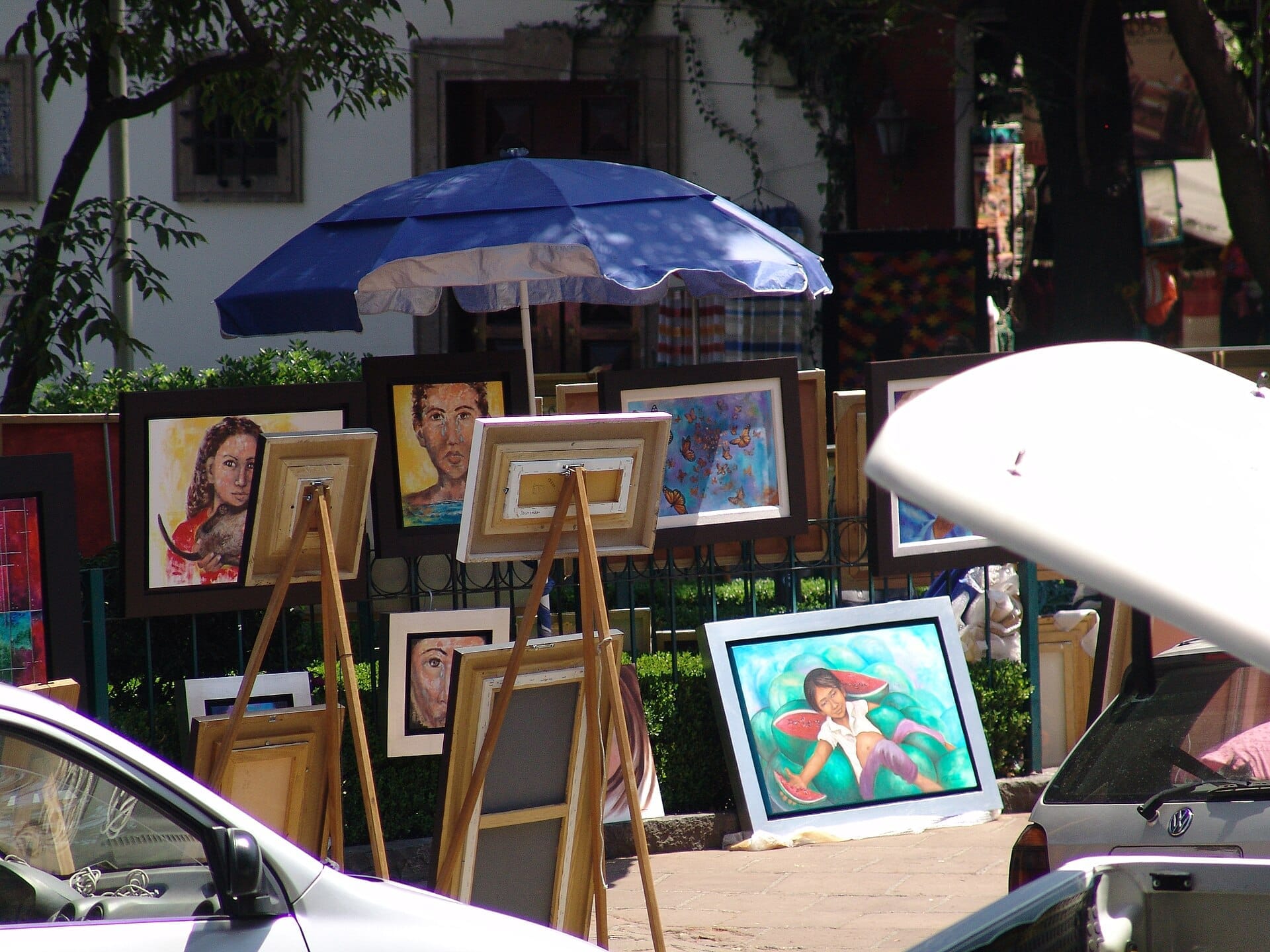
Every Saturday, Plaza San Jacinto in the colonial neighborhood of San Ángel transforms into one of Mexico City's best-known art markets. The Bazar del Sábado has gathered painters, jewelers, textile artists, and ceramic masters since 1960, with the current Plaza San Jacinto location since 1965, filling both an 18th-century mansion and the surrounding cobblestone plazas with work that earns the word "art."
Quick Facts
- Location
- Plaza San Jacinto 11, San Ángel, Álvaro Obregón, Mexico City
- Getting There
- Metrobús Line 1 to 'La Bombilla' station, then a short walk south
- Time Needed
- 2–3 hours for market; allow half a day if exploring the wider San Ángel neighborhood
- Cost
- Free entry; budget varies by purchases (MXN)
- Best for
- Art collectors, craft shoppers, architecture lovers, weekend explorers
- Official website
- www.bazardelsabado.com.mx
What Is the Bazar del Sábado?
The Bazar del Sábado, or San Ángel Saturday Art Market, is a weekly gathering of curated artisans and artists that takes over Plaza San Jacinto and its surrounding streets every Saturday. Unlike the souvenir-heavy craft markets found closer to the tourist center, this one has maintained quality controls since its founding in 1960: vendors are selected, and the work reflects it. You will find oil paintings, handwoven textiles, silver jewelry, talavera ceramics, papier-mâché sculpture, hand-printed fabrics, and carved wood alongside contemporary design pieces that would sit comfortably in a gallery.
The market originally launched as a centralized platform for artisans seeking a legitimate sales venue, and in 1965 it moved to its current address in its current Plaza San Jacinto 11 location at the edge of Plaza San Jacinto. That building, with its internal courtyard, arched corridors, and narrow interior passages, is itself part of the experience. The covered indoor section tends to feature the higher-end fine art and jewelry pieces, while the outdoor areas overflow with textiles, prints, and decorative crafts.
ℹ️ Good to know
The Bazar del Sábado is Saturdays only, roughly 10:00 to 19:00 (hours vary by source; plan to arrive early to see everything comfortably). It runs year-round.
The Setting: San Ángel and Plaza San Jacinto
San Ángel is one of Mexico City's best-preserved colonial neighborhoods, located in the southern borough of Álvaro Obregón at roughly 2,240 meters above sea level. Its streets are narrow, paved in volcanic stone, and lined with 17th and 18th-century mansions hidden behind bougainvillea-draped walls. It does not feel like the rest of the city. The ambient noise level drops noticeably once you turn off Avenida Revolución; the air smells of fresh flowers from nearby florist stalls and the faint sweetness of pan dulce from corner bakeries.
Plaza San Jacinto itself is a compact colonial square anchored by the Parroquia de San Jacinto, a 16th-century church that predates the market by four centuries. On any Saturday, the plaza fills from the church steps outward: vendors set up under canvas awnings, tourists and locals move slowly between displays, and the whole scene has a relaxed, unhurried pace that contrasts sharply with central Mexico City. If you are planning a broader Saturday in the south of the city, the market pairs naturally with a visit to the Diego Rivera and Frida Kahlo Studio Museum, which is a short walk away in the same neighborhood.
Tickets & tours
Live prices and dates from our booking partner. If you book, we may earn a commission at no extra cost to you.
Puebla and Cholula guided tour from Mexico City with optional lunch
From 43 €Instant confirmationFree cancellationXochimilco, Coyoacan and Frida Kahlo Museum with skip-the-line tickets
From 63 €Instant confirmationFree cancellationMexico City exploration game and tour in Chimalistac
From 10 €Instant confirmationFree cancellationCuernavaca and Taxco Guided Tour with Optional Lunch
From 40 €Instant confirmationFree cancellation
How the Market Is Laid Out
The market divides naturally into two zones. The indoor section occupies the building at Plaza San Jacinto 11. Here, the stalls are smaller and the merchandise more concentrated: jewelry displayed on velvet trays, framed paintings leaning against whitewashed walls, and sculptural ceramics arranged on wooden tables. The interior courtyard, open to the sky, tends to host textile artists and leather workers. Lighting inside is dim in places, so if you want to examine intricate silver work or fine painted details, bring the piece to an open window or the courtyard before committing to a price.
The outdoor market expands well beyond the mansion. It spreads across the plaza, along the atrium of the church, and down adjacent streets and small parks. This outdoor section is larger in vendor count, more varied in quality, and livelier in atmosphere. Street food vendors operate at the edges: look for tlayudas, elotes preparados, and freshly squeezed juice. The smell of grilling corn and chili powder becomes a constant backdrop by midday.
💡 Local tip
Start inside the mansion when you first arrive. The indoor stalls attract the most serious buyers and sell out or pack up earlier than outdoor vendors. Work your way outward toward the plaza as the morning progresses.
Timing Your Visit: Morning vs. Afternoon
The experience shifts significantly depending on when you arrive. Early morning, between 10:00 and 11:30, the market is at its quietest and most photogenic. The volcanic stone streets catch the diffused morning light at an angle that makes the colonial architecture glow. Vendors are still arranging displays and are generally more conversational and willing to discuss their work in detail. If you plan to negotiate prices, the early window is your best opportunity.
By noon the market reaches peak density. Families arrive from across the city, and the outdoor plazas become often crowded. Moving through the narrower corridors of the indoor mansion requires patience. This midday window has its own energy: musicians occasionally perform near the church steps, the food stalls hit their stride, and the people-watching is excellent. The tradeoff is that it becomes harder to have a focused conversation with a vendor or examine pieces carefully.
By 15:00, the crowd starts thinning. Some outdoor vendors begin wrapping up, especially if it has been a strong sales day. The light softens toward late afternoon. If you are a photographer, the window between 14:30 and 16:00 offers warm, lower-angle light on the plaza and church facade with fewer people in the frame.
⚠️ What to skip
San Ángel is in southern Mexico City and traffic on Avenida Insurgentes and Avenida Revolución is notably heavy on Saturday afternoons. If you are returning to central areas or Polanco after the market, budget extra time or book a ride-hailing pickup well in advance.
What to Buy and How to Approach It
The market's curatorial standard means prices reflect genuine craft and, in some cases, fine art. Expect to pay more here than at a general craft market, and understand that much of the work justifies it. Handwoven rugs from Oaxacan weavers, painted amate bark paper from Guerrero artisans, and original oil paintings by Mexico City artists are all represented. At the top end, custom silver jewelry can run into several thousand pesos; at the accessible end, small ceramic pieces, printed textiles, and decorative tiles are available for a few hundred.
Gentle bargaining is acceptable in the outdoor sections but less common among the indoor fine-art vendors, who are often the artists themselves and price their work accordingly. If you want a broader comparison point for crafts and regional goods, the La Ciudadela artisan market in the city center offers a wider volume of goods at more negotiable prices, though it lacks the Bazar del Sábado's curatorial focus and architectural setting.
Bring cash in pesos. While some vendors accept card payments, many do not, and the ATMs in San Ángel are not always accessible or well-stocked on Saturdays. Withdraw cash before making the trip south.
Getting There and Practical Logistics
The most straightforward public transit option is Metrobús Line 1, which runs along Avenida Insurgentes. Alight at the 'La Bombilla' station and walk north toward Plaza San Jacinto, roughly a short walk. Metrobús requires a rechargeable card (tarjeta de movilidad integrada), available at stations. For a broader overview of navigating the city's transit network, see the guide to getting around Mexico City.
Driving is technically possible but strongly discouraged. Parking in San Ángel on Saturdays is scarce and the surrounding streets become congested by mid-morning. Ride-hailing apps including Uber, Didi, and Cabify all serve San Ángel; request your pickup from a cross-street slightly away from the plaza to avoid the congestion immediately around the market.
Accessibility requires careful consideration. The market occupies cobblestone streets and a colonial building with uneven floors, narrow corridors, and, in some sections, steps with no ramps. Wheelchair users and visitors with strollers will find the outdoor plaza areas more navigable than the interior mansion. There is limited documented accessibility infrastructure (ramps, lifts) at the venue.
Worth Your Time?: Who Will Love This and Who Should Skip It
The Bazar del Sábado is excellent for anyone with a serious interest in Mexican craft traditions, folk art, or decorative arts, and for visitors who enjoy browsing at leisure without hard-sell pressure. It is also a strong reason to spend a Saturday morning in San Ángel rather than the more tourist-dense areas around the historic center. The combination of the market, the colonial architecture, and the neighborhood's calmer pace makes for a distinctly different Mexico City experience.
Visitors who find craft markets repetitive or who are focused on major historical monuments and archaeological sites may find two to three hours here feels long. It is also not the right choice if your Saturday itinerary is already dense: the market is in the south of the city, and the round trip from central neighborhoods takes time. If you have only one or two days in Mexico City, weigh carefully whether San Ángel fits before committing a full morning.
Travelers interested in art but working with a tight budget should be aware that this market trends more expensive than general craft markets; the free-entry free things to do in Mexico City guide may help structure a broader day that complements a visit without overspending.
Weather and What to Wear
Mexico City's subtropical highland climate means mornings in San Ángel can be cool, particularly between November and February when overnight lows drop toward 6–7°C. By midday the temperature typically reaches the low-to-mid 20s°C. A light jacket or layer for early arrival, removable by noon, is the standard approach for most of the year.
During the rainy season (roughly May through October), afternoon thunderstorms arrive with reliable frequency. The outdoor sections of the market have limited cover. If you are visiting between June and September, morning arrival is especially important: the storms typically roll in after 14:00, and a saturated cobblestone plaza is significantly less pleasant to browse. Wear comfortable, closed-toe shoes; the stone paving is uneven and becomes slippery when wet.
Insider Tips
- The indoor mansion section tends to host the most serious artists, many of whom are present in person. Ask vendors about their process or regional origin: most are happy to talk craft, and the conversation often reveals context that makes the work more meaningful (and sometimes unlocks a better price).
- If you plan to buy anything large or fragile, bring a sturdy bag or a small rolling trolley. The market provides no packaging service, and carrying ceramics or framed art back through crowded cobblestone streets in a paper bag is a recipe for disappointment.
- The restaurant inside the mansion's courtyard, which operates on Saturdays, is a legitimate option for lunch, but fills quickly by 13:00. Either arrive for a late breakfast around 11:00 or plan to eat at one of the outdoor street food stalls instead.
- Combine the market with a walk to the nearby Museo Casa Estudio Diego Rivera y Frida Kahlo, which is a short distance away and open on Saturdays. The two together make a coherent half-day itinerary without requiring any transit between stops.
- Prices in the outdoor sections have a small amount of flexibility on Saturdays after 14:00, when vendors start calculating what they want to carry home. It is not a flea market dynamic, but polite negotiation on higher-value pieces is more likely to succeed in the final hour of trading.
Who Is San Ángel Saturday Art Market (Bazar del Sábado) For?
- Art collectors and buyers looking for curated Mexican fine art and craft
- Travelers who want to shop for quality souvenirs with genuine provenance
- Architecture and heritage enthusiasts drawn to colonial Mexico City
- Weekend explorers combining San Ángel's neighborhood with a morning market
- Photographers seeking colonial streetscapes, artisan portraits, and warm morning light
Nearby Attractions
Other things to see while in San Ángel:
- Casa Luis Barragán
The Luis Barragán House and Studio is the only individual residential property in Latin America inscribed as a UNESCO World Heritage Site. Built in 1948 and preserved almost exactly as Barragán left it, this is less a museum and more an immersive encounter with one of the 20th century's most distinctive architectural minds.
- Museo Casa Estudio Diego Rivera y Frida Kahlo
Designed in 1931 by architect Juan O'Gorman and completed in 1932, this pair of linked studio-houses in San Ángel is where Diego Rivera and Frida Kahlo lived and created some of their most important work. One of Latin America's first functionalist buildings, it offers an unusually intimate look at how two of Mexico's greatest artists actually worked, rather than how they chose to be remembered.
Planning a trip? Discover personalized activities with the Nomado app.