Casa Luis Barragán: Inside Mexico City's UNESCO Masterpiece of Light and Color
The Luis Barragán House and Studio is the only individual residential property in Latin America inscribed as a UNESCO World Heritage Site. Built in 1948 and preserved almost exactly as Barragán left it, this is less a museum and more an immersive encounter with one of the 20th century's most distinctive architectural minds.
Quick Facts
- Location
- General Francisco Ramírez 12, Colonia Ampliación Daniel Garza, Miguel Hidalgo, Mexico City
- Getting There
- Metro Constituyentes (Line 7) or Metrobús Parque Lira (Line 2)
- Time Needed
- 1.5 to 2 hours (guided tours only; advance booking required)
- Cost
- Paid admission; check current ticket prices at casaluisbarragan.org before visiting
- Best for
- Architecture enthusiasts, design professionals, photography lovers, and anyone drawn to meditative spaces
- Official website
- www.casaluisbarragan.org/eng/en_index.html
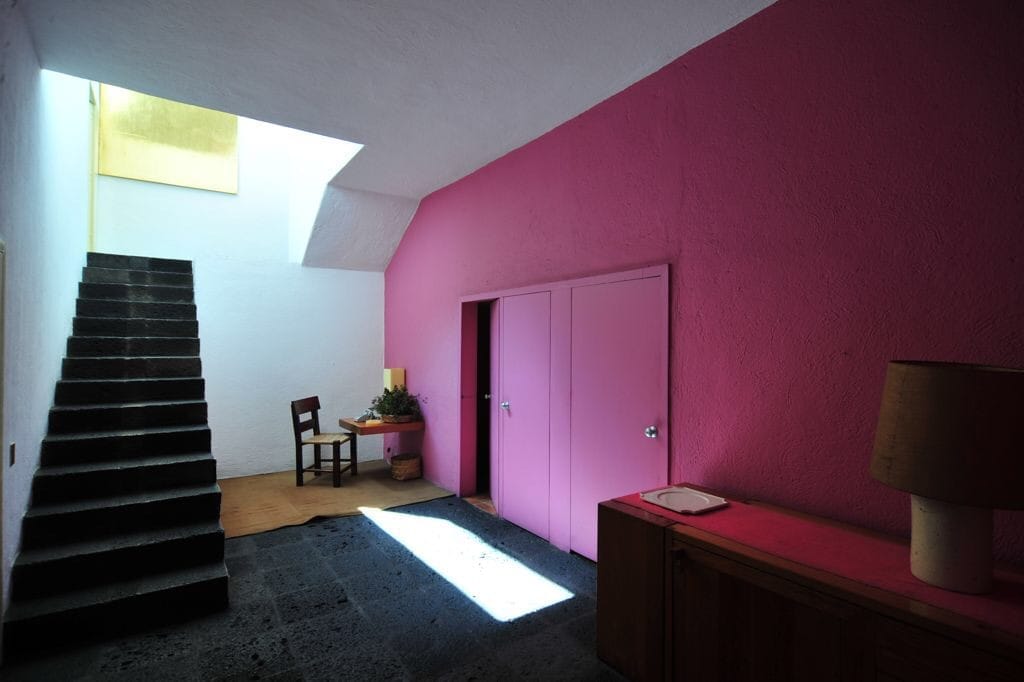
What Casa Luis Barragán Is
The Luis Barragán House and Studio is not a conventional museum. There are no information panels lining the walls, no glass cases full of artifacts, and no audio guide trying to fill every pause. What you get instead is the house itself: a three-story private residence that the Mexican architect Luis Barragán built in 1948, lived and worked in until his death in 1988, and left behind in a state of extraordinary preservation. Since its conversion into a museum in 1994, and its inscription as a UNESCO World Heritage Site in 2004, it has become one of the most visited works of architecture in Latin America, though visited is a relative term. Group sizes are deliberately small, access is strictly controlled, and the experience is closer to a private tour than a public attraction.
The UNESCO citation describes it as 'one of the most important works of contemporary architecture.' . The house represents Barragán's fully developed synthesis of Mexican vernacular traditions, European modernism (particularly the influence of Le Corbusier and the Moroccan landscape he encountered on travels), and a deeply personal approach to spirituality and silence. Every decision, from the rough-textured lava stone walls to the floor-to-ceiling windows that frame pieces of sky like paintings, was intentional.
⚠️ What to skip
Tickets must be booked in advance through the official website. Walk-in visits are not permitted, and availability is seriously limited. Book at least several days ahead, and check current ticket prices and available time slots at casaluisbarragan.org before planning your day around this visit.
The Architecture: What You Are Actually Looking At
From the street, the house gives almost nothing away. The façade on Calle General Francisco Ramírez is intentionally austere: a plain concrete wall painted white, with a simple wooden door. There is no sign, no grand entrance, no hint of what is inside. This is the first lesson Barragán teaches: architecture does not need to announce itself.
Once inside, the house unfolds through a sequence of spaces that feel choreographed rather than merely designed. Barragán worked with compressed corridors that open into tall, light-flooded rooms. He used color not as decoration but as structure: a wall of deep magenta acts as a visual anchor in one room; a panel of yellow filters afternoon light into gold. The staircase is a sculptural object in its own right, with fat timber handrails worn smooth over decades. The library, where Barragán worked and thought, is lined floor to ceiling with books he actually read.
The garden is perhaps the most surprising element. In a dense city neighbourhood, Barragán created a private enclosure of volcanic rock, tall grasses, and mature trees that absorbs most ambient sound. Standing in it mid-morning, the sense of distance from Mexico City is complete. The light in the garden changes significantly across the day: early morning delivers cool, diffuse illumination; by late morning the garden receives direct sun that activates the colours of the planting and the rough black lava walls.
Tickets & tours
Live prices and dates from our booking partner. If you book, we may earn a commission at no extra cost to you.
Puebla and Cholula guided tour from Mexico City with optional lunch
From 43 €Instant confirmationFree cancellationXochimilco, Coyoacan and Frida Kahlo Museum with skip-the-line tickets
From 63 €Instant confirmationFree cancellationMexico City exploration game and tour in Chimalistac
From 10 €Instant confirmationFree cancellationCuernavaca and Taxco Guided Tour with Optional Lunch
From 40 €Instant confirmationFree cancellation
The Guided Tour Experience
All visits are guided. A knowledgeable guide leads small groups through the residence, covering Barragán's biography, the architectural decisions visible in each room, and the cultural context of Mexican modernism. Tours are typically conducted in Spanish, though English-language tours are available on specific days. Confirm language availability when booking.
The experience is contemplative by design. Guides understand that part of the house's purpose is silence, and they build pauses into the tour so that visitors can absorb the way light moves through a room, or the way a corridor narrows before widening into a double-height space. This is not the place to rush. Visitors who have only allocated 45 minutes will feel the pressure of it. Those who give it the full recommended time, around 90 minutes to two hours, tend to leave with a altered sense of what architecture can do.
💡 Local tip
Morning time slots, particularly those starting around 10:00 or 11:00, offer the best interior light. The main living spaces are oriented to receive low, warm light from the east and south, and the garden is at its most photogenic before midday shadows shift.
Photography Inside the House
Photography is permitted inside the house, which is less obvious than it sounds: some comparable house museums do not allow cameras at all. The interiors are exceptionally photogenic. The challenge is managing contrast: Barragán's rooms often pair very dark surfaces with shafts of bright natural light, and a phone camera will struggle to capture both simultaneously. A camera with manual exposure control, or the ability to shoot RAW, will produce significantly better results.
The staircase, the yellow-lit corridor on the upper floor, and the view from the garden looking back toward the house are the three most-photographed compositions. If those images appear on your mood board before you arrive, spend less time replicating them and more time finding the details that do not circulate widely online: the texture of the lime-plastered walls, the grain of the wooden flooring, the arrangement of objects on Barragán's desk exactly as he left them.
Getting There and Practical Logistics
The house sits in Colonia Ampliación Daniel Garza, in the Miguel Hidalgo borough, near the historic center of Tacubaya. This is not a neighborhood that appears on most tourist itineraries, which adds to the sense of discovery. The nearest Metro station is Constituyentes on Line 7 (the orange line). From there, it is a short walk. Alternatively, Metrobús Line 2 stops at Parque Lira, which is also a reasonable walk away. If you use Ecobici, look for docking station 188 on Gob. Melchor Múzquiz.
Ride-hailing apps including Uber, Didi, and Cabify all operate in Mexico City and will drop you directly at the address. For visitors arriving from Chapultepec or Polanco, a ride takes roughly 10 to 15 minutes depending on traffic. The bookstore on the ground floor, which sells architecture publications and Barragán-related titles, is open without a ticket on weekdays from 11:00 to 17:00 and on Saturday mornings from 11:00 to 14:00. It is closed on Sundays.
Visitors with limited mobility should contact the museum directly before booking, as the official site does not publish detailed accessibility information. The minimum age for entry is 12 years, with no exceptions according to the official visitor policy.
Luis Barragán: Why This House Matters
Luis Barragán (1902-1988) is one of Mexico's most significant cultural exports in the field of design. He was awarded the Pritzker Architecture Prize in 1980, the first year the prize was awarded and the first time it went to a Mexican architect. His influence on contemporary architecture is disproportionate to the relatively small number of buildings he completed. Architects as different as Tadao Ando and Ricardo Legorreta have cited him as a primary reference.
The house on Francisco Ramírez is where his mature vision crystallized. He moved in when the building was complete in 1948 and made incremental adjustments over four decades, adding and removing elements as his thinking evolved. The result is not a snapshot of a single moment but a layered record of a mind at work. The books in the library are real and annotated. The furniture is original. The garden has grown into the form he intended. Almost nothing is reconstruction.
For visitors with a deeper interest in Mexican modernism, the visit pairs well with the Casa Estudio Diego Rivera in San Ángel, another preserved artist's home that offers a very different reading of the same mid-century period.
Who This Is For, and Who Should Skip It
This attraction is suited to a narrow slice of travelers, and that is a compliment to it. If you have a strong interest in architecture, design history, or the relationship between space and emotional experience, this is one of the most rewarding two hours you can spend in Mexico City. If you are neutral on those subjects, the experience may feel slow, and the restricted access and advance booking overhead may feel like more effort than the reward justifies.
Families traveling with children under 12 are excluded by the museum's own policy. Visitors looking for a broad overview of Mexican history or art will find more to engage with at the Museo Nacional de Antropología or the Palacio de Bellas Artes. Casa Luis Barragán rewards those who arrive with some prior knowledge of who Barragán was and why his approach was distinctive. Reading even a brief biography before the visit significantly deepens what the guide's commentary connects to.
If you are building an itinerary around cultural sites, this works naturally as part of a half-day in the western city. Combine it with a visit to San Ángel and its weekend Bazar del Sábado for a day that moves between architecture, art, and neighbourhood life without requiring too much transit. For broader context on how to structure your time, see our 3-day Mexico City itinerary.
Insider Tips
- Book as far in advance as possible, particularly for English-language tours, which run less frequently than Spanish ones. Check the official ticketing calendar weekly if your preferred slot is unavailable; cancellations do appear.
- The bookstore requires no ticket and is well worth a visit even if you cannot get a tour slot. The architecture and design titles available there are not easily found in general bookshops, and the space itself offers a small taste of the building's atmosphere.
- Arrive five to ten minutes before your scheduled tour rather than 30 minutes early. There is no waiting area inside the house, and lingering outside in the street adds nothing to the experience.
- Wear shoes with quiet soles. The floors are original timber and the acoustics in several rooms are extraordinary. Heel-strike on hard soles interrupts both your experience and other visitors' ability to hear the guide clearly.
- If you are serious about photography, morning slots on weekdays provide the most usable interior light and, typically, the smallest group sizes.
Who Is Casa Luis Barragán For?
- Architecture and design professionals or students seeking direct engagement with a canonical 20th-century work
- Photographers interested in interior light, color, and spatial composition
- Travelers who prefer depth over breadth and are comfortable with a slow, contemplative pace
- Anyone building a wider itinerary around Mexican modernism alongside sites like the UNAM campus or the Anahuacalli Museum
- Solo travelers looking for a unusual alternative to conventional museum visits
Nearby Attractions
Other things to see while in San Ángel:
- Museo Casa Estudio Diego Rivera y Frida Kahlo
Designed in 1931 by architect Juan O'Gorman and completed in 1932, this pair of linked studio-houses in San Ángel is where Diego Rivera and Frida Kahlo lived and created some of their most important work. One of Latin America's first functionalist buildings, it offers an unusually intimate look at how two of Mexico's greatest artists actually worked, rather than how they chose to be remembered.
- San Ángel Saturday Art Market (Bazar del Sábado)
Every Saturday, Plaza San Jacinto in the colonial neighborhood of San Ángel transforms into one of Mexico City's best-known art markets. The Bazar del Sábado has gathered painters, jewelers, textile artists, and ceramic masters since 1960, with the current Plaza San Jacinto location since 1965, filling both an 18th-century mansion and the surrounding cobblestone plazas with work that earns the word "art."
Planning a trip? Discover personalized activities with the Nomado app.