Museo Frida Kahlo (Casa Azul): The Complete Visitor's Guide
The Frida Kahlo Museum, known as La Casa Azul, is one of Mexico City's most-visited cultural sites. Located in the tree-lined streets of Coyoacán, this cobalt-blue house is where Kahlo was born, lived most of her life, and died. The rooms preserve her belongings, her studio, and an extraordinary collection of pre-Columbian artifacts as if time stopped in 1954.
Quick Facts
- Location
- Londres 247, Colonia Del Carmen, Coyoacán, 04100, Mexico City
- Getting There
- Metro Coyoacán (Line 3), then about a 15-min walk or short taxi ride
- Time Needed
- 1.5 to 2.5 hours
- Cost
- MXN $320 general; MXN $160 national residents; MXN $60 students/teachers; free for children 6–12 on Saturdays and Sundays; free for under-6 and visitors with disabilities
- Best for
- Art lovers, Kahlo and Rivera enthusiasts, architecture fans, solo travelers
- Official website
- www.museofridakahlo.org.mx/?lang=en
What Is the Museo Frida Kahlo?
The Museo Frida Kahlo, universally known as La Casa Azul (The Blue House), is a house museum at Londres 247 in the Coyoacán district of Mexico City. The property has belonged to the Kahlo family since 1904 and was later expanded. Frida Kahlo and her muralist husband Diego Rivera made it their primary residence from 1931. Kahlo lived here for 36 of her 47 years, and the house opened to the public in July 1958, four years after her death.
The property spans roughly 1,200 square metres, with approximately 800 square metres of constructed space across a main house and garden. Unlike many artist memorials that feel sanitized, this one retains personal texture: Kahlo's wheelchair positioned before her easel in the studio, her medical corsets displayed in glass cases, jars of pigment still on shelves, and her four-poster bed hung with mirrors above it so she could paint while lying down after her many surgeries. The museum's curators have maintained the house as a biographical document rather than a gallery, which makes it feel unusually intimate.
⚠️ What to skip
Tickets are sold only online via the official site or at the official self-service kiosk (not a staffed ticket window). Book in advance at boletos.museofridakahlo.org.mx, especially for weekend visits, which sell out days ahead.
Opening Hours and Ticket Prices
The museum is open Tuesday and Thursday through Sunday from 10:00 to 18:00. On Wednesdays, doors open an hour later, at 11:00. The museum is closed on Mondays. On December 24 and 31, reduced hours apply (11:00 to 14:00 only).
Two extended evening events are worth knowing about. An extended-hours “Verano Azul” runs on select Thursdays, Fridays, and Saturdays from 17:15 to 21:00 (subject to availability), and Noche de Museos takes place on the last Wednesday of each month in the evening, typically 17:15 or 18:00 to 21:00. Both may have restrictions on room access; confirm on the official site before planning your visit around them.
- General admission: MXN $320
- National residents with valid Mexican ID: MXN $160
- Students and teachers with valid ID: MXN $60
- Licensed guides and tour operators with valid ID: MXN $60
- Children aged 6–12: free on Saturdays and Sundays; seniors: see current policies on the official site
- Children under 6 and visitors with disabilities: free (disability admission is handled at the museum entrance)
Tickets & tours
Live prices and dates from our booking partner. If you book, we may earn a commission at no extra cost to you.
The Physical Experience: Rooms, Garden, and Atmosphere
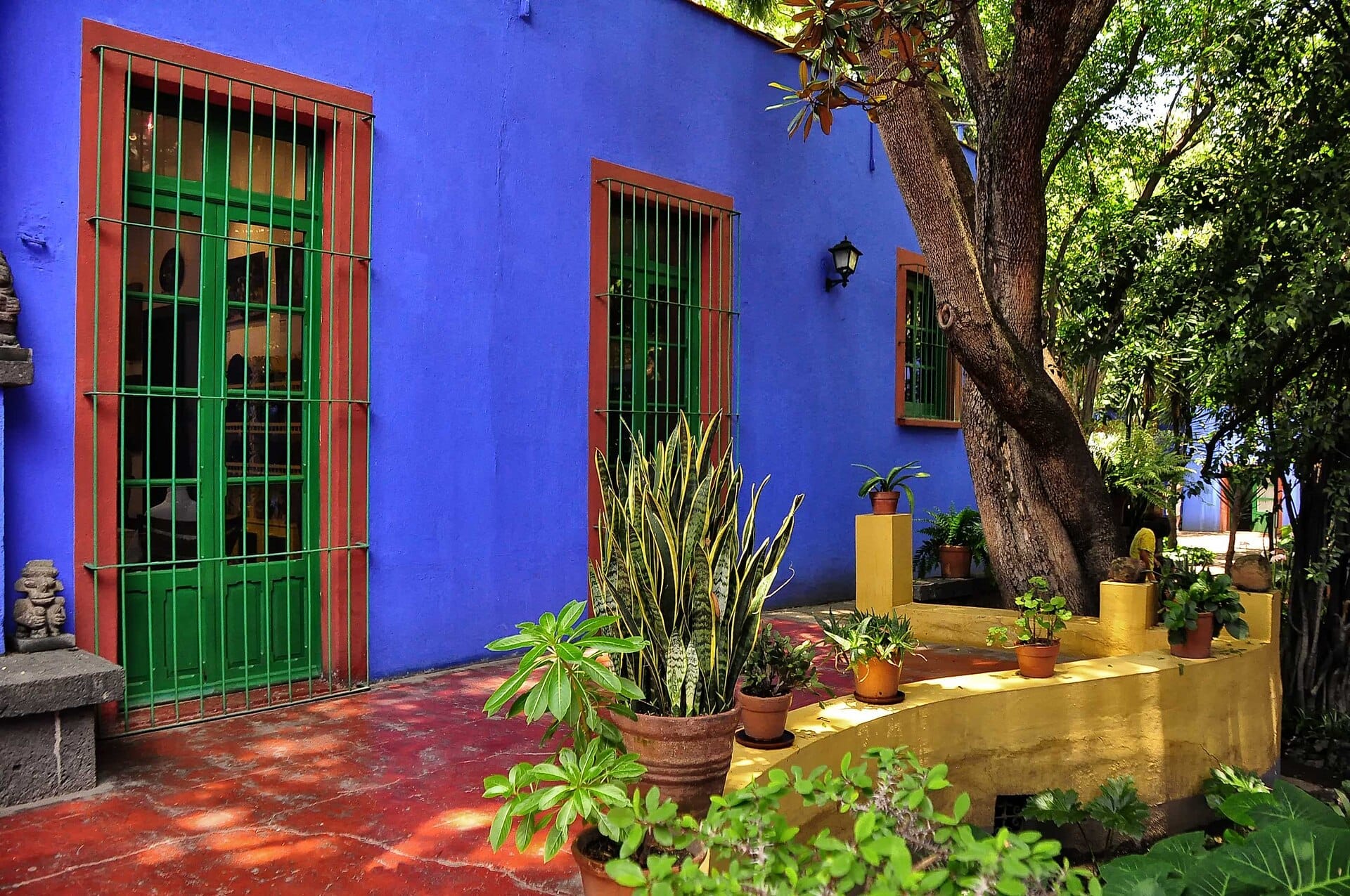
You approach the museum along a narrow cobblestone street. The exterior wall is unmistakable: a flat face of deep cobalt blue, broken only by a wooden door and the museum sign. Nothing about the street-level view prepares you for how much is inside. Once through the entrance, the space opens into a garden courtyard shaded by a large pyramid-shaped pre-Columbian stone idol that Rivera placed there himself. The courtyard is planted with cacti, ferns, and bougainvillea, and the light changes significantly depending on the time of day.
The house moves through a series of connected rooms: the kitchen with its yellow-and-blue ceramic tiles and a wall display of Kahlo and Rivera spelled out in miniature clay pots, the dining room, the bedroom where Kahlo spent much of her later life, and the studio where her easel and paint-covered palette are still set up. Each room is organized to reflect daily life rather than art history. The overall atmosphere is quiet and slightly dense with objects. You notice Kahlo's collection of roughly 2,000 pre-Columbian pieces arranged in the garden and corridors, a collection Rivera assembled over decades.
Photography rules inside are strict: most rooms prohibit flash photography, and staff enforce this actively. The garden and exterior are generally more relaxed for photos. Bring a phone or camera with a capable low-light sensor if documentation matters to you, because interior light is limited and uneven.
💡 Local tip
Arrive at opening time (10:00 on most days) to move through the rooms before tour groups arrive. By 11:30, the bedroom and studio become crowded, making close observation difficult.
How the Experience Changes Through the Day
Early morning visits, within the first hour of opening, offer a noticeably different quality of experience. The courtyard has good natural light from the east before midday, and the rooms are cool and uncrowded. You can stand at length in front of the corset display or the retablo collection without competing with other visitors for position. The staff are also more likely to answer questions during this window.
By midday, particularly on weekends, the corridors fill with organized tour groups that move in tight clusters. The studio, the bedroom, and the kitchen become difficult to linger in. If you are visiting with children or anyone who needs space to absorb a room slowly, a midday Saturday visit is the least suitable option. Weekday afternoons, especially Tuesday and Thursday, tend to be calmer than weekends at any hour.
The Thursday Noche Azul evening opening changes the character of the visit substantially. With fewer visitors and the house lit differently than in daylight, certain details in the studio become more prominent. However, some rooms may be closed during evening events, so the daytime visit remains the more complete option for first-timers.
Historical and Cultural Context
Frida Kahlo (1907–1954) was born in this house and, after a near-fatal bus accident at age 18 left her with permanent physical injuries, spent much of her adult life within its walls. Her painting practice was largely shaped by convalescence: the overhead mirror above her bed, the specially built easel that allowed her to work lying down, and the medical corsets she decorated with paint and collage are among the most affecting objects in the collection. The house is where she created many of her approximately 143 paintings.
Diego Rivera, whose relationship with Kahlo was famously turbulent, also lived here and contributed his collection of pre-Columbian artifacts to what is now on display. The broader Coyoacán district provided important context for both artists: it was then a semi-rural neighborhood on the southern edge of Mexico City, intellectually active but physically removed from the political intensity of the historic center. You can read more about the neighborhood in our guide to Coyoacán.
The museum also holds a collection of roughly 6,000 personal objects that were sealed in a bathroom Rivera ordered closed after Kahlo's death, and which only came to light in 2004. A rotating portion of these objects, including clothing, jewelry, and personal correspondence, is on view in the museum's Appearances Can Be Deceiving exhibition. This addition gives the museum unexpected depth beyond the famous rooms.
Getting There and Getting Around
The nearest Metro station is Coyoacán on Line 3 (the green line). From Viveros, the museum is roughly a 15-minute walk northeast through residential streets. The walk is flat and straightforward, though the streets are narrow and the signage is minimal; use a map app. Taxis and ride-hailing services (Uber, Didi) can drop you directly at the entrance on Londres, which is sometimes worth the extra cost if you are arriving with young children or luggage.
Most visitors combine the museum with the surrounding Coyoacán neighborhood, which is walkable and compact. The Mercado de Coyoacán is about a 10-minute walk and provides a practical and lively lunch option. The main plaza and colonial church are in the same direction. If you are planning a full day in the area, read about Museo Anahuacalli, Diego Rivera's dramatic basalt-stone museum about a 20-minute drive south, which holds his pre-Columbian collection and is architecturally striking.
Accessibility and Practical Notes
The museum is a preserved historic house, and its original architectural structure limits accessibility. Some areas are wheelchair accessible, but others are not, because the institution must protect the original design. Visitors with mobility limitations should contact the museum before visiting to understand which rooms are reachable. Visitors with disabilities receive complimentary admission, handled at the entrance rather than online.
Service animals are permitted with medical documentation. Other pets are not allowed. Large bags must be stored in lockers available near the entrance. The museum does not have a significant on-site cafe, though small vendors operate near the entrance on busy days. Plan food and water accordingly, particularly in the warmer months of March through May, when the garden becomes hot by mid-morning.
ℹ️ Good to know
Mexico City sits at approximately 2,240 metres above sea level. If you have just arrived, you may feel mild breathlessness or fatigue during an active day of sightseeing. The Casa Azul visit is largely indoors and low-exertion, but allow yourself time to acclimatize before combining it with longer walking tours.
Is It Worth It? Worth Your Time?
The Museo Frida Kahlo is one of Mexico City's most-visited attractions, and the line between cultural pilgrimage and tourist obligation can feel thin on busy days. The house does not contain large-scale Kahlo paintings. Most of her major canvases are in the Museo Dolores Olmedo, the Museo de Arte Moderno, or international collections. What the Casa Azul offers is something different: a spatial and biographical record of how she lived and worked, and a collection of personal objects that contextualize the painting in unexpected ways.
Visitors who arrive expecting a conventional painting gallery will be underwhelmed. Visitors who come prepared to read the house as a document, and who have some prior knowledge of Kahlo's biography, will find it deeply absorbing. If Kahlo's work is unfamiliar to you, consider reviewing it beforehand or pairing this visit with a stop at the Dolores Olmedo Museum, which holds the largest single collection of her paintings.
For travelers building a broader understanding of Mexican art, the Casa Azul pairs well with the Museo Casa Estudio Diego Rivera in San Ángel, where Rivera and Kahlo also lived and worked, and which gives a very different picture of their life together.
Insider Tips
- Book tickets as early as possible online at boletos.museofridakahlo.org.mx. Weekend slots, especially Saturday mornings, sell out several days in advance. If you find your preferred slot is unavailable, check again the morning of your visit as cancellations occasionally free up spots.
- Wednesday opens at 11:00 rather than 10:00, but the last Wednesday of each month includes Noche de Museos from 18:00–21:00. This evening event draws a specific crowd and feels distinctly different from daytime visits. Confirm room availability before planning specifically around it.
- The kitchen is one of the most photographed rooms, but many visitors walk past the retablo collection in the adjacent corridor too quickly. These small devotional paintings, which Kahlo collected, directly influenced the narrative style of her own work. Spend time here.
- The garden courtyard is the best place in the museum for photography without restrictions. Morning light from the east hits the cobalt facade directly and makes for cleaner shots before midday shadows flatten the color.
- If you read Spanish, the original labels and object descriptions throughout the house contain details not reproduced in the English translations. The English-language audio guide (available for rent at the museum) fills many gaps but is not a substitute for reading the primary labels.
Who Is Museo Frida Kahlo (Casa Azul) For?
- Art and design enthusiasts who want biographical and spatial context for Kahlo's painting practice
- Solo travelers with the freedom to move slowly through rooms without time pressure
- Visitors with prior knowledge of Mexican muralism or 20th-century Latin American art
- Photographers interested in architectural texture, color, and courtyard light
- Travelers combining a full day in Coyoacán with market visits and the colonial plazas nearby
Nearby Attractions
Other things to see while in Coyoacán:
- Mercado de Coyoacán
Mercado de Coyoacán (officially Mercado Público No. 89 'Coyoacán') is a free public market open daily from 9am to 6pm, with 489 stalls selling fresh produce, prepared food, handicrafts, and more. Located steps from the Frida Kahlo Museum in one of Mexico City's most distinctive southern neighborhoods, it offers one of the most genuine market experiences in the capital.
- Museo Anahuacalli
Conceived by Diego Rivera in 1933 and built from volcanic rock quarried near Coyoacán, the Museo Anahuacalli is part museum, part monument, and part personal mythology. It holds Rivera's collection of over 50,000 pre-Columbian artifacts and feels unlike any other cultural space in Mexico City.
- Museo Nacional de Culturas Populares
Founded in 1982 by anthropologist Guillermo Bonfil Batalla, the Museo Nacional de Culturas Populares in Coyoacán is one of Mexico City's most underrated cultural institutions. Dedicated entirely to temporary exhibitions on indigenous crafts, regional traditions, and living popular culture, it offers something different every visit — all for a nominal fee of about 22 MXN, or nothing at all on Sundays.
Planning a trip? Discover personalized activities with the Nomado app.