Museo Nacional de Culturas Populares: Mexico's Folk Traditions in Coyoacán
Founded in 1982 by anthropologist Guillermo Bonfil Batalla, the Museo Nacional de Culturas Populares in Coyoacán is one of Mexico City's most underrated cultural institutions. Dedicated entirely to temporary exhibitions on indigenous crafts, regional traditions, and living popular culture, it offers something different every visit — all for a nominal fee of about 22 MXN, or nothing at all on Sundays.
Quick Facts
- Location
- Av. Hidalgo 289, Col. Del Carmen, Coyoacán, Mexico City
- Getting There
- Metro Viveros (Line 3) or Copilco (Line 3), then a 10-15 min walk into Coyoacán
- Time Needed
- 45 minutes to 1.5 hours depending on current exhibitions
- Cost
- 22 MXN general; free for students, teachers, children under 13, INAPAM holders, and all visitors on Sundays
- Best for
- Travelers interested in Mexican folk art, indigenous crafts, and cultural identity
- Official website
- mncp.cultura.gob.mx/el-museo
What the Museo Nacional de Culturas Populares Is
The Museo Nacional de Culturas Populares — officially the National Museum of Popular Cultures — is a federal institution operated by Mexico's Secretaría de Cultura. It was inaugurated on September 24, 1982, under the vision of anthropologist Guillermo Bonfil Batalla, whose intellectual project argued that Mexico's identity was rooted not in elite or colonial culture, but in the living traditions of its indigenous and mestizo communities. That founding philosophy still shapes everything the museum does.
One thing sets this museum apart from most others in Mexico City: it has no permanent collection on display. Every exhibition is temporary, meaning the galleries change regularly throughout the year. Visits separated by even a few months can feel like entirely different experiences. This model keeps the space focused on process and community rather than objects behind glass, and it explains why the museum attracts working artists, researchers, and cultural practitioners alongside tourists.
ℹ️ Good to know
Because all exhibitions are temporary, check the museum's official website (mncp.cultura.gob.mx) before visiting to see what is currently on. Arriving without knowing the current program is fine, but knowing in advance helps you calibrate expectations and time.
The Setting: Coyoacán as Context
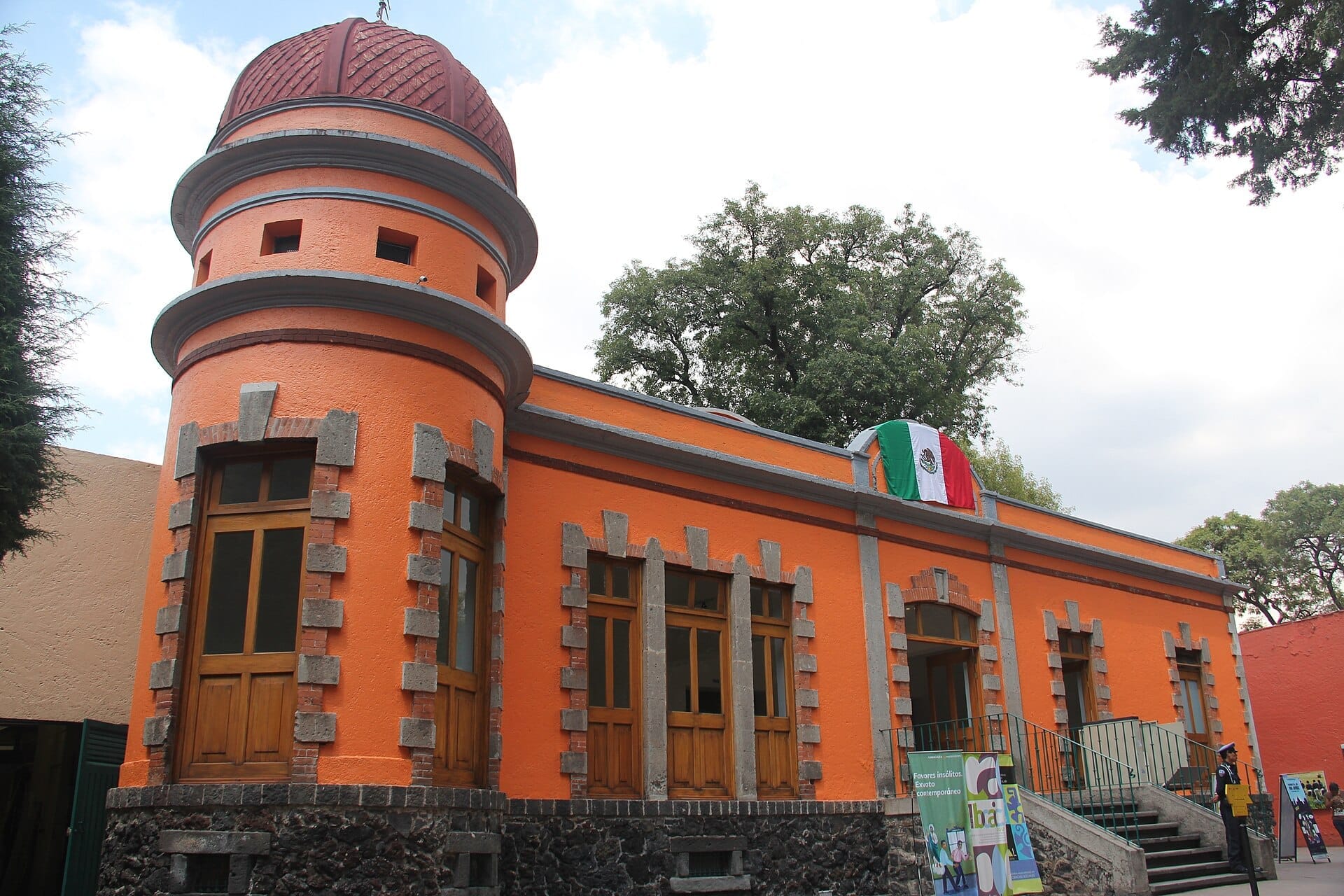
The museum sits on Avenida Hidalgo in the colonial heart of Coyoacán, one of Mexico City's most historically layered neighborhoods. Coyoacán predates the Spanish conquest and retains a distinctly village-like atmosphere — cobblestone streets, jacaranda trees, low colonial-era buildings painted in terracotta and ochre. The museum building itself fits this texture, a modest structure with a courtyard that opens to the street rather than sealing visitors away from the neighborhood.
The location is deliberate. Positioned steps from the central plazas of Coyoacán, the museum draws in foot traffic from people already exploring the area, but it also draws serious visitors who come specifically for the programming. The surrounding streets fill with vendors, particularly on weekends, selling everything from handmade jewelry to tlayudas — which makes the walk from the metro a cultural warm-up of its own.
If you are combining this visit with other sites nearby, the Museo Frida Kahlo is roughly a ten-minute walk to the northwest, and the Mercado de Coyoacán is equally close. The neighborhood rewards a half-day itinerary that includes all three.
Tickets & tours
Live prices and dates from our booking partner. If you book, we may earn a commission at no extra cost to you.
Xochimilco, Coyoacan and Frida Kahlo Museum with skip-the-line tickets
From 63 €Instant confirmationFree cancellationFrida Kahlo and Diego Rivera legacy visit to three museums with skip-the-line tickets
From 67 €Instant confirmationFree cancellationSix Flags Amusement Park tickets and transportation
From 87 €Instant confirmationFree cancellationMexico City National Museum of Anthropology guided tour
From 57 €Instant confirmationFree cancellation
Inside the Exhibitions: What You Will Find
Past exhibitions at the museum have covered topics ranging from the regional traditions of Día de Muertos across different Mexican states to the craft textiles of Oaxacan Zapotec communities, the visual culture of lucha libre, and the history of piñatas as a cultural form. The thematic range is broad, but the focus is consistent: how do ordinary Mexicans — across ethnic, regional, and generational lines — produce and sustain cultural meaning?
The exhibition spaces are modest in scale, typically spanning several interconnected rooms arranged around the central courtyard. The design is unpretentious. Labels are primarily in Spanish, with limited English text in some shows. This means non-Spanish speakers will get less contextual depth from the explanatory panels, though the visual and tactile quality of the objects on display often communicates well across the language gap. Textile displays, ceramic installations, and large-format photography tend to be particularly accessible.
💡 Local tip
Spanish readers will get significantly more from this museum than non-readers. If your Spanish is basic, consider using a translation app on your phone to photograph and translate exhibition panels — the content is well worth the extra effort.
The courtyard at the center of the building is often used as an event space and sometimes as an auxiliary exhibition area. On weekday mornings it tends to be quiet and shaded, with pigeons and the faint smell of coffee drifting in from nearby street stalls. On weekend afternoons, especially Sundays, it fills with families, students, and passersby who wander in because entry is free. The energy shifts considerably between these two modes.
When to Visit and How Time of Day Affects the Experience
Tuesday through Thursday mornings — the museum opens at 11:00 from Tuesday to Sunday — are the quietest visiting windows. The galleries are rarely crowded, staff are attentive, and you can move through the exhibitions at your own pace without competing with school groups or weekend visitors. The light in the courtyard is good for photography in the morning hours before noon.
Sundays draw the largest crowds because admission is free to everyone. The neighborhood around the museum is also at its most active on Sundays, with markets and street food vendors operating nearby. This makes Sunday the most atmospheric day to visit if you want to experience Coyoacán at full energy, but you should expect the museum itself to be noticeably busier, particularly between noon and 3:00 PM.
Friday and Saturday evenings — the museum stays open until 19:00 on those days, as well as on Sundays — offer a quieter late-afternoon window after the lunch crowds thin out. The courtyard takes on a different quality as the light softens, and you can sometimes catch the tail end of a weekend program or performance that began earlier in the afternoon.
💡 Local tip
Arrive between 11:00 and 13:00 on a weekday for the most relaxed visit. If Sunday is your only option, go early — before noon — and pair the visit with a walk through the Coyoacán market and plazas afterward when the museum gets busier.
Practical Guide: Getting There, Tickets, and Logistics
The museum is at Av. Hidalgo 289, Colonia Del Carmen, Coyoacán. The most straightforward route from central Mexico City is Metro Line 3 (olive green) to either Viveros or Copilco stations. From either station, it is roughly a ten to twenty minute walk through residential and commercial streets into the colonial center of Coyoacán. The walk itself is pleasant, passing through tree-lined blocks that gradually give way to the neighborhood's characteristic low colonial architecture.
Ride-hailing apps (Uber, DiDi, Cabify) are a practical option from most parts of the city and drop you directly outside the museum. This is useful if you are arriving from a distant neighborhood or are unfamiliar with the metro network. For general navigation advice across Mexico City, the getting around Mexico City guide covers transit options in detail.
General admission is 22 MXN — a nominal fee. Free entry applies automatically on Sundays and for teachers, students with credentials, children under 13, and INAPAM (older adult) cardholders on all days. There is no advance booking system; you pay at the door. Expect to show identification to access free-admission categories.
The museum is closed on Mondays. Opening hours are Tuesday to Thursday from 11:00 to 18:00, and Friday to Sunday from 11:00 to 19:00. These hours are set by the Secretaría de Cultura and are not subject to seasonal variation, though they should be verified against the museum's official site before visiting, as federal cultural institutions occasionally adjust hours during national holidays.
⚠️ What to skip
Detailed accessibility information is limited in official public documentation. Visitors with mobility or sensory needs should contact the museum directly via mncp.cultura.gob.mx before planning a visit to confirm current conditions.
Photography, Context, and Worth Your Time?
Photography is generally permitted in the galleries for personal use, though this can vary by exhibition depending on loan agreements for specific objects. The courtyard and building exterior are always fine to photograph. Natural light in the courtyard makes it one of the more photogenic spots in a neighborhood already rich with visual texture.
An note on expectations: this museum is not trying to compete with the Museo Nacional de Antropología or the Museo de Arte Popular on scale or scope. Its rooms are small, its budget is modest, and the depth of any single visit depends entirely on which temporary exhibition is running. On a weak programming cycle, the experience can feel thin — two or three rooms and 45 minutes and you are done. On a strong cycle, it can be quietly revelatory, particularly for visitors interested in how contemporary Mexican communities negotiate tradition and identity.
What the museum does consistently well is ground popular culture in intellectual seriousness. Guillermo Bonfil Batalla's original framework — that popular culture is not folklore kitsch but a political and social fact — still runs through the curatorial approach. Even modest exhibitions here tend to treat their subjects with clear respect rather than touristic romanticism.
Who Should Skip This Museum
Travelers with very limited time in Mexico City who are prioritizing major sites should rank this lower on the list. It requires a dedicated trip to Coyoacán and does not work as a quick detour from the historic center. If your schedule is tight, the neighborhood itself — the plazas, market, and Frida Kahlo Museum — may be a better use of a Coyoacán visit than adding this museum on top.
Visitors who need comprehensive English-language interpretation, or who prefer large permanent collections they can browse at length, will likely find the experience more limiting than expected. The museum makes no apology for its Spanish-language curatorial voice, which is appropriate given its audience but worth knowing in advance.
Insider Tips
- Check the museum's official website a few days before visiting to see the current exhibition title and theme. If the subject interests you, the visit will feel twice as rewarding. If not, adjust your Coyoacán itinerary to weight other sites more heavily.
- The museum occasionally hosts free public events including craft demonstrations, talks, and performances — especially around major Mexican cultural dates like Día de Muertos in late October and early November. These events are listed on the official site and are worth planning around if your dates overlap.
- The shaded courtyard is a good place to rest during a Coyoacán afternoon walk, even if you do not spend long in the galleries. Staff are generally unbothered by visitors lingering in the public areas.
- Combine this visit with the Museo Casa Estudio Diego Rivera, a short distance away in San Ángel, for a connected day of Mexican cultural history that spans folk tradition and modernist art.
- Sunday mornings before noon give you the benefit of free admission with manageable crowd levels. After 13:00 on Sundays, both the museum and the surrounding streets become significantly more crowded.
Who Is Museo Nacional de Culturas Populares For?
- Travelers with serious interest in Mexican indigenous and folk traditions beyond surface-level souvenirs
- Budget-conscious visitors, especially students and those visiting on Sundays
- Cultural researchers, anthropology enthusiasts, and educators
- Anyone spending a half-day in Coyoacán who wants to add depth to the neighborhood walk
- Repeat visitors to Mexico City looking for programming that changes between trips
Nearby Attractions
Other things to see while in Coyoacán:
- Mercado de Coyoacán
Mercado de Coyoacán (officially Mercado Público No. 89 'Coyoacán') is a free public market open daily from 9am to 6pm, with 489 stalls selling fresh produce, prepared food, handicrafts, and more. Located steps from the Frida Kahlo Museum in one of Mexico City's most distinctive southern neighborhoods, it offers one of the most genuine market experiences in the capital.
- Museo Anahuacalli
Conceived by Diego Rivera in 1933 and built from volcanic rock quarried near Coyoacán, the Museo Anahuacalli is part museum, part monument, and part personal mythology. It holds Rivera's collection of over 50,000 pre-Columbian artifacts and feels unlike any other cultural space in Mexico City.
- Museo Frida Kahlo (Casa Azul)
The Frida Kahlo Museum, known as La Casa Azul, is one of Mexico City's most-visited cultural sites. Located in the tree-lined streets of Coyoacán, this cobalt-blue house is where Kahlo was born, lived most of her life, and died. The rooms preserve her belongings, her studio, and an extraordinary collection of pre-Columbian artifacts as if time stopped in 1954.
Planning a trip? Discover personalized activities with the Nomado app.