Adelaide Oval: Inside One of the World's Great Sporting Grounds
Adelaide Oval is a heritage-listed cricket and football stadium on War Memorial Drive, North Adelaide, operating since 1873. Stadium tours depart daily at 11am and 2pm from A$17, covering the stands, dressing rooms, and the famous manually-operated scoreboard. Whether you're visiting on an event day or just exploring the precinct, the combination of architecture, sports history, and riverside setting makes it one of Adelaide's most distinctive attractions.
Quick Facts
- Location
- War Memorial Drive, North Adelaide, SA (edge of the Adelaide CBD parklands)
- Getting There
- Adelaide Railway Station is a short walk across the footbridge; multiple bus routes serve the precinct
- Time Needed
- 1.5–2 hours for a guided tour; 30–45 minutes to walk the precinct and riverbank
- Cost
- Tours from A$17; free to walk the external precinct; event tickets priced separately
- Best for
- Sports history enthusiasts, architecture fans, families, and anyone curious about Australian sporting culture
- Official website
- www.adelaideoval.com.au
What Is Adelaide Oval, Exactly?
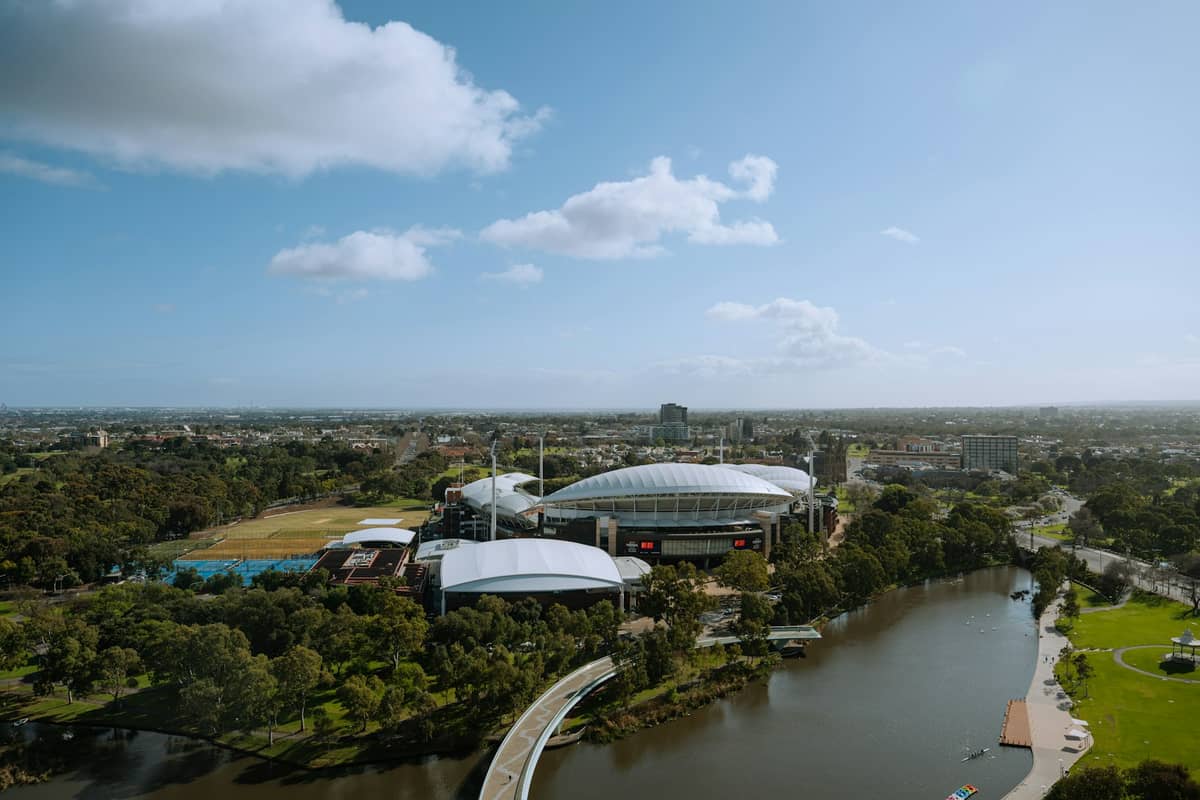
Adelaide Oval is a multi-use sports stadium on War Memorial Drive, sitting at the northern edge of the city's parkland ring where the Adelaide CBD meets the River Torrens. It hosts Australian rules football (AFL) games for the Adelaide Crows and Port Adelaide Power, Sheffield Shield and international cricket, and occasional rugby and soccer matches. The ground opened for cricket on 13 December 1873, making it one of the longest continuously operating cricket venues in the world.
The playing oval itself measures approximately 190 metres by 125 metres, placing it among the largest cricket grounds in Australia. But the numbers matter less than the atmosphere: the combination of the heritage scoreboard, St Peter's Cathedral framing the northern end, and the hills visible beyond the stands on clear days gives the Oval a visual depth that modern purpose-built stadiums rarely achieve.
Even outside event days, the precinct connects naturally with the River Torrens Linear Park and the broader Adelaide Park Lands, so a visit here can anchor a longer walk through the city's green belt.
The Stadium Tour: What You Actually See
Guided stadium tours depart daily at 11am and 2pm and must be booked in advance through the Adelaide Oval website. Prices start at A$17, with reduced rates for children and concessions; Adelaide Oval Football Members and SACA members can attend for free on presentation of their membership card. Tours last roughly 90 minutes.
⚠️ What to skip
Tours can be cancelled or rescheduled on event days when the stadium is in use. Always check the Adelaide Oval website before booking, especially during AFL season (March to September) and the cricket season (October to March).
The route typically takes visitors through areas closed on normal event days: players' change rooms, the coaches' box, the media centre, and the members' areas. Standing on the turf with the stands rising around you on all sides is a noticeably different experience from watching from the seats, and guides tend to be well-versed in both the cricket history and the AFL rivalry that has defined the venue since it added football to its calendar.
The heritage-listed Adelaide Oval Scoreboard at the southern end is a centrepiece of the tour. Still operated manually by scoreboard attendants during cricket matches, it is more than a century old. Up close, the scale of the individual number panels is surprisingly large, and the interior mechanics are genuinely interesting even for visitors with no particular cricket knowledge. Note that the scoreboard area is the one section of the tour not accessible by wheelchair.
Tickets & tours
Live prices and dates from our booking partner. If you book, we may earn a commission at no extra cost to you.
Architecture and Heritage: More Than a Sports Ground
The stadium underwent a major redevelopment completed in 2014, but the process was unusually careful about what it retained. The heritage scoreboard, the northern mound (a grass hill popular with spectators), and the general sightlines from St Peter's Cathedral were all factored into the rebuild. The result is a venue that seats 50,000 people, with standing room for 3,500, while still feeling connected to its 19th-century origins.
From the outside, the tensile roof structure is worth examining. The white cable-stayed canopy that wraps the stands has a structural elegance that reads differently depending on the light. Early morning, when the sun hits the cables from the east and long shadows fall across the brick perimeter walls, is arguably the best time to photograph the exterior. By midday in summer, the stonework radiates heat and the setting flattens out visually.
For a broader look at Adelaide's architectural heritage, the North Terrace cultural precinct is a 15-minute walk south and pairs well with an Oval visit on the same afternoon.
Attending a Live Event: What Changes
The stadium transforms on match and test days. The precinct along War Memorial Drive and the footbridge from the railway station fills quickly in the two hours before bounce-down or first ball, and the crowd noise, the smell of the turf, and the particular buzz of a packed ground are experiences the tour cannot replicate. If your dates align with an AFL match or an international cricket fixture, consider prioritising a ticket over the standard tour.
AFL crowds in Adelaide have a different character from Melbourne or Sydney: louder during the actual play, a bit more relaxed in the breaks. Cricket days here, particularly Test matches that stretch across five days, develop their own rhythm: spectators drift in and out, the members' stand fills and empties, and the quality of light over the ground shifts through the afternoon in a way that rewards simply sitting and watching.
💡 Local tip
For cricket, the Northern Mound (the grass embankment at the Adelaide end) is a popular spot for groups. Arrive early on the first two days of a Test to claim a good position. Bring sunscreen, a hat, and cash for the vendors, as card readers can be slow during busy sessions.
Summer Test matches at Adelaide Oval carry a specific hazard worth flagging: temperatures routinely exceed 35°C, and the concrete and metal of the stands retain heat through the afternoon. Shade is available in the stands but can be limited in some sections. Dehydration is a real risk for visitors not accustomed to Adelaide's Mediterranean-pattern summers, where December through February are typically the driest and hottest months.
Getting There and Around the Precinct
Adelaide Railway Station on North Terrace connects to the Oval via a footbridge over the River Torrens. The walk takes around 10 minutes at a relaxed pace and passes through the parklands. On event days this route becomes a river of people; on quiet mornings it is a genuinely pleasant path with views toward the CBD and the water below.
Multiple Adelaide Metro bus routes also serve the War Memorial Drive precinct directly. Rideshare drop-off is possible on non-event days; on event days, traffic management around the Oval significantly extends travel times for vehicles, so public transport is the practical choice. Cycling is also viable via the river trail.
If you are planning your transport strategy across the city, the getting around Adelaide guide covers the full Adelaide Metro network and practical tips for visitors.
The Surrounding Precinct: Before and After Your Visit
The riverbank directly south of the Oval has been developed as a public plaza with seating, food and coffee vendors, and views back to the cathedral. On weekday mornings it is largely the domain of office workers and joggers; on weekend afternoons it fills with families and spectators. The combination of the water, the parklands, and the stadium's white roof structure makes this one of the more photogenic urban spots in the city, particularly in the hour before sunset.
Immediately adjacent is Elder Park, a broad riverside lawn frequently used for festivals and outdoor events. Combined with the Oval precinct, this stretch of the northern CBD edge gives a good sense of how Adelaide has developed its relationship with the Torrens over the past two decades.
Food options within the precinct are primarily event-day oriented, with multiple venues inside the stadium and a few external kiosks. On non-event days the choice is more limited. North Adelaide, a short walk north of the Oval, offers a broader range of cafes and restaurants along O'Connell Street, which is worth factoring into your plans if you are visiting outside of game days.
ℹ️ Good to know
Accessibility: Main stadium entrances have ramps and lifts, and accessible seating is available throughout the venue. Most tour areas are accessible by wheelchair and walking aids. The heritage scoreboard section of the tour is the exception and is not wheelchair accessible. Contact the Oval directly before booking if you have specific accessibility requirements.
What to Know: Is the Tour Worth It?
For visitors with a genuine interest in sports history, Australian Rules football culture, or cricket heritage, the tour delivers solid value at A$17. The access to areas you cannot enter on a normal match day is the clear point of difference, and the guide commentary tends to be specific enough to hold the attention even of non-sports fans.
For visitors with no connection to cricket or AFL and only casual curiosity about the venue, the tour may feel long. The format is guided and structured, not self-paced, and the volume of sport-specific context assumes at least some baseline familiarity. If you fall into this category, the free option of walking the exterior precinct and the riverbank is a perfectly satisfying alternative that takes 30 to 45 minutes.
If your Adelaide itinerary leans more toward culture and the arts, pair a quick walk past the Oval with a visit to the Art Gallery of South Australia or the South Australian Museum on North Terrace, both of which are free to enter.
Insider Tips
- Book the 11am tour rather than the 2pm one in summer. By early afternoon, the stands and field-level areas can be uncomfortably hot; the morning session is cooler and the light is better for photography inside the ground.
- The footbridge from Adelaide Railway Station offers one of the best unobstructed views of the stadium exterior and the cathedral backdrop. Cross it slowly rather than treating it as a shortcut — it is genuinely one of the better vantage points in the precinct.
- If you are attending an AFL match, the Northern Mound general admission area is standing-room, which means you can reposition during the game. Experienced spectators use this to follow the play up and down the ground rather than staying fixed to one end.
- On Cricket Test days, days three through five often have lower attendance and reduced ticket prices, while the play can be the most tactically complex. It is a quieter and sometimes more interesting experience than the opening days.
- The stadium has a rooftop walk experience (the RoofClimb) for those wanting a higher vantage point, but this is a separate activity with its own pricing and booking process, distinct from the standard stadium tour.
Who Is Adelaide Oval For?
- Sports history enthusiasts wanting behind-the-scenes access to one of Australia's oldest cricket grounds
- AFL supporters looking to experience the home ground of Adelaide's two competing clubs
- Architecture and heritage fans interested in how a 150-year-old venue has been modernised without losing its character
- Families with older children who will engage with the scale of the players' facilities and the scoreboard mechanics
- Visitors combining a riverside walk through the parklands with a structured cultural stop
Nearby Attractions
Other things to see while in Adelaide CBD:
- Adelaide Arcade
Opened in December 1885, Adelaide Arcade is one of Australia's oldest and best-preserved Victorian-era shopping arcades. Free to enter and located opposite Rundle Mall's fountain, it offers a rare combination of architectural beauty, specialty retailers, and a genuine sense of Adelaide's commercial history.
- Adelaide Botanic Garden
Open daily and completely free, Adelaide Botanic Garden covers 50 hectares on the northern edge of the CBD. From a 19th-century palm house to a full-scale tropical rainforest glasshouse, it rewards a slow morning or a purposeful afternoon walk.
- Adelaide Central Market
Adelaide Central Market has operated continuously since 1869, making it one of the largest undercover fresh produce markets in the Southern Hemisphere. Spread across 5,720 square metres in the heart of the CBD, it draws locals, chefs, and curious visitors to its mix of produce stalls, specialty food traders, and casual eateries. This guide covers everything you need to plan a worthwhile visit.
- Adelaide Festival Centre
Opened in 1973, Adelaide Festival Centre is South Australia's flagship performing arts complex, anchoring the northern edge of the CBD along King William Road. From major theatre productions to intimate performances, it draws both locals and visitors year-round — and its riverside location makes it as much a place to linger as to attend a show.
Planning a trip? Discover personalized activities with the Nomado app.