Elder Park & River Torrens: Adelaide's Civic Waterfront Explained
Elder Park, also known as Tarntanya Wama (Park 26), lines the south bank of the River Torrens in the heart of Adelaide's CBD. Free to enter, steeped in colonial and Kaurna history, and animated by events year-round, it is one of the city's most useful green spaces — as long as you know when to go.
Quick Facts
- Location
- King William Road, Adelaide CBD — south bank of the River Torrens, beside the Adelaide Festival Centre
- Getting There
- Adelaide tram stops along King William Street; multiple Adelaide Metro bus routes serve the CBD. The park is walkable from Rundle Mall in under 10 minutes.
- Time Needed
- 30–90 minutes for a casual visit; longer if attending a scheduled event
- Cost
- Free to enter (public open space). Event tickets vary by organiser.
- Best for
- Morning walkers, families with young children, festival-goers, and anyone wanting a green pause in the middle of a city day
- Official website
- www.cityofadelaide.com.au/park/elder-park-tarntanya-wama-park-26
What Elder Park Actually Is
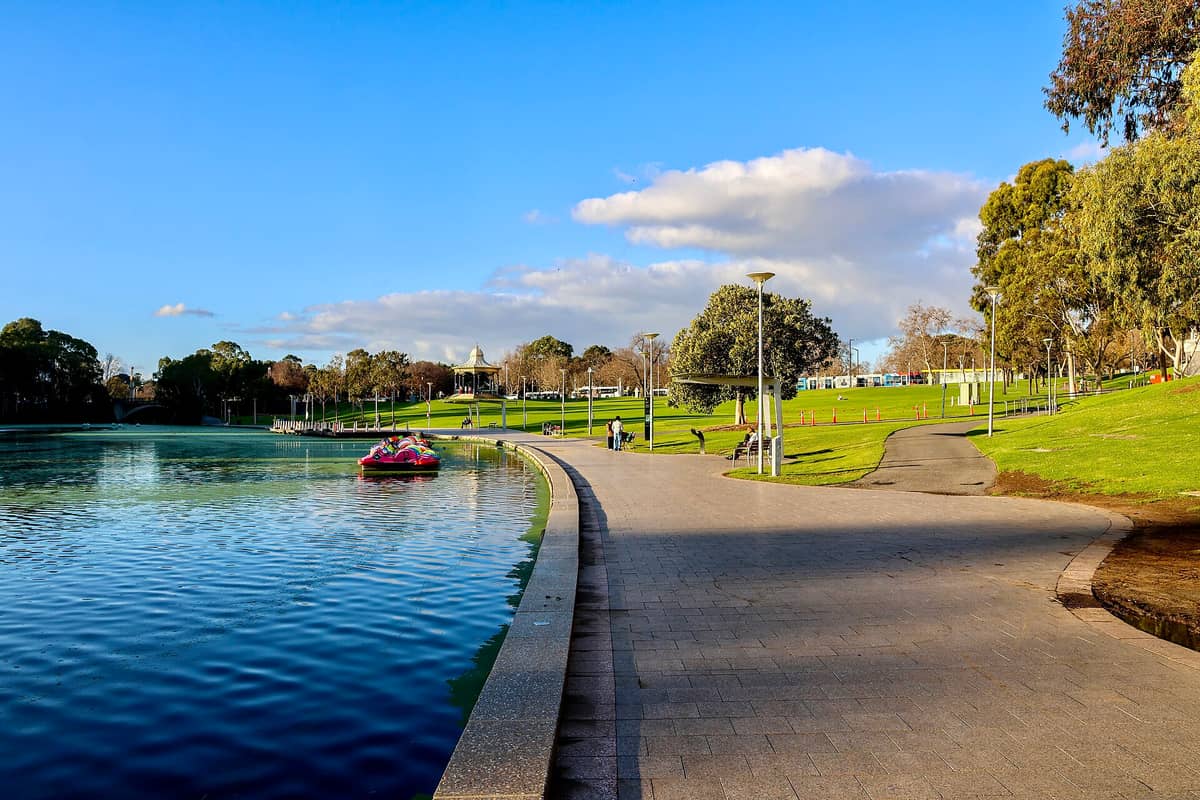
Elder Park, officially Elder Park / Tarntanya Wama (Park 26), occupies a narrow but prominent strip of lawn and path along the south bank of the River Torrens — known in Kaurna as Karrawirra Parri — right at the geographic heart of Adelaide's CBD. It sits between King William Road and the Adelaide Festival Centre to the south, with Torrens Lake stretching out to the north. The result is one of those rare city parks that feels genuinely useful rather than decorative.
The park is compact. You can walk its length in about ten minutes at a relaxed pace. But its position — between the cultural precinct, the river, and the grid of the CBD — makes it a natural gathering point for everyone from office workers eating lunch on the grass to crowds streaming in for festival events on summer evenings.
The defining landmark is the Elder Park Rotunda, a Victorian-era bandstand that has stood near the river's edge since its opening on 28 November 1882. Cast iron and ornate, it is one of the most photographed structures in the city. The park itself was renamed in 1907 to honour Sir Thomas Elder, the Scottish-born pastoralist and philanthropist who shaped much of colonial South Australia's public life.
ℹ️ Good to know
The Torrens Lake you see today was formed when a weir was completed in July 1881, backing up the river to create a permanent body of water in the city. Before that, the Torrens was a seasonal stream that could run dry in summer.
Kaurna Country and the Name Tarntanya Wama
Elder Park sits on the traditional lands of the Kaurna people, the Aboriginal Australians of the Adelaide Plains. The dual naming — Tarntanya Wama alongside Elder Park — reflects the City of Adelaide's effort to acknowledge that this landscape has been inhabited, used, and known far longer than its colonial history suggests. Karrawirra Parri, the Kaurna name for the River Torrens, translates roughly as 'Red Gum Forest River', a reminder that the landscape before European settlement was substantially different from the mown lawns and weir-backed lake visitors see today.
If you want to engage more seriously with that history, the Living Kaurna Cultural Centre offers direct programming and context. The park itself carries the name but provides limited interpretive signage on-site, so independent research or a guided experience will add considerably more meaning to your visit.
Tickets & tours
Live prices and dates from our booking partner. If you book, we may earn a commission at no extra cost to you.
Ultimate Adelaide and Hahndorf full-day tour
From 94 €Instant confirmationFree cancellationHalf-day Lofty Descents tour by bike
From 89 €Instant confirmationFree cancellationAdelaide kayak tour with expert instructors
From 51 €Instant confirmationFree cancellationTrue Crime Tour in Adelaide
From 21 €Instant confirmationFree cancellation
What It Feels Like to Be Here
Early mornings — particularly on weekdays between 7am and 9am — the park is genuinely quiet. Joggers follow the riverside path, a few cyclists pass through, and the water on Torrens Lake catches flat light from the east. The air at this hour carries the faint smell of cut grass and river water. It is the best time to appreciate the Victorian geometry of the rotunda without crowds framing every photograph.
By late morning, especially on weekends, the dynamic shifts. Paddle boats appear on the lake (hire is available from operators near the park, though availability and pricing should be confirmed on-site). The lawns begin to fill with families, and the area around the rotunda becomes a backdrop for wedding photographs — you will almost certainly encounter at least one bridal party if you visit on a Saturday afternoon.
Summer evenings transform the park again. When the Adelaide Festival, the Adelaide Fringe, or other major events are running, the lawns and surrounding paths become staging areas for crowds of several thousand people. The Festival Centre's Amphitheatre, which backs directly onto the park, hosts outdoor performances, and the Torrens waterfront takes on a carnival atmosphere: food trucks, buskers, and the smell of barbecue smoke. It is atmospheric and enjoyable, but if you came for the rotunda or a quiet riverside walk, come back in the morning.
💡 Local tip
For photography: the rotunda photographs best in the hour after sunrise, when light hits it from the east and the lawns are empty. In the afternoon, the Festival Centre building casts irregular shadows across the park, which can be harder to work with.
The River Torrens Linear Park and Walking Beyond Elder Park
Elder Park is technically the starting point — or the endpoint, depending on direction — of the River Torrens Linear Park, a continuous green corridor that traces the river from the coast near West Beach all the way to the Adelaide Hills foothills. Within the CBD stretch, the path is flat, paved, and accessible to prams, wheelchairs, and cyclists.
Walking east from Elder Park along the northern edge of the CBD, you pass through the university quarter, with the parklands widening gradually as you move away from the Festival Centre. The path remains pleasant for roughly two kilometres before the surroundings become more suburban. Most casual visitors turn back somewhere around the zoo, which makes for a comfortable 4–5 kilometre round trip with a clear destination.
The Adelaide Zoo sits less than a kilometre upstream along the Torrens and is easily combined with an Elder Park visit, especially if you have children in tow.
Practical Walkthrough: Getting There and Around
Elder Park requires no planning to reach if you are already in the CBD. From Rundle Mall, walk north along King William Street for about eight minutes and the park opens on your right before you reach the river. The Adelaide Festival Centre is directly adjacent to the south, and North Terrace — the city's main cultural boulevard — is two blocks south of the park.
Adelaide Metro trams run along King William Street, which is the closest tram route. Multiple bus services also stop nearby. If you are building a broader city day, North Terrace is a short walk south and connects to the Art Gallery of South Australia, the South Australian Museum, and other major institutions.
The park itself is largely step-free, with sealed paths running along the riverfront. Some areas involve gentle slopes, and surfaces can become slippery after rain. Accessible viewing areas are typically arranged during major events, but it is worth confirming with individual event organisers if specific requirements apply. There is no admission fee to enter the park at any time.
⚠️ What to skip
Adelaide's summer heat (December to February) can be severe, with temperatures occasionally exceeding 40°C. The park has limited shade outside the rotunda and the Festival Centre's eaves. If you plan a midday visit in summer, bring water and a hat, or consider shifting to early morning.
Events, Festivals, and When the Park Changes Character
Adelaide is one of Australia's most festival-dense cities, and Elder Park sits at the centre of that activity. The Adelaide festival calendar is heavily concentrated in February and March, when the Adelaide Festival and the Adelaide Fringe both run simultaneously. During those weeks, the park's southern edge becomes a genuine outdoor venue, with projection mapping on the Festival Centre exterior, pop-up bars on the lawns, and crowds that arrive after 8pm and stay well past midnight.
Outside of event periods, the park hosts weekend markets and community gatherings through the year. Exact dates are published by the City of Adelaide and by event organisers closer to the time. The park's open lawn area is also used informally for picnics, group exercise classes in the early morning, and the occasional school excursion.
One honest caveat: when the park is not hosting an event, it can feel slightly underwhelming to visitors expecting a grand destination. The rotunda is handsome but small. The lawns are pleasant but unremarkable. Elder Park earns its place in a city itinerary as a connector — between the Festival Centre, the river walk, North Terrace's museums, and the rest of the CBD — rather than as a standalone attraction that justifies a special trip.
Who Should Reconsider a Visit
Travellers with very limited time who are specifically looking for dramatic scenery or immersive cultural experiences may find Elder Park too understated. It is a city park, not a set piece. If your Adelaide itinerary has only one or two days, the park is worth passing through, but should not anchor a morning unless you are pairing it with the river walk, the zoo, or a festival event.
Similarly, visitors arriving in the middle of a hot summer afternoon with no shade plan will find the experience uncomfortable rather than relaxing. Come early, or come in autumn and spring when temperatures sit in the 15–25°C range and the lawns are at their greenest.
Insider Tips
- The rotunda looks best lit from the east, so arrive at sunrise or in the first hour of morning light. By mid-morning on weekends, wedding parties frequently take over the immediate surroundings.
- If you want to walk the Torrens east toward the zoo, start at Elder Park and follow the north bank path. You can cross back via the footbridge near Adelaide Zoo and return along the south bank for a natural loop.
- During the Adelaide Fringe (February to March), the park lawns often host free outdoor performances in the evening. Check the Fringe program for free Garden of Unearthly Delights events nearby.
- Paddle boat hire on Torrens Lake is popular with families on weekends. Arrive before 11am to avoid queues and to get calm water before afternoon breezes pick up.
- The path running directly beneath the Festival Centre on the river's south bank is cooler than the open lawn on hot days, thanks to the building's overhang. It is also where you will find the best waterline views of the rotunda from across the river.
Who Is Elder Park & River Torrens For?
- Families with young children who want open lawns and water views without paying admission
- Festival-goers using the park as a meeting point or pre-show gathering space
- Morning joggers and walkers starting or finishing a Torrens riverside route
- Visitors building a North Terrace cultural day who want a green break between museums
- Photographers looking for Victorian-era architecture against a river backdrop
Nearby Attractions
Other things to see while in Adelaide CBD:
- Adelaide Arcade
Opened in December 1885, Adelaide Arcade is one of Australia's oldest and best-preserved Victorian-era shopping arcades. Free to enter and located opposite Rundle Mall's fountain, it offers a rare combination of architectural beauty, specialty retailers, and a genuine sense of Adelaide's commercial history.
- Adelaide Botanic Garden
Open daily and completely free, Adelaide Botanic Garden covers 50 hectares on the northern edge of the CBD. From a 19th-century palm house to a full-scale tropical rainforest glasshouse, it rewards a slow morning or a purposeful afternoon walk.
- Adelaide Central Market
Adelaide Central Market has operated continuously since 1869, making it one of the largest undercover fresh produce markets in the Southern Hemisphere. Spread across 5,720 square metres in the heart of the CBD, it draws locals, chefs, and curious visitors to its mix of produce stalls, specialty food traders, and casual eateries. This guide covers everything you need to plan a worthwhile visit.
- Adelaide Festival Centre
Opened in 1973, Adelaide Festival Centre is South Australia's flagship performing arts complex, anchoring the northern edge of the CBD along King William Road. From major theatre productions to intimate performances, it draws both locals and visitors year-round — and its riverside location makes it as much a place to linger as to attend a show.
Planning a trip? Discover personalized activities with the Nomado app.