Art Gallery of South Australia: What to Know Before You Visit
The Art Gallery of South Australia has anchored Adelaide's cultural precinct since 1881, offering free entry to one of the country's most significant permanent collections. From European masters to contemporary Indigenous art, it rewards repeat visits across different moods and hours.
Quick Facts
- Location
- 490 North Terrace, Adelaide CBD SA 5000
- Getting There
- Buses on North Terrace (outside the Gallery); tram stops ~125 m away; Adelaide Railway Station ~5-min walk
- Time Needed
- 1.5–3 hours for the permanent collection; longer if a ticketed exhibition is running
- Cost
- Free general entry; ticketed special exhibitions vary — check agsa.sa.gov.au for current prices
- Best for
- Art lovers, rainy-day shelter, solo explorers, couples, anyone curious about Australian and Pacific art
- Official website
- www.agsa.sa.gov.au
What the Art Gallery of South Australia Actually Is
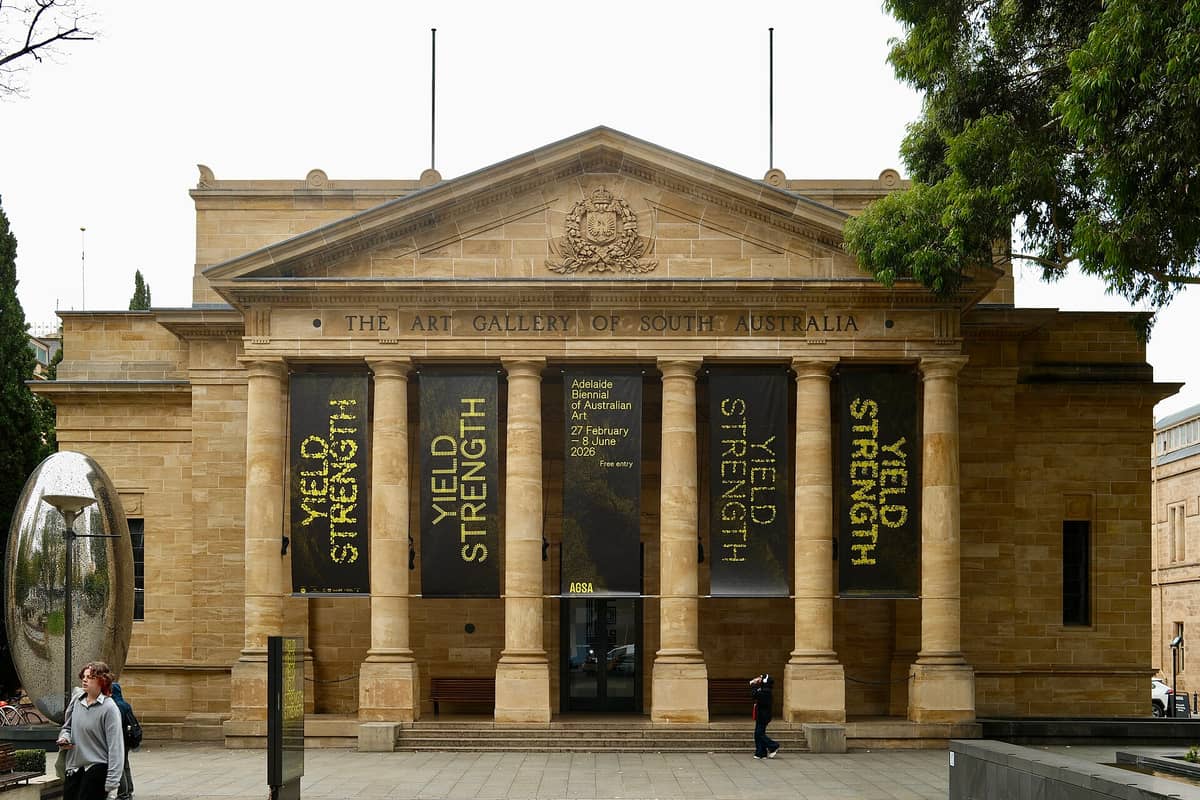
The Art Gallery of South Australia (AGSA) is a state institution with genuine depth. Founded in 1881 and relocated to its current North Terrace building in 1900, it holds more than 45,000 works spanning European Old Masters, Australian colonial and contemporary painting, decorative arts, photography, and one of the most significant collections of Asian and Pacific art in the Southern Hemisphere. The building itself is a sandstone presence on one of Adelaide's most culturally loaded streets, sitting between the South Australian Museum and the University of Adelaide.
General entry to the permanent collection is free, which changes the calculus of how long you should stay. There is no pressure to rush through to justify a ticket price. Visitors often return across multiple days during a longer Adelaide stay, treating the gallery the way locals do: as a resource rather than a tick-box attraction.
💡 Local tip
The Gallery runs extended Friday opening hours until 8:30 pm The Gallery runs extended Friday opening hours until 8:30 pm during *Monet to Matisse: Defying Tradition*. Check the current schedule at agsa.sa.gov.au before planning an evening visit. Check the current schedule at agsa.sa.gov.au before planning an evening visit.
The Building and Its Setting
The North Terrace facade is classical and restrained, with a colonnade that offers shade even in Adelaide's harshest summer heat. that offers shade even in Adelaide's harshest summer heat. Walking up the front steps, there is a shift in temperature and acoustics that happens before you reach the first gallery: the stone absorbs sound, and the interior air carries that faintly cool, mineral smell common to old civic buildings.
Internally, the Gallery's layout is not entirely intuitive on a first visit. The permanent collection spreads across multiple floors and wings that reflect different construction phases, including a 1996 addition. Signage is adequate but not exceptional, so picking up a floor map from the information desk near the entrance is worth the few seconds it takes. The North Terrace cultural precinct that surrounds the Gallery is worth treating as a half-day route in itself, pairing the visit with the South Australian Museum next door or the Mortlock Wing of the State Library a short walk west.
Tickets & tours
Live prices and dates from our booking partner. If you book, we may earn a commission at no extra cost to you.
Southern cultural bus tour
From 171 €Instant confirmationFree cancellationAboriginal Art workshop
From 34 €Instant confirmationFree cancellationUltimate Adelaide and Hahndorf full-day tour
From 94 €Instant confirmationFree cancellationHalf-day Lofty Descents tour by bike
From 89 €Instant confirmationFree cancellation
The Permanent Collection: What to Seek Out
The European galleries cover the expected ground: Dutch and Flemish painters, British portraits, French Impressionists, and Post-Impressionist works. The collection is not the largest in Australia, but it is carefully curated and presented without the overcrowding that can overwhelm larger institutions. There is room to stand back from paintings and think.
Australian art is where the collection becomes genuinely distinctive. Works by Tom Roberts, Arthur Streeton, and Hans Heysen reflect the colonial and Federation-era preoccupation with capturing light and landscape in a country that had no established visual precedent. Alongside these, the Gallery holds a growing body of contemporary First Nations art that reframes the same landscapes through very different eyes. This juxtaposition is not always explicitly staged, but it rewards visitors who move between wings with that contrast in mind.
The Asian and Pacific galleries occupy a quieter section of the building and are frequently less crowded than the European and Australian rooms. If you have any interest in Japanese lacquerware, Chinese ceramics, or Pacific material culture, this part of the collection justifies the visit on its own. For broader context on First Nations art and history in Adelaide, the Living Kaurna Cultural Centre and the South Australian Museum nearby offer complementary perspectives.
How Visiting Changes by Time of Day
Weekday mornings between 10 am and midday are the calmest period. School groups arrive through the mid-morning on term-time days, which adds noise to the lower-floor galleries around 10:30–11:30 am but rarely disrupts the upper-level collections. If you are primarily interested in the Australian and European paintings, arriving at opening and going upstairs first is a sound strategy.
Lunch hours on weekdays bring office workers from the surrounding CBD, particularly to the cafe on the ground floor. The galleries themselves remain relatively quiet during this period. Weekend afternoons are the busiest time across all floors, and the ground-floor ticketed exhibition spaces in particular can feel cramped. Weekend mornings from 10–11:30 am strike a reasonable balance between atmosphere and crowd density.
Friday evening openings during major exhibitions create a noticeably different social atmosphere. The Gallery feels more animated, the cafe and bar area draws a crowd, and there are often curator talks or live programming. For visitors who want to experience the Gallery as a social space rather than a contemplative one, this is the session to choose.
ℹ️ Good to know
The Gallery is open daily 10 am to 5 pm, and closed on 25 December. Extended Friday hours until 8:30 pm apply during *Monet to Matisse: Defying Tradition*. Confirm at agsa.sa.gov.au before visiting. Confirm at agsa.sa.gov.au before visiting.
Ticketed Exhibitions and What to Expect
The Gallery regularly stages international loan exhibitions with a separate admission charge. These have included major European Impressionist surveys and thematic shows drawing from collections in the UK, France, and the United States. The production values are consistently high, and the interpretation is written for a general audience rather than specialists.
Booking in advance is advisable for the most popular exhibitions, particularly on weekends. Without a booking, entry is not guaranteed during peak periods. Prices vary by exhibition, so checking the ticketing page at agsa.sa.gov.au before arrival is the simplest way to avoid surprises. The ticketed spaces are entirely separate from the free permanent collection, so visiting without a ticket still gives full access to the main galleries.
Getting There, Accessibility, and Practicalities
The Gallery's address is 490 North Terrace, Adelaide. Multiple bus routes stop on North Terrace directly outside. The tram line runs roughly 125 metres away, The Gallery's address is 490 North Terrace, Adelaide. Multiple bus routes stop on North Terrace directly outside. The tram line runs roughly 125 metres away. For visitors staying in the , the Gallery is easily walkable from most central accommodation. For visitors staying in the Adelaide CBD, the Gallery is easily walkable from most central accommodation.
Accessibility is well-considered for a heritage building of this age. Public areas are accessible throughout, using a combination of ramps, lifts, and gallery wheelchair lifts where stairs exist. Wheelchairs and walkers are available to borrow free of charge from the front desk. Guide and assistance dogs are welcome. Accessible parking is available in the surrounding area, though street parking on North Terrace is limited.
Photography is permitted in the free permanent collection for personal use with handheld devices, except where signs indicate restrictions. Flash and tripods are not allowed without permission. Ticketed exhibition photography policies vary and are posted at the entrance to each show.
💡 Local tip
The Gallery's cafe is a reasonable lunch stop and does not require gallery admission. It is a useful meeting point if you are visiting with someone who has different interests and wants to explore the area separately before reconvening.
Who Will Get the Most From This Visit
Visitors with a genuine interest in Australian cultural history will find the permanent collection deeply rewarding. The same applies to anyone interested in Asian material culture or Pacific art, categories that are underrepresented in most major galleries outside the region. The free entry model also makes this a strong choice for budget-conscious travelers; for a broader list of no-cost options in Adelaide, the free things to do in Adelaide guide covers the full landscape.
Visitors looking for a few hours of thoughtful, unhurried time will find the Gallery accommodating. It is not a high-energy, interactive experience: there are no immersive technology installations in the permanent collection, no scavenger hunts, and little in the way of hands-on programming outside of scheduled events. Families with younger children may find the Adelaide Zoo or Adelaide Botanic Garden more immediately engaging for under-10s, though the Gallery does run family programs during school holidays that are worth checking in advance.
Travelers who prefer large, encyclopedic collections over a more curated experience may find the scale modest compared to the National Gallery of Victoria or the Art Gallery of New South Wales. That is not a criticism: the AGSA has made considered decisions about what it collects and presents, and the result is coherent rather than overwhelming. But if sheer volume of works is what you're after, adjust expectations accordingly.
Insider Tips
- The upper-level Australian painting galleries are almost always quieter than the ground floor, even when the building is busy. Start there if you want the contemplative experience the space is designed for.
- Free guided tours of the permanent collection run regularly. Free guided tours of the permanent collection run daily at 11 am and 2 pm and last 50 minutes. Check the Gallery's website for current details. These are led by volunteer Gallery Guides.
- If you are visiting during a major international loan exhibition, book your timed entry online before arriving. Walk-up availability exists but is not reliable on Saturday afternoons or during school holiday periods.
- The North Terrace cultural strip runs east from King William Street. Budget two to three hours to properly combine the Art Gallery with the South Australian Museum in a single morning or afternoon without feeling rushed at either institution.
- The Gallery shop near the main entrance stocks a strong selection of art books focused on Australian and Pacific art, including titles that are difficult to find outside specialist bookshops. Worth browsing even if you don't buy.
Who Is Art Gallery of South Australia For?
- Art enthusiasts interested in Australian, European, and Asian collections under one roof
- Budget travelers seeking a high-quality cultural experience with no entry cost
- Solo visitors who want a few hours of quiet, self-directed exploration
- Couples looking for a thoughtful half-day anchor before exploring North Terrace
- Anyone seeking indoor options on an unseasonably hot Adelaide summer day
Nearby Attractions
Other things to see while in Adelaide CBD:
- Adelaide Arcade
Opened in December 1885, Adelaide Arcade is one of Australia's oldest and best-preserved Victorian-era shopping arcades. Free to enter and located opposite Rundle Mall's fountain, it offers a rare combination of architectural beauty, specialty retailers, and a genuine sense of Adelaide's commercial history.
- Adelaide Botanic Garden
Open daily and completely free, Adelaide Botanic Garden covers 50 hectares on the northern edge of the CBD. From a 19th-century palm house to a full-scale tropical rainforest glasshouse, it rewards a slow morning or a purposeful afternoon walk.
- Adelaide Central Market
Adelaide Central Market has operated continuously since 1869, making it one of the largest undercover fresh produce markets in the Southern Hemisphere. Spread across 5,720 square metres in the heart of the CBD, it draws locals, chefs, and curious visitors to its mix of produce stalls, specialty food traders, and casual eateries. This guide covers everything you need to plan a worthwhile visit.
- Adelaide Festival Centre
Opened in 1973, Adelaide Festival Centre is South Australia's flagship performing arts complex, anchoring the northern edge of the CBD along King William Road. From major theatre productions to intimate performances, it draws both locals and visitors year-round — and its riverside location makes it as much a place to linger as to attend a show.
Planning a trip? Discover personalized activities with the Nomado app.