2 Days in Macau: The Perfect Itinerary
Macau packs an extraordinary amount into a tiny 33.3 km² territory: UNESCO-listed baroque ruins, Portuguese-Chinese temples, world-class casino resorts, and some of the best street food in Asia. This two-day itinerary sequences everything logically, so you spend less time commuting and more time experiencing. Whether you arrive by ferry from Hong Kong or fly into MFM, this guide covers it all.
TL;DR
- Day 1 focuses on the Macau Peninsula's Historic Centre — Ruins of St. Paul's, Senado Square, temples, and the Macau Museum — most of which is free to enter.
- Day 2 crosses to Cotai and Taipa: the mega-resort strip, Taipa Village's street food, and Macau Tower's observation deck (MOP 208 for adults).
- October to December is the best window for this itinerary — dry, sunny, and cool. Avoid typhoon season (July–September) for outdoor-heavy days. See the best time to visit Macau for a full seasonal breakdown.
- Several major museums close on Mondays; plan accordingly and verify hours on official sites before you go.
- HKD is accepted almost everywhere at roughly 1 HKD to 1.03 MOP — no need to exchange currency if arriving from Hong Kong. Getting here is straightforward via the Hong Kong to Macau ferry or HZMB bus.
Before You Arrive: Logistics Worth Sorting in Advance
Macau is a Special Administrative Region of China with its own immigration controls, currency (the Macanese pataca, MOP), and transport network. Most Western nationalities enter visa-free for stays of up to 30 days, but rules vary by passport — verify your specific entitlement with the Macau Public Security Police Force before traveling. The international dialing code is +853, and the territory operates on China Standard Time (UTC+8) with no daylight saving adjustments; note that while peak typhoon risk is July–September, the official season runs roughly May to November.
The majority of visitors arrive from Hong Kong. The Hong Kong-Zhuhai-Macau Bridge (HZMB) shuttle buses are the fastest land crossing, running 24 hours a day, typically every 5–10 minutes during most daytime hours and every 15–30 minutes overnight. High-speed ferries from Hong Kong Island (Sheung Wan), Kowloon (Tsim Sha Tsui), and Hong Kong International Airport also operate almost around the clock. Check the complete Hong Kong to Macau transport guide for current schedules. If flying directly, Macau International Airport (IATA: MFM) sits on Taipa island, with taxi distance to the Historic Centre around 9 km and driving routes ranging 16–24 km depending on the itinerary. Casino shuttle buses from the airport to major resorts and ferry terminals are free and run frequently — the most practical option for most travelers.
💡 Local tip
Many major casino resorts operate free shuttle buses connecting the airport, ferry terminals, border gates, and their properties. Even if you're not staying at a resort, these shuttles are generally open to anyone and cover most major areas. Check individual resort websites for timetables before you travel.
On the ground, Macau's public bus network is dense and cheap, covering the Peninsula, Taipa, Cotai, and Coloane. The Macau Light Rapid Transit (LRT Taipa Line) serves the airport, Cotai resort areas, and Taipa Ferry Terminal along its route. Taxis are metered and widely available, though drivers may not always speak English — having your destination written in Chinese characters helps. Private-hire Uber does not operate; licensed taxis can be booked through the Uber app (relaunched in 2026).
Day 1: The Historic Centre — Baroque Ruins, Sacred Temples, and Senado Square
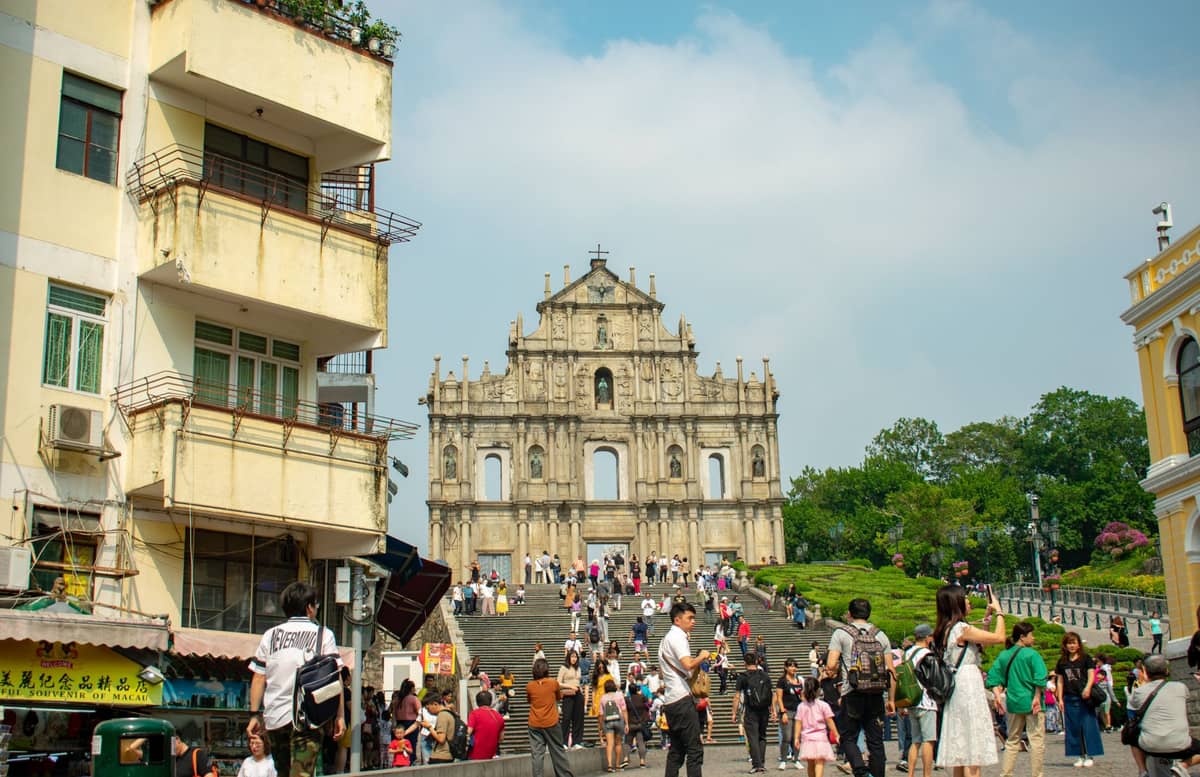
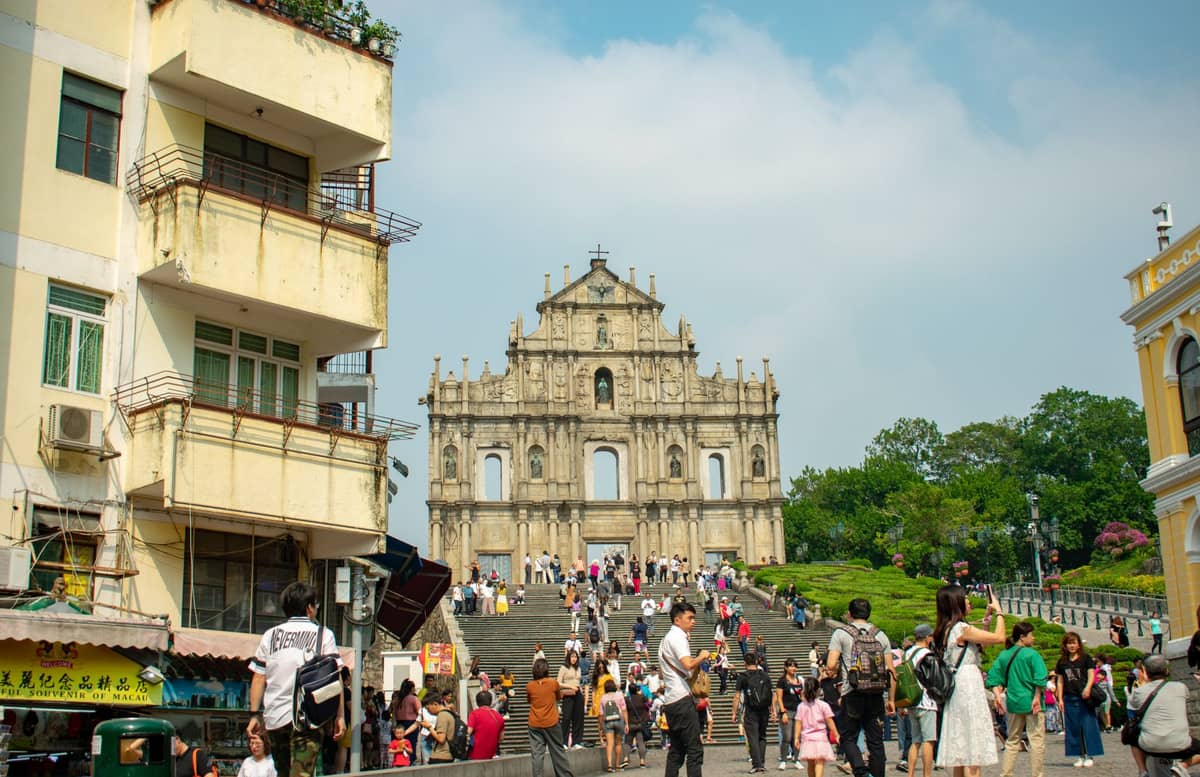
The Macau Peninsula is where the city's 400-plus years of Portuguese colonial history become tangible. The UNESCO-listed Historic Centre of Macau contains 22 historic buildings and 8 public squares within easy walking distance of each other. Start early — by 10:00 the Ruins of St. Paul's are already filling with tour groups, particularly on weekends.
- 08:30 — A-Ma Temple Begin at the oldest site in Macau, dating to the late 15th century and built in honor of the sea goddess A-Ma. Entry is free and mornings are quieter. The temple's layered pavilions climbing the hillside offer a completely different atmosphere from the baroque churches you'll see later.
- 09:30 — Moorish Barracks and Mandarin House A short walk from A-Ma Temple, these two sites illustrate Macau's multicultural layers: neoclassical Portuguese barracks and the largest traditional Chinese residential compound in the territory. Both are free to enter.
- 10:30 — Senado Square and St. Dominic's Church The wave-patterned mosaic square is Macau's public living room. St. Dominic's Church (free entry) houses a small museum of sacred art on its upper floors. Grab a pork chop bun from a nearby bakery — Sei Kee Café on Rua do Campo is a local institution.
- 11:30 — Ruins of St. Paul's and Macau Museum The iconic 17th-century baroque façade is free to visit any time. The adjacent Sacred Art Museum and Crypt (inside the ruins complex) opens at 09:00 and closes at 18:00, with last admission at 17:30 — closed Tuesday afternoons. The Macau Museum above at Fortaleza do Monte is open 10:00–18:00 daily except Mondays, with free entry on Tuesdays and the 15th of each month.
- 14:00 — Afternoon: Lou Lim Ieoc Garden or Guia Fortress Lou Lim Ieoc Garden is a classical Chinese garden ideal for a post-lunch rest. Alternatively, walk uphill to Guia Fortress, which contains Macau's oldest lighthouse and a chapel with original frescoes — the views over the Peninsula are worth the climb.
- Evening — Inner Harbour for dinner The streets around Rua do Cunha in Taipa Village or the older lanes near the Inner Harbour have no-frills Portuguese-Chinese restaurants serving African chicken, Portuguese egg tarts, and caldo verde. This is where locals actually eat.
⚠️ What to skip
Several Heritage sites operate reduced hours or close one day per week. The Macau Museum closes Mondays (except public holidays). Always check current opening times on the official Macau World Heritage site (wh.mo) before planning a tight schedule — a closed attraction on day one can derail the whole itinerary.
The Historic Centre is compact — you can walk between A-Ma Temple and the Ruins of St. Paul's in under 20 minutes on flat ground. However, some sections involve steep lanes and uneven cobblestones. For a curated route with context on each site, the Macau heritage walk guide maps out the full UNESCO circuit with timings and practical notes. If you want to go deeper on the religious architecture specifically, the Macau churches guide covers every colonial-era church with historical background.
Day 2: Cotai, Taipa Village, and Macau Tower
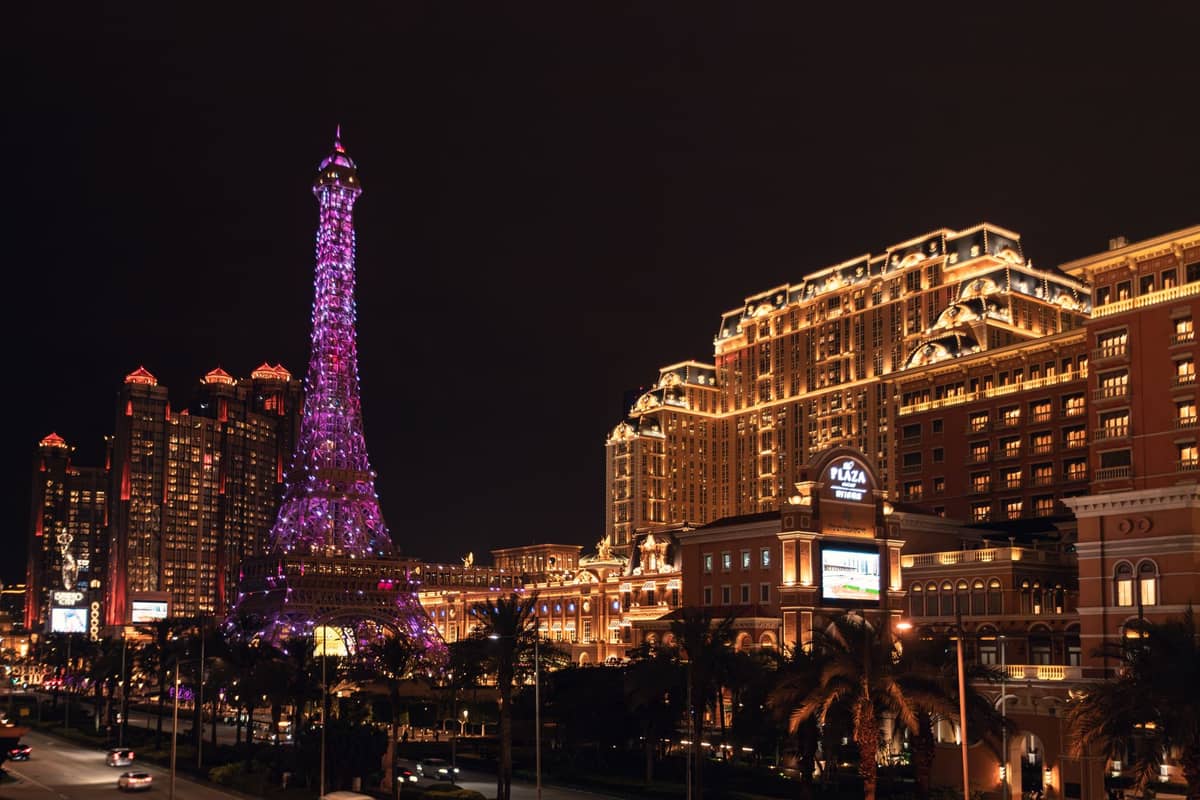
The Cotai Strip is built on reclaimed land between Taipa and Coloane islands. It's a genuine spectacle: The Venetian Macao (Asia's largest casino floor), The Parisian Macao with its half-scale Eiffel Tower replica, Galaxy Macau, Wynn Palace, and City of Dreams cluster within a few kilometers. Even if gambling isn't your priority, the architecture and scale are worth seeing. Most resorts are free to walk through and the internal shopping arcades, atria, and light shows are genuinely impressive.
Start Day 2 mid-morning on Cotai, walk between two or three resorts, then head to Taipa Village for lunch. The contrast between the two is jarring in the best way: you go from a 3,000-room mega-resort to a narrow alley selling Portuguese custard tarts within a five-minute taxi ride. Taipa Village has the highest density of quality street food in Macau — pork chop buns, serradura (Portuguese sawdust pudding), almond biscuits, and dried pork jerky from competing shops along Rua do Cunha.
- Morning — Cotai resort walk The Venetian Macao is the anchor point: free to enter, the Grand Canal Shoppes have gondolas, and the casino floor is extraordinary in scale. Walk to The Parisian next door for the Eiffel Tower observation deck (ticketed) or continue to Wynn Palace for the free Performance Lake fountain show, which runs throughout the day.
- Midday — Taipa Village Take a taxi or bus from Cotai to Taipa Village (10 minutes). Rua do Cunha is the main food street. Try Lord Stow's Bakery's egg tarts, pick up almond cookies from Choi Heong Yuen, and eat a proper sit-down lunch at any of the Portuguese restaurants on the quieter side streets.
- Afternoon — Macau Tower Head to the southern tip of the Peninsula for Macau Tower. The observation deck costs MOP 208 for adults and MOP 138 for children aged 3–11, giving panoramic views across the Pearl River Delta toward Zhuhai and Hong Kong on clear days. The bungee jump from the 233-meter deck is priced at MOP 3,088 per person — the world's highest commercial bungee at the time of its record-setting. Sky walks and tower climbs are also available at lower price points.
- Evening — Macau Peninsula waterfront or casino dinner End the trip along the Macau waterfront near the Lisboa area, or return to Cotai for dinner at one of the resort restaurants. Budget options exist inside every mega-resort alongside the high-end Michelin-starred venues.
For a deeper look at the Cotai resorts and how to navigate between them, the Cotai Strip guide breaks down each property and what's worth your time. If you want to extend beyond two days, Coloane deserves at least a half-day: quieter beaches, hiking trails through Seac Pai Van Park, and Coloane Village's small central square with its chapel are about as far from the casino strip as Macau gets.
✨ Pro tip
Casino shuttle buses run between Cotai resorts and key transport hubs on the Macau Peninsula. Timing them right means you can cross the territory without paying for multiple taxis. The Sands/Venetian shuttle to the ferry terminals stops near the Lisboa hotel area — useful for linking Day 2 locations without hassle.
Eating Well in Two Days: What to Prioritize
Macau's food scene is one of Asia's most underrated. The territory's Macanese cuisine is a genuine hybrid: Portuguese techniques applied to Chinese and Southeast Asian ingredients over four centuries. You can spend two days eating extremely well without touching a casino buffet. The Macau food guide covers the full dining landscape, but here's what two days demands: at least one egg tart (Lord Stow's in Coloane or Taipa Village is the benchmark), one pork chop bun, one bowl of congee from a street stall near the Red Market area, and one sit-down meal of African chicken with Portuguese wine.
For street food specifically, the Historic Centre and Taipa Village are the two main corridors. The Macau street food guide maps the best stalls and what to order at each. One practical note: the egg tart shops on the main tourist drag near the Ruins sell a watered-down product at inflated prices. Walk two streets off the main axis and the quality improves dramatically while prices drop.
Practical Details: Getting Around, Costs, and Timing
Macau operates on 220V / 50Hz electricity with Type G plugs (UK-style three rectangular pins) most common, though some older properties have Type F or C sockets. Pack a universal adaptor. Tap water is treated but many local advisories suggest boiling before drinking — bottled water is cheap and widely available. The main emergency number is 999 (ambulance, fire, police), with 110 and 112 also usable; Macau's country code is +853.
Tipping is not customary in Macau, but a 10% service charge is often included in restaurant and hotel bills. Check before leaving extra. Cantonese is the dominant spoken language; English is widely understood in tourist areas, hotels, and casinos. Mandarin is useful with Mainland Chinese staff. Portuguese appears on signage and in official contexts but is spoken by a small minority.
- Currency: Macanese pataca (MOP). HKD accepted almost everywhere at close to a 1:1 rate (typically around 1 HKD to 1.03 MOP). No need to exchange before arrival if coming from Hong Kong.
- Budget benchmark: Historic Centre sightseeing costs almost nothing. Factor in MOP 208 for Macau Tower, transport (public buses are very cheap, taxis cost around MOP 20–50 for most Peninsula journeys), and meals (MOP 60–120 for a sit-down lunch at a mid-range Portuguese restaurant).
- Crowds: Weekends bring large numbers of Mainland Chinese day-trippers. The Ruins of St. Paul's and Senado Square are noticeably busier on Saturday and Sunday mornings. Arrive at major sites before 09:30 to beat the rush.
- Weather: October–December is optimal. Summers (June–September) are hot (high 20s to low 30s°C), humid, and at risk of typhoons. If a Typhoon Signal 8 or above is raised, outdoor activities and some transport shut down — monitor the Macau Meteorological and Geophysical Bureau (smg.gov.mo) during typhoon season.
- Getting around: Public buses cover everything for a few MOP per ride. The Macau LRT Taipa Line connects the airport, Cotai, and Taipa Ferry Terminal. Free casino shuttles fill the gaps between major resort areas and the Peninsula.
ℹ️ Good to know
Macau's official tourism hotline operates 24 hours: +853 2833 3000. The Macao Government Tourism Office (MGTO) portal at macaotourism.gov.mo has current event listings, transport updates, and downloadable maps. It's worth checking 24–48 hours before arrival, especially during major events like the Macau Grand Prix (usually held in November) or Chinese New Year, when crowds surge and hotel prices spike.
Is Two Days in Macau Enough?
Two days covers the main circuit comfortably if you stay focused. The Historic Centre, Cotai Strip, Taipa Village, and Macau Tower are all genuinely distinct experiences and none of them requires a full day on their own. What two days doesn't allow for: a proper afternoon on Hác Sá Beach in Coloane, the Macau Grand Prix Museum, serious time at the Macau Museum of Art, or an evening at a live entertainment venue. If any of those matter to you, a third day makes sense. Things to do in Macau covers the full roster of options if you're building a longer stay.
For travelers who are curious about Macau but undecided, the is Macau worth visiting guide addresses the question directly. Macau is worth it for almost anyone passing through the region. The UNESCO heritage alone justifies a day, and the sheer contrast between 16th-century Portuguese churches and 21st-century mega-casinos is unlike anything else in Asia. It's not a beach destination or a nature destination — if that's what you need, look at other options. But as a compact city with genuine historical depth and exceptional food, two days is a satisfying and complete experience.
FAQ
Can you do Macau in 2 days from Hong Kong as a day trip?
Technically you can do a day trip, but two days is significantly better. A single day leaves you rushed between the Historic Centre and Cotai. By staying overnight, you get to experience Macau at night (when the casino facades light up and crowds thin out), eat at a proper sit-down restaurant rather than grabbing food on the run, and start Day 2 fresh for Taipa and Macau Tower. Ferry and HZMB bus connections make a two-night stay logistically simple.
Is Macau expensive for two days?
Macau can be done cheaply or expensively depending on choices. The Historic Centre sightseeing is almost entirely free. Street food meals cost MOP 30–60. Macau Tower's observation deck is MOP 208 for adults. The main cost drivers are accommodation (casino hotel rooms range from budget to extremely expensive) and optional splurges like the bungee jump (MOP 3,088). A realistic mid-range two-day budget excluding flights and accommodation is around MOP 500–900 per person for transport, entry fees, and decent meals.
What's the best area to stay for a 2-day Macau itinerary?
The Macau Peninsula puts you within walking distance of all Day 1 Historic Centre sites, which saves significant commuting time. Cotai hotels are larger, often cheaper per night, and more spectacular in terms of facilities, but you'll spend more time on transport to reach the Heritage sites. For a two-day trip focused on seeing everything efficiently, Peninsula accommodation wins on logistics. For pure resort experience with less sightseeing, Cotai is more appropriate.
Do I need to book the Ruins of St. Paul's or Senado Square in advance?
No. Both are free public spaces with no ticketing or reservations required. The Sacred Art Museum and Crypt inside the Ruins complex also has free entry with no advance booking needed. The Macau Museum nearby requires no advance booking; adult admission is MOP 15, with free entry on Tuesdays and the 15th of each month. The only major attraction in the two-day itinerary that benefits from pre-booking is Macau Tower's adventure activities (bungee jump, sky walk) which have limited capacity.
What should I avoid on a 2-day Macau trip?
Avoid planning both museum-heavy mornings on days when key sites are closed — the Macau Museum closes Mondays. Don't eat at the tourist-trap egg tart shops immediately adjacent to the Ruins of St. Paul's; the product is inferior and the prices are higher. Avoid assuming you need to gamble: most casino resorts are worth walking through purely for the architecture and spectacle, with no obligation to play. And don't underestimate heat and humidity if visiting between June and September — the Historic Centre's steep cobbled lanes feel very different in 32°C humidity versus October's comfortable 24°C.