Zurich Guild Houses (Zunfthäuser): Architecture, History, and Where to Step Inside
The Zunfthäuser are among the most architecturally striking survivors of medieval Zurich, lining the Limmatquai and gathering around Münsterhof square. Some are now restaurants where you can eat in rooms used by powerful trade guilds for centuries. Others are event venues or hold small museum collections. This guide explains what they are, how to experience them, and which ones are worth prioritizing.
Quick Facts
- Location
- Limmatquai and Münsterhof, Altstadt, Zurich
- Getting There
- Tram 4 or 15 to Rathaus or Rudolf-Brun-Brücke stop; S-Bahn to Zürich HB then about a 10-minute walk
- Time Needed
- 1–2 hours for a walk; longer if dining in one of the guild restaurants
- Cost
- Free to view exteriors; restaurant prices apply for dining; individual museum fees vary by venue
- Best for
- History enthusiasts, architecture walkers, and travelers who want to dine somewhere genuinely historic
What Are the Zunfthäuser?
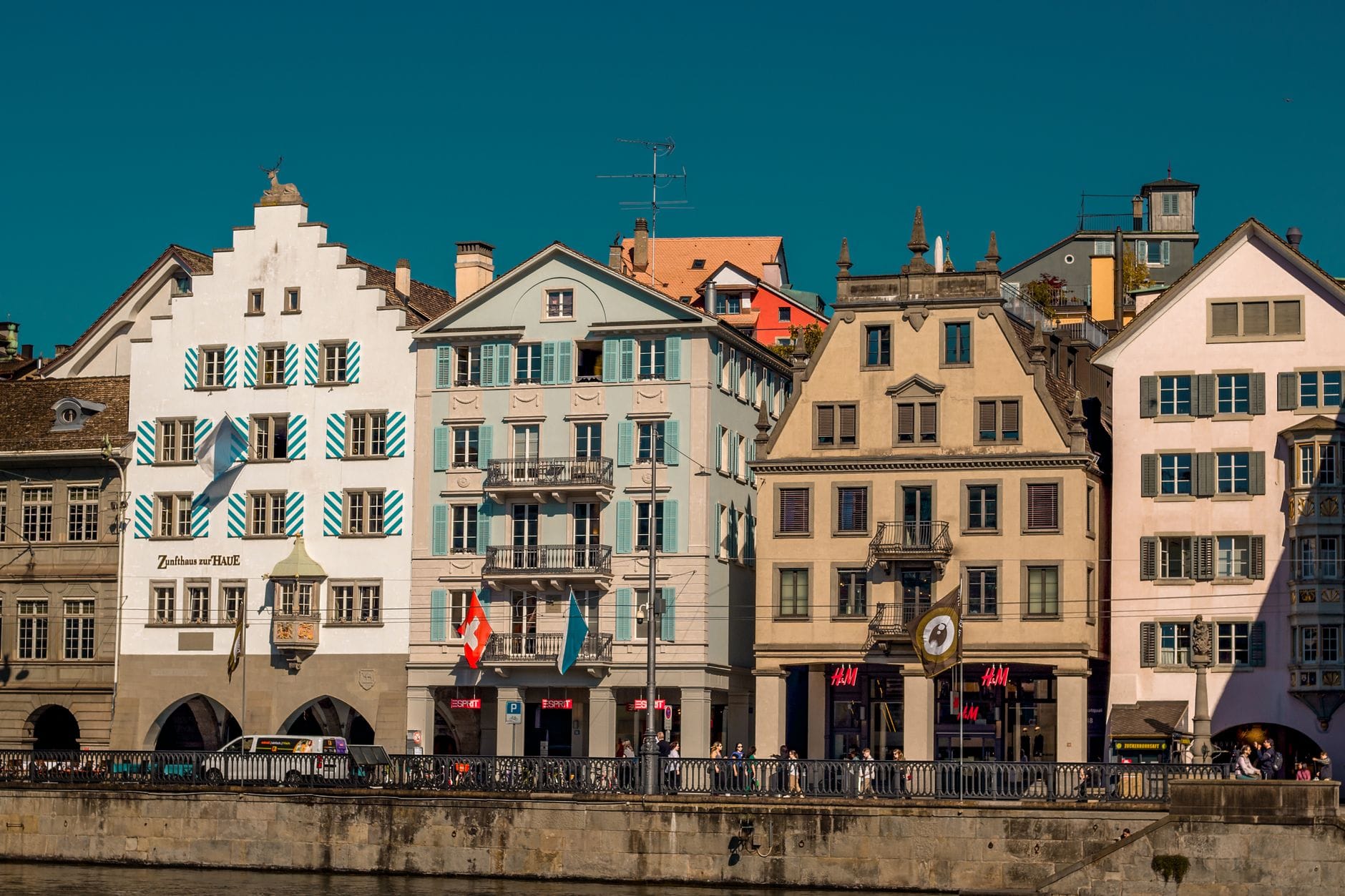
The Zurich Guild Houses, known in German as Zunfthäuser, are the physical legacy of a trade-guild system that shaped this city for over five centuries. They are not a single monument but a collection of historic buildings, each belonging to a specific guild, scattered across the Altstadt on both banks of the Limmat. The most impressive cluster runs along the Limmatquai on the eastern bank and around the Münsterhof square on the western side.
Zurich's guild system dates to 1336, when Rudolf Brun led what historians call the 'guild revolution,' overthrowing the patrician city council and establishing a constitution that gave trade guilds direct political power. For the next several centuries, thirteen major guilds, covering crafts and trades from blacksmiths to weavers, from merchants to butchers, governed the city alongside the nobility. The buildings you see today are the meeting halls, banquet rooms, and administrative headquarters those guilds built and repeatedly enlarged across the following centuries.
ℹ️ Good to know
The exteriors of all guild houses are freely visible at any hour. If you want to enter, most require either a restaurant reservation or an event booking. A few have publicly accessible ground floors or small exhibits. Plan accordingly.
The Architecture: What to Look For
The guild houses are not uniform in style, and that variety is part of what makes walking past them instructive. The earliest surviving structures incorporate Gothic masonry, but most of what dominates visually today dates from the 17th and 18th centuries, when the guilds were at the height of their wealth and chose to rebuild or refacade their headquarters in the Baroque and late-Renaissance styles fashionable across German-speaking Europe at the time.
Look for the characteristic stepped or curved gable ends rising above neighboring rooflines, the ornate stone window surrounds, and the painted or carved guild crests still embedded in facades. Many buildings have projecting oriel windows on upper floors, a design feature that both declared status and allowed guild members to survey the street below. The stone quality, the carved detailing at cornices, and the sheer scale of these buildings relative to their surroundings signal what economic weight these institutions once carried.
The Zunfthaus zur Meisen at Münsterhof is considered one of the finest examples of Rococo architecture in the city, its pale facade decorated with restrained but high-quality stonework. The Zunfthaus zur Zimmerleuten on the Limmatquai is another frequently cited example, its tall gabled form reflected in the river when the light is right, particularly in the early morning before the waterfront fills with pedestrians.
For broader architectural context across the Altstadt, the Grossmünster and Fraumünster are within easy walking distance and complete a picture of how Zurich's medieval and early modern builders worked across different building types.
Tickets & tours
Live prices and dates from our booking partner. If you book, we may earn a commission at no extra cost to you.
Best intro tour of Zurich with a local
From 116 €Instant confirmationFree cancellationZurich Old Town guided walking tour
From 27 €Instant confirmationFree cancellationZurich chocolate hunting tour with a local
From 151 €Instant confirmationFree cancellationExplore the Instaworthy spots of Zurich with a local
From 87 €Instant confirmationFree cancellation
The Limmatquai Walk: Experiencing the Guildhalls from Outside
The single most efficient way to see the Zunfthäuser is to walk the Limmatquai from the Rudolf-Brun-Brücke south toward the Rathaus. This stretch of quayside takes perhaps twenty minutes at a slow pace. On the water side, trams pass regularly. On the building side, the guild houses rise in a near-continuous row, their ground floors now occupied by cafes, pharmacies, and small shops, but their upper stories and facades still carrying the original architectural language intact.
In the morning, between roughly 8am and 10am, the eastern facades catch direct sun, and the stone detail on gables and window surrounds reads clearly. This is also when the quay is least crowded, with locals cycling to work past tourists who have not yet arrived in force. By midday the Limmatquai is considerably busier and the outdoor cafe tables fill. Late afternoon light comes from the west and illuminates the facades less directly, but the golden hour before 7pm in summer turns the roofline a warm color that photographs well.
The Altstadt walking route pairs naturally with a visit to the nearby Lindenhügel (Lindenhof), the elevated terrace on the western bank that offers a clear view across to the guild houses and the Limmat below. From that height you get a sense of the buildings' roofscape that is impossible from street level.
Dining Inside a Guild House: What to Expect
Several Zunfthäuser operate as restaurants, and eating in one is a legitimate way to access their interiors without requiring a museum ticket or a special event. The dining rooms typically occupy the main hall on the first floor, where the guilds held their formal banquets. Ceilings are often paneled in dark wood, walls carry painted coats of arms or historic scenes, and the furniture, while updated for comfort, tends toward the formal. The atmosphere is emphatically not casual.
Expect Swiss and Central European cuisine at price points that reflect both the location and the setting. These are not budget options. A main course at a guild house restaurant will generally be toward the upper end of Zurich's already elevated dining costs. Reservations are strongly recommended for dinner and advisable even for weekend lunches. Some guild houses primarily host private events and are not reliably open for walk-in dining, so confirm availability before making it a fixed plan.
💡 Local tip
If you want to eat inside a guild house, check the specific restaurant's website before visiting. Several Zunfthäuser only open their dining rooms on weekday lunches or for pre-booked group events. A midweek lunch reservation is the most reliable way to guarantee access.
The Zunfthaus zur Meisen: The One with Museum Access
Among all the Zurich guild houses, the Zunfthaus zur Meisen on Münsterhof square deserves particular attention because it has historically offered public access beyond a restaurant visit. The building, constructed in the early 18th century for the wine merchants' guild, is considered one of the most accomplished Rococo interiors in the city. The stucco ceilings in the upper rooms are particularly fine work. The Münsterhof location, right beside the Fraumünster church and the Fraumünster quay, also makes it geographically easy to combine with other sights on that side of the river.
Museum access arrangements and any associated fees can change with exhibitions and institutional decisions, so confirm current visiting conditions directly with the venue or through the Zurich Tourism website before visiting.
The Münsterhof is also close to the Augustinergasse, one of the Altstadt's most photogenic medieval lanes, which makes for a natural extension of any guild house walk on the western bank.
Practical Walkthrough: How to Plan Your Visit
There is no single entrance, no ticket booth, and no guided route that covers all the guild houses as a unified experience. This is a self-directed architectural walk, and its quality depends on how much context you bring to it. Reading a brief outline of the 1336 guild revolution and the role of Zurich's guilds in Swiss Reformation politics (the guilds backed Zwingli's reforms in 1519, a decision that fundamentally changed the city's religious character) will make the facades considerably more interesting.
A practical loop works as follows: start at Zurich Main Station, walk south along the Limmatquai past the guild house row to the Rathaus, cross to Münsterhof via the Münsterbrücke bridge, see the Zunfthaus zur Meisen and the Fraumünster facade, then loop back north through the narrow Altstadt lanes. This covers the main concentration of buildings in well under two hours at a relaxed pace.
The Swiss National Museum, immediately north of Zurich HB, provides excellent historical context on Swiss guild culture and medieval urban society if you want to deepen the visit. It makes a logical starting point before the Limmatquai walk.
Wear comfortable shoes. The Altstadt's cobblestones are uneven in places, particularly in the narrower lanes away from the quay. Accessibility for mobility-impaired visitors varies significantly from building to building and from street to street; the Limmatquai itself is relatively flat and manageable, but some of the guild house interiors have historic staircases with no lift alternatives.
For a fuller introduction to the neighborhood, the Zurich walking tour guide covers the Altstadt in depth and can be used alongside this visit.
Weather, Seasons, and When the Walk is Most Rewarding
The Limmatquai is pleasant in all seasons, but the experience changes considerably. In late spring and summer, the outdoor cafe tables outside guild house ground-floor restaurants are occupied, the river light is bright, and the facades are easier to photograph without the low-contrast gray sky that dominates from November through February. Summer also brings considerably more tourists to the Altstadt, and the Limmatquai can feel crowded at midday in July and August.
Autumn and winter offer a quieter, more contemplative version of the same walk. The Limmat often carries mist in autumn mornings, and the guild house rooflines emerging through it create a genuinely atmospheric scene. At Christmas, the areas around Münsterhof and the nearby Niederdorf fill with market stalls, and the lit facades of the guild houses take on a different quality at dusk. Winter weather in Zurich can bring near-freezing temperatures and occasional snow, which settles on the gable ends and cornices in a way that emphasizes the architectural detail.
Insider Tips
- The Limmatquai facades are best photographed from the opposite bank of the river, specifically from the narrow path running between the Schipfe and the Lindenhügel stairways. From there you get the full row of guild house rooflines against the sky, with the Limmat in the foreground.
- If you want to understand the guild system before walking, spend thirty minutes in the Swiss National Museum first. The permanent history collection covers Zurich's medieval political structure and gives the facades on the Limmatquai a completely different meaning.
- The Zunfthaus zur Meisen on Münsterhof is the most architecturally intact interior you are likely to access as a regular visitor. Try to see it rather than just passing by on the way to the Fraumünster.
- Guild house restaurants tend to be quiet on weekday lunchtimes compared to evenings. If you want to eat inside one without competing for tables or atmosphere, a Tuesday or Wednesday lunch in shoulder season is your best window.
- The Rathaus (City Hall), just south of the main guild house cluster on the Limmatquai, is itself a guild-era building and worth a slow look at its courtyard if it is open. It provides a sense of how civic and guild architecture overlapped in early modern Zurich.
Who Is Zurich Guild Houses (Zunfthäuser) For?
- Architecture walkers who appreciate building detail and want to read a cityscape rather than just photograph it
- History-minded travelers with an interest in medieval Swiss urban politics and the Reformation
- Travelers seeking a genuinely historic dining experience rather than a themed reconstruction
- Slow travelers who prefer quality of context over quantity of sights
- Photographers working in early morning light looking for reflections on the Limmat
Nearby Attractions
Other things to see while in Altstadt (Old Town):
- Augustinergasse
Augustinergasse is a short, narrow pedestrian lane threading through Zurich's Altstadt between Bahnhofstrasse and St. Peterhofstatt. Free to walk, open at all hours, and steeped in history dating to a 13th-century Augustinian monastery, it rewards those who look up, slow down, and pay attention to what surrounds them.
- ETH Zurich Main Building
The ETH Zurich Main Building (Hauptgebäude) is one of the most architecturally significant public buildings in Switzerland, designed by Gottfried Semper in 1864 and freely open to visitors. Standing above the Altstadt on Rämistrasse, it offers a rare chance to walk through a world-class university's historic core without paying a cent.
- Fraumünster
Founded in 853 and home to five monumental stained glass windows designed by Marc Chagall, Fraumünster is one of the most visually striking churches in Switzerland. Small in footprint but overwhelming in atmosphere, it earns its place on any serious itinerary of Zurich's Old Town.
- Grossmünster
The Grossmünster has defined Zurich's skyline for nearly 900 years. This Romanesque church is where Ulrich Zwingli launched the Swiss Reformation in 1519, and today its twin towers remain the most recognizable silhouette on the Limmat. Entry to the church is free; the tower climb costs CHF 5 and rewards you with one of the clearest views over the Old Town.
Planning a trip? Discover personalized activities with the Nomado app.