Fraumünster Church, Zurich: The Stained Glass That Stops You Cold
Founded in 853 and home to five monumental stained glass windows designed by Marc Chagall, Fraumünster is one of the most visually striking churches in Switzerland. Small in footprint but overwhelming in atmosphere, it earns its place on any serious itinerary of Zurich's Old Town.
Quick Facts
- Location
- Münsterhof 2, 8001 Zürich (Altstadt)
- Getting There
- Trams 2, 7, 8, 9, 10, 11, 13 to Paradeplatz or 4, 15 to Helmhaus; ~10–12 min walk from Zürich HB
- Time Needed
- 30–60 minutes
- Cost
- CHF 5 adults; free for under-16s; Zürich Card does not generally include Fraumünster entry
- Best for
- Art lovers, architecture fans, travellers seeking a quiet pause in the Old Town
- Official website
- http://www.fraumuenster.ch
What Fraumünster Actually Is
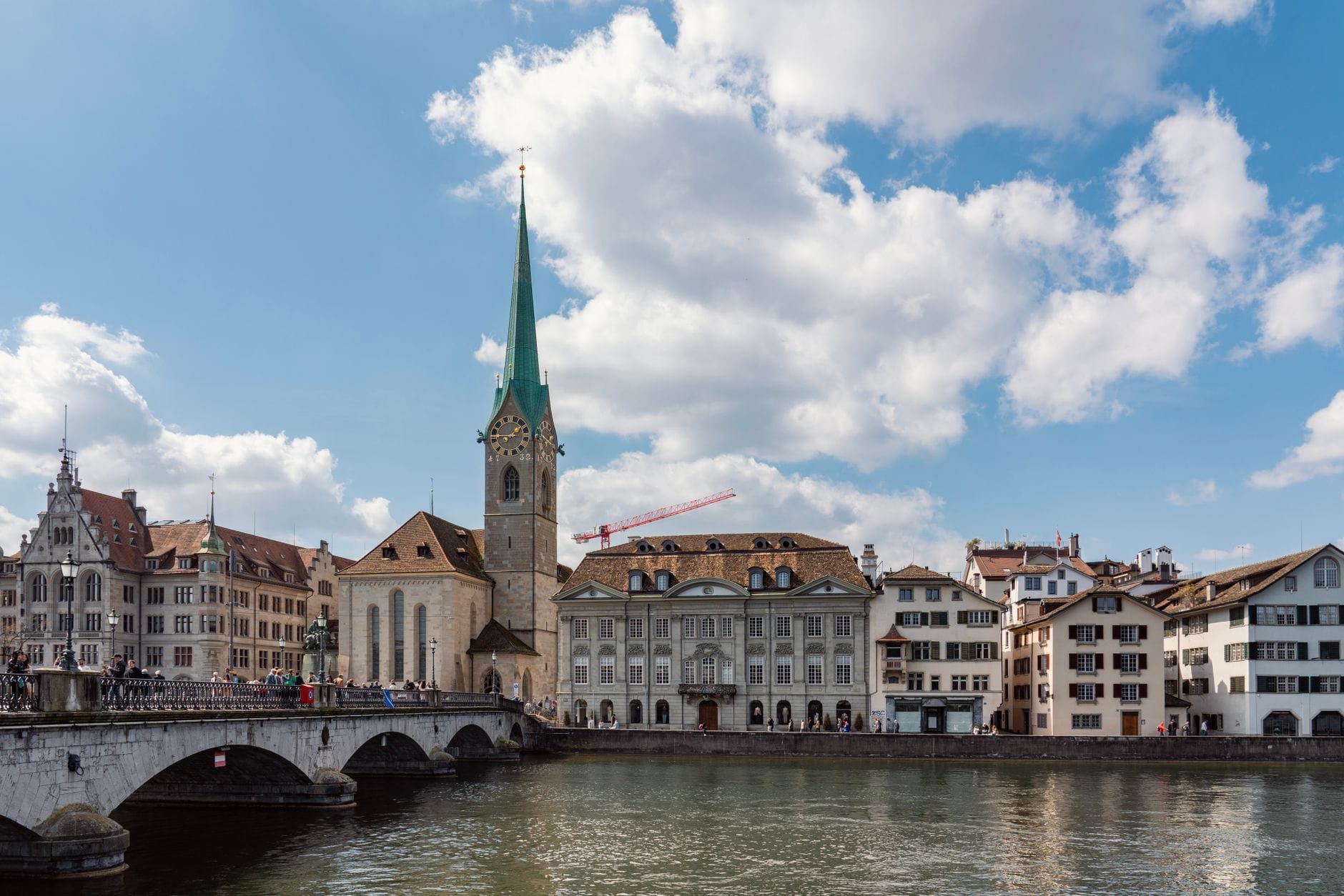
Fraumünster, formally the Fraumünster Kirche at Münsterhof 2, is a Protestant church in the heart of Zurich's Altstadt. It sits on the west bank of the Limmat, directly across the river from the Grossmünster, and its slender teal-green spire is one of the defining elements of the city's skyline. But the exterior, graceful as it is, does not prepare you for what is inside.
The church is relatively compact. The interior is not a grand cathedral experience. What it offers instead is concentration: five floor-to-ceiling stained glass windows in the chancel designed by Marc Chagall and installed between 1970 and 1978, plus a separate large rose window in the north transept designed by Augusto Giacometti in 1945. These windows are the reason most visitors come, and for a significant number of people, seeing them in person is genuinely arresting in a way that photographs do not convey.
💡 Local tip
Arrive between 10:00 and 11:00 on a clear morning. Morning light enters from the east, bounces off interior stonework, and makes Chagall's blues especially intense. Overcast days mute the effect considerably.
Fraumünster sits within Zurich's Altstadt, a compact neighbourhood where almost every street has a medieval or early-modern pedigree. The church is a five-minute walk from the Lindenhof hill and about twelve minutes on foot from Zürich Hauptbahnhof, making it an easy addition to any Zurich walking tour.
A Brief History Worth Knowing
The origins of Fraumünster go back to 853, when King Louis the German founded a Benedictine convent here for his daughter Hildegard and other women of aristocratic birth. The name translates roughly as 'Minster of Women' or 'Women's Minster'. For centuries the abbesses of Fraumünster held significant civic authority, including the right to hold markets, levy tolls, and coin money — powers that shaped the commercial development of Zurich itself.
The Reformation of the 16th century ended the convent's religious function, and ownership of the church passed to the city. The Romanesque chancel survives from the 13th century, and the vaulted transept gives the building its structural character. The nave underwent its last major renovation in 1911. The resulting interior is layered — Romanesque bones, Gothic height, and 20th-century glass — in a way that rewards looking carefully rather than moving quickly.
Tickets & tours
Live prices and dates from our booking partner. If you book, we may earn a commission at no extra cost to you.
Mount Titlis snow fun for first-time skiers from Zurich
From 212 €Instant confirmationFree cancellationSwiss ski experience from Zurich
From 321 €Instant confirmationFree cancellationBest intro tour of Zurich with a local
From 116 €Instant confirmationFree cancellationZurich Old Town guided walking tour
From 27 €Instant confirmationFree cancellation
The Chagall Windows: What You're Actually Looking At
The five chancel windows were designed by Marc Chagall and installed between 1970 and 1978. They are arranged in a row across the apse and each addresses a distinct biblical theme. From left to right: the Prophets (yellow and green tones), the Torah (blue and green), the Christ window (blue, the most intensely coloured), the Zion window (red), and the Apostles (violet and gold). The Christ window, dead centre, is the one most visitors photograph, but the Zion window's deep crimson is arguably the most physically striking in person.
Chagall's signature visual language is fully present: floating figures, animals, stars, and fragments of text dissolve into each other across each panel. There is no single reading axis. Your eye moves in loops rather than lines, which is unusual for a window designed to be read from a fixed position in a pew. The effect is more meditative than instructional, and on a clear day the coloured light actually falls across the stone floor in visible beams.
The rose window in the north transept, by Giacometti, predates Chagall's work by 25 years. Its palette is lighter and more diffuse, and it is often overlooked by visitors who come specifically for Chagall. That is a mistake: the Giacometti window offers a useful contrast, and the transept position catches afternoon light in a completely different way.
ℹ️ Good to know
Photography of the windows is generally permitted without flash. The church is a functioning place of worship, so silence is expected and services take priority over tourist access.
When to Visit and What to Expect by Time of Day
Morning visits, roughly 10:00 to 12:00, offer the best light for the Chagall windows and the fewest people. The church is quiet at this hour, the stone is cool, and you can stand in the chancel without competing for space. Midday and early afternoon bring the heaviest foot traffic, especially in summer, when tour groups move through in clusters of fifteen to thirty people. The space is small enough that a single group changes the atmosphere entirely.
Late afternoon is a reasonable compromise. The light enters from the west at that hour, which changes the character of the windows — the reds and golds in the Zion and Apostles windows pick up direct light while the blue Christ window becomes more recessive. Sunday opening hours begin after the morning church service, typically meaning access from 12:00 onwards. Verify current hours before your visit, as seasonal schedules apply: the church is open 10:00–18:00 from March through October and 10:00–17:00 from November through February.
⚠️ What to skip
Fraumünster closes during church services and on certain religious holidays. It is worth checking the official schedule at fraumuenster.ch before making it the anchor of your morning, particularly on Sundays.
Getting There and Practical Logistics
Tram lines 2, 7, 8, 9, 10, 11, and 13 to Paradeplatz or 4 and 15 to Helmhaus all stop within a short walk of Münsterhof. From Zürich Hauptbahnhof, the walk along Bahnhofstrasse takes roughly 10–12 minutes and passes through some of the city's most interesting retail and civic architecture. If you are arriving from the Grossmünster side of the river, cross the Münsterbrücke and the church entrance is immediately in front of you on the square.
The Münsterhof square itself is worth a few minutes of attention. It was historically a pig market and is now one of the more composed public spaces in the Altstadt, surrounded by guild house facades. The guild houses of Zurich's Old Town are visible from the church entrance and provide context for how commercially and politically central this neighbourhood once was.
Admission is CHF 5 for adults. Children under 16 enter free; Zürich Card and student discounts are not consistently granted and should be checked in advance. Payment is made at a small desk near the entrance. The church has no dedicated luggage storage, and large bags are awkward in the narrow chancel area.
On accessibility: the church is located in a flat part of the Old Town and is reachable on foot or by tram without significant hills. Internal step-free access is not confirmed in publicly available documentation, so anyone with specific mobility requirements should contact the church office directly before visiting.
How Fraumünster Fits Into a Zurich Day
Fraumünster works well as part of an Old Town loop. From the church, the Grossmünster is a three-minute walk across the Münsterbrücke — the two churches are visually paired across the Limmat and are architecturally quite different, which makes the comparison interesting. The Grossmünster's tower climb offers views back over the Fraumünster spire that are worth the effort.
To the north, Lindenhof hill is a ten-minute walk and provides the best free elevated view of the Fraumünster's setting within the city's medieval layout. South of the church, a short walk along the lakeside promenade reaches Bürkliplatz, the departure point for lake cruises if you want to extend the afternoon.
If art is your primary interest in Zurich, Kunsthaus Zürich is about fifteen minutes away on foot and offers a very different but complementary experience — particularly relevant given Chagall's place within 20th-century European art movements.
Honest Assessment: Who This Is For and Who It Isn't
Fraumünster is a relatively small church with a specific, concentrated draw. If you are primarily interested in grand cathedral architecture or a full sacred space experience, it may feel brief. The nave is modest by European standards, and outside of the windows and the Giacometti rose, the interior decoration is restrained. Visitors expecting a sprawling complex or an extensive museum presentation will be done in twenty minutes and may feel underwhelmed.
For anyone with an interest in 20th-century art, religious art history, or the intersection of modernism and sacred spaces, the Chagall windows are the real thing and entirely worth CHF 5. Photographers working in natural light will find the chancel genuinely challenging and interesting at the same time. Families with young children can visit comfortably given the short time needed, though the silence expectation requires some management.
Insider Tips
- The pew directly in front of the chancel and slightly left of centre gives you the most balanced sightline across all five Chagall windows simultaneously. Most visitors stand too close to the left or right and miss the full composition.
- The Giacometti rose window in the north transept catches the best light between roughly 14:00 and 16:00. If you visit in the morning for Chagall, consider returning briefly in the afternoon specifically for Giacometti — the church is small enough that this takes under ten minutes.
- The Münsterhof square outside is one of the quieter squares in the Altstadt and a good place to sit after the church. There are benches near the central fountain, and the surrounding guild house facades are worth photographing without the crowds that gather on Rathausbrücke.
- The Zürich Card, available from the airport and Zürich HB, includes public transport and several museum entries; check current benefits to confirm whether Fraumünster is covered for your dates. If you're visiting for two or more days, the card often pays for itself by midday.
- Avoid visiting on the same morning as a school group — they are typically booked in late morning slots on weekdays. Arriving close to the usual opening time (10:00 Monday through Saturday) almost guarantees a quiet first thirty minutes, but always confirm current hours.
Who Is Fraumünster For?
- Art and design travellers drawn specifically to Chagall or 20th-century sacred art
- Architecture enthusiasts interested in Romanesque structures and how they absorb modern interventions
- Travellers doing a half-day Old Town walking circuit who want substance beyond medieval streetscapes
- Couples looking for a calm, visually rich stop that doesn't require advance booking
- Budget-conscious visitors: CHF 5 for a genuinely significant artwork in its original setting is good value by any measure
Nearby Attractions
Other things to see while in Altstadt (Old Town):
- Augustinergasse
Augustinergasse is a short, narrow pedestrian lane threading through Zurich's Altstadt between Bahnhofstrasse and St. Peterhofstatt. Free to walk, open at all hours, and steeped in history dating to a 13th-century Augustinian monastery, it rewards those who look up, slow down, and pay attention to what surrounds them.
- ETH Zurich Main Building
The ETH Zurich Main Building (Hauptgebäude) is one of the most architecturally significant public buildings in Switzerland, designed by Gottfried Semper in 1864 and freely open to visitors. Standing above the Altstadt on Rämistrasse, it offers a rare chance to walk through a world-class university's historic core without paying a cent.
- Grossmünster
The Grossmünster has defined Zurich's skyline for nearly 900 years. This Romanesque church is where Ulrich Zwingli launched the Swiss Reformation in 1519, and today its twin towers remain the most recognizable silhouette on the Limmat. Entry to the church is free; the tower climb costs CHF 5 and rewards you with one of the clearest views over the Old Town.
- Kunsthaus Zürich
Kunsthaus Zürich is one of Switzerland's largest art museums, housing a permanent collection that spans seven centuries of European and international art. The original 1910 Beaux-Arts building on Heimplatz was joined in 2021 by a major extension designed by David Chipperfield Architects, nearly doubling its exhibition space. Together they form one of the most substantial art destinations in the German-speaking world.
Planning a trip? Discover personalized activities with the Nomado app.