Kunsthaus Zürich: What to Expect at Switzerland's Premier Art Museum
Kunsthaus Zürich is one of Switzerland's largest art museums, housing a permanent collection that spans seven centuries of European and international art. The original 1910 Beaux-Arts building on Heimplatz was joined in 2021 by a major extension designed by David Chipperfield Architects, nearly doubling its exhibition space. Together they form one of the most substantial art destinations in the German-speaking world.
Quick Facts
- Location
- Heimplatz 1, 8001 Zürich (Altstadt)
- Getting There
- Trams 3, 8, 9 or Bus 31 to Kunsthaus stop
- Time Needed
- 2 to 4 hours; half day for the full collection
- Cost
- CHF 31 (collection + major exhibitions); CHF 24 / CHF 17 reduced (permanent collection only); free with Zürich Card
- Best for
- Art lovers, architecture fans, rainy-day culture seekers
- Official website
- www.kunsthaus.ch/en/besuch-planen/besucherinfos
What Kunsthaus Zürich Actually Is
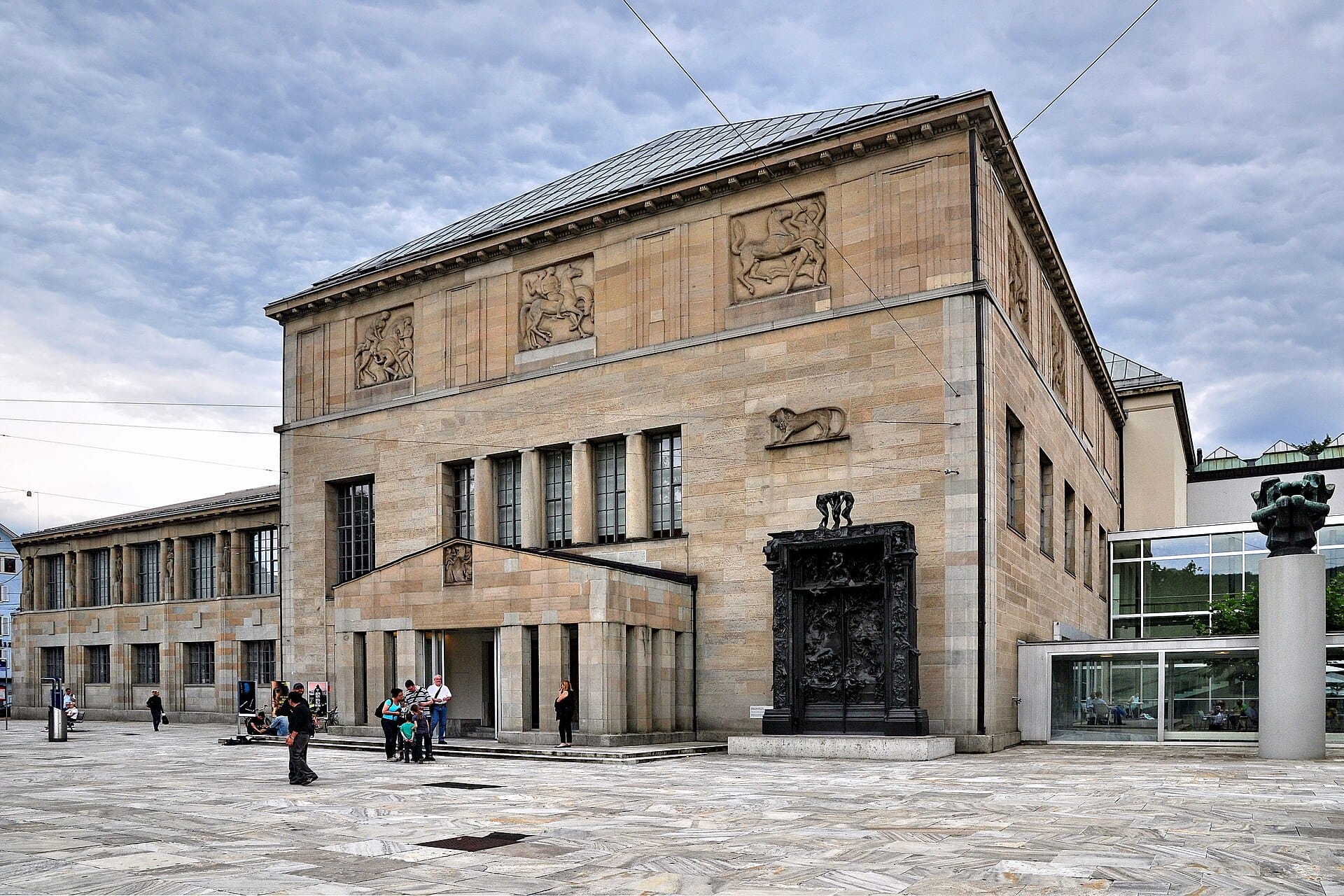
Kunsthaus Zürich is one of Switzerland's largest art museums and one of the most significant public art collections in the German-speaking world. Its roots go back to 1787, when the Zürcher Kunstgesellschaft (Zurich Art Society) began systematically acquiring works. The current main building on Heimplatz, designed in a restrained Beaux-Arts style by architects Karl Moser and Robert Curjel, opened in 1910. For over a century it was the sole home of the collection. Then, in 2021, a David Chipperfield Architects extension opened directly across Heimplatz, connected to the original building by an underground passage and adding roughly 5,000 square metres of gallery space, bringing the total to approximately 11,500 square metres.
The two buildings now operate as a unified institution, but they feel distinct. The original 1910 wing has marble floors, high coffered ceilings, and the quiet gravitas of a traditional museum. Chipperfield's new building is deliberate in its restraint: sandstone-coloured concrete, large skylights, and a sparse civic aesthetic that keeps your attention on the art rather than the architecture. Neither building competes with the collection, which is the correct priority.
💡 Local tip
If you hold a Zürich Card, admission to the permanent collection is free. The card also covers public transport, making it practical value if you plan to visit multiple attractions. Students get discounted access on Thursday evenings (18:00–20:00) for just CHF 10 during the Legi evening.
The Collection: What You Will Actually See
The permanent collection covers roughly seven centuries of European art, with particular depth in Swiss and German Expressionism, French Impressionism and Post-Impressionism, and 20th-century international art. The museum holds one of the world's most important collections of works by Alberto Giacometti, the Swiss sculptor whose elongated bronze figures have become shorthand for a particular strain of existential 20th-century art. Seeing them in concentrated form here, rather than scattered across different institutions, clarifies how profoundly he worked a single set of ideas over decades.
The collection also holds significant works by Claude Monet, Pablo Picasso, Marc Chagall, and Edvard Munch, alongside major Swiss painters including Ferdinand Hodler, whose monumental canvases of Alpine landscapes and allegorical figures occupy full walls. The contemporary and post-war holdings, particularly from the Bührle and Hubert collections incorporated in recent years, have deepened the museum's coverage of the late 19th and 20th centuries considerably, though some of these acquisitions have attracted ongoing scholarly and ethical scrutiny regarding wartime provenance that the institution continues to address publicly.
For context on how Kunsthaus fits into Zurich's broader cultural landscape, the best museums in Zurich guide covers the full range of options across the city, from design to natural history.
Tickets & tours
Live prices and dates from our booking partner. If you book, we may earn a commission at no extra cost to you.
Mount Titlis snow fun for first-time skiers from Zurich
From 212 €Instant confirmationFree cancellationSwiss ski experience from Zurich
From 321 €Instant confirmationFree cancellationBest intro tour of Zurich with a local
From 116 €Instant confirmationFree cancellationZurich Old Town guided walking tour
From 27 €Instant confirmationFree cancellation
How the Experience Changes by Time of Day
Weekday mornings, particularly Tuesday through Friday before noon, are the quietest time to visit. The Chipperfield wing in particular benefits from being seen in morning light: the skylights are designed to diffuse daylight evenly across the galleries, and on a clear morning the quality of light across large-format canvases is noticeably different from the artificial lighting that takes over later in the day or in cloudy weather.
Thursday evenings until 20:00 draw a younger, more relaxed crowd, partly because of the Legi discount. The atmosphere shifts from contemplative to more social, with people moving at a faster pace and occasional groups gathered around particular works. If you prefer silence and space, Thursday evening is not your best option, but if you enjoy a museum with some life in it, the extended hours work well.
Weekend afternoons, especially on rainy Saturdays, are the most crowded periods. The main atrium and the Giacometti galleries in particular become congested. If you are visiting on a weekend, arriving at opening time (10:00, Tuesday to Sunday) makes a genuine difference.
⚠️ What to skip
The museum is closed on Mondays. Public holidays generally have 10:00–18:00 hours, but some (such as 25 December and 1 January) are closed entirely, so check the official website before planning a visit around a Swiss public holiday.
Getting There and Getting In
Heimplatz sits at the eastern edge of the Altstadt, about a ten-minute walk from the Grossmünster or from Central station. Tram lines 3, 8, and 9, as well as bus line 31, all stop at the Kunsthaus stop directly in front of the museum. The tram is the simplest option from most parts of the city centre. There is no dedicated museum car park, and parking in this part of Zurich is expensive and limited, so public transport is genuinely the better choice.
If you are unfamiliar with Zurich's tram system, the getting around Zurich guide explains how ZVV ticketing works, including day passes that make unlimited tram use cost-effective.
Tickets can be bought at the museum entrance. The main entrance is in the original 1910 building on Heimplatz. The Chipperfield extension has its own entrance on Pfauenplatz, on the opposite side of the street. You can enter from either side and cross between buildings via the underground connector, but plan your entry point based on which part of the collection you want to start with. Staff at the entrance can advise.
Practical Walkthrough: How to Structure Your Visit
Two hours is enough to cover the highlights of the permanent collection without rushing. Four hours, or splitting the visit across two sessions, is a better allocation if you want to give the post-war and contemporary holdings in the Chipperfield wing proper attention alongside the historical collection in the original building.
A practical route for a two-hour visit: start in the original building with the Old Masters and 19th-century Swiss works, including the Hodler rooms, then move to the Giacometti gallery, which is unmissable. Cross to the Chipperfield wing for the Impressionist and Post-Impressionist holdings, then work forward through the 20th-century collection. The museum's floor maps, available at the entrance, are clear and worth picking up rather than relying entirely on the app.
The museum has a café and a restaurant, both in the original building. The café is a reasonable place to pause without the formality or price of the restaurant. Bag storage lockers are available at both entrances, and large bags are not permitted in the galleries.
💡 Local tip
Photography is permitted in most of the permanent collection galleries without flash. Temporary exhibitions may have different rules, posted at each entrance. Always check the signage at the gallery door before shooting.
Architecture: The 1910 Building and the Chipperfield Extension
For visitors with an interest in architecture, the pairing of the two buildings is worth examining closely. The original Moser-Curjel building has the confident authority of early 20th-century Swiss civic architecture: a rusticated stone facade, a pronounced entry portico, and interiors where the proportions of each room were calibrated around a pre-modernist understanding of how art should be displayed, with natural light controlled through skylights and high clerestory windows.
Chipperfield's 2021 addition takes the opposite approach: modular, neutral, and deliberately understated in its exterior presence, avoiding any visual competition with the older building across Heimplatz. It is a thoughtful piece of urban architecture rather than a landmark statement, which is arguably the right call for a city as architecturally considered as Zurich. The Altstadt surrounding the museum has some of the city's most significant historic streetscapes, and the extension's restraint respects that context.
Is Kunsthaus Zürich Worth Your Time?
For anyone with genuine interest in European art from the medieval period through to the late 20th century, Kunsthaus Zürich is one of the best museums in Switzerland, full stop. The Giacometti collection alone justifies the visit. The Impressionist holdings are strong without being encyclopedic, and the Swiss Expressionist and Symbolist rooms offer context that is hard to find outside German-speaking Europe.
Visitors who are primarily interested in contemporary or cutting-edge art may find the offering more uneven. The museum has contemporary holdings and regularly hosts temporary exhibitions, but its identity is rooted in historical depth rather than curatorial risk-taking. If you are looking for a broader picture of Zurich's cultural life, including its design history and contemporary scene, the Museum für Gestaltung provides a complementary perspective.
Visitors who find large museum collections exhausting, who have very limited time in Zurich, or who are travelling with young children who are not engaged by static art displays may prefer to prioritise other attractions. The museum is not designed as a family entertainment space, though there are occasional family programmes. CHF 31 is a meaningful sum, so being honest about your interest level before committing is worthwhile.
If you are planning a broader itinerary and want to see how Kunsthaus fits into two days in the city, the 2 days in Zurich guide offers a sequenced approach to the major cultural and neighbourhood highlights.
Insider Tips
- The underground passage connecting the original building to the Chipperfield extension occasionally displays smaller works and installation pieces along its corridor walls. Most visitors walk through it quickly, but it is worth slowing down.
- Thursday evenings offer a real discount for students (CHF 10 for the Legi evening, 18:00–20:00), but come earlier in the week if you want the galleries to yourself.
- The museum's temporary exhibition programme is strong and sometimes more intellectually adventurous than the permanent collection suggests. Check the website for what is running during your visit before deciding how much time to budget.
- The café in the original building gets busy at lunchtime on weekends. If you want a seat without a wait, arrive before 12:00 or after 14:00.
- If you are combining Kunsthaus with a walk through the Altstadt, the museum sits at the eastern boundary of the old city, making it a natural starting or ending point for a loop through the Niederdorf area and along the Limmat.
Who Is Kunsthaus Zürich For?
- Art enthusiasts wanting depth in European painting and sculpture from the 15th to 20th centuries
- Architecture-focused visitors interested in comparing early 20th-century civic building with contemporary museum design
- Travellers visiting Zurich on a grey or rainy day who want a full half-day of indoor cultural content
- Giacometti admirers: the museum holds one of the most important Giacometti collections anywhere
- Zürich Card holders who can access the permanent collection for free and want maximum value from the card
Nearby Attractions
Other things to see while in Altstadt (Old Town):
- Augustinergasse
Augustinergasse is a short, narrow pedestrian lane threading through Zurich's Altstadt between Bahnhofstrasse and St. Peterhofstatt. Free to walk, open at all hours, and steeped in history dating to a 13th-century Augustinian monastery, it rewards those who look up, slow down, and pay attention to what surrounds them.
- ETH Zurich Main Building
The ETH Zurich Main Building (Hauptgebäude) is one of the most architecturally significant public buildings in Switzerland, designed by Gottfried Semper in 1864 and freely open to visitors. Standing above the Altstadt on Rämistrasse, it offers a rare chance to walk through a world-class university's historic core without paying a cent.
- Fraumünster
Founded in 853 and home to five monumental stained glass windows designed by Marc Chagall, Fraumünster is one of the most visually striking churches in Switzerland. Small in footprint but overwhelming in atmosphere, it earns its place on any serious itinerary of Zurich's Old Town.
- Grossmünster
The Grossmünster has defined Zurich's skyline for nearly 900 years. This Romanesque church is where Ulrich Zwingli launched the Swiss Reformation in 1519, and today its twin towers remain the most recognizable silhouette on the Limmat. Entry to the church is free; the tower climb costs CHF 5 and rewards you with one of the clearest views over the Old Town.
Planning a trip? Discover personalized activities with the Nomado app.