Augustinergasse: Zurich's Most Atmospheric Medieval Lane
Augustinergasse is a short, narrow pedestrian lane threading through Zurich's Altstadt between Bahnhofstrasse and St. Peterhofstatt. Free to walk, open at all hours, and steeped in history dating to a 13th-century Augustinian monastery, it rewards those who look up, slow down, and pay attention to what surrounds them.
Quick Facts
- Location
- Augustinergasse 1, 8001 Zürich — Altstadt (Old Town), left bank of the Limmat
- Getting There
- Zürich HB (main station) is a 6–8-minute walk via Bahnhofstrasse; trams along Bahnhofstrasse stop nearby
- Time Needed
- 15–30 minutes for the lane itself; 1–2 hours if you explore the surrounding Altstadt
- Cost
- Free — public pedestrian street, open 24 hours, no ticket required
- Best for
- Photography, architecture, quiet walking, Old Town orientation
- Official website
- www.zuerich.com/en/visit/attractions/augustinergasse
What Is Augustinergasse?
Augustinergasse is a medieval pedestrian lane in Zurich's historic Altstadt, running between Bahnhofstrasse — the city's main commercial artery — and St. Peterhofstatt, the small square fronting St. Peter Church. It is one of the oldest streets in Zurich, named after the Augustinian monastery (Augustinerkloster) that was founded on this site around 1270. The monastery was dissolved in 1525 during the Reformation, and the adjoining church survives today as the Augustinerkirche. The lane itself has been part of the city's urban fabric for over seven centuries.
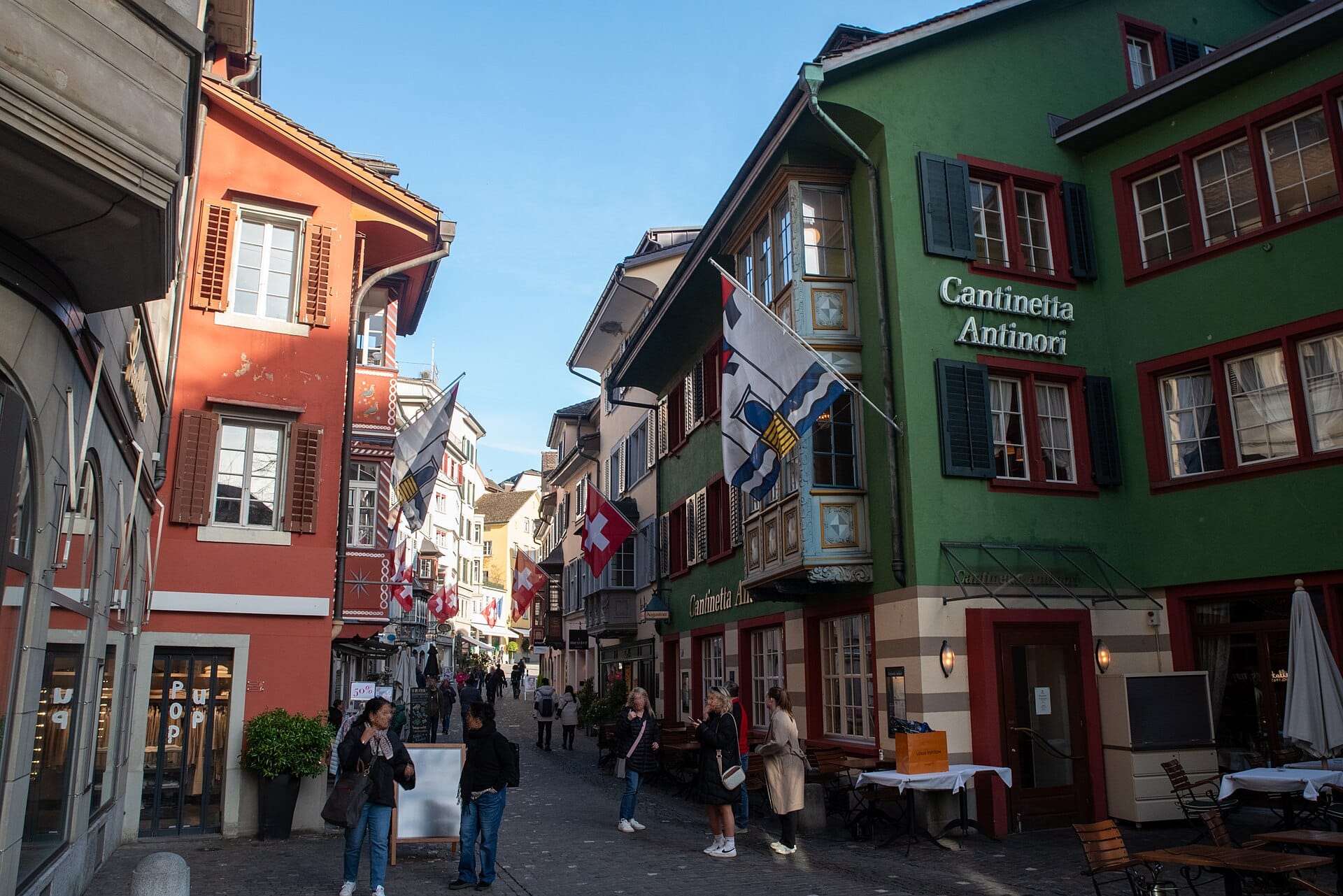
Despite being just a couple of hundred metres long, Augustinergasse has a texture that many longer streets lack. The buildings lean slightly toward each other above street level, painted in muted ochres, creams, and terracotta. Wrought-iron shop signs protrude from facades at intervals. Window boxes carry seasonal flowers. At the southern end, the Augustinerkirche fills the view with its modest Gothic stonework. None of this was designed for tourism — it accumulated over centuries of ordinary urban life, which is precisely what makes it feel genuine.
💡 Local tip
Look up as you walk: the upper floors of buildings along Augustinergasse show architectural details — carved cornices, painted window frames, old guild marks — that are easy to miss at street level.
The History Behind the Lane
The street's name anchors it firmly in medieval religious history. The Augustinian friars established their monastery here around 1270, making it one of the earlier mendicant foundations in Zurich. For roughly 250 years, the monastery shaped the character of this part of the Altstadt. When the Reformation swept through Zurich under Huldrych Zwingli in the 1520s, the monastery was abolished — a fate shared by most of the city's religious houses. The church building survived and was eventually returned to Catholic use as the Augustinerkirche, which still stands at the southern end of the lane.
The street also connects meaningfully to the broader story of Zurich's historic core and its later urban improvements along the lakefront promenades, known as the Seeuferanlage, created between 1881 and 1887 along Lake Zurich. For deeper context on the Altstadt's layered history, the Swiss National Museum near the main station provides one of the best overviews of Swiss urban and cultural development.
Tickets & tours
Live prices and dates from our booking partner. If you book, we may earn a commission at no extra cost to you.
Mount Titlis snow fun for first-time skiers from Zurich
From 212 €Instant confirmationFree cancellationSwiss ski experience from Zurich
From 321 €Instant confirmationFree cancellationBest intro tour of Zurich with a local
From 116 €Instant confirmationFree cancellationZurich Old Town guided walking tour
From 27 €Instant confirmationFree cancellation
What the Street Looks and Feels Like
Augustinergasse is narrow enough that close passing can feel intimate, especially when people are carrying shopping bags or umbrellas. The cobblestones are original — uneven underfoot and wet-slick after rain, which is worth knowing before you wear smooth-soled shoes. The buildings on both sides rise to three or four storeys, which creates a compressed, almost corridor-like atmosphere that amplifies sound: the echo of footsteps, the distant clang of a tram on Bahnhofstrasse, conversations from a window above.
At street level, the lane is lined with small independent shops, jewellers, and occasional cafe fronts. None of the retail is chain-dominated, which keeps the visual character intact. The Augustinerkirche at the south end of the lane is small and quiet — its interior can sometimes be visited and offers a genuine contrast to the busier Grossmünster and Fraumünster across the river. Step inside if the door is open: the vaulted ceiling and unadorned stone walls have a stillness that is easy to appreciate even briefly.
The lane feeds directly into St. Peterhofstatt, the square around St. Peter Church — famous for having the largest clock face of any church tower in Europe. From the square you can see the clock clearly, and it makes a natural endpoint for a short walk from Bahnhofstrasse.
How the Experience Changes by Time of Day
Early morning, before 8am, Augustinergasse is almost empty. The light in summer enters at a low angle from the east, hitting the upper facades of the buildings while the lane itself stays in cool shadow. Delivery vehicles occasionally stop at the entrance points to the pedestrian zone, but the lane remains quiet. This is the best time for photography without people in frame.
By mid-morning the shops open and foot traffic picks up steadily. At lunchtime the lane sees a mix of office workers cutting through and tourists pausing to photograph the buildings. The density peaks around midday on weekends in summer. Even at its busiest, Augustinergasse does not become overwhelming — the lane is a through-route rather than a destination with a queue — but if you want contemplative quiet, mid-morning on a weekday is noticeably calmer than a Saturday afternoon.
Evening light in late spring and summer turns the painted facades a warm amber. After most shops close around 6–7pm, foot traffic drops sharply and the lane recovers its medieval character. The street lamps here are period-style iron fittings, and at dusk they produce a warm, low illumination. Winter evenings, especially in December, bring a different quality: cold air, lit window displays, and the possibility of light snowfall on the cobblestones — a combination that makes the lane look almost implausibly picturesque.
ℹ️ Good to know
In December, Zurich's Old Town becomes one of the city's main Christmas market zones. The area around Augustinergasse and St. Peterhofstatt sees additional decorations and occasional market stalls, which adds atmosphere but also increases foot traffic significantly on weekends.
Getting There and Walking the Area
From Zürich Hauptbahnhof, walk south along Bahnhofstrasse for roughly five minutes. Augustinergasse branches off to the left (east) on the right-hand side of the street. The entrance is easy to miss if you are focused on Bahnhofstrasse's shop fronts, so look for the narrow opening between buildings. Alternatively, trams running along Bahnhofstrasse stop close to the lane; check current ZVV timetables for the most direct stop.
The lane connects naturally to a short Altstadt walking circuit. From the St. Peterhofstatt end, you are two minutes from the Lindenhügel — the hill topped by Lindenhof, Zurich's oldest public square — and five minutes from the Limmat waterfront. A logical sequence is: Bahnhofstrasse entrance, Augustinergasse, St. Peter Church clock face, Lindenhof for the view over the river, then down to the Limmatquai and across to Niederdorf. The full circuit takes around 90 minutes at a relaxed pace.
For a more structured introduction to the Altstadt, the Zurich walking tour guide covers Augustinergasse as part of a broader Old Town route with additional historical context for the surrounding streets.
Photography, Accessibility, and Practical Notes
For photography, a wide-angle lens or a phone camera with a standard field of view works better here than a telephoto — the street is too narrow to get architectural compression shots without stepping back into a doorway. The best compositional approach is from the Bahnhofstrasse entrance looking south toward the Augustinerkirche, with the converging building lines creating natural depth. Shoot this in early morning or late afternoon to avoid flat overhead light.
On accessibility: the cobblestone surface is uneven throughout, and there are no step-free alternatives within the lane itself. Wheelchairs and pushchairs can be used, but the cobbles require effort and some sections are moderately cambered. Visitors with mobility limitations should assess the surface conditions, which can be especially slippery when wet. The lane is entirely pedestrianised, so there is no vehicle traffic to contend with.
There are no toilets on the lane itself. The nearest public facilities are at Zürich HB (a few minutes' walk). Several cafes and restaurants in the immediate area provide access for customers.
⚠️ What to skip
Cobblestones on Augustinergasse become genuinely slippery after rain or in icy conditions. Flat-soled leather shoes or heels are a poor choice. Rubber-soled footwear is noticeably safer on wet stone.
Honest Assessment: Is It Worth Your Time?
Augustinergasse is not a destination that justifies a separate trip across the city. It is a 200-metre lane. What it offers is atmosphere, architectural authenticity, and a clean sense of what Zurich's medieval core actually looked like before mass tourism reshaped most European old towns into open-air shopping zones. In that context, it earns its place in any Old Town walk without overstating its importance.
Visitors looking for major museums, dramatic viewpoints, or structured experiences will find more elsewhere. But if you are already in the Altstadt — heading to St. Peter Church, walking between Bahnhofstrasse and the Limmat, or simply orienting yourself in the old city — Augustinergasse is the kind of short detour that leaves a clear impression long after more programmatic sightseeing has blurred together.
Travelers who want to understand how this lane fits into the wider fabric of the city's historic left bank should read the Altstadt neighborhood guide before arriving.
Insider Tips
- The Augustinerkirche at the southern end of the lane is often overlooked in favor of the Grossmünster and Fraumünster. Its interior is quietly beautiful and rarely crowded — step in if the door is open.
- The entrance from Bahnhofstrasse is easy to miss. Look for the narrow gap in the building line on the right side of Bahnhofstrasse as you walk south from the main station, just before the street widens slightly.
- For the cleanest architectural photographs, arrive before 8am on a weekday. The lane clears out almost entirely, and the light on the upper building facades in summer is excellent in the first hour after sunrise.
- St. Peterhofstatt — the square at the south end of the lane — has a small cafe with outdoor seating that faces the St. Peter Church clock tower. It is a good spot to sit and look up at what is reportedly the largest church clock face in Europe.
- The lane connects within minutes to Lindenhof, the elevated park where Romans once built a fort. The combination of Augustinergasse and Lindenhof makes a 20-minute circuit that covers 2,000 years of the city's history in a compact area.
Who Is Augustinergasse For?
- First-time visitors to Zurich wanting to understand the medieval Old Town without following a formal tour
- Photographers looking for authentic architectural detail and low foot traffic in the early morning
- Couples doing a slow Altstadt walk who want somewhere quieter than the main tourist thoroughfares
- Travelers combining a stop at the Augustinerkirche with the nearby St. Peter Church and Lindenhof
- Anyone with limited time who wants a condensed impression of Zurich's historic left-bank character
Nearby Attractions
Other things to see while in Altstadt (Old Town):
- ETH Zurich Main Building
The ETH Zurich Main Building (Hauptgebäude) is one of the most architecturally significant public buildings in Switzerland, designed by Gottfried Semper in 1864 and freely open to visitors. Standing above the Altstadt on Rämistrasse, it offers a rare chance to walk through a world-class university's historic core without paying a cent.
- Fraumünster
Founded in 853 and home to five monumental stained glass windows designed by Marc Chagall, Fraumünster is one of the most visually striking churches in Switzerland. Small in footprint but overwhelming in atmosphere, it earns its place on any serious itinerary of Zurich's Old Town.
- Grossmünster
The Grossmünster has defined Zurich's skyline for nearly 900 years. This Romanesque church is where Ulrich Zwingli launched the Swiss Reformation in 1519, and today its twin towers remain the most recognizable silhouette on the Limmat. Entry to the church is free; the tower climb costs CHF 5 and rewards you with one of the clearest views over the Old Town.
- Kunsthaus Zürich
Kunsthaus Zürich is one of Switzerland's largest art museums, housing a permanent collection that spans seven centuries of European and international art. The original 1910 Beaux-Arts building on Heimplatz was joined in 2021 by a major extension designed by David Chipperfield Architects, nearly doubling its exhibition space. Together they form one of the most substantial art destinations in the German-speaking world.
Planning a trip? Discover personalized activities with the Nomado app.