Bahnhofstrasse Zurich: What It's Really Like to Walk the City's Most Famous Street
Bahnhofstrasse is Zurich's central spine: a 1.4-kilometer largely car-free boulevard connecting the main railway station to Lake Zurich. It's free to walk, open at any hour, and genuinely different depending on when you arrive. This guide covers what you'll actually encounter, from the quiet morning light to the dense afternoon crowds.
Quick Facts
- Location
- Bahnhofstrasse, 8001 Zürich (Zurich HB District)
- Getting There
- Zürich Hauptbahnhof (Zurich HB) — start of the street; trams 6, 7, 11, 13 run along the boulevard
- Time Needed
- 20 minutes end-to-end at walking pace; 2–3 hours if you stop to browse
- Cost
- Free — open public street, no ticket required
- Best for
- First-time visitors, window shoppers, architecture lovers, evening strollers
- Official website
- www.zuerich.com/en/visit/attractions/bahnhofstrasse
What Bahnhofstrasse Actually Is
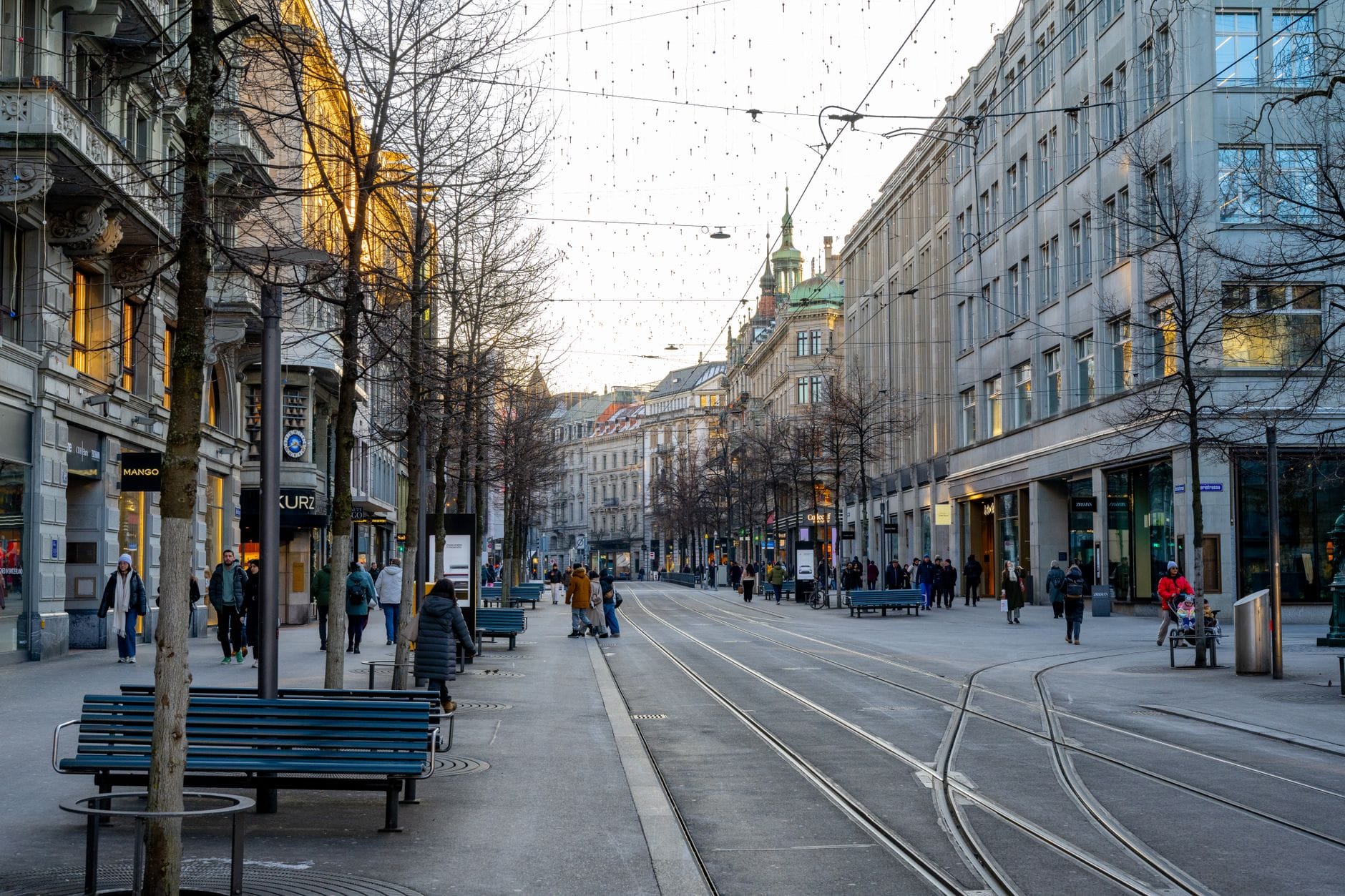
Bahnhofstrasse is a 1.4-kilometer pedestrian-priority boulevard that runs in a straight line from Zürich Hauptbahnhof southward to Bürkliplatz on the shore of Lake Zurich. Its name translates simply to 'station street,' and that practicality suits it: this is a working street, not a themed attraction. Trams glide silently through the center lane, lime trees line the pavements, and private cars are largely absent. What you get is a rare thing in a major European city: a genuinely walkable central axis where pedestrians are not an afterthought.
The street was laid out in the second half of the 19th century following the construction of Zurich's main railway station, replacing what had previously been the city's defensive moat (the Fröschengraben). That act of urban transformation set the tone: Bahnhofstrasse was designed from the outset to project civic ambition and commercial seriousness. The grand banking facades and flagship retail stores that line it today are part of a tradition that stretches back over 150 years.
ℹ️ Good to know
Bahnhofstrasse is an open public street with no admission fee and no closing time. You can walk it at any hour of the day or night, 365 days a year.
The Street Changes by the Hour
Early morning, before 9am, Bahnhofstrasse belongs to commuters and delivery workers. The trams are already running, shopfronts are still shuttered, and you can actually hear the lime trees if there's a breeze. The stone paving gleams when it has rained overnight. This is when the proportions of the street read most clearly: it's wide enough to feel spacious but framed tightly enough by four- and five-storey facades to feel urban rather than suburban. Serious photographers working without a crowd will find this window useful.
By mid-morning, the commercial rhythm takes over. Shops open between 9am and 10am, and foot traffic builds steadily. The lunch hour, particularly from midday to 1:30pm on weekdays, brings a concentrated surge of office workers from the banking and financial institutions whose headquarters line the street. On Saturday afternoons this becomes the most densely crowded public space in Zurich, with queues forming at premium goods stores and the trams threading slowly through the press of people. If you want to simply walk the full length without stopping, a weekday morning or a Sunday is the rational choice.
Evenings take on a different texture. After 7pm, most shops are closed, the crowds thin, and the street lights lend the stone facades a warmer, amber tone. In December, the Christmas lights installation transforms the upper section into something considerably more atmospheric. Winter or summer, the southern end near Bürkliplatz always rewards a few extra minutes: you emerge from the retail corridor to a clear view down Lake Zurich, and the shift in scale is abrupt enough to feel like a reveal.
💡 Local tip
To walk the full length in relative quiet, aim for a weekday before 9:30am or after 7pm. Sunday mornings offer calm with the bonus of open cafés.
Tickets & tours
Live prices and dates from our booking partner. If you book, we may earn a commission at no extra cost to you.
Mount Titlis snow fun for first-time skiers from Zurich
From 212 €Instant confirmationFree cancellationSwiss ski experience from Zurich
From 321 €Instant confirmationFree cancellationBest intro tour of Zurich with a local
From 116 €Instant confirmationFree cancellationZurich Old Town guided walking tour
From 27 €Instant confirmationFree cancellation
The Retail Landscape: What's Here and What It Costs
Bahnhofstrasse is frequently grouped with the world's most expensive shopping streets, alongside Bond Street and Avenue Montaigne. The comparison is accurate in terms of the category of retailers present: Swiss watch brands, high-end jewelry houses, global luxury fashion labels, and department stores that stock all of the above. Prices reflect this positioning without apology. A casual walk along the upper section will put flagship stores for the major Swiss watch manufacturers within easy reach, and several of these are worth entering purely to look at the interiors, which tend toward quiet, meticulous design.
The department store Jelmoli, near the northern end close to Zurich HB, anchors the mid-market segment and is genuinely useful for visitors who need practical purchases. The lower section of the street, toward Bürkliplatz, shifts toward banking institutions, whose imposing stone and glass headquarters serve as a reminder that Zurich's commercial identity is rooted as much in finance as in retail. For context on what to expect price-wise across the city, the Zurich shopping guide covers neighbourhoods with a broader range of budgets.
One practical note: the tram stop names along the street can serve as rough navigation markers. Paradeplatz, roughly at the midpoint, is where two of Switzerland's largest banks face each other across the tracks. It's an architecturally significant square in its own right and marks the point where the street's character shifts from predominantly retail in the northern half to predominantly financial in the southern half.
Architecture and Street-Level Detail
The buildings on Bahnhofstrasse are not individually dramatic in the way that, say, a Gothic cathedral is. Their quality is cumulative and tonal. Most date from the late 19th and early 20th centuries, with a consistent cornice line that gives the street its coherent visual weight. Look up above the ground-floor retail signage and the architecture becomes more interesting: ornate stonework, carved keystones, and the occasional art nouveau detail that survived successive shopfront modernizations.
The area around Zurich's main station itself is worth understanding as a separate space. The station building, a 19th-century terminus with an impressive barrel-vaulted hall, functions as both a transport hub and a retail and dining destination in its own right. Spending time there before or after walking Bahnhofstrasse gives useful context for how the street fits into the broader district. The Zurich Main Station page covers what to look for inside.
At the southern terminus, Bürkliplatz opens onto the lake with a different architectural mood: lower buildings, open sky, and the smell of fresh water. The square hosts regular markets and serves as a boarding point for lake cruises. The transition from the enclosed corridor of Bahnhofstrasse to this open lakeside space is one of the more satisfying urban sequences in the city.
Getting There and Getting Around
The street begins directly outside Zurich HB, which is served by national rail, S-Bahn suburban trains, trams, and buses. From the airport, trains reach Zurich HB in roughly 10 to 15 minutes. Once at the station, Bahnhofstrasse is immediately in front of you as you exit the main entrance facing south. No additional transport is needed.
Trams 7, 11, and 13 run along the street north of Paradeplatz, while lines 2, 5, 9, and 11 serve the section to the south, stopping at Bahnhofstrasse/HB, Rennweg, Paradeplatz, Kantonalbank, and Bürkliplatz. These are useful if you want to skip a section or reach a specific point without walking the full length. The trams are part of the ZVV city network; verify current fares with the ZVV authority before travel, as prices are periodically updated.
The street is car-free for most of its length, which makes it fully accessible on foot. The pavement is level and wide, with no significant slopes or steps along the main walking route. For those planning a fuller day in the district, the guide to getting around Zurich explains how the tram and S-Bahn networks connect to other neighborhoods.
Practical Realities: Who This Street Is and Isn't For
Bahnhofstrasse is frequently presented as a top attraction in Zurich, and in one sense that's fair: if you are visiting the city for the first time, walking its length provides an orientation point and an efficient way to absorb something of Zurich's commercial identity and urban scale. The lake at the far end is a genuine payoff. The architecture, taken as a whole, is more distinguished than the average European high street.
But travelers who dislike crowds, premium retail, or urban walking corridors will find the street's reputation slightly inflated. The middle section in particular, between Rennweg and Paradeplatz, functions as a global luxury shopping strip and has more in common with equivalent streets in London or Paris than with anything distinctively Swiss. Visitors looking for authentic local character or historical texture will find more of both in the old town immediately to the east. The Niederdorf quarter and the Lindenhof hill above the river offer a different and in many ways richer experience of the city.
Shoppers with serious intent will find Bahnhofstrasse well-suited to their purpose, particularly for Swiss watches and jewelry. Those on a tight budget should treat it as a walking route rather than a shopping destination, since even casual café stops in this stretch of the city carry a price premium. Street-level window browsing, however, costs nothing.
⚠️ What to skip
Saturday afternoons are extremely crowded between October and December. If your goal is the street rather than specific shops, consider a weekday visit or the quieter early-morning hours.
Photography Notes
The northern end of Bahnhofstrasse, closest to the station, photographs well in the morning when the light falls at an angle along the building facades and the trams move through a relatively empty frame. The lime trees provide filtered green light in summer and a structural graphic quality in winter when bare. Paradeplatz is worth a few minutes with a camera for the tram-crossing geometry and the banking facades.
The southern end looking back toward the city, with Lake Zurich in the foreground and the Zurich skyline framed by the street corridor behind you, works best in early evening light in summer. In winter, the December lighting installation along the upper street creates a distinctive nighttime scene that is specific to this location and this time of year.
Insider Tips
- Walk the street south-to-north in the morning: the early light hits the building facades from a better angle and you finish at the station rather than at the lake, which is more useful if you're continuing onward.
- Paradeplatz, at the midpoint, is where two of Switzerland's largest bank headquarters face each other. The square itself is architecturally coherent and worth pausing in rather than treating purely as a tram stop.
- The department store Jelmoli near the northern end stocks Swiss-made everyday goods alongside luxury items and is one of the more practical stops on the street if you need to buy something useful.
- In December, the Bahnhofstrasse Christmas lights installation is a specific local tradition. It draws significant crowds in the evening, but the early morning hours around 7–8am offer the lights with almost no other people present.
- The transition from Bahnhofstrasse to Bürkliplatz at the lake end is abrupt and worth experiencing deliberately: step off the street and onto the lakeside square and look back. The shift from enclosed urban corridor to open water is one of the better spatial moments in central Zurich.
Who Is Bahnhofstrasse For?
- First-time visitors who want a clear orientation walk through central Zurich
- Watch and jewelry shoppers interested in seeing the full range of Swiss luxury retail in one location
- Architecture enthusiasts drawn to coherent 19th-century urban streetscapes
- Evening walkers looking for a lit, safe, and pleasant route from the station to the lake
- Travelers in December who want to see the famous Christmas lights without paying for an event
Nearby Attractions
Other things to see while in Zurich HB & City Centre:
- Swiss National Museum
The National Museum Zurich (Landesmuseum Zürich) holds Switzerland's largest collection of cultural history, from medieval weapons and guild artifacts to contemporary design. Positioned directly beside Zürich Hauptbahnhof, it is one of the most accessible major museums in the country, and one of the most underutilized by travelers short on time.
- Zurich Christmas Market at HB
Running from late November to December 24 inside Zurich's historic Hauptbahnhof, the Christkindlimarkt at Zurich HB packs around 120 to 140 stalls into the station’s grand main hall. Entry is free, the crowds are real, and knowing when to arrive makes all the difference.
- Zurich Hauptbahnhof (HB)
Zürich Hauptbahnhof, known locally as Zürich HB, is more than a transit hub. Opened in 1847, it is Switzerland's largest and busiest railway station, handling around 2,900 train movements per day across 26 tracks. Whether you are passing through, starting a city exploration, or simply watching the choreography of Swiss rail precision, the station rewards a deliberate visit.
Planning a trip? Discover personalized activities with the Nomado app.