Zürich Hauptbahnhof (HB): Switzerland's Grand Railway Hub
Zürich Hauptbahnhof, known locally as Zürich HB, is more than a transit hub. Opened in 1847, it is Switzerland's largest and busiest railway station, handling around 2,900 train movements per day across 26 tracks. Whether you are passing through, starting a city exploration, or simply watching the choreography of Swiss rail precision, the station rewards a deliberate visit.
Quick Facts
- Location
- Museumstrasse 1, 8001 Zürich, District 1 (Altstadt)
- Getting There
- Zürich HB is itself the transit hub; trams 3, 4, 6, 7, 10, 11, 13, 14 stop at Bahnhofplatz
- Time Needed
- 30–90 minutes depending on depth of exploration
- Cost
- Free to enter; train tickets priced in CHF via SBB counters and machines
- Best for
- Architecture lovers, first-time visitors, rail enthusiasts, shoppers, transit users
- Official website
- http://zuerich-hb.ch
What Zürich HB Actually Is
Zürich Hauptbahnhof is Switzerland's largest railway station and, by many measures, one of the most operationally dense rail hubs in Europe. Around 2,900 train movements pass through its 26 tracks every single day. That figure alone puts the scale of this place in perspective: for a city of roughly 440,000 residents, it is an extraordinary piece of infrastructure.
The station sits at the northern end of Bahnhofstrasse, directly facing the Swiss National Museum, and occupies the geographic and symbolic heart of central Zürich. From its front plaza, Bahnhofplatz, trams radiate outward into every district. From its lower concourses, S-Bahn trains reach the airport in around 15 minutes and suburban lines extend across the entire Zürich metropolitan area. Long-distance trains connect to Basel, Bern, Geneva, Lucerne, and international routes across Europe.
ℹ️ Good to know
Entry to the station is completely free. You do not need a train ticket to walk through, browse ShopVille, or explore the main hall.
A Station That Opened Swiss Rail History
Zürich HB opened in 1847 as the terminus of Switzerland's first railway line, the Zürich–Baden route affectionately nicknamed the Spanisch-Brötli-Bahn, a reference to the sweet bread rolls that passengers would bring back from Baden. That origin makes it one of the oldest railway stations in the country. The current station building is not the original structure; the main hall as visitors see it today dates from a later phase of construction, with its broad arched facade and vaulted interior reflecting the confident civic ambition of 19th-century Swiss engineering.
What the building communicates architecturally is seriousness. The main hall ceiling is high enough to feel cathedral-like, the ironwork and stone carry a restrained formality, and the scale is calibrated to make you aware that you are standing inside something that was designed to last. For anyone interested in the history of European rail architecture, Zürich HB belongs in the same conversation as Paris Gare de Lyon or London St Pancras, even if it doesn't always receive the same tourist attention.
The station's position directly opposite the Swiss National Museum is no coincidence. Both institutions emerged from the same era of Swiss nation-building in the latter half of the 19th century, and the visual pairing from Bahnhofplatz remains one of the more understated urban compositions in the city.
Tickets & tours
Live prices and dates from our booking partner. If you book, we may earn a commission at no extra cost to you.
Mount Titlis snow fun for first-time skiers from Zurich
From 212 €Instant confirmationFree cancellationSwiss ski experience from Zurich
From 321 €Instant confirmationFree cancellationBest intro tour of Zurich with a local
From 116 €Instant confirmationFree cancellationZurich Old Town guided walking tour
From 27 €Instant confirmationFree cancellation
The Station at Different Hours
The experience of Zürich HB changes significantly depending on when you arrive. Weekday mornings between 7:00 and 9:00 are the most intense: the main hall fills with commuters moving with practiced efficiency, the departure boards flicker constantly, and the sound level rises to a low, directional roar. It is a useful reminder that this is primarily a working station, not a tourist attraction, and that Swiss punctuality is not a stereotype but a deeply embedded operational reality.
Midday and early afternoon offer the most comfortable window for exploration. Crowds thin noticeably, the light through the main hall windows is at its most generous, and the indoor market stalls along the ground level concourse are in full operation. If you want to actually look at the architecture without being swept along by foot traffic, this is the time.
Evenings, particularly Friday and Saturday nights, bring a different demographic entirely. The station becomes a meeting point: groups gather near the main clock, the food and drink options in ShopVille and on the platforms fill up, and the energy shifts from purposeful to social. Late-night trains still run on key routes, so the station does not go quiet in the way smaller terminals do.
💡 Local tip
The main hall clock, suspended from the central ceiling arch, is the traditional meeting point in Zürich. If someone tells you to meet at 'the clock at HB,' this is where they mean.
Navigating the Station: Levels and Zones
Zürich HB has multiple levels, and understanding the layout prevents the mild disorientation that catches first-time visitors. The surface level contains the main hall and the majority of the numbered tracks. These handle most intercity, inter-regional, and direct international services. The tracks are numbered clearly, departure boards are large and multilingual, and finding your platform is genuinely straightforward.
Below the surface is ShopVille, an underground commercial concourse connecting the main station to the tram networks and to the Zürich HB SZU station beneath Bahnhofplatz. ShopVille contains a mix of grocery stores, pharmacies, bakeries, takeaway restaurants, and retail chains. It is open on Sundays, which matters in Switzerland where most regular shops remain closed. This makes it a practical stop for anyone arriving on a Sunday afternoon and needing supplies.
Deeper still is the Löwenstrasse underground station, handling a separate set of S-Bahn lines, and connections to cross-city rail routes. The signage is consistent throughout, using standard Swiss rail pictograms and colour coding, but if you are carrying heavy luggage or have mobility limitations, it is worth identifying your platform and exit before you arrive. Lifts and ramps are available, and the station meets SBB accessibility standards with staffed assistance points.
ShopVille and the Station as a Destination in Itself
One of the more practical things about Zürich HB is that it functions as a neighbourhood in miniature. The combination of ShopVille underground and the stalls and kiosks in the main concourse means you can arrive without local cash, buy a Zürich cantonal SIM card, pick up a good croissant, find a pharmacy, and send luggage storage in the space of twenty minutes. For travellers arriving late or leaving early, this convenience is real.
The station also hosts a weekly indoor farmers market, typically running along the main hall floor. Vendors sell regional produce, cheeses, breads, and prepared foods. It is one of the more atmospheric places in the city to sample Swiss market culture without having to navigate narrow medieval streets. The smell of fresh bread and aged Gruyère against a backdrop of train announcements overhead is a specific sensory experience that becomes difficult to forget.
Beyond the station itself, the Bahnhofplatz tram stops give you direct access to most of Zürich's main attractions within a short ride. BahnhofstrasseBahnhofstrasse begins immediately at the station's south exit, stretching roughly two kilometres down to the lake. The Altstadt is walkable in under ten minutes from the main entrance.
Practical Intelligence for Visitors
Train tickets at Zürich HB are sold in Swiss francs (CHF) at SBB ticket machines throughout the station, at staffed counters, and via the SBB mobile app. The machines have an English-language option and accept major credit and debit cards. If you are planning to use public transport widely during your stay, it is worth asking about the Zürich Card or the ZVV day pass at the ticket counters; these cover trams, buses, and S-Bahn within the city zones and can significantly reduce transport costs.
From Zürich Airport, the direct SBB train takes approximately 15 minutes to reach Zürich HB and runs with high frequency throughout the day. This is the fastest and most cost-efficient connection from arrival to the city centre, and the train terminates at the main station, so there is no risk of missing your stop.
Luggage storage lockers are available within the station at varying sizes and daily rates, payable in CHF. If you are planning to arrive early or check out of accommodation before your train, this is a reliable option. For a broader look at how to get around the city, the guide to getting around Zürich covers all modes in detail.
⚠️ What to skip
Ticket prices, ZVV fare zones, and exact luggage locker rates change periodically. Verify current figures directly with SBB (sbb.ch) or ZVV before your trip.
Photography and Sensory Notes
The main hall is a reasonable photography subject, particularly in the midday hours when natural light enters from the upper windows and the floor-level market stalls add foreground interest. The arched ceiling and ironwork gain depth with a moderate wide-angle lens. Flash photography is unnecessary and will flatten the character of the space. The departure boards, with their rotating split-flap displays, are worth photographing before digital boards eventually replace them entirely.
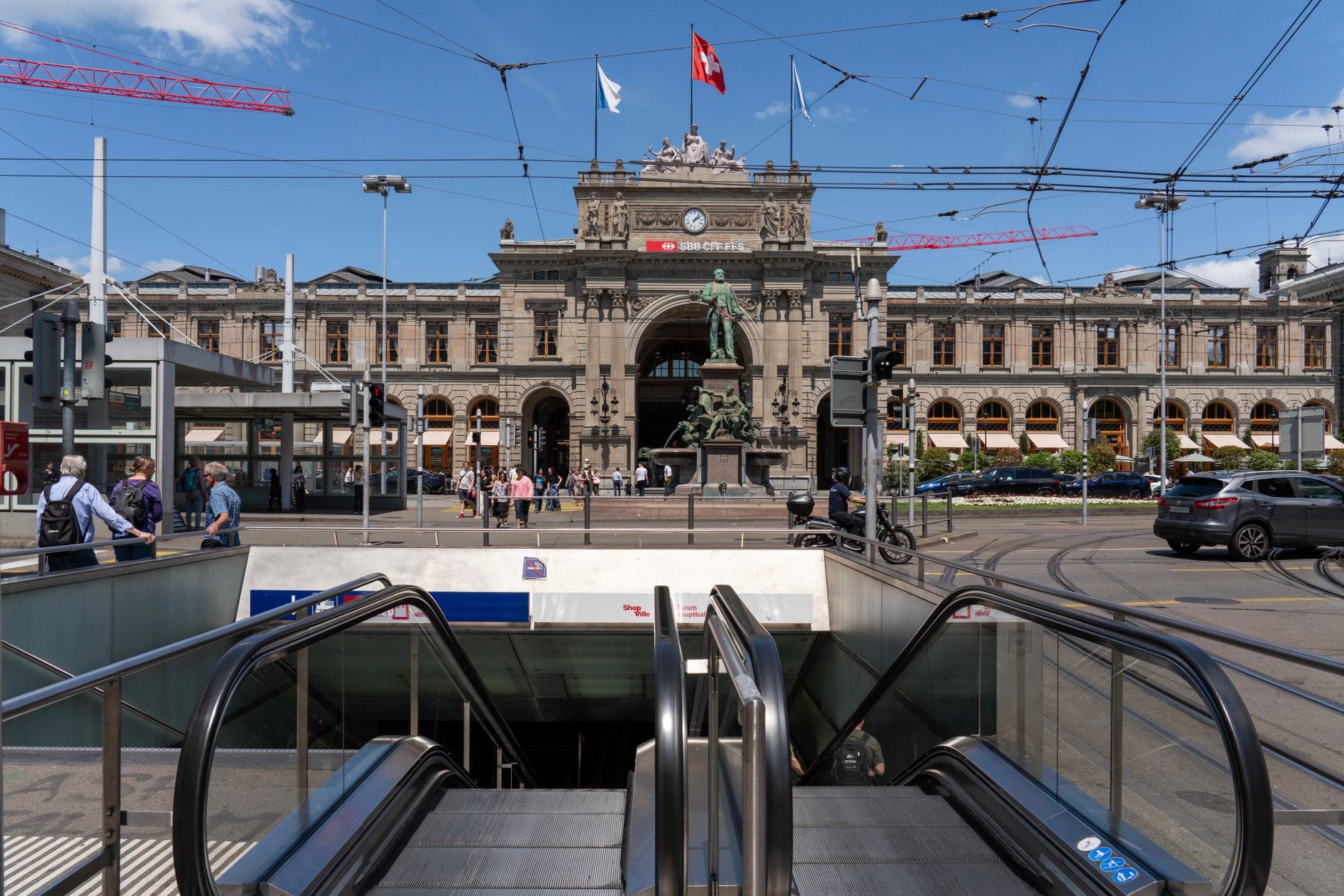
From the main entrance steps looking outward toward Bahnhofplatz, you get the juxtaposition of tram lines, pedestrian traffic, and the towers of the Swiss National Museum in the background. This is one of the more honest representations of how Zürich actually looks and operates as a city, rather than the polished lakeside images that tend to dominate travel photography.
If views are a priority during your visit, the Uetliberg summit is reachable directly from Zürich HB via the S10 line, making it one of the easiest half-day excursions from the station. The best viewpoints in Zürich guide includes options accessible with a standard city transport pass.
Insider Tips
- Sunday is one of the best days to visit ShopVille for practical shopping: most street-level shops in Zürich are closed on Sundays, but the underground concourse at HB operates with near-normal hours.
- The indoor market in the main hall is typically held on Thursdays and Fridays. Arrive between 11:00 and 13:00 to find the fullest selection of regional cheeses, breads, and prepared foods before vendors begin packing up.
- If you are taking the S-Bahn to Zürich Airport, buy your ticket before boarding. Unlike some urban transport systems, Swiss rail is inspected and fines for travelling without a valid ticket are steep.
- For the clearest view of the main hall's ceiling ironwork without crowds obscuring the floor-level perspective, position yourself near the centre of the hall on a Tuesday or Wednesday around 10:00.
- The Zürich HB SZU station beneath Bahnhofplatz connects to the Uetliberg line (S10). This is easy to miss because it sits below ShopVille rather than in the main hall, but the signage is clear once you descend to the lower level.
Who Is Zurich Hauptbahnhof (HB) For?
- First-time visitors to Zürich who need a geographic and transit anchor for the city
- Architecture and heritage enthusiasts interested in 19th-century Swiss rail infrastructure
- Travellers on a budget who want shopping and food options available on Sundays
- Rail enthusiasts wanting to observe Swiss precision at scale
- Anyone planning day trips or onward journeys across Switzerland and neighbouring countries
Nearby Attractions
Other things to see while in Zurich HB & City Centre:
- Bahnhofstrasse
Bahnhofstrasse is Zurich's central spine: a 1.4-kilometer largely car-free boulevard connecting the main railway station to Lake Zurich. It's free to walk, open at any hour, and genuinely different depending on when you arrive. This guide covers what you'll actually encounter, from the quiet morning light to the dense afternoon crowds.
- Swiss National Museum
The National Museum Zurich (Landesmuseum Zürich) holds Switzerland's largest collection of cultural history, from medieval weapons and guild artifacts to contemporary design. Positioned directly beside Zürich Hauptbahnhof, it is one of the most accessible major museums in the country, and one of the most underutilized by travelers short on time.
- Zurich Christmas Market at HB
Running from late November to December 24 inside Zurich's historic Hauptbahnhof, the Christkindlimarkt at Zurich HB packs around 120 to 140 stalls into the station’s grand main hall. Entry is free, the crowds are real, and knowing when to arrive makes all the difference.
Planning a trip? Discover personalized activities with the Nomado app.