Swiss National Museum Zurich: What to See, Tips, and How to Visit
The National Museum Zurich (Landesmuseum Zürich) holds Switzerland's largest collection of cultural history, from medieval weapons and guild artifacts to contemporary design. Positioned directly beside Zürich Hauptbahnhof, it is one of the most accessible major museums in the country, and one of the most underutilized by travelers short on time.
Quick Facts
- Location
- Museumstrasse 2, 8001 Zürich (beside Zürich HB)
- Getting There
- Zürich Hauptbahnhof (HB) — 2-minute walk, all tram and rail lines
- Time Needed
- 2–3 hours for main collection; 3–4 hours with temporary exhibitions
- Cost
- Adults CHF 13, Concessions CHF 10, Under 16 free, Zürich Card free
- Best for
- History lovers, architecture fans, rainy-day visitors, families with older children
- Official website
- www.landesmuseum.ch/en
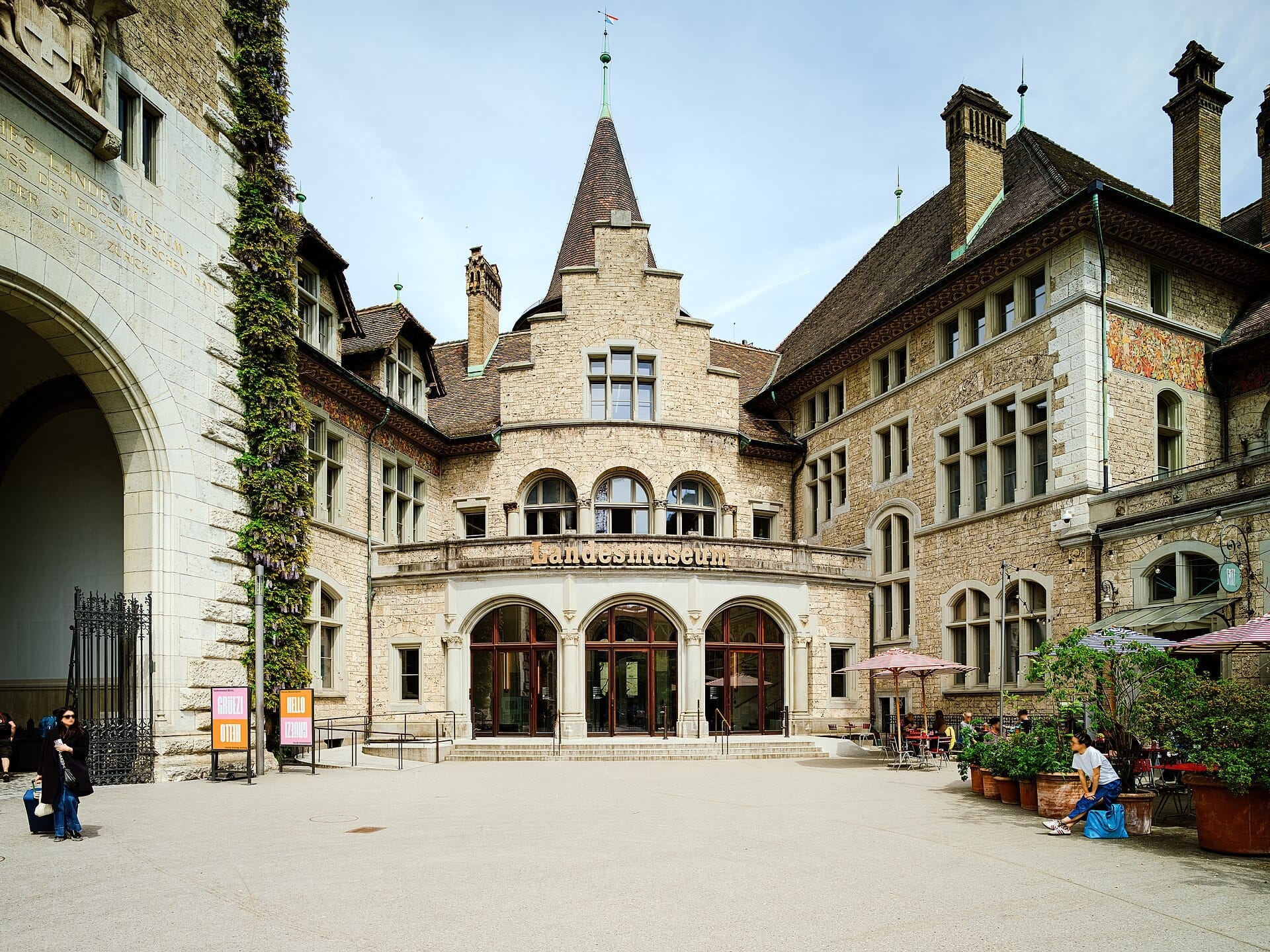
What the Swiss National Museum Actually Is
The National Museum Zurich, formally known as the Landesmuseum Zürich, is the main site of the Swiss National Museum (Schweizerisches Nationalmuseum SNM), a federal institution that also operates branches at Château de Prangins, Forum Schweizer Geschichte in Schwyz, and a collections centre in Affoltern am Albis. The Zurich site is the largest, and it holds Switzerland's most comprehensive collection of objects documenting the country's cultural history, from prehistoric tools and medieval church interiors to 20th-century applied arts and digital-age design.
The building itself is a statement before you even enter. The original structure, completed in 1898, was designed by Gustav Gull in an eclectic style that blends elements of Swiss Gothic and Renaissance castle architecture: turreted towers, steeply pitched roofs, and a facade that reads more like a fairy-tale fortress than a civic institution. In 2016, a major contemporary extension by architects Christ & Gantenbein was completed, adding a concrete-and-glass wing that contrasts deliberately with the historicist original. The tension between old and new is handled with confidence, and the two halves now feel like a conversation rather than a collision.
💡 Local tip
If you hold a Zürich Card, admission is free. The card also covers public transport across the city, making it good value if you plan to visit two or more attractions during your stay.
The Building: Two Centuries in One Footprint
The original 1898 building is organized around a large central courtyard, which today serves as the main atrium space under a glass roof. The interior of the old wing retains its ornate character: stone staircases, vaulted ceilings in some rooms, and carved wooden details that echo the collection housed within. Walking through it feels like moving through a serious institutional space from an era when museums were built to impress.
The Christ & Gantenbein extension, by contrast, is deliberately spare. Its pale concrete walls and irregular fenestration create gallery rooms with excellent diffuse light, well suited to displaying textiles, furniture, and objects that would suffer under harsh direct lighting. The extension houses much of the rotating temporary exhibition program, and the quality of the display architecture here is notably high. This is not a space where the architecture fights the exhibits for attention.
The museum sits at the edge of Platzspitz park, the narrow wedge of green formed at the confluence of the Limmat and Sihl rivers. On a clear day, the view from outside across the water toward the towers of the Grossmünster and the roofline of the old town is one of the better architectural views available near Zürich Hauptbahnhof. Arriving from the main station, the museum announces itself through the park; take the underpass beneath Museumstrasse and follow the signage rather than walking around the outside.
Tickets & tours
Live prices and dates from our booking partner. If you book, we may earn a commission at no extra cost to you.
The Collection: What You Will Actually See
The permanent collection is organized chronologically and thematically across multiple floors. The earliest rooms cover prehistoric and early medieval Switzerland, with artifacts including Celtic metalwork, Roman finds from across the Swiss plateau, and objects from early Christian settlements. These galleries are relatively compact and move quickly.
The medieval and early modern sections are where the collection deepens considerably. There are complete room reconstructions — guild hall interiors, a late Gothic oratory, and fragments of painted fresco cycles removed from demolished buildings and reinstalled within the museum. The stained glass collection is exceptional by European standards: panels from Swiss churches and monastery windows spanning several centuries, displayed with enough context to understand their original settings. If you have any interest in medieval applied arts, these rooms alone justify the admission price.
Moving into the 18th and 19th centuries, the collection covers Swiss domestic life, the development of federal institutions, and the country's relationship with Reformation theology. There is substantial material on Swiss textile production, watchmaking heritage, and the rise of alpine tourism as a cultural phenomenon. The 20th-century galleries connect industrial design to Swiss identity, with objects ranging from graphic design posters to furniture and everyday manufactured goods.
ℹ️ Good to know
The museum's temporary exhibitions run alongside the permanent collection and change several times per year. Check the program on landesmuseum.ch before your visit, as some temporary shows have been blockbuster-level in scope and require additional planning time.
When to Visit and How the Experience Changes
Tuesday and Wednesday mornings are consistently the quietest periods. The galleries thin out noticeably, and you can spend extended time in front of major objects without navigating around group tours. Thursday evenings, when the museum stays open until 19:00, attract a slightly younger crowd and tend to have a more relaxed atmosphere than weekend afternoons.
Weekend afternoons bring school groups and families, particularly in the rooms with interactive elements aimed at children. The museum handles this reasonably well by separating hands-on zones from the main display galleries, but some of the more popular rooms can feel crowded between 13:00 and 16:00 on Saturdays. If you are visiting with children under 12, weekends are actually a good choice because the museum offers family-specific programming and the energy in the building is welcoming rather than formal.
Rainy days drive higher visitor numbers because the museum is the obvious bad-weather option in the main station area. If Zurich is having a wet week, arrive at opening time (10:00) to get ahead of the crowd that builds by mid-morning.
Practical Walkthrough: Getting There and Getting Around
The museum is at Museumstrasse 2, roughly a 2-minute walk from the main exit of Zürich Hauptbahnhof. Every tram and rail line in the city connects to the HB, so there is no meaningful transit challenge involved. The Zurich public transport network covers the whole route from wherever you are staying. Trams 4, 11, 13, and 17 stop immediately outside the main station, and the museum is signposted from the station concourse.
The main entrance is on Museumstrasse. There is step-free access throughout the building via lifts, and the museum is wheelchair accessible. Coat and bag storage is available at the entrance, and bags larger than cabin luggage size are not permitted in the galleries — worth knowing if you arrive at the museum directly from the station with rolling luggage.
The museum has a café-bistro and a museum shop. The bistro is a reasonable stop for lunch, though it is busy around noon. Audio guides are available, and some exhibition sections have multilingual panel text in German, French, Italian, and English. Not every label is translated, however, particularly in the older permanent galleries — German readers will get more out of the detailed interpretive text.
⚠️ What to skip
The museum is closed on Mondays. Opening hours are Tuesday–Wednesday and Friday–Sunday 10:00–17:00, Thursday 10:00–19:00. Verify current hours and any special holiday openings at landesmuseum.ch before visiting, as schedules can vary on public holidays.
Photography, Context, and Honest Limitations
Photography without flash is generally permitted in the permanent collection. The stained glass galleries and the reconstructed room interiors photograph well in the diffuse natural light that filters through the old wing. The extension's concrete gallery walls can make images of objects feel flat without some attention to angle and light direction.
It is worth being direct about one limitation: the museum's scope is broad, and parts of the chronological narrative will feel slow to visitors without prior interest in Swiss history specifically. The prehistory and early medieval rooms, while scholarly in quality, lack the spectacle of equivalent rooms in larger national museums. Visitors who prefer art museums over history museums may find the Kunsthaus Zürich a better use of their time — it is Switzerland's largest art museum and is located a short tram ride away.
Equally, visitors whose primary interest is Zurich's contemporary urban culture and design scene will get more out of the Museum für Gestaltung (Museum of Design), which focuses specifically on graphic design, applied arts, and visual communication. The National Museum is the right choice for anyone who wants to understand Switzerland as a country — its history, plurality of cultures, and the objects that defined daily life across the centuries.
Combining with the Surrounding Area
The museum sits at the edge of the Zürich HB district, and Platzspitz park is worth a few minutes before or after your visit. The park is calm in the mornings and a useful decompression space after two or three hours inside. From there, the old town is a 10-minute walk south along the Limmat, and the main shopping street, Bahnhofstrasse, begins at the station's western exit.
If you are planning a full day that takes in Swiss history and the city's architectural character, a morning at the National Museum followed by an afternoon walk through the old town to the Fraumünster and the medieval streets of Niederdorf is a coherent itinerary. The two parts complement each other: the museum provides context, and the old town provides physical presence.
Insider Tips
- Thursday evening (open until 19:00) is the most pleasant time to visit: the afternoon crowd has thinned, the light through the extension's windows is warm, and the café is less congested.
- The reconstructed room interiors on the upper floors of the old wing are among the most impressive things in the museum and often overlooked by visitors who focus on object cases. Allow time specifically for these spaces.
- If you are combining the museum with other Zurich attractions, the Zürich Card covers admission and all public transport — calculate whether it saves you money based on your specific itinerary before buying individual tickets.
- The museum shop stocks an unusually good selection of books on Swiss history, craft traditions, and design — useful for anyone researching the country seriously rather than just looking for souvenirs.
- The courtyard atrium of the original 1898 building is worth five minutes of quiet attention even if the galleries are crowded. Sit on one of the benches and look up at the glazed roof and the surrounding historicist facade: it is one of the more atmospheric interior spaces in the city.
Who Is Swiss National Museum For?
- Travelers who want to understand Swiss cultural and political history before exploring the country further
- Architecture enthusiasts interested in the dialogue between 19th-century historicism and contemporary Swiss design (the Christ & Gantenbein extension is significant)
- Families with children aged 8 and older, particularly on weekends when family programming is available
- Visitors caught in bad weather looking for a substantive half-day or full-day alternative to outdoor activities
- Anyone with a Zürich Card who wants to maximize free museum access on a multi-day visit
Nearby Attractions
Other things to see while in Zurich HB & City Centre:
- Bahnhofstrasse
Bahnhofstrasse is Zurich's central spine: a 1.4-kilometer largely car-free boulevard connecting the main railway station to Lake Zurich. It's free to walk, open at any hour, and genuinely different depending on when you arrive. This guide covers what you'll actually encounter, from the quiet morning light to the dense afternoon crowds.
- Zurich Christmas Market at HB
Running from late November to December 24 inside Zurich's historic Hauptbahnhof, the Christkindlimarkt at Zurich HB packs around 120 to 140 stalls into the station’s grand main hall. Entry is free, the crowds are real, and knowing when to arrive makes all the difference.
- Zurich Hauptbahnhof (HB)
Zürich Hauptbahnhof, known locally as Zürich HB, is more than a transit hub. Opened in 1847, it is Switzerland's largest and busiest railway station, handling around 2,900 train movements per day across 26 tracks. Whether you are passing through, starting a city exploration, or simply watching the choreography of Swiss rail precision, the station rewards a deliberate visit.
Planning a trip? Discover personalized activities with the Nomado app.