St. Peter's Church Zurich: The Clock That Watches Over the Old Town
St. Peter's Church (Kirche St. Peter) is Zurich's oldest parish church, anchoring the left bank of the Altstadt with one of Europe's largest church clock faces. Free to enter, rich in medieval history, and surrounded by some of the city's most atmospheric lanes.
Quick Facts
- Location
- St.-Peter-Hofstatt, 8001 Zürich (Altstadt, left bank of the Limmat)
- Getting There
- 10-minute walk from Zürich HB; trams 2, 6, 7, 8, 9, 11, 13 to Paradeplatz (5-minute walk)
- Time Needed
- 20–40 minutes inside; budget extra time for the surrounding lanes
- Cost
- Free admission
- Best for
- Architecture lovers, history buffs, Old Town walkers
- Official website
- www.st-peter-zh.ch
What Makes St. Peter's Church Worth Your Time
St. Peter's Church, known in German as Kirche St. Peter, holds a claim that most Zurich churches cannot: it is the city's oldest parish church, with foundation walls dating back to the 9th century still visible beneath the choir. The building you see today is largely a product of 18th-century reconstruction, but the site itself has been a place of Christian worship for over a thousand years. That layering of eras, from Carolingian stonework to Baroque interior to a tower clock added in 1538, makes it a more complex building than its modest exterior suggests.
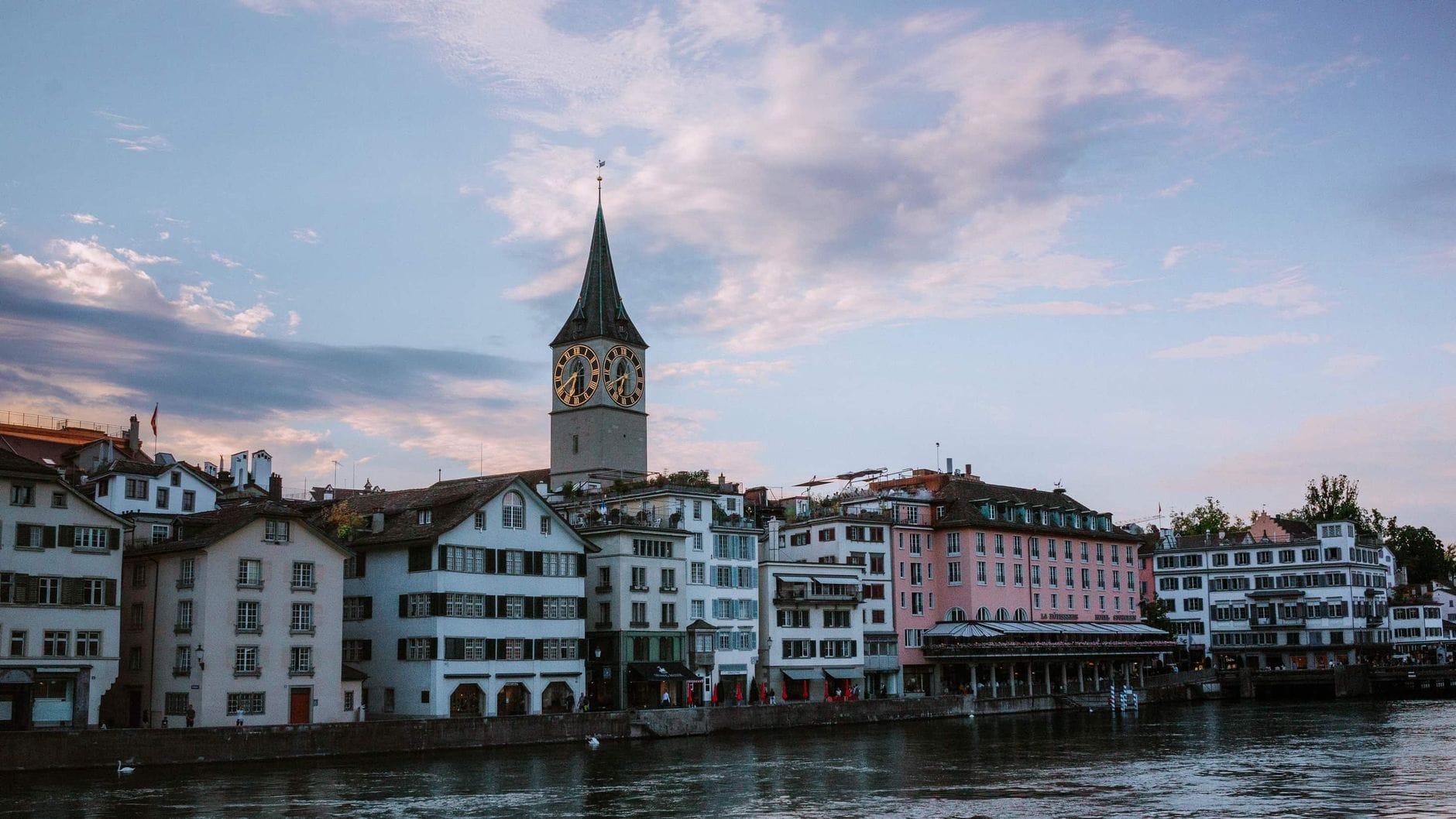
Most visitors notice the tower clock before they notice anything else. The clock face measures 8.7 metres in diameter, making it the largest church clock face in Europe. Standing in the small Hofstatt square below, the scale of it only registers properly when you see a person walk past the base of the tower. It is a striking piece of civic engineering for the 16th century, and it still tells the time accurately today.
💡 Local tip
Opening hours (when not affected by renovation or special events): Monday to Friday 09:00–18:00, Saturday and Sunday 09:00–16:00. Admission is free. Hours may vary on public holidays or during renovation works, so check the church's official website before visiting.
The History Beneath Your Feet
The site of St. Peter's has been a place of worship since at least the early medieval period. Archaeological evidence places the first church structure here in the 9th century, and remnants of those pre-Romanesque foundation walls are preserved under the choir, a detail that goes unnoticed by most visitors who walk straight to the nave without looking down. The current church building was substantially remodelled in the early 18th century, giving the interior its calm, light-filled Protestant character.
The Reformation reached Zurich in the 1520s under Huldrych Zwingli, and St. Peter's, like the city's other major churches, became a Reformed Protestant congregation. That theological shift is visible in the interior: there are no devotional statues, no gilded altarpiece, and no incense. What remains is whitewashed plaster, clear glass, and the kind of spare dignity that Reformed worship favoured. For visitors used to Catholic or Lutheran church interiors, the austerity can feel stark at first, but it has its own quiet authority.
The tower's five bells date from 1880. The largest weighs over 6,000 kilograms including its clapper, a figure that becomes easier to understand when you hear them ring on the hour and feel the vibration in the square below. The tower itself, with its distinctive onion-shaped cupola, is one of the defining silhouettes of the Zurich skyline, particularly visible from the right bank of the Limmat.
For a broader sense of how the Reformation reshaped Zurich's churches, the Zurich churches guide covers St. Peter's alongside the Grossmünster and Fraumünster in useful comparative detail.
Tickets & tours
Live prices and dates from our booking partner. If you book, we may earn a commission at no extra cost to you.
Mount Titlis snow fun for first-time skiers from Zurich
From 212 €Instant confirmationFree cancellationSwiss ski experience from Zurich
From 321 €Instant confirmationFree cancellationBest intro tour of Zurich with a local
From 116 €Instant confirmationFree cancellationZurich Old Town guided walking tour
From 27 €Instant confirmationFree cancellation
What the Visit Actually Looks Like
The entrance is on St.-Peter-Hofstatt, a small square that functions as a kind of pause in the dense medieval street grid of the left-bank Altstadt. In the morning, the square catches early light on the clock face and tends to be quiet, with the occasional commuter cutting through and a handful of visitors consulting maps. By midday, particularly in summer, the surrounding lanes fill with lunch crowds from the nearby restaurants, and the square itself becomes a minor throughway.
Inside, the atmosphere is noticeably calmer than the streets outside. The nave is not large by European cathedral standards, but the proportions feel considered and the light is even and clear. There are wooden pews, a modest pulpit, and a painted ceiling that rewards a moment of upward attention. Because admission is free and the church is not heavily marketed, it draws a more self-selecting crowd than the Grossmünster or the Fraumünster: people who already know what they are looking for, or who have wandered in from genuine curiosity.
The choir area, where the 9th-century foundation walls are preserved, is worth taking your time over. The visual evidence of the medieval structure is subtle, but the church provides enough context to make it meaningful. If the church is empty, which it often is on weekday mornings, you can sit in near-complete silence and hear the clock mechanism working overhead.
ℹ️ Good to know
The church is an active Protestant congregation, not solely a tourist attraction. Occasional services and events may limit access to parts of the interior. Check the official website for the current schedule.
How to Time Your Visit
Weekday mornings between 09:00 and 11:00 offer the most peaceful experience. The square is quiet, the interior is nearly empty, and the clock chimes have a different quality when there is no crowd noise to compete with them. Late afternoon on weekdays is also pleasant, though the surrounding lanes become noticeably more congested with after-work foot traffic.
Weekend visits are workable but busier, particularly Saturday afternoons when the nearby shops and market areas around Rennweg draw more people through the Altstadt. Sunday mornings are complicated by services, which may limit tourist access to the nave. If you are visiting primarily for the interior, aim for a weekday.
Photography of the clock tower is best in the morning, when the light hits the east-facing face directly. The square is narrow and the tower tall, so a wide-angle lens helps considerably. In winter, low-angled light in the late morning produces a particularly sharp contrast against the stone.
⚠️ What to skip
The approach to St. Peter's involves cobblestoned lanes and an uneven stone square. Official visitor information notes limited wheelchair access. Visitors with mobility considerations may find the approach from Augustinergasse, via a short walk from Paradeplatz (served by trams 2, 6, 7, 8, 9, 11, 13), offers slightly smoother surfaces.
The Surrounding Neighborhood
St. Peter's sits on the left bank of the Limmat in the heart of the Altstadt, a few minutes' walk from the Lindenhof hill and the guild houses that line the riverbank. The immediate streets, particularly Schüsselgasse and the lanes connecting to Augustinergasse, are among the most atmospheric in Zurich: narrow, shaded, and lined with a mix of historic facades, independent cafes, and small specialist shops.
The church fits naturally into a walking circuit of the left-bank Altstadt. From here, it is a short walk north to Lindenhof, Zurich's elevated Roman-era platform with clear views over the river and rooftops, or south toward Bahnhofstrasse and the lake.
If you have more time in the Altstadt, the Zurich walking tour guide plots a coherent route connecting St. Peter's with the other key landmarks on both sides of the Limmat without unnecessary backtracking.
Who Should Skip It (Honestly)
St. Peter's is not for everyone. If you have limited time and are choosing between Zurich's major church interiors, the Fraumünster's Chagall windows or the Grossmünster's twin towers offer more immediately dramatic experiences. St. Peter's rewards visitors who are interested in the layered history of a site rather than spectacle. The interior, while dignified, does not have the visual impact of the stained glass or carved stonework found in comparable European churches.
Visitors primarily interested in Swiss Reformed theology or medieval archaeology will find more here than general tourists. Those expecting the visual richness of a Catholic Baroque church will likely find the interior plain. That plainness is theologically intentional and historically significant, but it does require some interpretive frame to appreciate fully.
For a comparison of what each of Zurich's major churches offers, the Fraumünster and Grossmünster pages cover the distinct character of each building in detail.
Insider Tips
- Stand in the Hofstatt square at the top of any hour to hear the five bells ring. The largest bell produces a low resonance you feel as much as hear, and it carries across the Altstadt for several blocks.
- The 9th-century foundation walls beneath the choir are easy to miss. Look for the interpretive display near the entrance that explains what the archaeological layers represent before you approach the choir.
- For the cleanest photograph of the clock face without people in frame, arrive before 09:30 on a weekday. The square is often completely empty at that hour.
- The lanes immediately surrounding St. Peter's, particularly Schüsselgasse and the passage toward Augustinergasse, are some of the least-photographed medieval streets in the Altstadt. They reward slow walking.
- Because admission is free and the church is active, there is no ticket queue, no timed entry, and no audio guide infrastructure. Bring your own research or the official church website's history pages if you want depth.
Who Is St. Peter Church For?
- Visitors with an interest in medieval Swiss history and the Reformation
- Architecture walkers building a left-bank Altstadt circuit
- Photographers working on Zurich skyline and street-level tower shots
- Travelers who want a quiet, free pause in the middle of a busy Old Town day
- Anyone curious about how a 9th-century church site evolved across a thousand years
Nearby Attractions
Other things to see while in Altstadt (Old Town):
- Augustinergasse
Augustinergasse is a short, narrow pedestrian lane threading through Zurich's Altstadt between Bahnhofstrasse and St. Peterhofstatt. Free to walk, open at all hours, and steeped in history dating to a 13th-century Augustinian monastery, it rewards those who look up, slow down, and pay attention to what surrounds them.
- ETH Zurich Main Building
The ETH Zurich Main Building (Hauptgebäude) is one of the most architecturally significant public buildings in Switzerland, designed by Gottfried Semper in 1864 and freely open to visitors. Standing above the Altstadt on Rämistrasse, it offers a rare chance to walk through a world-class university's historic core without paying a cent.
- Fraumünster
Founded in 853 and home to five monumental stained glass windows designed by Marc Chagall, Fraumünster is one of the most visually striking churches in Switzerland. Small in footprint but overwhelming in atmosphere, it earns its place on any serious itinerary of Zurich's Old Town.
- Grossmünster
The Grossmünster has defined Zurich's skyline for nearly 900 years. This Romanesque church is where Ulrich Zwingli launched the Swiss Reformation in 1519, and today its twin towers remain the most recognizable silhouette on the Limmat. Entry to the church is free; the tower climb costs CHF 5 and rewards you with one of the clearest views over the Old Town.
Planning a trip? Discover personalized activities with the Nomado app.